
Do UV Lights Actually Work in Air Ducts? What the Evidence Shows
October 1, 2026
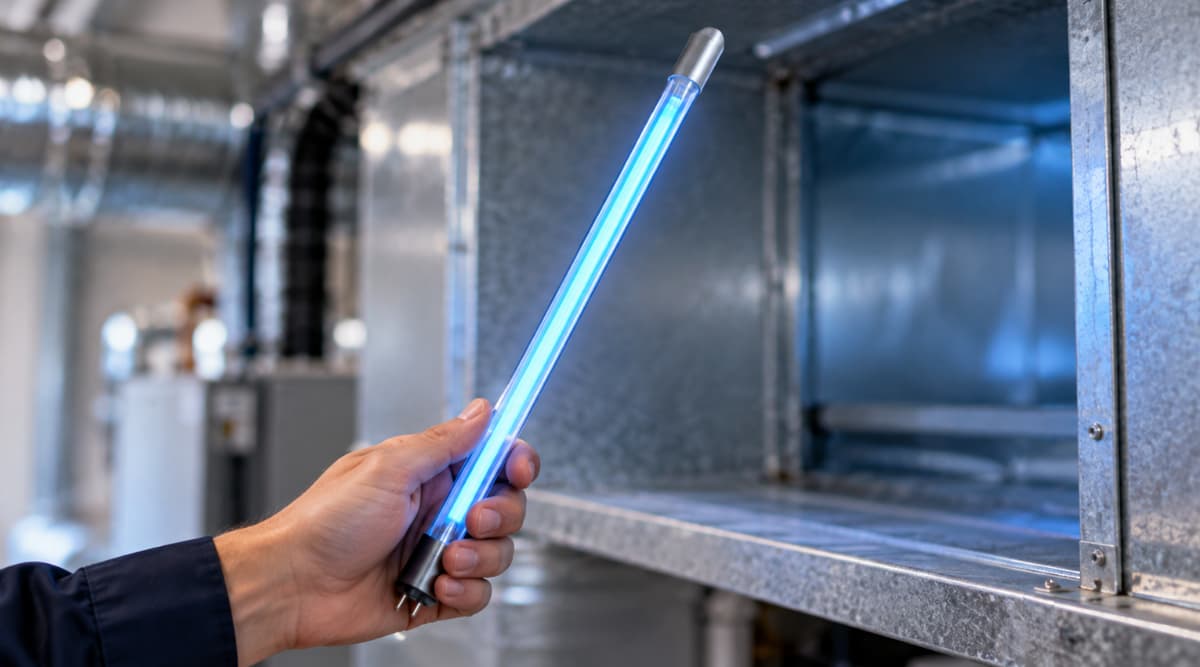
Yes, but it depends on where the light goes. UV lights aimed at your evaporator coil and drain pan work well because those surfaces get light all day. UV lights that treat moving air are harder to get right, since air rushes past the lamp in seconds or less.
- Coil UV: continuous exposure that slows microbial growth on coils and drain pans.
- In-duct UV: brief exposure that needs high-output, properly sized lamps.
- Air filter: still required, because UV light doesn’t capture dust, dander, or other particles.
The smartest first step is the right filter. Take the quick quiz below to find yours.
Exposure time is what makes UV work
UV effectiveness = light intensity × exposure time
Coil UV
Exposure: continuous
Targets: coil and drain pan
Goal: slow microbial growth on surfaces
Test standard: ASHRAE 185.2
✓ Clearer benefit
In-Duct UV
Exposure: seconds or less
Targets: air moving about 500 ft/min
Goal: inactivate airborne microbes
Test standard: ASHRAE 185.1
! Needs roughly 1,000–10,000 μW/cm²
Either way, start with your filter. UV light inactivates microbes. A filter captures dust, dander, and other particles. They work together, not instead of each other.
Find the right filter to pair with your UV light
Answer 3 quick questions and we’ll match you to your perfect filter.
Already know your size?
UV lights can work inside HVAC systems, but their effectiveness depends entirely on where and how they're installed. Coil-mounted UV lights can inhibit microbial growth on continuously illuminated surfaces, such as evaporator coils and drain pans. In-duct air-treatment systems can inactivate airborne microorganisms, but only when they deliver sufficient UV-C intensity and exposure time, conditions that are harder to achieve than many product claims suggest.
Key Takeaways
Coil-mounted UV lights can inhibit microbial growth on HVAC coils and drain pans because the surface receives continuous exposure.
In-duct UV systems must overcome short air-exposure times, and performance varies significantly by manufacturer and design.
The EPA's Environmental Technology Verification (ETV) program, conducted with RTI International, tested several in-duct UV products and found meaningful differences in microbial inactivation rates between them.
UV-C light is a supplement to particle filtration, ventilation, and moisture control, not a replacement for any of them.
ASHRAE Standards 185.1 and 185.2 outline testing methods for in-duct air disinfection and coil/surface irradiation devices, respectively, and note that systems designed for one purpose may not perform the other.
How Do UV Lights Work Inside HVAC Air Ducts?
UV-C light, the shortwave ultraviolet band used in most HVAC systems, damages the DNA and RNA of microorganisms, preventing them from reproducing. Inside an HVAC system, this can happen in two distinct ways: continuous irradiation of a surface (coil treatment) or direct exposure of moving air (in-duct air treatment).
What Determines the Effectiveness of a UV Light?
Effectiveness comes down to dose: the combination of UV-C intensity (irradiance) and exposure time. A low-powered lamp can still disinfect effectively if exposure time is long, which is exactly why coil treatment tends to outperform in-duct air treatment for the same wattage.
Five Factors That Affect HVAC UV Performance
Lamp output and wavelength: UV-C output must fall within the germicidal range to be effective.
Distance from the target surface or airstream: Irradiance drops sharply with distance.
Exposure time: Determined by airflow velocity for in-duct systems, or continuous for coil systems.
Lamp age and maintenance: UV output degrades over time, and dust buildup reduces transmission.
Duct or coil geometry: Reflective surfaces and lamp placement affect how evenly UV-C reaches the target.
Coil UV Lights vs. In-Duct Air UV Lights: What's the Difference?
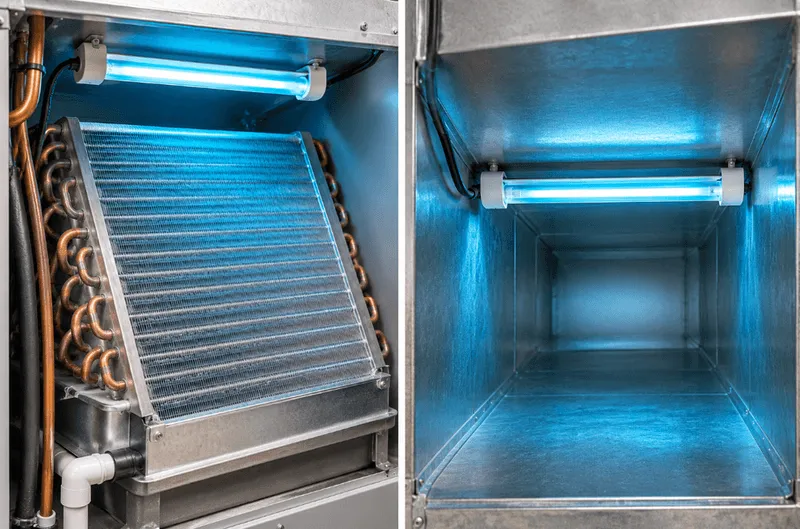
Coil Treatment vs. Air Treatment
Why Coil-Mounted UV Lights Can Be Effective
Because the coil and drain pan don't move, continuous UV-C exposure can meaningfully reduce microbial and biofilm buildup over time, which helps keep these components cleaner.
Can Coil UV Lights Keep an Evaporator Coil Clean?
Coil UV lights are primarily positioned to inhibit growth, not remove existing buildup. They work best as a preventive measure alongside routine HVAC maintenance.
What Makes In-Duct UV Air Treatment More Difficult?
Why Airflow Speed Matters
At a typical duct velocity of around 500 feet per minute, air passing a UV lamp receives only seconds (or fractions of a second) of exposure. That's a steep challenge compared to the unlimited dwell time of coil treatment.
Why One UV Lamp May Not Be Enough
Achieving the 1,000–10,000 μW/cm² irradiance range that ASHRAE associates with effective in-duct disinfection at these short exposure times often requires multiple high-output lamps, reflective duct sections, or narrowed airflow paths, design elements that aren't present in every installed system.
What Does Independent Testing Say About In-Duct UV Lights?
EPA-Sponsored In-Duct UV Test Results
The EPA's Environmental Technology Verification (ETV) program, in partnership with RTI International, independently tested several in-duct UV air-treatment products for microbial inactivation performance.
What Do These Results Tell Us?
The ETV testing shows that in-duct UV performance is not uniform across the industry. Results differed by product and by the type of microorganism being targeted, reinforcing that irradiance and exposure time, not the presence of a UV light alone, determine outcomes.
Does the EPA Endorse the UV Systems It Tested?
No. The EPA ETV program verifies performance data under specific test conditions; it does not certify, approve, or recommend specific products.
Why Do Some HVAC UV Lights Kill Bacteria but Struggle With Mold Spores?
Mold spores generally have tougher, more UV-resistant structures than bacteria, requiring a higher UV dose for inactivation. In-duct systems with limited exposure time may inactivate bacteria more readily than mold spores.
Can UV Lights Kill Mold in Air Ducts?
In-duct UV light can inactivate some airborne mold spores if irradiance and exposure time are sufficient, but it is not a guaranteed solution for existing mold colonization within ductwork.
Can Dead Mold Spores Still Cause Allergies?
Yes. Inactivated spores may no longer be able to reproduce, but their proteins can still trigger allergic reactions in sensitive individuals, which is why UV light doesn't eliminate the need for proper filtration and moisture control.
Do HVAC UV Lights Kill Airborne Viruses?
In-duct UV-C systems can inactivate some airborne viruses, with effectiveness again depending on dose. According to CDC guidance on ventilation and air cleaning, UV-C is one of several supplemental strategies for reducing airborne pathogen levels, used alongside ventilation and filtration rather than in place of them.
Can an In-Duct UV Light Prevent the Flu or Other Respiratory Infections?
No single HVAC component can prevent infection on its own. UV-C may reduce airborne pathogen load, but it works best as part of a layered approach that includes filtration, ventilation, and good hygiene practices.
Can HVAC UV Lights Improve Cooling Efficiency?
When Could Coil UV Improve HVAC Performance?
A cleaner evaporator coil transfers heat more efficiently. Choose coil UV if your system is prone to biofilm buildup that historically required frequent coil cleaning; it may help preserve airflow and efficiency between maintenance visits.
What Can't UV Lights in Air Ducts Do?
UV lights cannot remove dust, pet dander, or other particulates from the air. They do not replace the need for mechanical filtration, cannot fix duct leaks or poor ventilation design, and have no effect on odors caused by non-biological sources like VOCs.
HVAC UV Light vs. Air Filter: Which One Helps More?
Is MERV 13 Better Than an HVAC UV Light?
Choose a MERV 13 filter, such as Filterbuy's MERV 13 pleated air filter, if your primary concern is physically capturing fine particles like dust, pollen, and some bacteria-carrying particles. Choose a UV light if your concern is inactivating microorganisms on HVAC surfaces or in the airstream. For most households, the two serve complementary, not interchangeable, roles.
Are UV Lights in Air Ducts Worth It?
When Is a Coil UV Light Most Likely to Help?
Coil UV is most valuable in humid climates or systems with a history of coil fouling, where continuous surface exposure can meaningfully slow microbial regrowth.
When Should You Skip the UV Light?
Skip in-duct UV if your system can't support adequate irradiance and exposure time, or if your main concern is dust and allergens, a problem UV light doesn't solve.
What Should You Try Before Installing an HVAC UV Light?
Start with the basics: verify your filter's MERV rating matches your household's needs, ensure proper ventilation, and address moisture sources that encourage microbial growth. A Filterbuy MERV 11 or MERV 13 pleated air filter addresses a broader range of indoor air quality concerns before UV-C is even considered.
What Should You Check Before Buying an In-Duct UV Light?
Look for products with independent test data, such as EPA ETV results or compliance with ASHRAE 185.1 or 185.2, rather than relying on manufacturer claims alone. Confirm the system is sized for your duct dimensions and airflow velocity.
How Much Does an HVAC UV Light Cost to Own?
Why Your Air Filter Still Matters With a UV Light
UV-C light doesn't trap particles, so even a well-designed UV system still relies on your air filter to remove dust, dander, and other debris before and after treatment.
Keep UV-C Radiation Away From Susceptible Filter Media
Some filter materials can degrade with prolonged UV-C exposure. Position UV lamps according to manufacturer guidance, and choose filters rated for proximity to UV systems when installing both together.
UV Lights Can Work, but the Application Process Matters
UV lights are a legitimate HVAC technology, not a gimmick, but their marketing often outpaces the physics. Coil-mounted systems have a straightforward advantage: continuous exposure makes them reliably effective at inhibiting microbial growth on surfaces. In-duct systems face a tougher physical challenge, where airflow speed limits exposure time and demands much higher irradiance to achieve meaningful microbial inactivation.
For most households, the smartest first step is still the simplest one: a properly rated air filter. Upgrading to a Filterbuy MERV 11 or MERV 13 pleated air filter addresses particulates, allergens, and general air quality before UV-C even enters the conversation. From there, a coil or in-duct UV system can serve as a targeted supplement, not a substitute, for the filtration, ventilation, and moisture control that do the heavy lifting in any healthy HVAC system.
Frequently Asked Questions
Do UV lights actually work in air ducts?
Yes, conditionally. Coil-mounted UV lights can inhibit microbial growth on continuously exposed surfaces, while in-duct air UV systems can inactivate airborne microorganisms if they deliver sufficient irradiance and exposure time.
How much does it cost to install a UV light in an HVAC system?
Costs vary by system type, with coil UV lights generally less expensive to install than full in-duct air-treatment systems; both typically require annual bulb replacement.
How long does a UV light last in an air duct?
UV-C bulbs typically need replacement roughly once a year, even if the light still appears to be on, because UV output degrades over time.
Are HVAC UV lights safe?
When installed correctly within sealed ductwork, UV-C exposure is contained. Direct skin or eye exposure to UV-C should always be avoided.
Can a UV light replace my air filter?
No. UV light inactivates microorganisms but does not capture dust, pollen, or other particulates; filtration remains necessary.
Do UV lights help with allergies?
They may reduce certain biological allergens over time, but particulate allergens like dust and pollen require filtration, not UV exposure.
Can UV lights eliminate mold in ductwork?
UV light can inactivate some airborne mold spores with sufficient dose, but it does not remove existing mold growth or guarantee elimination.
Do UV lights kill viruses in HVAC systems?
In-duct UV-C can inactivate some airborne viruses, depending on dose, and works best as part of a layered air quality strategy.
What's the difference between coil UV and in-duct UV?
Coil UV continuously irradiates a stationary surface like the evaporator coil, while in-duct UV attempts to disinfect fast-moving air, requiring much higher irradiance to be effective.
Does the EPA approve or certify UV light products for HVAC systems?
No. The EPA's ETV program verifies test results under specific conditions but does not certify or endorse specific products.
What is ASHRAE Standard 185.1?
ASHRAE 185.1 establishes a test method for evaluating the microbial inactivation performance of in-duct UV air-treatment devices.
What is ASHRAE Standard 185.2?
ASHRAE 185.2 establishes a test method for evaluating UV devices designed to irradiate HVAC surfaces, such as coils, rather than moving air.
Is a MERV 13 filter better than a UV light for air quality?
For capturing dust, pollen, and fine particulates, a MERV 13 filter is more effective. For addressing microorganisms on HVAC surfaces or in airflow, UV light plays a different, complementary role.
How do I know if my HVAC system is a good candidate for UV light?
Systems with recurring coil fouling, high humidity, or documented microbial concerns are typically the best candidates for coil UV, while in-duct UV requires proper duct sizing and airflow conditions.
Can I install a UV light myself?
Installation typically requires an HVAC technician to ensure correct placement, electrical safety, and compatibility with existing ductwork and filtration.
Should I upgrade my air filter or add a UV light first?
Start with your air filter. A properly rated filter, such as a Filterbuy MERV 11 or MERV 13 pleated air filter, addresses a wider range of indoor air quality concerns before UV-C becomes a worthwhile addition.