
How Effective Are HVAC UV Lights? It Comes Down to Dose
October 8, 2026

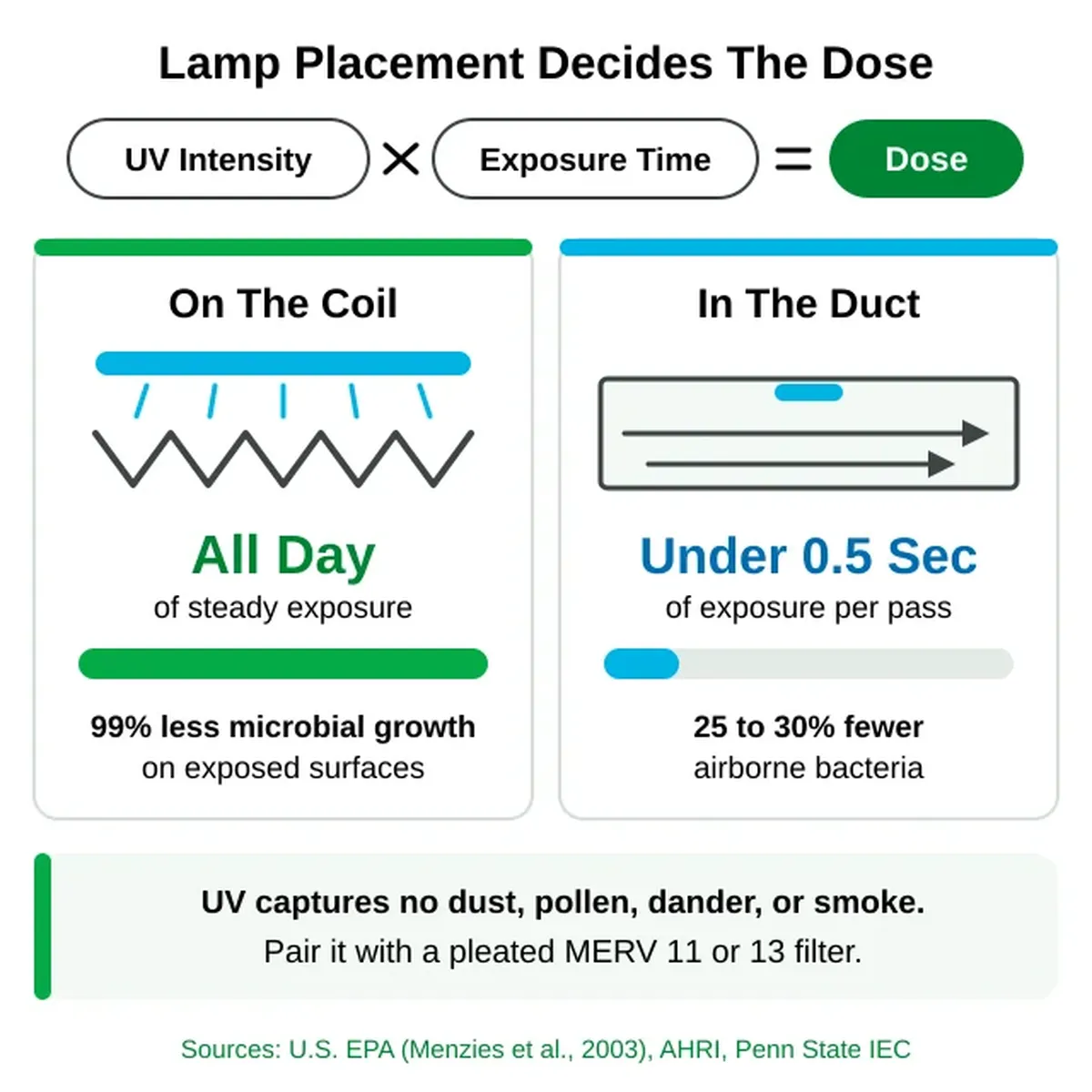
HVAC UV lights work well on the cooling coil, but they do far less for air moving through a duct. Results come down to dose, which is UV intensity multiplied by exposure time. A coil lamp shines on the same damp surface all day, while duct air passes a lamp in under half a second.
Coil-mounted UV: Steady exposure controls growth on the coil and drain pan.
In-duct UV: Air gets a fraction of a second, so each pass inactivates only part of the microbes.
Pleated air filter: Captures the dust, pollen, and pet dander that UV can't.
UV works alongside a pleated MERV 11 or MERV 13 filter, not in place of one. Check your HVAC manual for the highest MERV rating your system supports, then take the quick quiz below to find your match.
Answer a few quick questions and we'll match you to the right filter for your system.
TL;DR
An HVAC UV light works only as well as its dose, which is intensity multiplied by exposure time. A lamp aimed at a wet evaporator coil collects that dose around the clock, so coil UV lights get dependable results. Duct air crosses the lamp in a fraction of a second, so only part of its germs are inactivated per pass. UV-C also captures no dust or pollen, which is why Filterbuy recommends it alongside an air filter, never instead of one.
Key Takeaways
Dose equals intensity (µW/cm²) times exposure time (seconds).
Inactivating 85% of Staphylococcus aureus in one 500-fpm pass through a 2-foot zone takes about 2,260 µW/cm², over 20 times ASHRAE’s 50–100 µW/cm² coil minimum.
A coil lamp at 100 µW/cm² reaches the same dose in under 6 seconds and keeps going all day.
Why a filter maker ran the numbers: Filterbuy makes the pleated filters that sit upstream of these lamps, at company-owned plants in Alabama, Florida, Pennsylvania, and Utah. Our sister company, Filterbuy HVAC Solutions, installs the lamps in Florida homes. Selling both gives us no reason to oversell either, so we did the dose math ourselves.
“Before I recommend a coil lamp, I check the coil and drain pan for growth and make sure the filter fits snugly. If the real complaint is dust or allergies, I start with the filter.”
David Clark, Licensed HVAC Technician and President of Filterbuy HVAC Solutions
How Effective Are HVAC UV Lights?
HVAC UV lights are very effective on surfaces they light continuously and only modestly effective on air rushing past them. A coil-mounted lamp gives the damp coil and drain pan hours of exposure daily, enough to keep mold and bacterial film in check, while an in-duct lamp gets a fraction of a second with each pocket of air.
That’s why Filterbuy HVAC Solutions installers mount lamps at the evaporator coil, where moisture and growth concentrate, and put any second lamp at the blower or supply plenum.
The U.S. Environmental Protection Agency (EPA) agrees that typical home UV germicidal irradiation (UVGI) units have limited effectiveness against bacteria and molds. For the basics, start with how UV lights work in an HVAC system.
What Is UV Dose, and Why Does It Decide Results?
UV dose, also called fluence, is the total UV-C energy a microorganism absorbs, and it decides whether a UV light works. Dose is irradiance multiplied by exposure time, so a weak lamp with plenty of time can match a strong lamp with very little:
UV dose (µJ/cm²) = irradiance (µW/cm²) × exposure time (seconds)
Researchers at Penn State’s Indoor Environment Center used a published rate constant for Staphylococcus aureus, a common bacterium, to show that 542 µJ/cm² inactivates 85% of it.
How Long Is Air Exposed to a UV Light in a Duct?
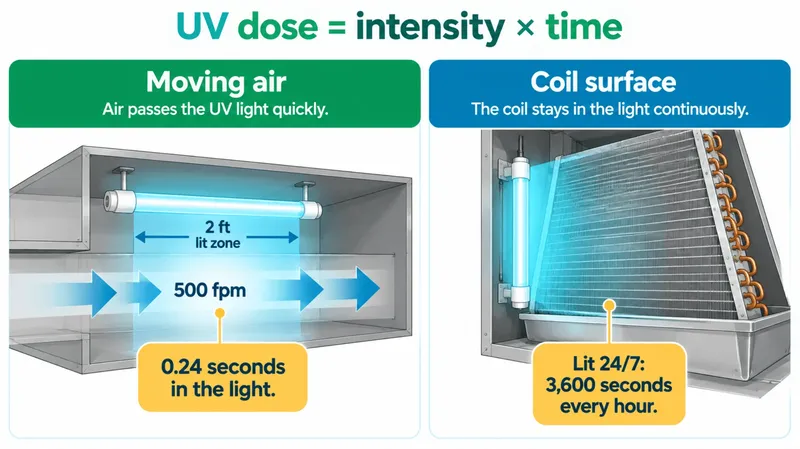
In most home ducts, air spends less than half a second near a UV lamp on each pass, which is the lit zone’s length divided by air speed. AHRI, the HVAC manufacturers’ trade group, notes that microbes pass a return-duct lamp at several hundred feet per minute (fpm), often too fast for the kill rate you want.
Filterbuy analysis. Seconds = lit length in feet ÷ (fpm ÷ 60).
An in-duct lamp also treats air only while the blower runs, and the EPA’s technical summary notes that home air cleaning typically happens less than 25% of the year.
How Much UV Does One Pass of Air Need?
Delivering the 542 µJ/cm² reference dose to duct air in a single pass takes thousands of µW/cm², about 2,260 at 500 fpm. By comparison, ASHRAE, the HVAC engineering society, sets just 50 to 100 µW/cm² as the minimum for a cooling coil.
Filterbuy analysis: average irradiance for an 85% single-pass kill of S. aureus, using Penn State's 542 µJ/cm² reference dose.
“Running these numbers changed how I explain UV. A coil gets its full dose in seconds, while air at 500 feet per minute barely gets started. So we tell people to buy UV to protect the coil.”
Michelle Wan, Brand Manager, Filterbuy
Does Airflow Affect UV Light Effectiveness?
Airflow reduces UV light effectiveness in two ways: faster air shortens exposure time, and cooler air lowers the lamp’s output. UV-C lamps run best near 103°F to 122°F, so cold air leaving a cooling coil works against them, an effect engineers call wind chill.
Wind chill. At 500 fpm and 55°F, typical just past a cooling coil, manufacturers de-rate lamps by about 50%.
Lamp aging. According to the Penn State study, UV-C output falls 15–20% in a lamp’s first 2,000 hours before leveling off. A lamp running 24/7 reaches 2,000 hours in about 12 weeks.
Dust. Any film on the bulb blocks UV-C. As a filter maker, Filterbuy sees the usual source: a loaded or loose filter. That’s why we cut every filter slightly under nominal size so it seats snugly.
Filterbuy analysis: Combine a 50% wind-chill derate with a 20% aging loss, and a lamp delivers about 40% of its rated output. The still-air rating on the box overstates what you’ll get in your ductwork.
Why Do Coil UV Lights Get Better Results?
Coil UV lights get better results because a coil sits still and collects dose all day. At ASHRAE’s 50–100 µW/cm² minimum, the coil reaches the 542 µJ/cm² reference dose in about 5 to 11 seconds and absorbs 180,000 to 360,000 µJ/cm² every hour.
In a study cited by the EPA (Menzies et al., 2003), UV cut microbial growth on exposed HVAC surfaces by 99% but reduced airborne bacteria by only 25–30%. For more, see Filterbuy’s guide to coil-mounted vs. in-duct UV lights.
What HVAC UV Light Results Can You Expect?
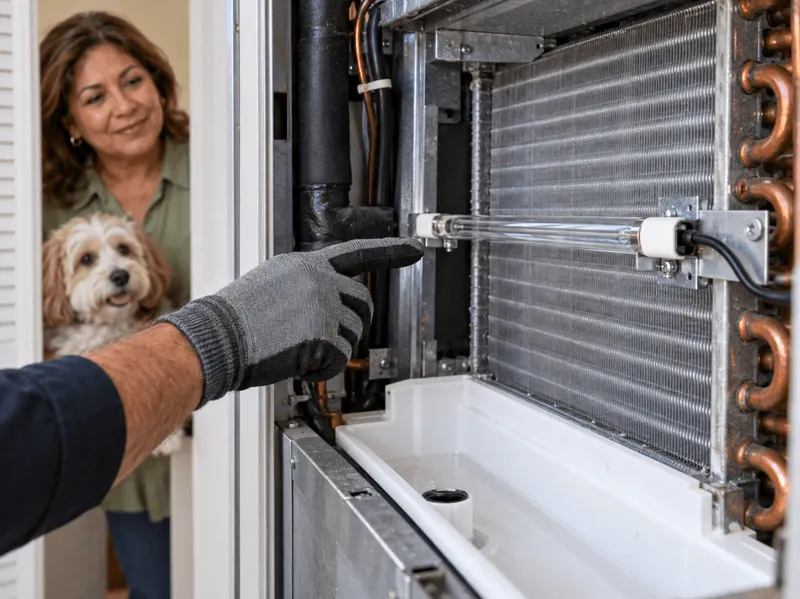
A well-placed HVAC UV light delivers its clearest results on the coil: less microbial film and fewer musty odors. Results on airborne germs are partial, and UV does nothing for dust, pollen, or dander, so allergy relief depends mostly on your filter.
For particles, use a pleated MERV 11 or MERV 13 filter (see Filterbuy’s MERV rating chart); for in-duct test results, see what the evidence shows on UV lights in air ducts.
How Do You Get the Most Dose From an HVAC UV Light?
To get the most dose from an HVAC UV light, aim it at the coil, run it nonstop, replace bulbs before output fades, and keep dust off the lamp with a clean filter.
Aim it at the coil and leave it on 24/7.
Ask for the dose math at your conditions. Check it with the steps below. In-duct units should also have ANSI/ASHRAE Standard 185.1 test data.
Replace bulbs on schedule. See the bulb FAQ below for timing.
Keep the filter fresh, and keep UV off it. Follow a schedule for how often to change your air filter. Keep the lamp’s light off the rack, since Filterbuy MERV 13 media is the synthetic type AHRI warns UV damages.
Filterbuy’s take: We sell both, and in most homes we still put the filter first and a coil lamp second. Shop American-made MERV 13 air filters in 600+ sizes, or set up air filter auto-delivery. In Florida, Filterbuy HVAC Solutions can assess whether a coil UV light fits your system.
How Can You Check a UV Light’s Claims Yourself?
You can check a UV light’s claims by estimating the dose it gives your duct air: multiply the lamp’s irradiance by the exposure time at your air speed.
Get the irradiance. Ask for the average µW/cm² across the lit zone at your airflow and air temperature.
Find your air speed. Divide airflow in cubic feet per minute (cfm) by the duct’s cross-section in square feet. For example, 1,200 cfm through a 16-by-20-inch duct (2.2 sq ft) moves about 540 fpm.
Do the math. Exposure time equals lit length in feet ÷ (fpm ÷ 60), and dose equals irradiance × exposure time.
Worked example (Filterbuy analysis):
A lamp averaging 1,000 µW/cm² over a 2-foot zone at 540 fpm gives the air about 0.22 seconds of exposure, or 220 µJ/cm².
Using Penn State’s S. aureus rate constant, that inactivates roughly 54% per pass.
With a 50% wind-chill derate, it drops to about 32%.
Partial kills add up as air recirculates, though only while the blower runs.
Supporting Statistics
About 80% less TB transmission at only 5–7 µW/cm²
A trial funded by NIOSH, the CDC’s workplace safety institute, ran on a hospital ward for seven months.
Why it matters: Room air passed through weak UV light for months; one duct pass lasts under a second.
Source: CDC Stacks (2015)
About 15% better coil heat transfer and airflow
ASHRAE’s RP-1738 field study in Tampa, Florida, the humid climate Filterbuy HVAC Solutions serves.
Why it matters: UV didn’t fully clear existing fouling, so start with a new or cleaned coil.
Source: ASHRAE
No significant asthma improvement after 12 months
An NIH-funded, sham-controlled trial, sponsored by the device maker, tested in-duct UV in 79 children’s homes.
The main asthma score didn’t change significantly, though a secondary measure showed fewer respiratory infections (30% vs. 56%).
Why it matters: Even a purpose-built home unit produced an inconclusive health result.
Source: NIH PubMed Central (2025)
Frequently Asked Questions
Do HVAC UV Lights Work When the Fan Is Off?
A coil UV light keeps treating the coil and drain pan with the fan off. An in-duct light treats only moving air, so it does nothing between cycles.
How Can I Tell if My UV Light Delivers Enough Dose?
Only a UV-C radiometer reading at the coil or in the duct can tell you. A glowing bulb isn’t proof, and you should never look directly at an operating UV-C lamp.
Can an HVAC UV Light Replace My Air Filter?
No. UV-C captures no dust, pollen, or pet dander, and the EPA’s technical summary on residential air cleaners says UV should be used in addition to particle filtration. Filterbuy pairs a coil lamp with a pleated MERV 11 or MERV 13 filter.
How Often Should HVAC UV Bulbs Be Replaced?
Many bulb makers recommend yearly replacement, according to AHRI, and Filterbuy’s Florida team installs two-year bulbs to cut down on changes. Output fades before the glow does, so replace bulbs on schedule. A standard lamp costs about 5 to 10 cents a day to run.
Do HVAC UV Lights Kill Mold Spores?
Coil UV lights control mold growing on the coil and drain pan, which get constant exposure. Airborne spores are harder: the EPA says they need minutes to hours of exposure, far longer than a duct pass.
Glossary
UV-C: Short-wave ultraviolet light, about 200–280 nm, that inactivates microorganisms. See what UV-C light is.
UV dose (fluence): Total UV energy absorbed, in µJ/cm²; irradiance × exposure time.
Sources
U.S. EPA, Does ultraviolet (UV) radiation from UV lamps kill mold?
U.S. EPA, Residential Air Cleaners: A Technical Summary, 3rd Edition (2018)
Bahnfleth, Lee, Lau, and Freihaut, Penn State Indoor Environment Center, Annual Simulation of In-Duct Ultraviolet Germicidal Irradiation System Performance (IBPSA 2009)
Consulting-Specifying Engineer, How UV-C energy works in HVAC applications: Part 3, by Forrest Fencl, president of lamp maker UV Resources (summarizes ASHRAE Handbook coil irradiation minimums)
Dharmadhikari et al., NIOSH-funded trial, Controlled trial of upper room ultraviolet air disinfection (CDC Stacks, 2015)
ASHRAE, How Ultraviolet Germicidal Irradiation Mitigates Coil Biofouling in HVAC Systems (RP-1738)
Bernstein et al., NIH/NIAID-funded trial, Randomized trial of ultraviolet irradiation units installed in homes of children and adolescents with asthma (PMC, 2025)
Filterbuy HVAC Solutions, UV Light Installation
Filterbuy, Coil-Mounted vs. In-Duct UV Lights and Do UV Lights Actually Work in Air Ducts? (cluster consistency)