
HVAC UV Light Maintenance: What To Check And How Often
October 8, 2026
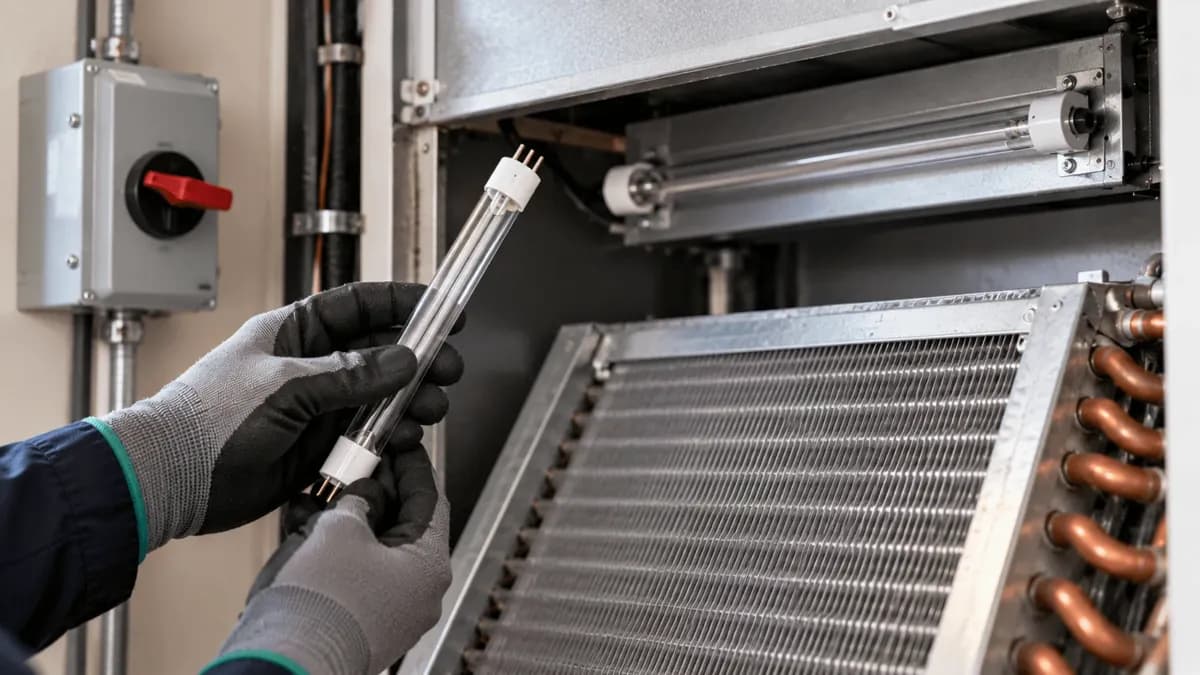
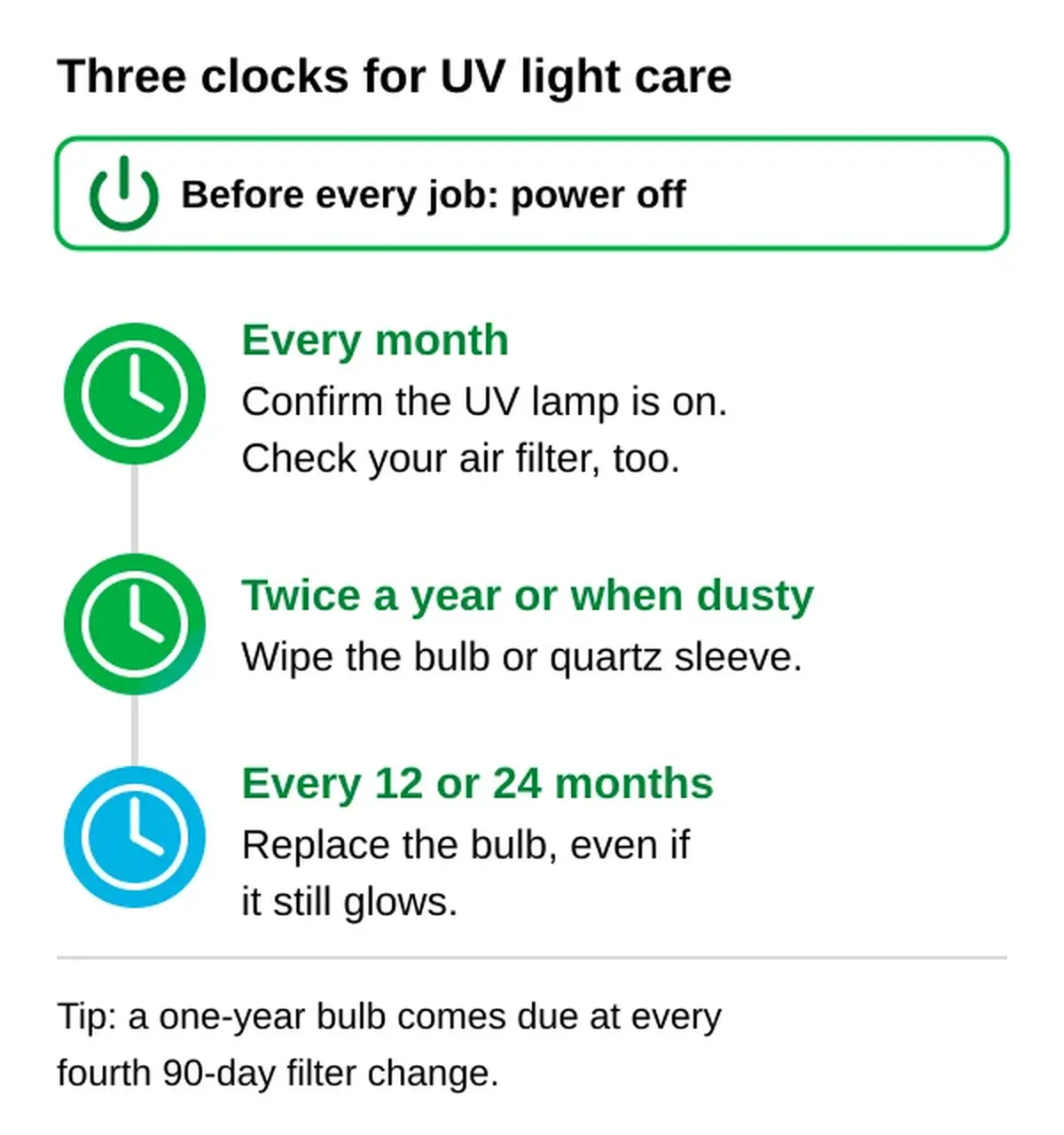
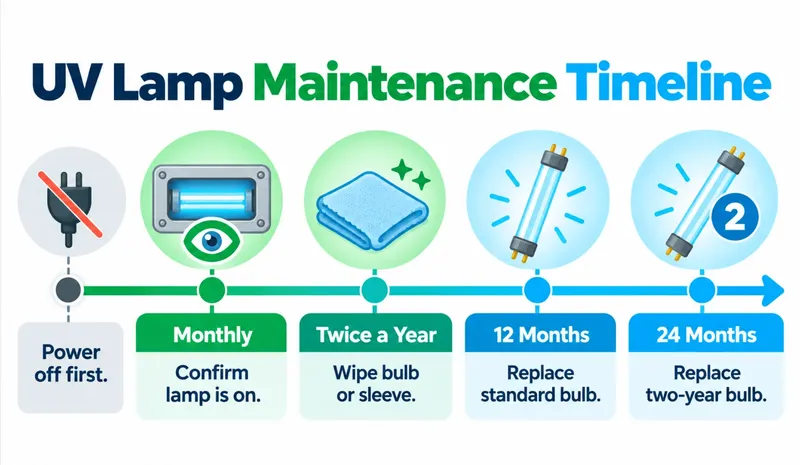
Check that your HVAC UV light is on every month, wipe the bulb or sleeve twice a year, and replace the bulb every 12 months (or every 24 for a two-year bulb). Switch off power to the UV unit and air handler before every job.
A bulb can keep glowing after its UV-C output fades, so go by the calendar, not the glow. Your air filter keeps dust off the bulb, so the two schedules work as a pair.
Not sure which filter belongs upstream of your lamp? Take the quick match quiz below.
Find the right filter for your system
Answer a few quick questions and we'll match you to your filter.
Already know your filter size?
Check each month that your HVAC UV light is on, and wipe the bulb or its sleeve whenever dust builds up. Replace the bulb itself every one or two years, and start every job by switching off power to the UV unit and air handler.
Filterbuy sees this job from both sides. We manufacture the pleated filters that sit upstream of the lamp, and our Filterbuy HVAC Solutions team installs UV lights and replaces their bulbs.
TL;DR
HVAC UV lamps fade long before they burn out, so Filterbuy recommends replacing them on a calendar, every 12 months for standard bulbs and every 24 for two-year bulbs. Shut off power and wear clean gloves for every job.
Key Takeaways
Most HVAC UV-C bulbs are rated for 9,000 to 12,000 hours, or about a year of continuous use.
A UV bulb can keep glowing after its germicidal output fades, so the glow is not proof it works.
UV-C light can injure skin and eyes within seconds, according to the U.S. Food and Drug Administration (FDA).
Skin oils on the glass reduce UV output, so handle new bulbs with clean gloves.
Most HVAC UV bulbs contain mercury and belong at a lamp recycling site, not in household trash.
How Often Does An HVAC UV Light Need Maintenance?
HVAC UV light maintenance runs on three clocks. Each month, confirm the lamp is on. About twice a year, or whenever dust appears, clean the bulb or sleeve. Every 12 months, replace the bulb, or every 24 months for a two-year lamp.
Intervals vary by manufacturer. Follow the replacement schedule in your UV unit's manual.
A lamp running around the clock logs 8,760 hours a year, which puts a 9,000-hour bulb at its rating in about 12 months. Even a 12,000-hour bulb gets there in about 16.
To keep it simple, Filterbuy ties the bulb to the filter. On a 90-day filter schedule, a one-year bulb comes due at every fourth filter change and a two-year bulb at every eighth, so one reminder covers both. Aim for spring, just before cooling season, since coil lamps work on a wet coil. Filterbuy's guide on how UV lights work in an HVAC system covers the lamp types.
Why A Glowing Bulb Is Not Proof The Lamp Is Working
A UV bulb's blue glow and its germicidal output are two different things. HVAC UV-C lamps put most of their energy out at about 254 nanometers, a wavelength the human eye cannot see, and the International Ultraviolet Association places peak germicidal effectiveness just above that, near 260 nm. The faint blue in the viewport is ordinary visible light, and it keeps shining after the UV-C output drops.
So at Filterbuy, we treat the glow as the least reliable signal on the unit. The monthly viewport check tells you the lamp has not failed outright, and only the calendar tells you it has faded. Field Controls, a residential UV air purifier maker, says its lamps' maximum output begins to lessen after one year and recommends annual replacement. Our explainer on UV-C light and the 254 nm wavelength covers the physics.
UV Bulb Handling Safety: Disconnect Power Before Every Job
Disconnecting power is the first step of every UV light maintenance task. According to an FDA safety communication on UV wands, UV-C radiation can injure the skin and eyes after just a few seconds of exposure. At home, the risk begins only when the cabinet opens with the lamp on.
Before you open any panel:
Turn the system off at the thermostat, then at the service disconnect or breaker.
Unplug the UV unit, or switch it off if it has its own switch.
Give the lamp a few minutes to cool.
Put on clean nitrile or cotton gloves and safety glasses.
Many UV units also include a safety interlock that cuts the lamp when the access door opens. Treat it as a backup, since interlocks wear out. And never look directly at a lit lamp.
How To Replace A UV Bulb In Your HVAC System
On units with an external lamp housing, replacing an HVAC UV bulb is a homeowner job. Lamps deep inside the air handler are best left to a technician. Our comparison of coil-mounted vs. in-duct UV lights shows where each type sits.
Before ordering, note these details from the old bulb or unit label:
UV unit brand and model number
Bulb part number and length
Base or pin style
Rated life (one-year or two-year)
An ozone-free marking
1. Confirm the replacement part against that list and your unit's manual.
2. Shut off all power and let the lamp cool.
3. Remove the old bulb. Most bulbs twist, unclip, or slide out of their housing. Hold the bulb by its base, never the glass.
4. Inspect while it is out. Look for dust in the housing and cracks in any sleeve. UV-C light degrades some plastics and insulation over time, so check nearby wiring and plastic for brittleness or discoloration.
5. Prepare the new bulb. Field Controls warns that skin oils reduce lamp intensity, so put on clean gloves and wipe the glass with an isopropyl alcohol pad.
6. Install and secure. Seat the bulb fully in its socket and close the housing.
7. Restore power and confirm. Switch the power back on and check the indicator light or viewport. Then write today's date on the housing.
How To Clean A UV Lamp Sleeve Or Bulb
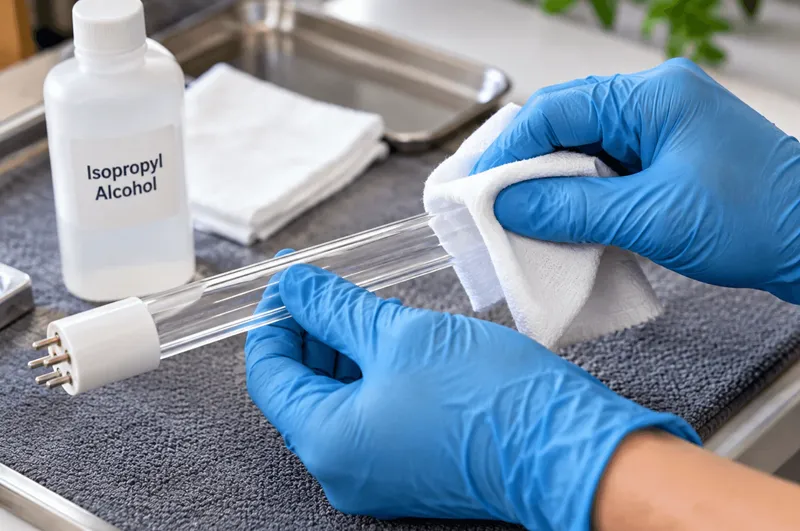
Cleaning a UV lamp sleeve takes only gloves and a lint-free cloth dampened with isopropyl alcohol. Dust on the glass absorbs UV-C before it reaches the coil, so UV light cleaning in an HVAC system belongs on every seasonal tune-up.
To clean the bulb or its quartz sleeve:
1. Disconnect power and let the lamp cool.
2. Remove the bulb or sleeve following your unit's manual.
3. Dampen a lint-free cloth with isopropyl alcohol and wipe the full length of the glass.
4. Skip abrasive pads and glass cleaners, which scratch quartz or leave residue.
5. Let the glass dry completely, then reinstall it with gloved hands.
As an air filter manufacturer, Filterbuy reads a dusty lamp as a filter problem first, since a clogged or poorly fitted filter lets debris slip past. Check how often to change your HVAC filter and keep a correctly sized pleated filter from Filterbuy air filters in place. A filter subscription can ship the next one on your schedule.
What To Do If A UV Lamp Breaks
Most HVAC UV-C lamps contain mercury, so a broken one deserves the same care as a broken fluorescent bulb. Clear the room and open a window first. Then shut off the HVAC system.
From there, follow EPA's cleanup steps for a broken fluorescent bulb. Collect the debris with stiff paper and tape, then seal it in a jar or bag. Skip the vacuum at first, since it can spread mercury vapor. If the bulb broke inside the air handler, call a technician.
How To Dispose Of An Old UV Bulb
Used HVAC UV bulbs belong at a household hazardous waste site or a retailer that accepts fluorescent lamps, and some localities ban them from household trash. NEMA's Lamp Recycle site, from the National Electrical Manufacturers Association, lists options by state.
When To Call For Professional HVAC UV Light Service
Call a licensed HVAC technician if you notice any of these warning signs.
Our guide to black mold in an AC unit explains what you can safely clean yourself. Still deciding whether you need a lamp? Read whether UV lights work in air ducts first.
How Filterbuy Approaches UV Light Maintenance
Our Filterbuy HVAC Solutions team is plain about bulb life: "Like any light bulb, a UV light will burn out. Most bulbs last 1 or 2 years."
On replacements, the team is just as direct: "While they are more expensive, we advise 2-year bulbs to avoid the headache of more frequent bulb changes." Service-area homeowners can book Filterbuy HVAC Solutions UV light service, and its Performance Care Plan includes proactive UV bulb replacement.
Supporting Statistics
1. Two-thirds of U.S. homes cool with central air or a central heat pump.
Source: U.S. Energy Information Administration, 2020 Residential Energy Consumption Survey findings (18,496 households)
Why it matters: Central systems are where coil-mounted UV lamps go.
2. Effective lamp life: 9,000 hours, measured at a 20% drop in UV output.
Source: Centers for Disease Control and Prevention, NIOSH ultraviolet germicidal irradiation guidelines (manufacturer benchmark)
Why it matters: Lamps fade before they fail, so replace them on the calendar.
3. A compact fluorescent bulb holds about 4 milligrams of mercury.
Why it matters: Most HVAC UV-C lamps use the same mercury technology, so recycle them.
Frequently Asked Questions
How Often Should I Replace The UV Bulb In My HVAC System?
Replace a standard HVAC UV bulb, rated 9,000 to 12,000 hours, every 12 months, and a two-year bulb every 24 months, even if it still glows.
Can I Touch A UV Bulb With Bare Hands?
No. Skin oils leave a film on the glass that reduces UV-C output. Wear clean gloves, and if you do touch the glass, wipe it with isopropyl alcohol before installing.
Is It Safe To Look At An HVAC UV Light?
No. A few seconds of exposure to a lit UV-C lamp can cause photokeratitis, a painful injury to the surface of the eye. The American Academy of Ophthalmology's EyeWiki lists germicidal lamps as a cause and notes that symptoms often appear hours later.
Do HVAC UV Lights Produce Ozone?
HVAC UV lights can produce ozone if the lamp emits the 185 nm wavelength. Ozone-free lamps use doped quartz that blocks it, so look for that marking on any replacement.
How Much Does A Replacement HVAC UV Bulb Cost?
Replacement HVAC UV bulbs typically cost about $10 to $100, depending on the bulb type, and a standard lamp costs roughly 5 to 10 cents a day to run.
Do I Still Need To Change My Air Filter If I Have A UV Light?
Yes. A UV light does not capture particles. The filter does that job and keeps dust off the bulb, which is why Filterbuy pairs the two schedules.