
Where Should a UV Light Go in Your HVAC System?
October 7, 2026
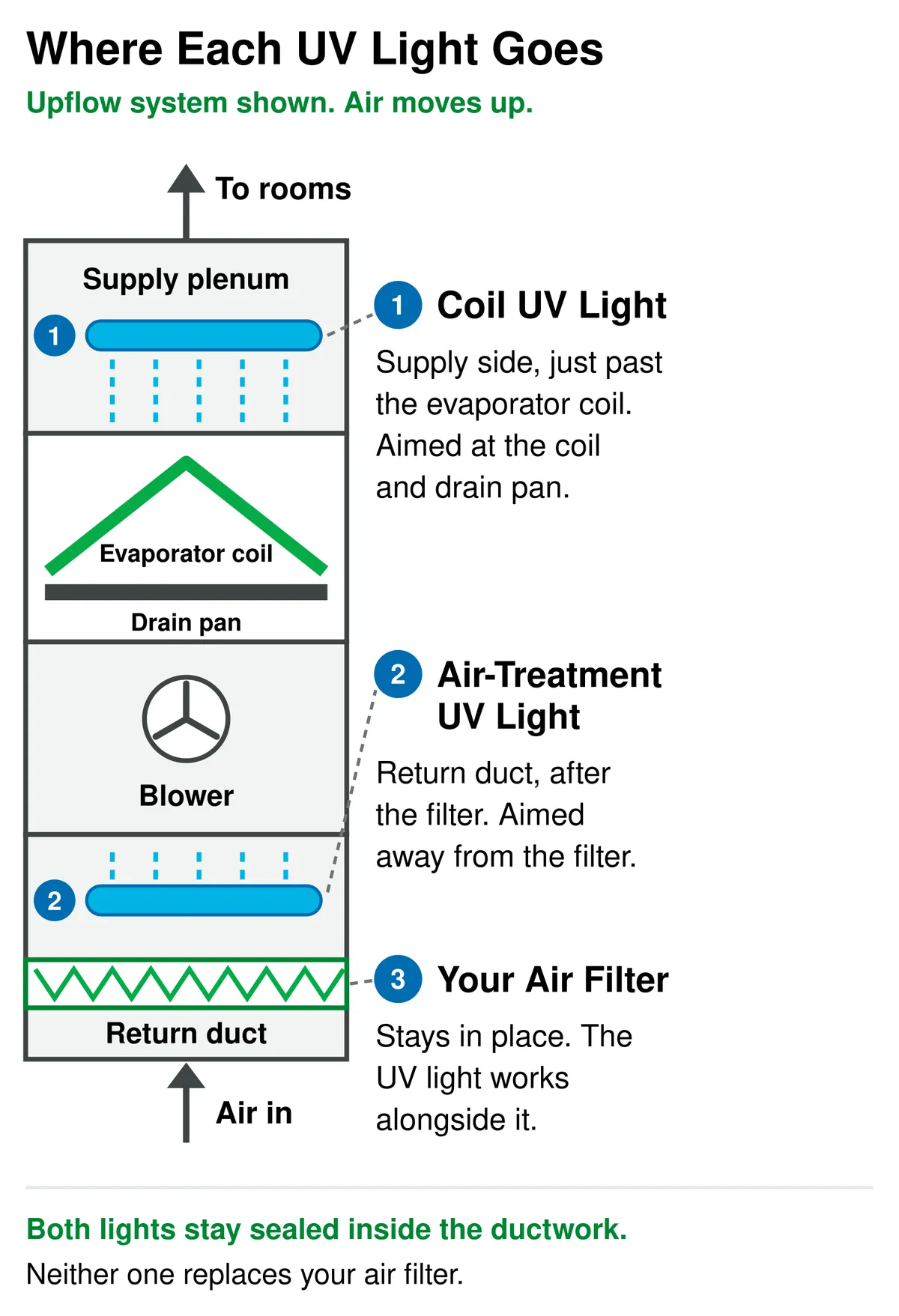
A coil UV light goes on the supply side, just past the evaporator coil, aimed at the coil and drain pan. An air-treatment UV light goes in the return duct, ideally after your air filter. Either one works alongside your air filter, never in place of it. Take the quick quiz below to find the filter that fits your system.
Answer a few quick questions and we'll match you to the right air filter for your home.
Already know your filter size? Shop air filters at Filterbuy
TL;DR
The best place to install a UV light in your HVAC system depends on its job. A coil UV light belongs on the supply side, just past the evaporator coil, aimed at the coil and drain pan. An air-treatment UV light mounts in the return duct, ideally after the air filter. As a filter maker and UV installer, Filterbuy adds one rule: keep the light off anything it can damage, starting with your filter.
Key Takeaways
Coil UV lights go on the supply side, just past the coil, aimed at coil and drain pan.
Air-treatment UV lights go in the return duct, preferably after the filter.
Clearances run from 30 inches to 6 feet; Filterbuy suggests the strictest that applies.
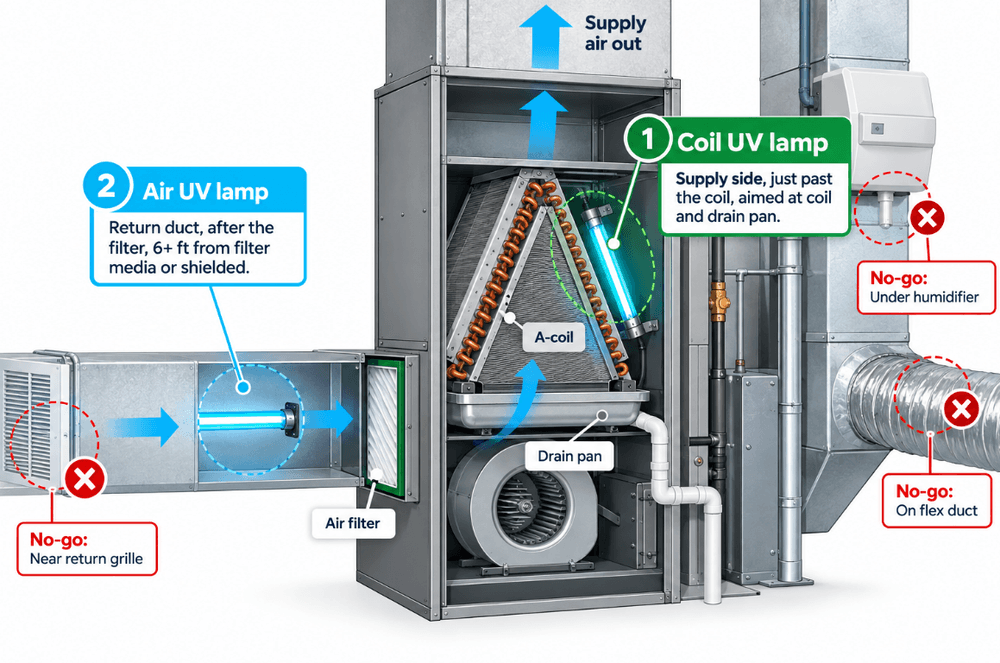
Never mount a lamp where its light shows, near a grille, under a humidifier, or facing flex duct.
A UV light works alongside your air filter, never in place of it.
Supply vs. Return vs. Coil: Which UV Light Placement Is Right for You?
HVAC UV light placement depends on the lamp's purpose. A coil (surface-treatment) lamp keeps the wet coil and drain pan free of mold and bacteria, while an air-treatment lamp targets microbes in moving air. See Filterbuy's guide to coil-mounted vs. in-duct UV lights.
Filterbuy's three-check placement rule. After comparing three manufacturer manuals with guidance from ASHRAE (the HVAC engineering society) and AHRI, we use three ordered checks:
Target: Surface or air? Coil lamps go on the supply side, air lamps in the return.
Line of sight: The lamp shouldn't see filter media, flex duct, wiring, humidifiers, or plastic pans.
Access and rating: Choose a reachable spot within the lamp's temperature rating.
Sources: Honeywell UV100E Ultraviolet Systems product data; Field Controls UV-Aire installation instructions. Always follow your lamp manufacturer's installation manual.
Why Is Coil Placement the Most Common Recommendation?
Coil placement wins because a coil never moves. Honeywell recommends installing its UV lights over the A-coil, and AHRI, the HVAC manufacturers' trade association, names the coil and drain pan the preferred location. Filterbuy HVAC Solutions technicians usually mount lamps there too. Lighting the coil around the clock lets even a modest lamp deliver a large dose.
By contrast, moving air at 500 feet per minute spends roughly 0.25 seconds in a 2-foot lit zone, per an ASHRAE Journal best-practices review.
In a peer-reviewed study by Luongo and Miller (2016), coil UV cut surface microbial loading by 55% on average, and growth was heaviest on the downstream side, which a supply-mounted lamp faces. Filterbuy's explainer on how UV lights work in an HVAC system covers the dose math.
Where Exactly Do You Mount a Coil UV Light?
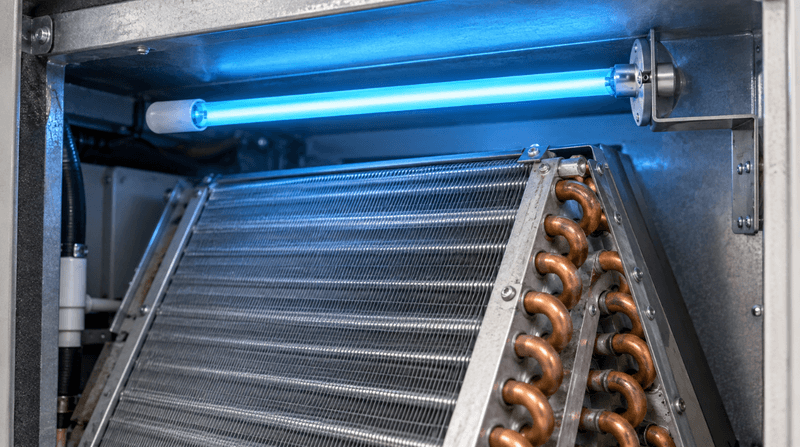
Mount a coil UV light in the supply plenum, just downstream of the evaporator coil. The Honeywell UV100E product data says the lamp's light should surround the coil and drip pan, and Field Controls' UV-Aire instructions call for mounting as close to the A-coil as possible.
Then fine-tune it:
Find the coil first. Field Controls says to locate it before drilling.
Before or after the coil? After, when you can. ASHRAE notes lamps work on either side, but downstream usually has more room and lights the drain pan better.
Check the drain pan. Honeywell notes that some pans may not tolerate UV.
Clean a moldy coil first. ASHRAE recommends starting with clean coils and pans; see Filterbuy's guide to black mold in your AC unit.
How Does UV Light Placement Change With Your Air Handler Type?
A coil lamp goes where air leaves the coil, which depends on your system's airflow.
Coil lamp positions follow airflow direction. Check your lamp manufacturer's installation manual for orientation and temperature limits.
On horizontal and downflow systems, check orientation limits before drilling; Honeywell's units can't mount upside down or face their lamps up.
Where Should an Air-Treatment UV Light Go: Before or After the Filter?
Install an air-treatment UV light in the return duct, after the air filter whenever possible. Field Controls prefers this spot, and AHRI notes that bulbs upstream of the filter collect dust; Honeywell recommends cleaning bulbs quarterly. For the evidence, read whether UV lights work in air ducts.
Protect your filter from the lamp. As a filter maker, we watch this detail most closely. Filterbuy pleated filters use synthetic media, the non-fiberglass type Honeywell says UV-C can discolor or break down. ASHRAE advises shielding synthetic media within 6 feet of an in-duct lamp, the clearance we recommend for our filters, and the Fresh-Aire UV APCO-X manual shows return lamps aimed away from the filter.
Pro Tip: Short on space? Have your technician aim the lamp away or shield the filter with foil duct tape, as Honeywell suggests, and check old filters for discoloring on the lamp side.
Where Should You Never Install an HVAC UV Light?
Manufacturers rule out certain spots to protect you and your equipment. UV-C can injure eyes and skin, and over time it breaks down plastics and wiring.
Clearances vary by source: Field Controls specifies 30 in., Honeywell 3 ft, and ASHRAE 6 ft for synthetic filter media. Filterbuy recommends the strictest distance that applies.
Filterbuy's take: when sources disagree, use the strictest distance for whatever the lamp can see.
Can You Install a UV Light Yourself?
UV light installation is a job for a trained HVAC technician. Honeywell specifies an experienced service technician for its UV100E, since the job means cutting into the plenum and wiring a mercury-containing lamp.
Filterbuy HVAC Solutions puts a standard lamp's running cost at 5 to 10 cents a day.
"Before I recommend a coil lamp, I check the coil and drain pan for growth and make sure the filter fits snugly. If the real complaint is dust or allergies, I start with the filter."
— David Clark, Licensed HVAC Technician and President of Filterbuy HVAC Solutions
How Do You Check a Finished Installation?
You can confirm a lamp works without ever looking at it. The manuals we compared share five checks:
Use the indicator, not your eyes. The units we reviewed have a UV-blocking indicator or sight glass. Never open the duct to look.
Watch for stray glow. If blue light leaks around the plenum, Field Controls says to unplug the unit and seal the gap.
Find the warning label. Honeywell and Fresh-Aire include a cabinet sticker so future technicians cut power first.
Confirm coil lamps stay on. They should run nonstop, not cycle with the fan.
Write down the bulb date. Note it with the replacement part number.
Does a UV Light Replace Your Air Filter?
No. A UV light inactivates microorganisms, but it doesn't remove particles from the air. The EPA's residential air cleaner summary says UV air cleaners should be used with filtration, not instead of it.
On Filterbuy's production floor, fit matters as much as rating: a filter that rattles in its slot lets dust onto the coil and bulb, and a dusty bulb puts out less UV-C.
Compare ratings in Filterbuy's MERV rating chart.
Stay on schedule with how often to change your air filter.
New system? Find your exact filter size among Filterbuy's 600+ American-made sizes, or set up auto-delivery.
Why Filterbuy Looks at UV Placement From Both Sides
We make the filter, and our Florida team installs the lamp. Filterbuy has built pleated air filters in company-owned U.S. plants since 2013, and Filterbuy HVAC Solutions installs UV lights in Florida homes. Our filters use synthetic media that UV-C can degrade, so every placement here comes with its clearance.
"We make the filter and we install the lamp, so we'd rather tell you which one solves the problem than sell you both."
— The Filterbuy team
Supporting Statistics
2–5 minutes: An unshielded 36-watt UV-C lamp exceeded NIOSH's daily exposure limit in 120 to 300 seconds, leaving three workers with eye irritation and peeling skin. (CDC Stacks, NIOSH, 2002)
99%: In a 48-week double-blind trial with 771 office workers, lamps aimed at cooling coils and drip pans cut surface microbial levels by 99%. (CDC Stacks, The Lancet, 2003)
150°F+: Attic air can exceed 150°F under peak summer conditions. Lawrence Berkeley National Laboratory cites measured peaks of 155°F and recorded 151°F in a Sacramento home. By comparison, Honeywell rates the UV100E for an ambient temperature range of just 30°F to 104°F. (Lawrence Berkeley National Laboratory — Distribution Effectiveness and Impacts on Equipment Sizing for Residential Thermal Distribution Systems (PDF)
Frequently Asked Questions
How far should a UV light be from the coil?
Follow your lamp's manual. ASHRAE calls mounting within 3 feet of the coil common practice, and Honeywell tested its UV100E coil unit's 99.9% mold-kill claim at 18 inches.
Can you install two UV lights in one HVAC system?
Yes. Filterbuy HVAC Solutions says two-lamp setups are getting more common, usually one at the coil and one at the blower or supply plenum.
Should an HVAC UV light run all the time?
Coil lamps should. AHRI recommends leaving them on rather than cycling with the fan, since mold grows fastest in still air. Some return-duct models, like Honeywell's UV100E, run only when they sense airflow.
How often should you replace an HVAC UV bulb?
Most last one to two years, and Filterbuy HVAC Solutions recommends two-year bulbs. Replace on schedule, because germicidal output fades before the bulb stops glowing.
Do HVAC UV lights produce ozone?
Some can. Honeywell lists its UV100E as ozone-free, so ask for a lamp its maker specifies the same way.
Glossary
UV-C: Short-wave ultraviolet light, about 254 nm in germicidal lamps, that damages microbial DNA.
Evaporator coil: The indoor AC coil, which stays wet during cooling.
A-coil: An upside-down-V evaporator coil, common on upflow furnaces.
Supply plenum: The duct box where air leaves the air handler.
Return duct: Ductwork returning room air through the filter.
Air handler: The indoor cabinet holding the blower and coil.
Drain (drip) pan: The tray under the coil that collects condensation.
Filterbuy: A family-owned U.S. maker of pleated MERV 8, 11, and 13 air filters since 2013.
Filterbuy HVAC Solutions: Filterbuy's Florida HVAC team, which installs UV lights.
Flex duct: Plastic-jacketed flexible duct that UV-C can degrade.
Synthetic filter media: Non-fiberglass media used in most pleated filters.
MERV (Minimum Efficiency Reporting Value): ASHRAE's 1–16 filter efficiency scale.
ASHRAE / AHRI: HVAC engineering and manufacturer groups.
About the Author and Reviewer
Michelle Wan is Filterbuy's Brand Manager. She works with Filterbuy's manufacturing teams and writes from how filters are built and used.
David Clark is President of Filterbuy HVAC Solutions, an EPA-certified HVAC technician, and a graduate of the South Florida Academy of Air Conditioning.
Sources
U.S. EPA: Does ultraviolet (UV) radiation from UV lamps kill mold?
Luongo and Miller (2016), Ultraviolet germicidal coil cleaning, via EPA HERO
ASHRAE Journal: Ultraviolet Germicidal Irradiation, Current Best Practices (Martin et al., 2008)
CDC Stacks (NIOSH): Occupational Risk from Ultraviolet Germicidal Irradiation Lamps (2002)