
Are HVAC UV Lights Dangerous? What The Safety Rules Require
October 8, 2026
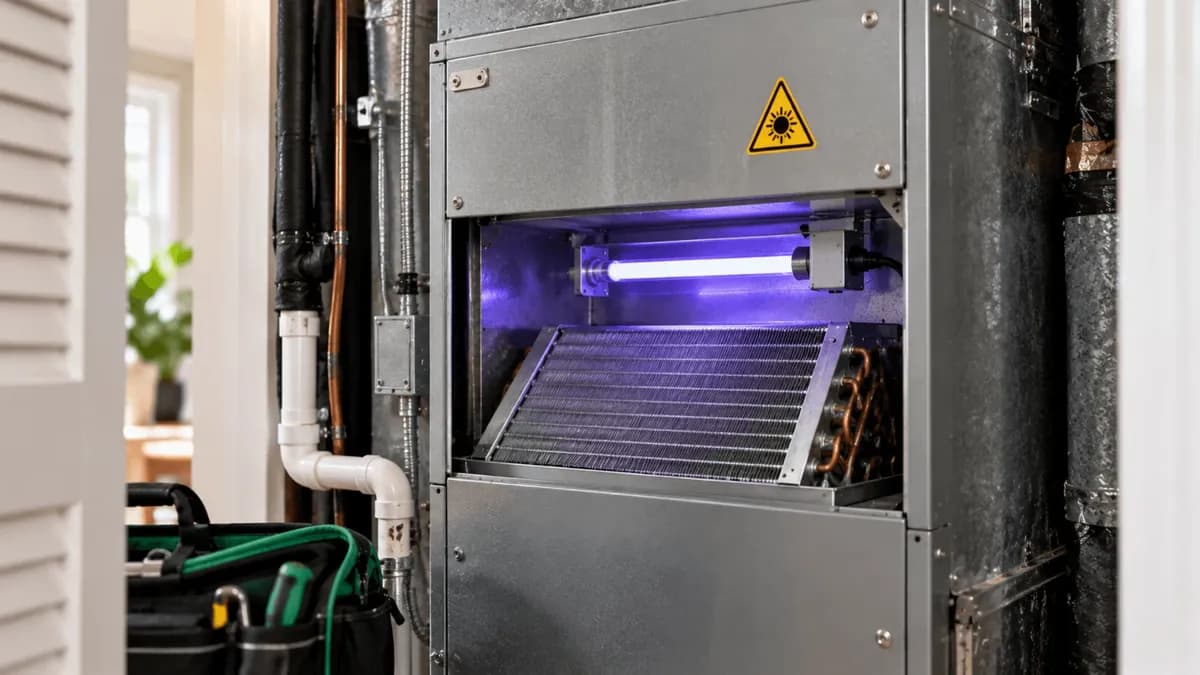
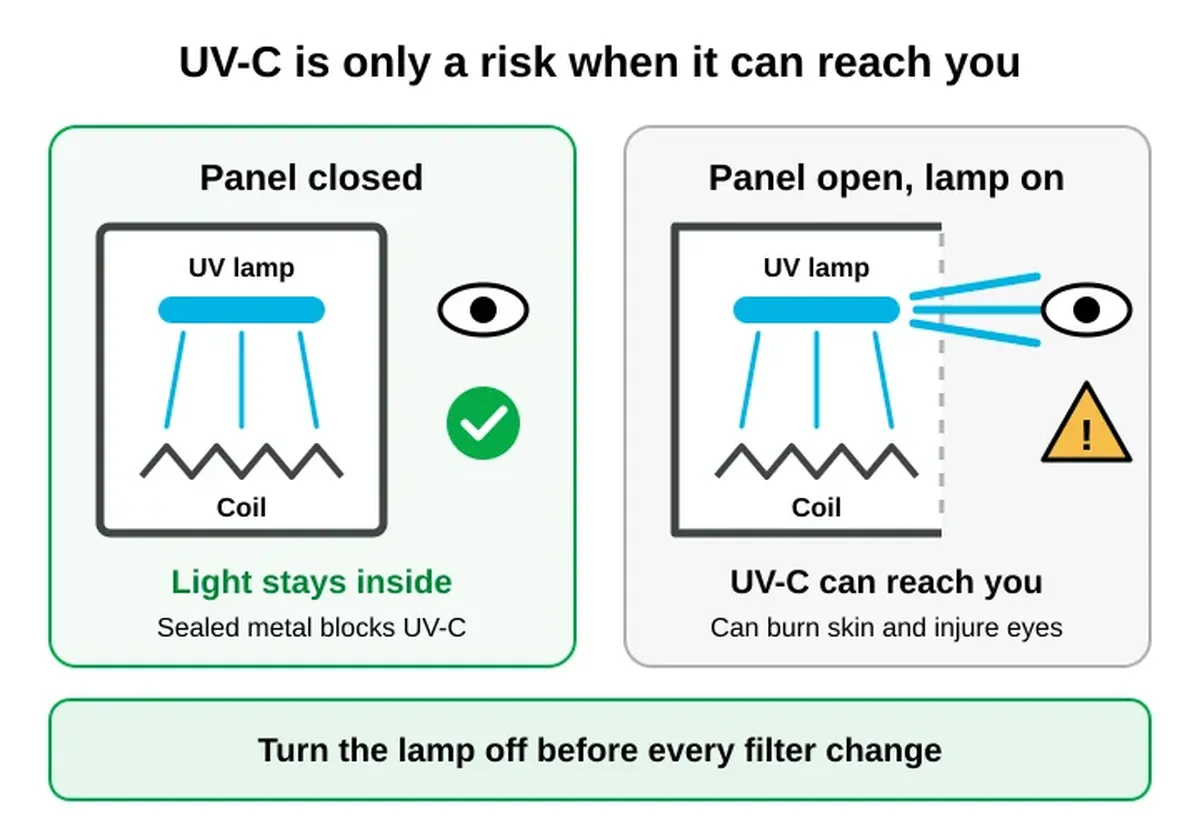
HVAC UV lights are safe when installed correctly. They're only dangerous when you can see them. Their UV-C light can burn skin and injure the surface of the eye, so the lamp belongs sealed inside the metal cabinet or ductwork. The riskiest moment is a filter change, so switch the lamp off before any panel comes off.
A UV light doesn't capture dust or pollen. That's still your air filter's job. Take the quick quiz below to find the MERV rating that fits your home.
Which MERV rating fits your home?
Answer a few quick questions and we'll match you to the right filter.
Shop Air FiltersHVAC UV lights are safe when installed correctly and dangerous to eyes and skin only when you can see them. Their UV-C light can burn skin and injure the surface of the eye, which is why every coil-mounted or in-duct lamp belongs sealed inside metal that blocks it. At Filterbuy, we make the air filters that often sit in the same cabinet as these lamps, and our HVAC service brand, Filterbuy HVAC Solutions, installs UV lights in Florida homes.
TL;DR
Brief, direct UV-C exposure from an HVAC lamp can cause painful eye injuries and skin burns. That risk exists only when the lamp is visible, most often when a panel comes off while the lamp is still running. A sealed, ozone-free unit installed by a licensed technician, and switched off before anyone opens the cabinet, keeps the light where it belongs.
Key Takeaways
UV-C from germicidal HVAC lamps can cause skin burns and photokeratitis, a sunburn-like injury to the cornea.
At 50 µW/cm², UV-C reaches the NIOSH daily exposure limit in about 2 minutes.
Ozone comes from lamps that emit 185 nm light, so choose lamps labeled ozone-free and validated to UL 2998.
A UV light is an optional AC add-on that does not capture dust or pollen. That remains the air filter's job.
How Can A UV Light In Your HVAC System Hurt You?
UV-C from an HVAC lamp can hurt you only if the light reaches you directly. Ozone is a separate risk, covered below. HVAC germicidal lamps emit UV-C, mostly at 254 nanometers, and the U.S. Food and Drug Administration states that UVC radiation can cause severe burns of the skin and eye injuries known as photokeratitis. Your eyes are the most vulnerable target, partly because you feel nothing while the cornea absorbs the dose.
Photokeratitis is a temporary but painful injury to the eye's outer layer. In one case report on germicidal lamp exposure archived by the CDC, office workers near an unshielded lamp developed gritty, sand-like eye pain and peeling facial skin. NIOSH recommends that daily exposure to 254 nm UV-C stay below 6,000 microjoules per square centimeter (µJ/cm²) on unprotected eyes or skin.
How Fast Does UV-C Reach The Daily Limit?
Filterbuy turned the NIOSH limit into a clock: divide 6,000 by the UV-C level in microwatts per square centimeter (µW/cm²) to get the seconds until someone reaches a full day's dose.
Filterbuy calculations from the NIOSH 6,000 µJ/cm² limit. Example levels, not measurements of any HVAC product.
When Does HVAC UV Light Exposure Actually Happen?
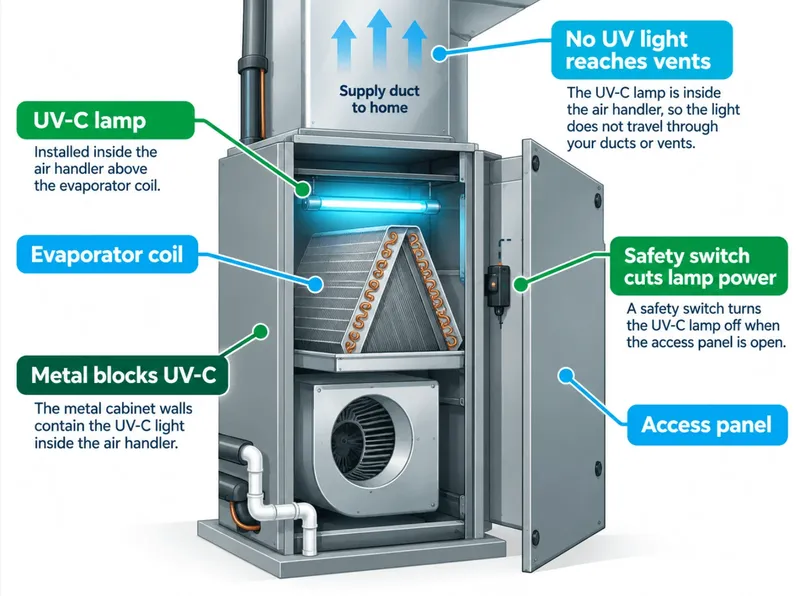
HVAC UV light exposure happens only when UV-C escapes the equipment. The air handler cabinet and sheet metal ductwork block UV-C, so a properly installed lamp shining on the evaporator coil cannot reach anyone in the home. Trouble starts when someone opens the cabinet while the lamp is on or peeks at the bulb to see if it works. A lamp mounted where light can leak through gaps or grilles creates the same risk.
As a filter maker, Filterbuy sees the riskiest moment as the most routine one: the filter change. It is the one job that puts a homeowner's hands and eyes inside the equipment, often in the same cabinet as the lamp.
What Safety Rules Apply To HVAC UV Lights?
HVAC UV lights are governed by equipment safety standards and ozone limits. On the equipment side, the ASHRAE Handbook chapter on ultraviolet lamp systems states that every intentional access point to a UV source must have an interlock that de-energizes the lamp when opened. That requirement comes from UL 1995, the long-standing safety standard for heating and cooling equipment. Newer equipment may instead carry a listing under UL 60335-2-40, the standard that replaced it.
The Global Lighting Association's UV-C safety guidelines for germicidal devices call for an automatic shut-off switch on any closed UV-C enclosure that an ordinary person can open without tools.
For ozone, California has required electronic in-duct air cleaning devices to be certified by the California Air Resources Board since October 2020, with emissions capped at 0.050 parts per million. Outside California, look for a UL 2998 zero-ozone validation on the lamp instead.
Does An HVAC UV Light Produce Ozone?
Whether an HVAC UV light produces ozone depends on the wavelengths its lamp gives off. A standard low-pressure mercury lamp emits a strong line at 254 nanometers, which does not create ozone, along with a weaker line at 185 nanometers, which splits oxygen molecules and forms it. Ozone-free lamps use treated quartz glass that blocks the 185 nm line, and Filterbuy's guide to what UV-C light is and why 254 nm matters walks through the physics.
Lamp wavelength matters because ozone is a regulated air pollutant, and a lamp that produces it sends it through every room your ducts serve.
What Else Can UV-C Damage Inside An HVAC System?
Over time, UV-C also breaks down plastics, rubber gaskets, wire insulation, and tape inside an air handler, and the same ASHRAE chapter warns that for certain filter media and insulation or gasket foams, degradation can be rapid and severe.
Lamp position matters as much as lamp choice, so a lamp aimed at the coil should not also flood nearby plastic parts or wiring.
How Can You Check That Your HVAC UV Light Is Installed Safely?
Filterbuy built this six-step check around the four exposure pathways above, and none of the steps require looking at the lamp.
Look for escaping light. With the system running and the room dim, check the return grilles and the seams of the air handler cabinet. A blue or violet glow means UV light is getting out, so have a technician reposition or reseal the lamp.
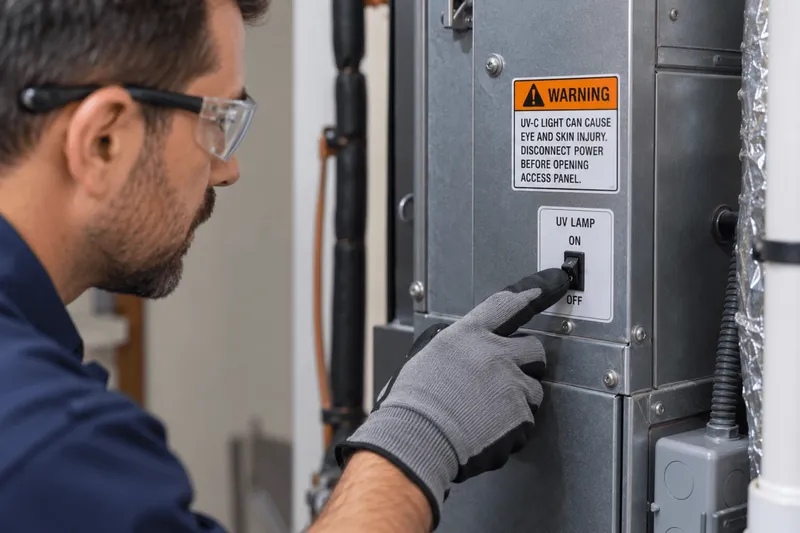
Find the shutoff. Ask your technician to show you the lamp's power switch and whether the access panel has a safety switch that cuts power when removed.
Read the labels. You should see a UV warning label on the access panel and a testing laboratory listing mark on the unit. The lamp documentation should also say ozone-free or UL 2998.
Switch it off before filter changes. If the lamp shares a cabinet with your air filter, turn the lamp off before every routine HVAC filter change, even if the unit has a safety switch.
Check lamp age. UV-C output fades well before the bulb stops glowing, so replace the lamp on the manufacturer's schedule.
Call a licensed HVAC technician if a lamp cracks or the unit has no shutoff switch.
Are UV Lights Necessary For AC Units?
No. A UV light is not necessary for an AC unit to run safely or efficiently. Filterbuy sees it as a coil-maintenance tool rather than an air cleaner: an optional add-on that targets microbial growth on the evaporator coil and, less reliably, in moving air. The EPA's guidance on UV lamps and mold is similarly cautious, noting that "typical UVGI cleaners used in homes have limited effectiveness in killing bacteria and molds."
A coil lamp makes the most sense in a humid climate where a technician has already found growth on the coil. If airborne spores are the bigger worry, see whether an air filter can help with mold. Before buying one, read how UV lights work in HVAC systems and what the evidence shows on whether UV lights work in air ducts.
Even though Filterbuy HVAC Solutions installs UV lights, we still recommend starting with the filter. A UV lamp does not capture particles, so dust, pollen, pet dander, and smoke particles pass it unchanged. The filter remains the main particle control, and Filterbuy's MERV 13 air filters capture a larger share of fine particles than MERV 8 or MERV 11 filters. Check your HVAC equipment manual or ask a technician to confirm your system can handle a higher MERV rating before you upgrade.
Expert Insight From The Filterbuy Team
"A UV lamp should never be something you can see. If light reaches a grille or the lamp runs while the panel is off, the installation needs work. Turn the lamp off before every filter change, and let the filter do the particle work."
Michelle Wan, Brand Manager and Air Quality Writer, Filterbuy
Supporting Statistics
The 8-hour UV-C limit averages out to just 0.2 microwatts per square centimeter.
The ACGIH limit for 254 nm UV-C is 6.0 mJ/cm² over eight hours.
UV-C is absorbed in the outermost layers of skin.
Source: U.S. Department of Energy workshop presentation on UVGI safety
California caps air cleaner ozone at 0.050 ppm.
That cap sits below the 0.070 ppm federal standard for outdoor air.
People spend 87% of their time in enclosed buildings.
The survey covered 9,386 U.S. respondents.
So any ozone from an in-duct lamp reaches people indoors.
Frequently Asked Questions
Can You Look At An HVAC UV Light?
No. Never look directly at a lit HVAC UV lamp, even for a moment. UV-C can injure the cornea within seconds to minutes, and the pain often does not start until hours later. Check it with the unit's indicator light or a UV-C test card instead.
Is It Safe To Sleep With An HVAC UV Light Running?
Yes, as long as the lamp is installed correctly. The surrounding metal blocks UV-C before it can reach a bedroom, and coil lamps are designed to run around the clock.
Is UV Light Eye Damage From An HVAC Lamp Permanent?
Usually not. Photokeratitis from brief UV-C exposure is typically temporary. The American Academy of Ophthalmology's EyeWiki entry on photokeratitis notes that symptoms appear 30 minutes to 12 hours after exposure and that the corneal surface usually heals within 24 to 72 hours. Anyone with eye pain after exposure should still see an eye care professional.
How Often Should An HVAC UV Bulb Be Replaced?
Follow the lamp manufacturer's replacement schedule. UV-C output drops before the bulb stops glowing, so a lit bulb is no proof it still works.
Glossary
UV-C: The shortest-wavelength ultraviolet band, 100 to 280 nm.
Germicidal Lamp (UVGI): A UV-C lamp, usually 254 nm, that damages microbial DNA.
Photokeratitis: A temporary, painful UV injury to the cornea.
ACGIH: The American Conference of Governmental Industrial Hygienists, which publishes workplace exposure limits.
NIOSH: The National Institute for Occupational Safety and Health, a federal research agency.
Ozone: A reactive gas formed when 185 nm UV light splits oxygen molecules.
UL 2998: A UL standard that validates zero-ozone claims for air-cleaning devices.
ASHRAE: The American Society of Heating, Refrigerating and Air-Conditioning Engineers, which publishes HVAC standards.
Safety Switch (Interlock): A switch that cuts UV lamp power when an access panel is removed.
MERV: Minimum Efficiency Reporting Value, the ASHRAE 52.2 rating of an air filter's particle capture.