
What Temperature Should You Leave the House for Your Dog or Cat?
November 10, 2026
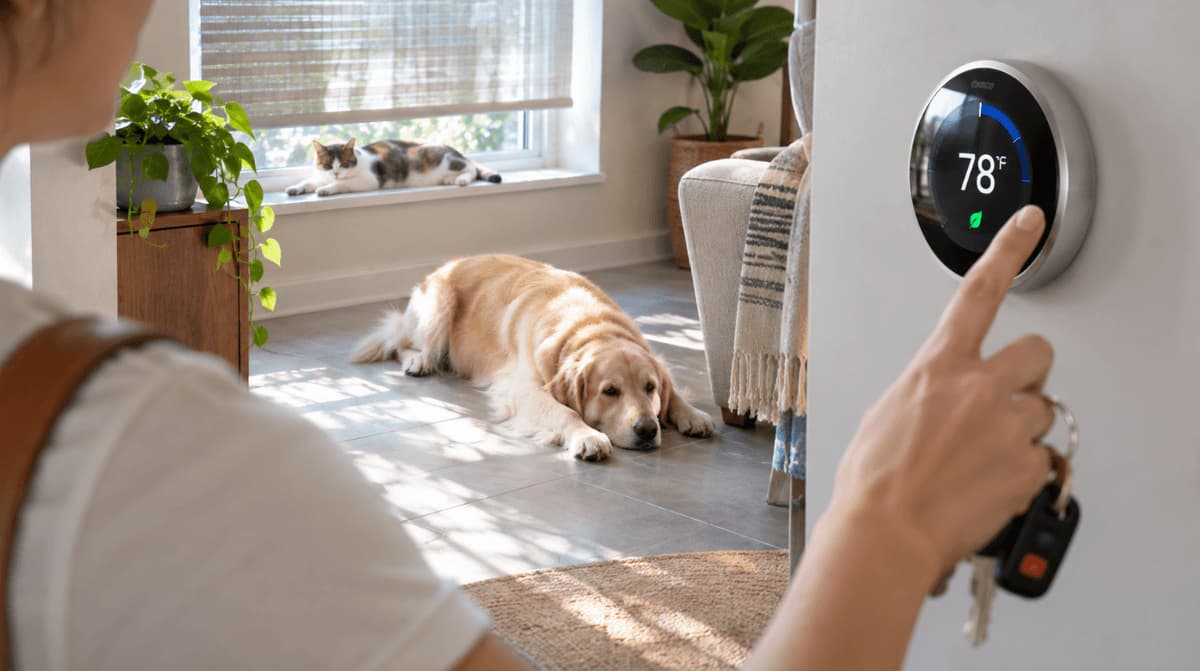
Set your thermostat to 75–78°F in summer and 64–68°F in winter when your dog or cat is home alone. Never let the house rise above 80°F or drop below 60°F.
Flat-faced, thick-coated, senior, young, and overweight pets need a cooler summer setting, closer to 72–75°F. Your AC needs steady airflow to hold that number, so take the quick quiz below to match your home to the right filter.
Your Pet-Safe Thermostat Range
Healthy adult dogs and cats, home alone
☀ Summer, Away
75–78°F
❄ Winter, Away
64–68°F
Have more than one pet? Set it for the one that handles heat the worst.
Find Your Filter Match
Answer a few quick questions and we’ll match you to the right filter for your home and pets.
Already know your size? Shop Filterbuy air filters.
TL;DR
When you leave a healthy adult dog or cat home in summer, set the thermostat between 75°F and 78°F and never let the house go above 80°F. In winter, aim for 64–68°F and don’t let it drop under 60°F. Flat-faced breeds, thick-coated dogs, seniors, very young pets, and overweight pets do better with a cooler, tighter range. After more than a decade of building air filters, we’ve learned at Filterbuy that the right number is only half the job; your HVAC system still has to hold it.
Key Takeaways
Summer away setting: Most healthy adult dogs and cats are comfortable at 75–78°F, and 80°F should be the absolute limit.
Winter away setting: Most pets do well at 64–68°F, while small, short-haired, hairless, senior, and young pets need 68°F or warmer.
Breed matters: In a study of more than 900,000 dogs, flat-faced (brachycephalic) breeds had about twice the odds of heat-related illness.
Standard energy-saving advice isn’t built for pets: A typical 10°F summer setback from 78°F leaves the house at 88°F, which is too hot for a pet home alone.
Humidity counts: Humid air slows the panting pets use to cool off, so keep indoor humidity at 30–50%.
Watch for hidden overrides: Some utility programs raise smart thermostats 2–4°F on hot afternoons.
What Is the Best Thermostat Setting for Pets When You’re Away?
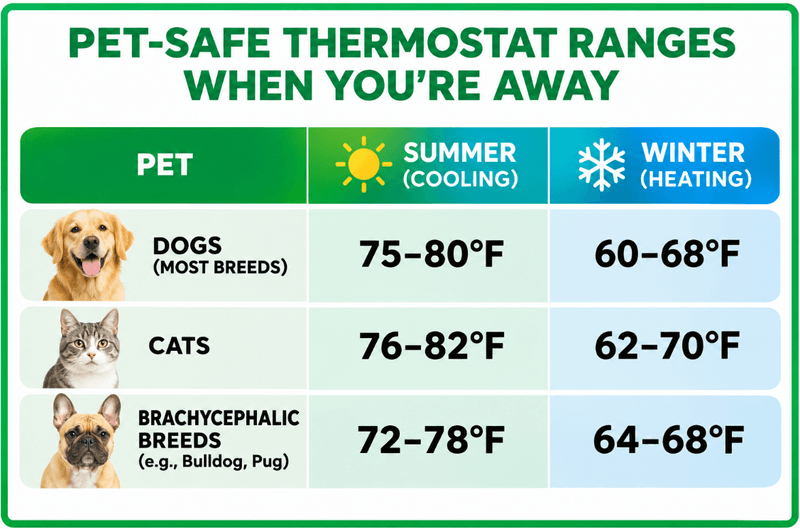
For most healthy adult dogs and cats, the best AC temperature while you’re away is 75–78°F in summer, and the best heat setting is 64–68°F in winter. At Filterbuy, we call the top of the summer range your pet’s Pet-Safe Ceiling: the warmest setting to allow while you’re out, whatever a bigger setback might save. If you have more than one pet, set it for whichever one handles heat the worst.
According to the American Animal Hospital Association (AAHA), a normal body temperature for dogs and cats is about 100–102.5°F, and heatstroke usually starts above 104°F. Because pets can’t sweat the way people can, they depend on panting and a cool place to lie down.
Filterbuy’s Pet-Safe Ceiling ranges, built from veterinary heat and cold guidance. Ask your veterinarian about a pet with a medical condition.
What Indoor Temperature Is Too Hot for Dogs and Cats?
Once the house climbs above 80°F, it’s too hot to leave most dogs alone, and most cats start to struggle above 82°F. The margin is smaller than many owners expect: Texas A&M’s College of Veterinary Medicine notes that heat stress can begin when a pet’s body temperature rises just two degrees above normal.
Breed makes the biggest difference. When researchers at the Royal Veterinary College and Nottingham Trent University reviewed the records of more than 900,000 UK dogs, their study found that these breeds faced the highest heatstroke risk compared with Labrador retrievers:
Dogs heavier than their breed average or older than two also faced higher risk, and flat-faced cats such as Persians share a similar airway problem.
Can You Leave Pets Home with the AC Off?
In hot weather, no. Leaving pets home with the AC off is unsafe in most U.S. climates, where a closed-up house holds heat through the afternoon and your pet can’t open a window or move somewhere cooler. Raise the setpoint a few degrees and leave the system running instead.
This is where standard energy-saving advice can work against pet owners. The U.S. Department of Energy says you can save up to 10% a year by turning the thermostat back 7–10°F for eight hours a day, but in summer that takes a 78°F home to 85–88°F. With a pet at home, stop the setback at your pet’s Pet-Safe Ceiling instead.
What Can Push Your Home Past a Safe Temperature While You’re Gone?
Even a well-chosen setting can be undone by something you don’t see.
Utility peak-demand events. Many utilities offer bill credits for nudging smart thermostats up on hot afternoons. The City of Mesa, Arizona, for example, adjusts enrolled thermostats for up to four hours between noon and 9 p.m., and the Lansing, Michigan, Board of Water & Light describes typical increases of 2–4°F. If your setting already sits at your pet’s ceiling, an event will push the house past it, so opt out in your thermostat app on days your pet is alone.
A thermostat in the wrong place. Your thermostat reads the temperature in one spot, usually a shaded hallway, while a crate in a sunny bedroom can run several degrees warmer. Keep your pet in a room that matches the reading.
High humidity. Muggy air is harder on a panting pet than dry air at the same temperature, so if indoor humidity rises above 50%, move to the low end of your pet’s range.
Why Does Your Air Filter Matter for Pet Safety?
Your thermostat only tells the AC what temperature to aim for. To actually get there, the system has to move enough air, and all of that air passes through your filter. Dander and hair clog filters faster in pet homes, restricting airflow on the hot afternoons when your pet needs cooling most.
“We’ve built air filters in the U.S. since 2013, and the lesson we keep coming back to is that comfort depends on airflow. In a pet home, a filter loaded with dander is easy to overlook and quick to replace.”
– The Filterbuy team
Pro tip from our HVAC reviewer: On a 95-degree day, a clogged filter can keep an AC from reaching its setpoint or even freeze the coil. That risk matters most when a pet is home alone.
How to Set Your Thermostat Before You Leave Your Pet
Before leaving your pet for several hours, run through this list:
Set a permanent hold. “Away” or “eco” modes can raise the temperature when they stop sensing motion, so lock in your Pet-Safe Ceiling.
Put a Wi-Fi temperature sensor where your pet sleeps. Have it text you if that room drifts out of range, since the hallway reading can miss a hot spot.
Close the blinds on sun-facing windows.
Leave two water bowls in different rooms in case one gets tipped over.
Give your pet a cool spot and a warm spot, such as a tile floor for summer and a bed away from drafts for winter.
Check your air filter. If it looks gray or matted with hair, swap it before the next hot day.
Plan for a power outage by giving a neighbor or pet sitter a key and your vet’s number.
Skip space heaters in winter. A pet can knock one over or curl up too close, so rely on central heat.
Which Air Filter Is Best for a Home with Pets?
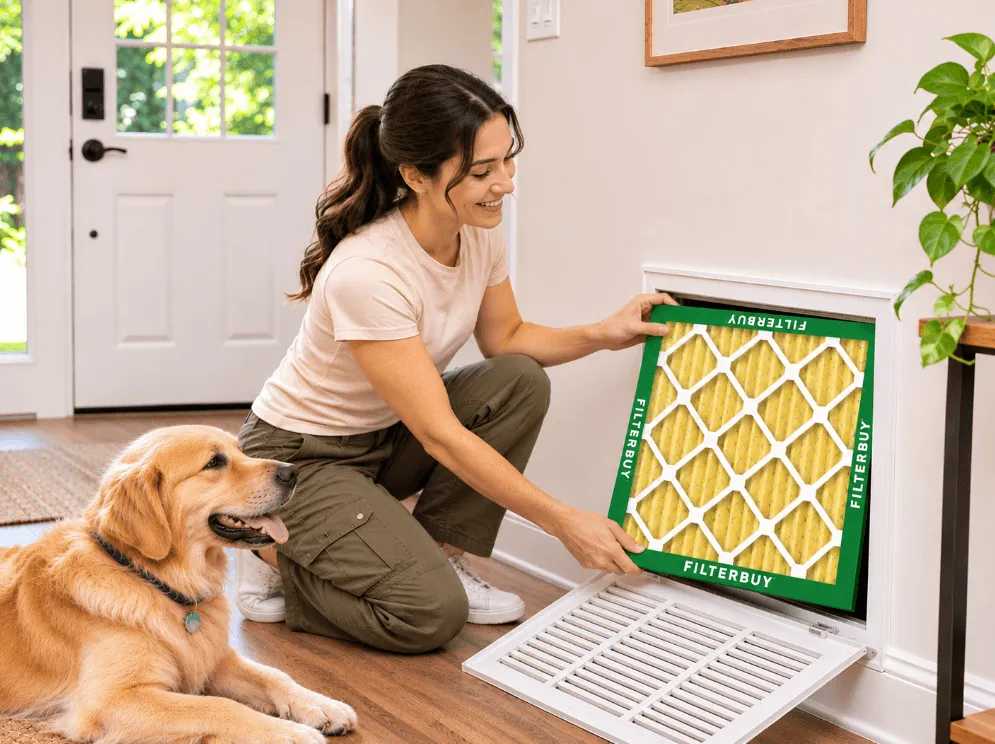
For most homes with pets, we recommend starting with a pleated Filterbuy MERV 11 filter. It captures fine particles like dander while keeping airflow healthy in a standard 1-inch filter slot.
MERV 11: Our pick for most pet homes. It captures at least 65% of particles from 1 to 3 microns and 85% from 3 to 10 microns, the size range that includes pet dander. Shop MERV 11 air filters.
MERV 13: A good step up for households with allergies or asthma, as long as your system can handle the added resistance.
Filterbuy Odor Eliminator: MERV ratings measure particles rather than smells, so this filter adds an activated carbon layer to handle litter box and “wet dog” odors.
Check your filter monthly and replace it every 60 days, or sooner if you have several pets or a heavy shedder. Filterbuy auto-delivery can ship your exact size on that schedule, and setting your thermostat fan to “circulate” keeps air moving through the filter between cooling cycles. Not sure which rating fits your system? Take our MERV rating quiz or read our guides to the best furnace filters for homes with pets and how to remove pet dander from the air.
Supporting Statistics
These figures from U.S. government and nonprofit sources match what we see at Filterbuy in pet homes.
95 million U.S. households owned at least one pet in 2025. Dogs live in 53% of U.S. households, and 53 million households have a cat, according to the American Pet Products Association (APPA) 2026 State of the Industry Report.
88% of U.S. households use air conditioning, and two-thirds rely on central AC or a central heat pump. These numbers come from the U.S. Energy Information Administration (EIA) 2020 Residential Energy Consumption Survey.
Pet dander can linger in a home for up to six months after a pet is gone. The Asthma and Allergy Foundation of America (AAFA) also notes that forced-air systems can carry pet allergens through the house and recommends a certified allergy-friendly or HEPA-level filter for central HVAC.
Frequently Asked Questions
What temperature should I leave the house for my cat?
75–80°F in summer and 64–68°F in winter suits most adult cats. Kittens, seniors, and hairless breeds need 68°F or warmer in winter.
How cold is too cold to leave a dog or cat home?
Below 60°F. Small, short-haired, senior, and young pets need 68°F or warmer.
Is a fan enough to keep my dog cool without AC?
No. Fans don’t lower room temperature, and dogs cool mainly by panting, so keep the AC on.
What are the signs my pet got too hot while I was gone?
Heavy panting, thick drool, red or pale gums, weakness, vomiting, or confusion, per AAHA. Cool your pet down and call your vet.
How often should I change my air filter if I have pets?
Check it monthly and replace it every 60 days, sooner with several pets.
Glossary
Brachycephalic: A flat-faced skull shape, seen in breeds like Bulldogs and Persian cats, that narrows the airway and makes panting less effective.
Heatstroke: Severe overheating (hyperthermia), usually a body temperature above 104°F in dogs and cats, that needs emergency veterinary care.
Away or eco mode: A smart thermostat setting that widens the temperature range when it senses nobody is home.
Demand response: A utility program that temporarily adjusts enrolled smart thermostats when electricity demand peaks.
Relative humidity: How much moisture the air holds compared with its maximum at that temperature. The EPA recommends 30–50% indoors.
Pet dander: Tiny flakes of skin shed by animals and a common indoor allergen.
MERV rating: Minimum Efficiency Reporting Value, a 1–16 scale for how well a filter captures airborne particles. Filterbuy makes MERV 8, 11, and 13 filters.
Pet-Safe Ceiling: Filterbuy’s term for the warmest summer away setting for a given pet profile, used to cap energy-saving setbacks.
Activated carbon: A porous filter material that traps odor molecules, used in Filterbuy Odor Eliminator filters.
Sources
Texas A&M Veterinary Medicine: Protecting Pets From Heat Stress
U.S. EIA: Nearly 90% of U.S. households used air conditioning in 2020
U.S. Department of Energy: Programmable Thermostats
Nottingham Trent University and Royal Veterinary College: Flat-faced dogs at greatest heatstroke risk (2020)
City of Mesa, AZ: Electric Smart Peaks Program