What Is SEER 17? Understanding Energy Efficiency Ratings
July 14, 2026
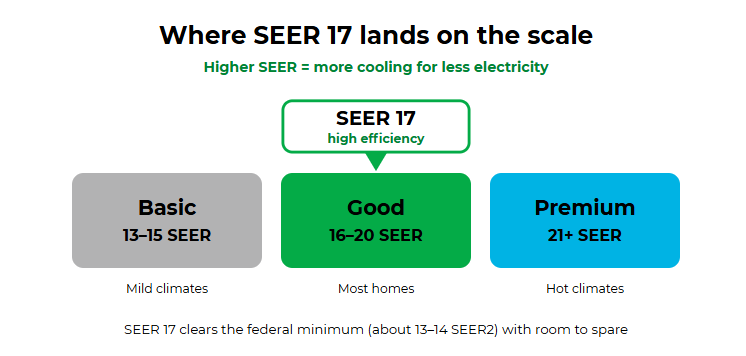
SEER 17 is a high-efficiency rating that sits in the sweet spot between basic and premium mini splits. SEER (Seasonal Energy Efficiency Ratio) measures how much cooling a system delivers for the electricity it uses over a full season, so a higher number means more cooling for less power. On the mini split scale, SEER 17 lands well above the federal minimum without the price jump of ultra-premium models.
Here is where the common ratings fall:
Basic (13–15 SEER): mild climates and budget installs
Good (16–20 SEER): most homes — where SEER 17 sits
Premium (21+ SEER): hot climates and maximum efficiency
Not sure which rating fits your space? Take the quick match quiz below.
Answer 3 quick questions and we will match you to the right mini split.
Ready to browse SEER 17 systems by size?

Shopping for a mini split system can feel overwhelming, especially when you're trying to decode efficiency ratings. You've probably seen numbers like SEER 14, SEER 17, and SEER 20+ plastered across product pages. But what do they actually mean for your home and your wallet?
SEER stands for Seasonal Energy Efficiency Ratio. Think of it as the miles-per-gallon rating for your air conditioner. It measures how efficiently a cooling system operates over an entire cooling season, not just on one perfect day in a testing lab.
The formula is straightforward: SEER = Total Cooling Output (BTUs) ÷ Total Electricity Used (Watt-Hours)
Higher SEER means more cooling for less electricity, which translates to lower utility bills. Mini splits typically range from 13 to 30+ SEER, with SEER 17 landing firmly in the high-efficiency category.
Key Takeaways:
SEER measures cooling efficiency over a full season
SEER 17 is considered high efficiency under current standards
SEER2 is the updated testing standard introduced in 2023
SEER 17 systems balance strong savings with reasonable upfront cost
Filterbuy's SEER 17 mini splits are ideal for homeowners wanting efficiency without overspending
What Does SEER Mean?
SEER is the Seasonal Energy Efficiency Ratio, a measurement created by the U.S. Department of Energy to help consumers compare cooling systems. The rating reflects how much cooling a system delivers per unit of electricity consumed during a typical cooling season.
A higher SEER number means better efficiency. A SEER 17 system uses significantly less electricity than a SEER 13 system to produce the same amount of cooling. This matters because cooling costs make up a substantial portion of home energy bills during warmer months.
Ductless mini splits often achieve higher SEER ratings than traditional central air systems. The reason? They avoid duct losses, which can waste up to 30% of energy in conventional ducted systems. By delivering conditioned air directly into the space, mini splits operate more efficiently from the start.
Here's how different SEER levels compare:
| Rating Level | SEER | Best For |
|---|---|---|
| Basic | 13–15 | Mild climates, budget installs |
| Good | 16–20 | Most homes |
| Premium | 21+ | Hot climates, maximum efficiency |
SEER 17 sits comfortably in the "Good to High Efficiency" category, offering substantial energy savings without the premium price tag of ultra-high-efficiency models.
What Is SEER2 and Why Does It Matter?
If you've been researching mini splits recently, you may have noticed a new term: SEER2. This updated efficiency standard became official in 2023, replacing the older SEER measurement.
SEER2 testing is 4–7% stricter than the original SEER standard. The new testing conditions more accurately reflect real-world operating scenarios, including external static pressure and different airflow rates. This means a 16 SEER system under the old standard roughly equals a 14–15 SEER2 system under the new one.
Federal minimum efficiency standards now range from roughly 13.4 to 14.3 SEER2, depending on your region. A SEER2 17 rating meets modern performance expectations and may qualify for rebates or incentives in certain areas.
When shopping for a mini split today, look at SEER2 ratings for accurate comparisons. This ensures you're comparing apples to apples across different brands and models.
Is SEER 17 Considered High Efficiency?
Absolutely. SEER 17 exceeds minimum federal standards by a significant margin.
Here's the efficiency breakdown:
SEER 13–14: Minimum standard
SEER 15–16: Mid-tier
SEER 17+: High efficiency
A SEER 17 mini split delivers strong energy savings, modern inverter technology, balanced upfront investment, and long-term performance value. It's not entry-level, but it's also not priced at ultra-premium levels.
At Filterbuy, we focus on practical efficiency tiers that deliver long-term value without unnecessary cost inflation. SEER 17 represents that smart middle ground—efficient enough to make a real difference in your energy bills, but affordable enough to make sense for most homeowners.
SEER 17 vs Lower Ratings (Real-World Comparison)
Understanding efficiency ratings becomes clearer when you see how SEER 17 stacks up against other common ratings.
Compared to SEER 13:
Roughly 20–30% improvement in efficiency
Lower seasonal cooling costs
Better temperature consistency
Compared to SEER 14:
Noticeable monthly savings on electricity bills
Better comfort control throughout the day
More advanced inverter technology
Compared to Older 10 SEER Systems:
Major energy reduction (up to 40% improvement)
Dramatically lower utility bills
Modern features like variable-speed operation
It's worth noting that 22+ SEER units can save up to 65% versus very low-end systems, but the payback period often extends to 3–5 years or longer. For most homeowners, SEER 17 offers the best balance between upfront cost and long-term savings.
How SEER 17 Works with Variable Speed (Inverter) Technology
SEER ratings measure seasonal efficiency, but the technology inside the system determines how that efficiency is achieved. Modern SEER 17 mini splits use inverter compressors, which fundamentally change how the system operates.
Traditional air conditioners work like a light switch—they're either on at full blast or completely off. This constant cycling wastes energy and creates temperature swings. Inverter technology works more like a dimmer switch, adjusting compressor speed to match your cooling needs precisely.
Benefits of inverter-driven SEER 17 systems:
Less energy spikes and lower electricity consumption
More consistent temperature (no hot and cold cycles)
Quieter operation at lower speeds
Reduced wear and tear on components
Longer system lifespan
Filterbuy's SEER 17 mini splits all feature inverter-driven compressors, ensuring you get both the rated efficiency and the comfort benefits that come with variable-speed operation.
Does SEER 17 Save You Money?
The short answer is yes, but the exact savings depend on several factors.
A SEER 17 system reduces your energy consumption compared to lower-rated units. This translates to lower monthly electricity bills during cooling season. The system also puts less strain on its components, which can extend its lifespan and reduce repair costs over time.
Many utility companies and local governments offer rebates for high-efficiency systems. Depending on where you live, a SEER 17 mini split may qualify for incentives that offset part of the purchase price.
However, it's important to set realistic expectations. Energy savings vary based on climate, usage patterns, home insulation, and local electricity rates. A well-insulated home in a moderate climate will see different results than a poorly insulated home in a hot region.
The key takeaway? SEER 17 provides meaningful savings without requiring you to invest in the highest-priced system on the market.
Is SEER 17 Right for Your Space?
SEER 17 mini splits work well in a variety of applications. They're particularly ideal for:
Single-room upgrades in existing homes
Garage workshops and studios
Home additions without ductwork
Sunrooms and enclosed porches
Older homes that can't accommodate ducts
Home offices requiring consistent temperature control
Energy-conscious homeowners balancing efficiency and cost
Choosing the right capacity matters as much as the SEER rating. Here's a general guide:
12,000 BTU: 450–650 sq ft
18,000 BTU: 700–1,000 sq ft
24,000 BTU: 1,000–1,500 sq ft
Filterbuy offers SEER 17 systems across these capacities, making it easy to find the right size for your space without sacrificing efficiency.
SEER 17 + R32 Refrigerant: Modern Efficiency
Efficiency isn't just about electricity consumption. The refrigerant used in your mini split also plays a role in both performance and environmental impact.
Many SEER 17 mini splits now use R32 refrigerant, which offers several advantages over older refrigerants like R410A:
Lower global warming potential (GWP): R32 has roughly one-third the GWP of R410A
Better heat transfer efficiency: R32 moves heat more effectively, improving system performance
Future-forward compliance: R32 meets evolving environmental standards
By choosing a SEER 17 system with R32 refrigerant, you're investing in technology that's both energy-efficient and environmentally responsible.
Why SEER 17 Is a Smart Efficiency Tier
SEER 17 represents a practical sweet spot in the efficiency spectrum. It exceeds minimum federal standards by a comfortable margin while avoiding the premium pricing of ultra-high-efficiency models.
This efficiency tier delivers strong seasonal performance through inverter technology, balanced investment compared to the long-term savings, and suitability for most U.S. homes and climates.
For homeowners who want meaningful energy savings without overpaying for diminishing returns, SEER 17 makes excellent sense. It's efficient enough to reduce your environmental footprint and lower your bills, but practical enough to deliver reasonable payback periods.
Upgrade to High-Efficiency Comfort
Ready to experience the benefits of SEER 17 efficiency? Explore Filterbuy's SEER 17 Mini Split Systems:
12K BTU: Perfect for bedrooms, offices, and small spaces
18K BTU: Ideal for living rooms and medium-sized areas
24K BTU: Great for larger rooms and open-concept spaces
Find the right size for your space and start saving on energy without overpaying for unnecessary ultra-premium ratings.
Frequently Asked Questions
What does SEER 17 mean?
SEER 17 means the system produces 17 BTUs of cooling for every watt-hour of electricity used over a cooling season. This measurement accounts for varying outdoor temperatures and usage patterns throughout the season.
Is SEER 17 good for a mini split?
Yes. SEER 17 is considered high efficiency under modern standards and offers strong energy savings without premium pricing. It's an excellent choice for homeowners who want both performance and value.
What is the difference between SEER and SEER2?
SEER2 uses updated testing standards introduced in 2023 and is 4–7% stricter than older SEER measurements. SEER2 provides a more accurate representation of real-world efficiency.
Is SEER 17 better than SEER 14?
Yes. SEER 17 systems are significantly more efficient and can reduce cooling costs compared to SEER 14 units. The difference becomes more noticeable in hot climates with longer cooling seasons.
How much can I save with SEER 17?
Savings depend on climate, usage, and electricity rates, but upgrading from older 10–13 SEER systems can result in meaningful reductions in energy use. Most homeowners see lower monthly bills during cooling season.
Does SEER 17 qualify for tax credits?
Eligibility depends on SEER2 ratings and current federal or state incentive programs. Check with your local utility company and review IRS guidelines for the most current information on available rebates and credits.