
Adding a Mini Split AC System in Maryland
Costs, Rebates & What Actually Qualifies in 2026
By Michelle Wan, Brand Manager and air quality writer at Filterbuy, where she turns MERV ratings, filtration, and HVAC efficiency into plain-English advice and fronts much of the brand's educational video content. B.A., University of California, Santa Cruz.
Reviewed by David Clark, Licensed HVAC Technician. Published June 25, 2026 · Updated June 25, 2026
Adding a ductless mini split in Maryland typically costs $3,000–$6,000 for a single room or $6,000–$13,000 for a multi-zone system, before rebates. The federal tax credit ended December 31, 2025, but Maryland's EmPOWER rebates still apply in 2026 — roughly $800–$1,700 per heat pump taken off the price instantly, or up to $15,000 through a whole-home energy audit.
Most ductless mini splits qualify, because a mini split is a type of air-source heat pump. Take the quick match quiz below to find the right mini split for your space, or browse Filterbuy's mini split systems.

Answer a few quick questions and we'll match you to the right mini split system.
Quick answer. Adding a ductless mini split in Maryland usually runs about $3,000–$6,000 for a single zone and $6,000–$13,000 for a multi-zone system, before incentives. The federal tax credit ended December 31, 2025, but Maryland's EmPOWER rebates still apply in 2026: instant utility rebates of roughly $800–$1,700 per heat pump through a participating contractor, or up to $15,000 if you go through a whole-home energy audit.
A ductless mini split is one of the simplest ways to cool (and usually heat) a room that your central system never quite reaches: a bonus bedroom, a finished basement, a sunroom, a garage office. No ductwork, quiet operation, and room-by-room control. The catch is the upfront cost. The good news for Maryland homeowners: the state still has some of the most generous energy rebates in the country, and most ductless mini splits qualify. Here's exactly what it costs, what's changed in 2026, and how to bring that number down.
One quick note before we dig in: this is general guidance, not tax advice. Rebate amounts and deadlines change, so confirm the current details with your utility and a tax professional before you install.
How Much Does It Cost to Add a Mini Split in Maryland?
Most Maryland homeowners spend about $3,000 to $6,000 for a single-zone mini split (one indoor head, one room) and $6,000 to $13,000 for a multi-zone system that conditions several rooms from one outdoor unit. Installation labor, the number of indoor heads, and how far the line set has to run are the biggest cost drivers.
Ranges are typical industry figures and vary with your home and installer.
Do Mini Splits Qualify for Maryland Rebates?
Yes, most ductless mini splits qualify for Maryland's heat-pump rebates, because a ductless mini split is a type of air-source heat pump.
Here's the distinction that trips people up. The rebates are built around heat pumps, systems that both heat and cool. Nearly every mini split sold today is a heat pump, so it qualifies. A rare cooling-only mini split (no heating mode) generally does not earn the big electrification rebates, though it may still be eligible for smaller efficiency incentives. If your goal is “adding AC,” you'll almost always come out ahead choosing a heat-pump mini split: same cooling, plus efficient heating, plus access to the larger rebates.
Qualifies for the larger rebates: ENERGY STAR–certified ductless mini-split heat pumps installed by a participating contractor.
Usually does not: cooling-only ductless units, DIY installs, and equipment below the program's efficiency thresholds.
Wait, Isn't There a Federal Tax Credit?
Not anymore for 2026 installs. The federal Energy Efficient Home Improvement Credit (Section 25C), the one that covered 30% of a heat pump up to $2,000, expired on December 31, 2025. It was ended by the One Big Beautiful Bill Act, signed in July 2025. A mini split installed in 2026 does not qualify for it.
Installed in 2025? You can still claim it. If your system was installed and running by December 31, 2025, you can still claim the 25C credit on your 2025 federal return (Form 5695). “Placed in service” means actually installed and operational. A signed contract or a deposit doesn't count.
A lot of older articles (and some contractor quotes) still promise a federal credit “through 2032.” That timeline came from the Inflation Reduction Act and was cut short in 2025. For the full breakdown, see Filterbuy's guide to the 2025 heat-pump tax credit and the IRS Section 25C page. The upside for Marylanders: the state and utility programs below are very much still running.
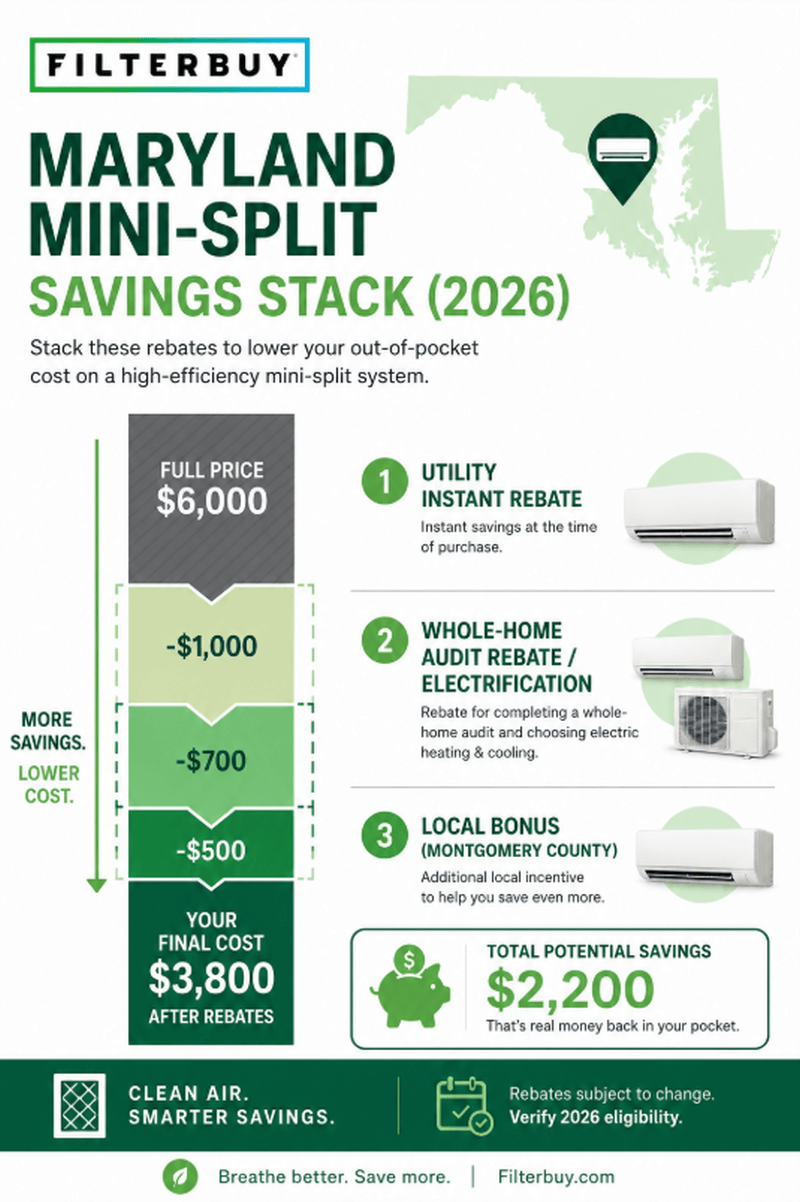
Maryland mini split rebates available in 2026
In 2026, Maryland savings come mostly from EmPOWER Maryland, the statewide efficiency program funded through your utility bill and run by BGE, Pepco, Potomac Edison, Delmarva Power, and SMECO. Most homeowners can stack a utility rebate with their utility's whole-home program, and some areas add a local bonus on top.
Each utility runs its own portal, so check yours for current numbers (for example, Pepco's HVAC Efficiency Program). The newer federally funded IRA rebates (HEAR and HOMES) are tracked by the Maryland Energy Administration and were not yet open to applications as of early 2026.
Programs are scheduled to run through December 31, 2026, but funding and amounts are reviewed regularly, so confirm before you install.
| Program | What it gives a mini split | Catch / how to access |
|---|---|---|
| EmPOWER instant (midstream) rebate | ~$800–$1,700 per heat pump, taken off the price at install | Must use a participating contractor; no audit needed |
| Home Performance with ENERGY STAR (HPwES) | Up to $15,000 (75% of cost) to replace oil/propane/gas with a heat pump; up to $10,000 for other efficiency upgrades | Requires a $100 home energy audit (normally ~$400); whole-home approach |
| Potomac Edison Switch-to-Electric (Western MD) | Bonus on top of midstream (commonly ~$4,000) | Must decommission a fossil-fuel system |
| Montgomery County Electrify MC | Adds ~$2,500; stacks with Pepco | Montgomery County homeowners |
| MEA / IRA HEAR & HOMES rebates | Income-qualified amounts (e.g., up to $8,000 for a heat pump) when launched | Not accepting applications as of early 2026 |
| BeSMART Home Loan (DHCD) | Low-interest financing up to $30,000 for efficiency upgrades | Credit-score and DTI requirements apply |
Two Ways to Claim: Instant Rebate vs. Whole-Home Audit
Maryland gives you two routes, and the right one depends on whether you're just adding a mini split or doing a bigger comfort upgrade.
Go the Instant (Midstream) Route If…
You mainly want to add cooling/heating to a room or two with a mini split, fast and simple.
You'd rather see the rebate come straight off the price at install with no extra paperwork or audit.
Go the Whole-Home (HPwES) Route If…
You're replacing an oil, propane, or gas system, which unlocks the up-to-$15,000 electrification rebate.
You also want insulation, air sealing, or duct work. The audit bundles them and pays up to 75% of the project.
Rule of thumb: adding a single mini split → instant rebate. Replacing your home's heating with ductless and tightening up the house → the audit pays far more. You generally use one path per project, so pick the one that fits the job.

How to Actually Get the Rebate (Step by Step)
Find your utility. Check the top of your electric bill: BGE, Pepco, Potomac Edison, Delmarva, or SMECO. That determines your program.
Choose a participating contractor. Rebates only pay out through approved installers. Ask up front: “Are you enrolled in EmPOWER / the midstream rebate program?”
Decide your path. Instant rebate for a simple add; book the $100 energy audit first if you want the whole-home rebate.
Confirm the equipment qualifies. ENERGY STAR–certified ductless heat pump that meets the program's efficiency tier. Keep the AHRI certificate and model numbers.
Get pre-approval if required. Whole-home rebates usually need sign-off before installation, so don't install first and ask later.
Install, then file or take the instant discount. Midstream rebates come off the invoice; whole-home rebates are submitted by your contractor and typically processed in 6–8 weeks.
How Much Can You Really Save?
Here's a realistic (illustrative) example for a Maryland homeowner adding a two-zone ductless heat pump to a finished basement and bonus room:
Example only, not a quote. Your savings depend on your utility, county, equipment, and whether you replace a fossil-fuel system.
Don't Forget the Filter That Keeps It Efficient
A mini split cools and heats more efficiently when air moves freely, and that depends on clean filtration. Ductless heads have their own washable filters that need rinsing every few weeks, and if the rest of your home runs on central HVAC, the right replacement filter keeps the whole system breathing easy. A clogged filter makes any system work harder, which quietly raises the energy bills those rebates were meant to lower.
If you're already investing in efficient comfort, it's worth pairing it with good whole-home air quality. You can check your local air quality on our live Maryland AQI map, see which MERV-13 filter fits your system, and set up auto-delivery so a fresh filter shows up right when it's time. No errands, no thinking about it.
Frequently Asked Questions
Adding a mini split is a great way to take charge of the comfort, and the air, in the rooms you use most. Lock in your Maryland rebate while the programs are funded, choose an efficient heat-pump model, and keep it running clean. Start by checking your home's air quality and finding the right filter for the system you've got.