
Air Quality in Maryland
Air quality index (AQI⁺) and PM2.5 air pollution in Maryland •


Get Alerts For Unhealthy AQI In Your Area
When air quality in your area reaches unhealthy levels, we'll send you a quick alert, along with expert tips on how to reduce your exposure.
Live Air Quality Ratings in Maryland
Live Most Polluted City Ranking
Real-time most polluted cities in Maryland
Live Cleanest City Ranking
Real-time cleanest cities in Maryland
The Right Air Filter For High AQI Days
When outdoor air quality drops, the EPA recommends upgrading to a MERV 13 filter — or the highest-rated filter your HVAC system can handle — to help capture more of the fine particulate (PM2.5) that comes with poor air quality. MERV 13 is the highest rating most residential systems can run without restricting airflow.
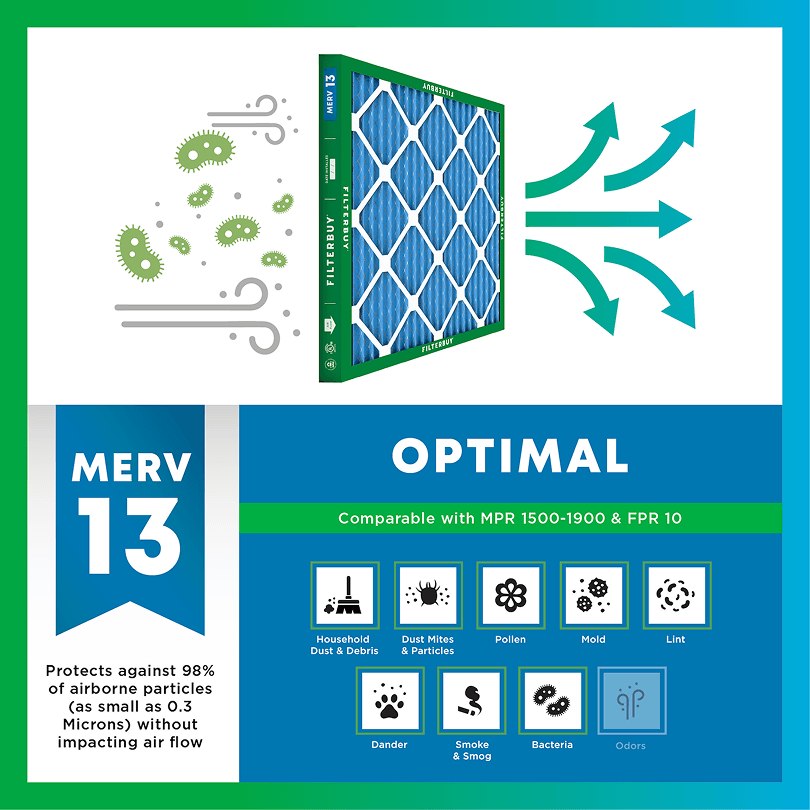

- Captures PM2.5 and other fine particulates
- Filters ash, soot, and smoke particles
- Rated to capture particles as small as 0.3 microns
- Matches the filter rating the EPA suggests during high-AQI and smoke events

AQI FAQs
What is AQI?
AQI stands for Air Quality Index, the EPA's scale for reporting daily air quality. It runs from 0 to 500. The higher the number, the greater the level of air pollution. Values at or below 100 are generally considered satisfactory; values above 100 mean air quality is unhealthy, first for sensitive groups, then for everyone as numbers climb.
What does AQI measure?
The AQI tracks five major pollutants regulated by the Clean Air Act: ground-level ozone, particle pollution (PM2.5 and PM10), carbon monoxide, sulfur dioxide, and nitrogen dioxide. The reported AQI value reflects whichever pollutant is highest at that time — most often ozone or fine particles (PM2.5).
How is AQI calculated?
Monitoring stations measure pollutant concentrations, and the EPA converts each into a standardized 0–500 score using set breakpoints. Each pollutant gets its own sub-index, and the highest sub-index becomes the reported AQI. That's why a single number can represent different pollutants on different days.
What is a good AQI?
An AQI of 0–50 is rated "Good" — air quality poses little or no risk. 51–100 is "Moderate," acceptable for most people though unusually sensitive individuals may want to limit prolonged outdoor exertion. Anything at or below 100 is generally considered satisfactory air quality.
What does an AQI of 100 (or 150) mean?
100 is the dividing line: at or below it, air quality is satisfactory for the general public. From 101–150, air is "Unhealthy for Sensitive Groups" — people with respiratory conditions, older adults, and children. From 151–200, it's "Unhealthy" and everyone may begin to feel effects.
Why is the AQI bad today?
Short-term AQI spikes usually come from wildfire smoke, temperature inversions that trap pollutants near the ground, high-ozone weather (hot, sunny, stagnant days), or heavy traffic and industrial activity. Check a real-time source like the map on this page to see which pollutant is driving today's reading in your area.
What AQI is bad for running or exercise?
Many runners follow the EPA category lines: below 50, no adjustment needed; 51–100, unusually sensitive people may shorten intense workouts; above 100, sensitive groups are advised to reduce prolonged or heavy outdoor exertion; above 150, that advice extends to everyone. Exercise increases how much air you breathe in, which is why thresholds matter more during workouts.
What AQI is safe to open windows?
A common rule of thumb is to keep windows open when the AQI is under 100 and close them when it climbs above, especially during wildfire smoke events when fine particles are elevated. When windows are closed, running your HVAC system with a fresh filter helps capture particles circulating indoors.
Should I wear a mask based on AQI?
Public health agencies generally suggest considering a well-fitted N95-style respirator outdoors when the AQI exceeds 150, particularly during smoke events. Cloth and surgical masks don't filter fine particles effectively. Follow guidance from your local health department, which may adjust recommendations during severe episodes.

Check Today's Live Real Time Air Quality Index AQI Map in Maryland Now
Most Marylanders don't realize how dramatically air quality can swing from one end of the state to the other on the same afternoon. The Padonia monitor in Northern Baltimore can hit Code Orange while Piney Run out in Garrett County stays Green at the very same hour, which means the same state and the same hour can be two completely different days for anyone with asthma. A statewide AQI average can't tell you whether it's safe to take your kid to soccer practice this evening. The live map below pulls real-time readings from every active EPA monitoring station in Maryland, so you can check the air at the address that actually matters to you.
In our work supplying filters to families across Maryland, we've watched the check-the-air habit go mainstream since the 2023 Canadian wildfire smoke turned the Baltimore-Washington corridor dark orange for days. The map is where to start.
TL;DR Quick Answers
What Is the Air Quality in Maryland Today?
Check the live map above for your specific area. Statewide, Maryland's air quality varies by region and by season. Western Maryland (Garrett County) typically posts the cleanest readings, while the Baltimore-Washington corridor and Cecil County see the most Code Orange and Code Red days, especially during the summer ozone season from June through August.
Is the Air Quality Bad in Maryland Today?
“Bad” depends on who you are and what you're doing. Any AQI reading at 101 or above falls into Unhealthy for Sensitive Groups, meaning people with asthma, heart conditions, or chronic lung disease should ease back on outdoor activity. At 151 or above, the recommendation extends to everyone. Check the live map for the current reading at your nearest monitoring station.
What Is Maryland's PM2.5 Level Today?
The live map above shows the current PM2.5 reading at each Maryland monitoring station, measured in micrograms per cubic meter. PM2.5 represents fine particles small enough to lodge deep in the lungs. Sources include vehicle exhaust, power plants, and seasonal wildfire smoke. The EPA's 24-hour PM2.5 standard is 35 micrograms per cubic meter.
Top Takeaways
The live Maryland AQI map above pulls real-time readings from EPA monitoring stations across the state and refreshes on an hourly cadence.
Ground-level ozone is Maryland's biggest air quality issue from late spring through early fall, with the worst days clustering in June, July, and August.
EPA reclassified the Baltimore metro area from Moderate to Serious ozone nonattainment in August 2024, with a federal attainment deadline of August 3, 2027
Five Maryland counties sit inside the Washington DC nonattainment area and share air quality risk with the District and Northern Virginia.
Regional wildfire smoke can push Maryland's AQI into Code Red on otherwise clear days, which makes indoor filtration the second line of defense.
What Drives Maryland's Air Quality
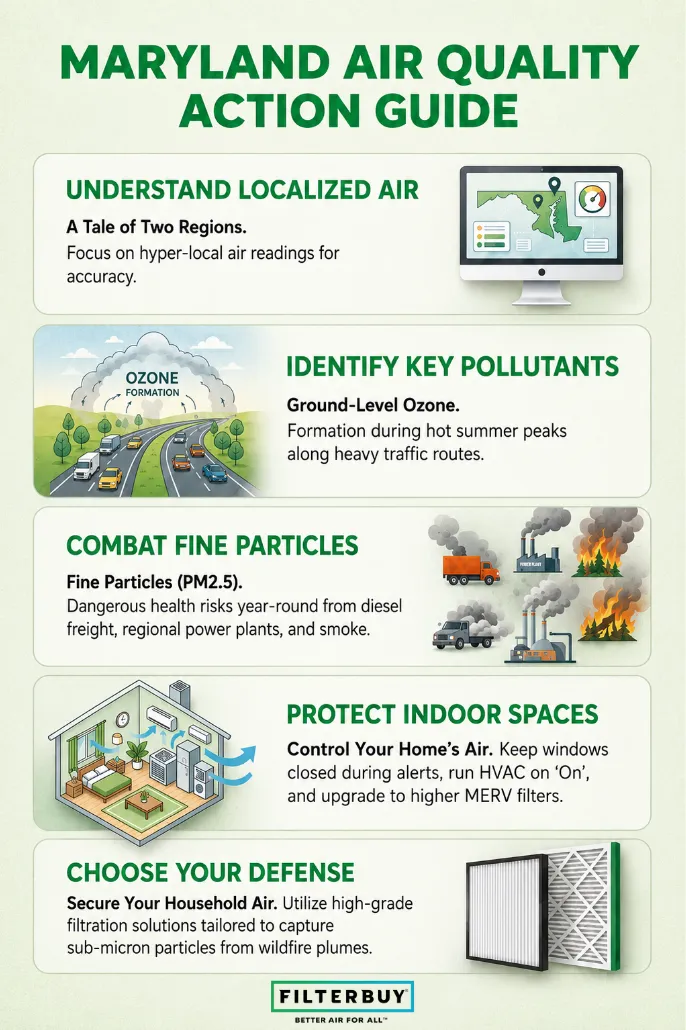
Two pollutants do most of the damage to Maryland's air, and they take turns through the year. Ground-level ozone runs the show from late spring through early fall. Nitrogen oxides from vehicles on I-95, the Beltway, and the Baltimore-Washington Parkway combine with volatile organic compounds in sunlight, and Maryland's hot summer afternoons cook up exactly the conditions ozone needs to form.
Fine particle pollution, or PM2.5, does its worst work the rest of the year, plus during regional wildfire smoke events. The 2023 Canadian wildfires were the breakthrough that put PM2.5 on every Marylander's radar, but the diesel-heavy freight corridor between Baltimore and Washington puts particles in the air year-round. PM2.5 is small enough to lodge deep in the lungs, which is why it hits people with asthma, kids, and older adults hardest.
Outside Maryland's borders, upwind factors make all of this worse. Power plant emissions from Pennsylvania, Ohio, and West Virginia drift east on prevailing winds, and the Maryland Department of the Environment has formally petitioned the Ozone Transport Commission about it. The geography of the Chesapeake Bay and the Eastern Shore also traps humidity, which keeps particulates close to the ground on still summer days.
Garrett County, out near the West Virginia line, has the cleanest air in the state. The counties with the most ozone bad days cluster around the Baltimore and Washington metros: Anne Arundel, Baltimore, Harford, and Prince George's.
How to Read the Map and the AQI Number
The number you see on the map is doing a lot of work, but it isn't telling you the whole story by itself. The color band breaks down like this: green is Good (0 to 50), yellow is Moderate (51 to 100), orange is Unhealthy for Sensitive Groups (101 to 150), red is Unhealthy (151 to 200), purple is Very Unhealthy (201 to 300), and maroon is Hazardous (301 and above). The number itself reflects the highest single reading among the pollutants tracked at the closest station, usually ozone in summer and PM2.5 the rest of the year.
A Code Yellow afternoon is common across Maryland in summer. It isn't an emergency. People with asthma, heart conditions, or chronic lung disease should think about easing back on long outdoor exertion, but most people can go about their day. Code Orange tightens that recommendation for sensitive groups, who should reduce strenuous outdoor activity, and active children and older adults should pay attention to symptoms. By Code Red, the recommendation extends to everyone. Limit outdoor exertion, keep the windows closed, and run the HVAC with a filter rated for fine particles.
For a deeper reference on how the scale was developed and what each pollutant means at each level, the Air Quality Index article is a useful starting point.
The color alone doesn't tell you which pollutant is driving the reading, and that matters more than people think. A Code Orange ozone day calls for different protection than a Code Orange PM2.5 day. Ozone is mostly an outdoor exposure problem, so coming inside and closing windows does a lot of the work. PM2.5 from wildfire smoke infiltrates buildings through normal air leakage, which is where indoor filtration becomes the second line of defense.
What Maryland Residents Can Do When Air Quality Drops
When the map turns orange or red, what happens inside your house matters more than what happens outside it. Outdoor exposure is hard to control if you live in the Baltimore-Washington corridor. The air indoors, however, is yours to manage.
The most useful thing you can do first is check the forecast. The Maryland Department of the Environment publishes a 3-day air quality forecast across ten Maryland regions, which means a Code Orange in Western Maryland doesn't necessarily mean a Code Orange in Cecil County or on the Eastern Shore. Match the forecast to your specific area before you cancel a hike or move a soccer practice indoors.
For the rest of the day, control your home's envelope. Close the windows during Code Orange and above. Run the HVAC fan continuously so air keeps cycling through the filter, even when the system isn't actively heating or cooling. On wildfire smoke days, swap up to a MERV 13 or higher filter, which captures most of the PM2.5 particles small enough to slip inside through normal air leakage. For households running portable purifiers, putting one in the bedroom and one in the room where the family spends most of its waking hours covers most of the exposure.
The longer view also matters. Maryland's ozone season runs April through September every year. If your home has older windows, worn weatherstripping, or any noticeable air leakage, summer is the time to fix it. If your HVAC filter has been in place longer than 90 days, replace it. Households in the Baltimore-Washington corridor, especially those with kids or elderly family members at home, benefit from keeping a higher-MERV filter on hand for the inevitable Code Orange afternoons.
If you want to compare Maryland's readings against the rest of the country, the nationwide live AQI map shows real-time conditions across all fifty states.
After manufacturing filters for over a decade and serving more than two million households, what surprises me about Maryland is how often the air shifts under your feet. Our order data shows it clearly. Filter replacements from the Baltimore-Washington corridor spike two or three days after a Code Red event, when families finally realize the wildfire smoke or ozone surge has been sitting in their HVAC system the whole time.
— Filterbuy Team
Seven Maryland Air Quality Resources Worth Bookmarking
When the map above tells you something you need to act on, these are the official agencies and watchdog organizations we keep in our own browser bookmarks. Each one tracks a different piece of the Maryland air quality picture.
1. Maryland Department of the Environment Air Quality Forecast
MDE's 3-day air quality forecast covers ten Maryland regions, prepared by MDE meteorologists working with the Metropolitan Washington Council of Governments. It's the most localized state-level forecast available.
2. EPA AirNow Maryland Real-Time AQI Map
The federal real-time map showing current AQI readings for every active Maryland monitoring station, with hourly updates and historical data going back years.
3. EPA Ground-Level Ozone Pollution Overview
EPA's explainer on how ozone forms, why it matters for human health, and how the National Ambient Air Quality Standards translate into the AQI categories on the map.
4. CDC Wildfire Smoke and Your Health Guidance
CDC's plain-language guidance for protecting lung health when wildfire smoke pushes regional PM2.5 levels into the orange or red range.
5. American Lung Association State of the Air Report
The annual county-by-county air quality report card, including ozone and particle pollution grades for every monitored Maryland jurisdiction.
6. National Weather Service Baltimore Washington Forecast Office
The local National Weather Service office covering central Maryland weather conditions that drive air quality, including the temperature inversions and stagnant air patterns behind Code Orange days.
7. NIEHS Air Pollution and Your Health Overview
The National Institute of Environmental Health Sciences research summary on long-term and short-term health effects of common air pollutants found in Maryland readings.
Three Numbers That Tell the Maryland Air Quality Story
Three figures from federal records show where Maryland actually sits on air quality.
1. Baltimore Reclassified to Serious Ozone Nonattainment, August 3 2027 Attainment Deadline
On August 1, 2024, EPA approved Maryland's voluntary reclassification of the Baltimore metro area from Moderate to Serious for the 2015 8-hour ozone NAAQS, with an attainment deadline of August 3, 2027.
2. Eleven Maryland Counties Plus Baltimore City Carry Ozone Nonattainment Status
Maryland's ozone nonattainment counties span the Baltimore area (Anne Arundel, Baltimore, Carroll, Harford, Howard, plus Baltimore City), the Washington DC area (Calvert, Charles, Frederick, Montgomery, Prince George's), and Cecil County in the Philadelphia-Wilmington-Atlantic City area.
3. NOAA Tracked Record Mid-Atlantic Wildfire Smoke Transport in 2023
NOAA's Hazard Mapping System Fire and Smoke Product tracked Canadian wildfire smoke transport into the Mid-Atlantic at levels rarely seen before during summer 2023, including events that pushed Maryland AQI readings into Code Red.
Our Take on What Maryland's Air Really Means for Your Family
There's a temptation to talk about “Maryland's air” like it's one thing. It isn't. The air over Annapolis on a humid August afternoon is a different problem than the air over Cumberland in late October. Statewide averages flatten that reality. The map above is useful because it lets you zoom to the actual station nearest your house.
We've spent years putting filters into Maryland homes, and the same observation keeps coming up. The outdoor forecast tells you what to brace for, but the indoor air is the part you actually get to control. When MDE issues a Code Orange or a Code Red, the air your kids are breathing inside the house runs through your HVAC system. Whatever filter is in that system is doing the real work of protecting them.
Where to Go From Here After Checking the Map
If the map above is showing Good or Moderate today, you've got a normal day. Plan outdoor activity like usual, let your HVAC do its background work, and replace the filter on your usual schedule.
If the map shows Unhealthy for Sensitive Groups or worse, the next six hours are when your indoor air choices matter most. Close the windows and set the HVAC fan to run continuously so air keeps cycling through the filter. Then check what's actually in the filter slot right now. For wildfire smoke and heavy PM2.5 events, a MERV 13 or higher filter does meaningful work that a standard MERV 8 simply won't.
Frequently Asked Questions
Protect the One Part of the Air You Fully Control
You can't change today's outdoor reading on the map, but you can change what your family breathes inside the house. When Maryland's air drops into Code Orange or Code Red, your HVAC filter is the thing standing between the outdoor pollution and your family's lungs. Filterbuy makes filters in over 600 sizes, including custom dimensions for older Maryland homes that don't match standard measurements, and we ship to every Maryland zip code from American factories.