How to Prepare Your Mini Split for Summer: Pre-Season Maintenance Checklist
August 12, 2026
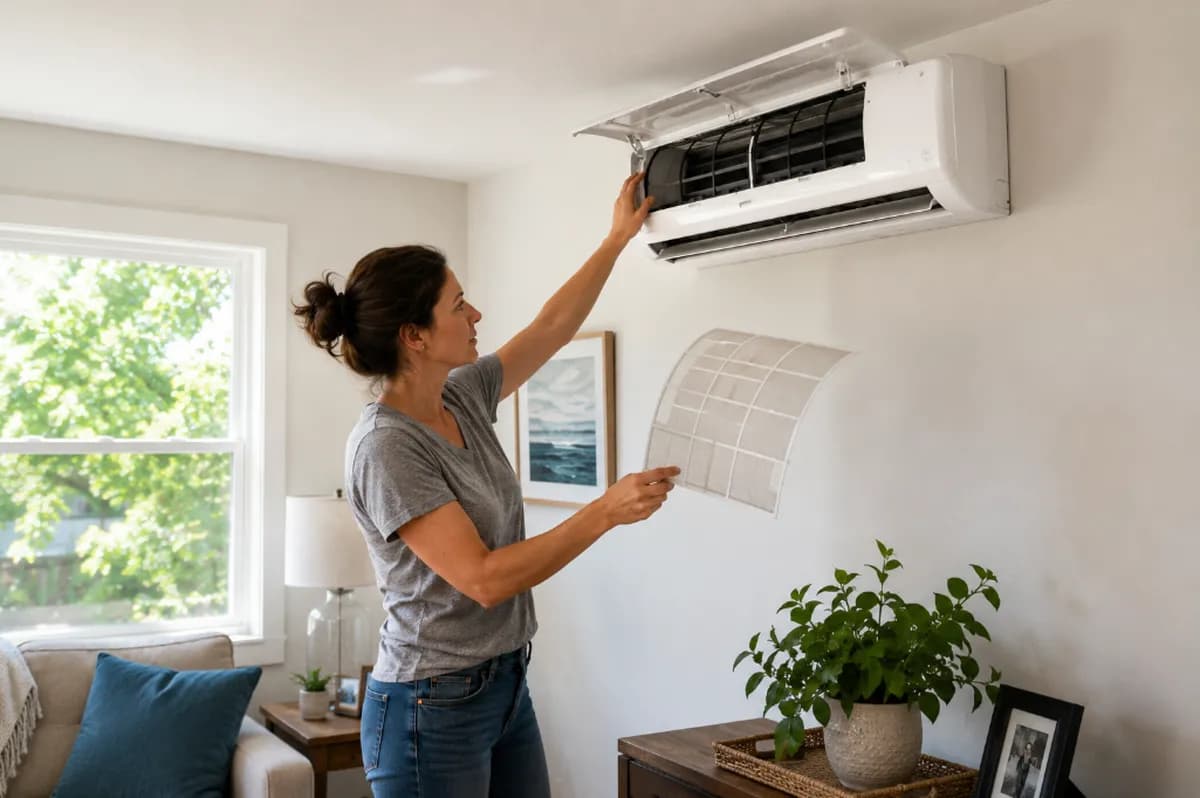
How To Get Your Mini Split Ready For Summer
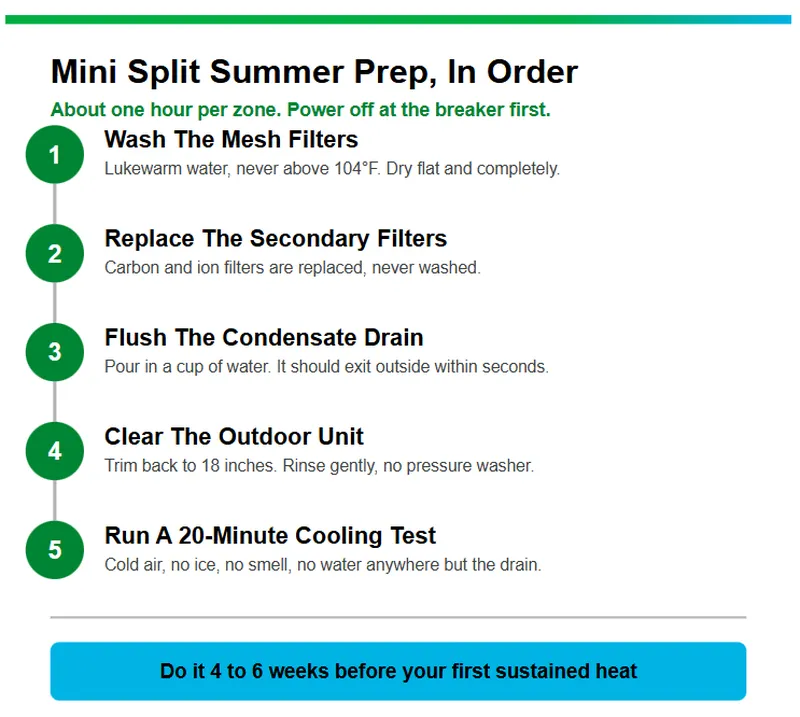
Wash the mesh filters, replace any non-washable secondary filters, flush the condensate drain, clear 18 inches around the outdoor unit, then run a 20-minute cooling test. Budget about an hour per zone, and do it four to six weeks before your area's first sustained heat.
Cut power at the breaker before you start. Begin with the head you use least, because an idle head still collected dust all winter. If your system struggled last summer, it may be time to price a new ductless mini split system instead of prepping the old one.
Not sure which way to go? Take the quick match below.
Answer 3 quick questions and we will match you to the right mini split setup for your space.
Replacing rather than repairing? Filterbuy ductless systems are 17 SEER2 with a coil self-dry cycle and a filter-clean reminder standard on every unit.
How to Get a Mini Split Ready for Summer
Clean the mesh filters, replace any non-washable secondary filters, flush the condensate drain, clear at least 18 inches around the outdoor unit, then run a full cooling test cycle before the first heat wave. Do it four to six weeks ahead of peak heat, and book a professional tune-up in the same window. This is the order Filterbuy's HVAC Solutions team works in on ductless systems in the field.
TL;DR: Preparing a ductless mini split for summer takes about an hour: the washable mesh filters, any secondary carbon or ion filters, the condensate drain, the outdoor unit's clearance, and a test run in cooling mode. Do it in late spring, before you need the system. A clean filter alone lowers an air conditioner's energy use by 5% to 15%, per the U.S. Department of Energy. On newer equipment, the system handles several of these steps itself.
Key Takeaways
A mini split that heated your home all winter needs more spring prep, not less. Every hour in heating mode pulled dust through the same filters and coil you're about to ask to cool the room.
The washable mesh filter is the highest-return task, and it's free. The DOE estimates a clean filter cuts an air conditioner's energy consumption by 5% to 15% versus a clogged one.
A dried-out condensate drain is the failure we would most like to prevent. The line sits empty all heating season, and anything lodged inside becomes a drip down your wall the first humid day you run cooling.
Several of these steps are now equipment features, not chores. A coil self-dry cycle and a filter-clean reminder are standard on every Filterbuy mini split, premium-tier on most competing brands.
Why Mini Splits Need a Different Spring Routine Than Central AC
A ductless mini split needs a spring startup a central system doesn't, because the filter and evaporator coil sit inches from the air you breathe. The mesh filters are washable, so "spring filter change" means clean, dry, reinstall. The drain runs by gravity through a small wall line, so a partial clog shows up as water on your floor.
The coil sits close enough that a dirty one smells within minutes. The EPA's guide to air cleaners and filters in the home is blunt about what that mesh is for: protecting the equipment, not scrubbing every fine particle from the room.
"Most spring HVAC advice was written for a furnace and a central air handler. A ductless system doesn't work that way. It ran all winter, it filters the room it is standing in, and its drain has been dry since October. We wrote this checklist for that machine, not a generic one."
Michelle Wan, Brand Manager & Air Quality Writer, Filterbuy
What We See in the Field
We have manufactured air filters in the United States since 2013, more than 50 million of them, and our HVAC Solutions team services ductless systems in Florida and Texas homes. That combination is why this checklist leads with the filter and the drain rather than the thermostat.
Two things we have measured shape it. In our service data, a dirty, restricted filter cuts a mini split's efficiency by 5% to 30%, depending on how bad the buildup is. And when we tested particle capture in our own factories, fine dust under 10 microns proved harder on a system than visible dirt, because it settles deeper into the coil and resists cleaning later.
The spring translation: do not wait until the mesh looks filthy, and do not count last fall's cleaning as this year's. The arithmetic is lopsided. In our customer-service data, restoring a dust-coated coil after a neglected filter runs about $350 to $600. The mesh you rinse in the sink costs nothing.
The One-Hour Mini Split Summer Prep Checklist
To prepare a mini split for summer, cut power at the breaker, wash and fully dry the mesh filters, replace any non-washable secondary filters, wipe the indoor coil face, flush the condensate drain, clear debris from the outdoor unit, then restore power and run a cooling test cycle. Budget an hour per zone.
Start with the head you use least. Those get skipped, and an idle head still collected dust all winter. You'll want a step stool, a vacuum with a brush attachment, mild soap, a microfiber cloth, a garden hose, and fresh batteries.
Cut the power at the breaker. Switching off with the remote is not the same as de-energizing. Flip the breaker so the fan can't start while your hands are inside.
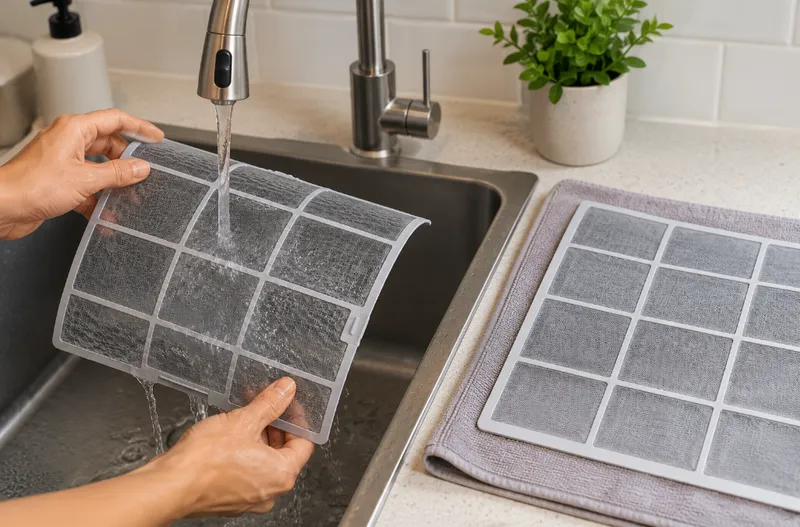
Wash the mesh filters and let them dry completely. Vacuum off loose dust, rinse in lukewarm water (never above 104°F) with mild soap, and air-dry flat in the shade. A damp filter reinstalled into a warm unit is the single failure we see turn a clean system musty, and it is entirely avoidable. Our step-by-step guide to cleaning mini split filters covers the brand-by-brand differences.
Replace the secondary filters. Carbon, silver-ion, and photocatalytic filters break down when soaked, so manufacturers specify replacement rather than washing. Check behind the mesh and order before the season starts.
Inspect and wipe the indoor coil and blower. With the filters out, shine a flashlight at the coil and down into the blower wheel. Light dust wipes off the coil face with a dry microfiber cloth. Black speckling or fuzzy growth on the blower wheel is a professional job, and the point where upkeep starts affecting your indoor air quality. This is the failure a coil self-dry cycle exists to prevent; Filterbuy units run one at 55°C after each cooling cycle.
Flush the condensate drain. Pour a cup of water into the drain pan and watch for it to exit the outdoor end of the line within seconds. Slow or no flow means a partial clog. Ten minutes in April; drywall damage in July. We would rather you did it now.
Clear and rinse the outdoor unit. Clear leaves, mulch, and winter debris from the base and coil, and trim vegetation back to at least 18 inches. With power off, rinse the coil gently from the inside out. Skip the pressure washer; aluminum fins bend under it.
Check the line set and mounting. UV-cracked insulation on the refrigerant lines costs efficiency and is a cheap fix.
Restore power and run a test cycle. Fresh batteries, switch from heat to cool, and let it run. Details below..
When to Do It, and Who Does What
Schedule mini split spring maintenance four to six weeks before your area's first sustained heat: March in the Gulf South, April through May across most of the country, late May up north. ENERGY STAR advises pre-season check-ups in spring, precisely because contractors get busy once summer arrives.
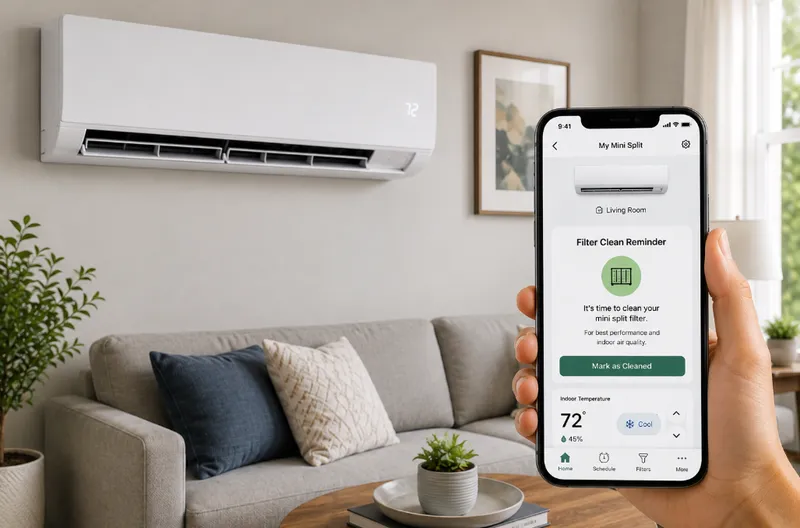
Set a recurring phone reminder for the filter washes, or let the equipment carry it. Filterbuy systems include a built-in filter-clean reminder, though it counts run hours rather than actual dirt, so the white-paper check still wins.
Refrigerant is the dividing line. EPA Section 608 rules define adding or removing refrigerant as work that requires federal certification. A mini split that "just needs a top-off" every year has a leak that needs finding.
Renting? The filters and the drain test are yours. Anything involving the outdoor unit, the breaker panel, or the sealed system goes to your building manager in writing, before the season starts and before the request joins a queue.
Already in the Heat? A Triage Order for the Rest of Us
Plenty of people find this page in July, not April, with a system that is already struggling. The full checklist is the wrong advice at that point, and so is waiting for a contractor who is booked out. Do these three, in this order, and leave the rest until fall.
Wash the mesh filters. Ten minutes, free, and the only step that can restore real airflow the same afternoon. Run the unit fan-only while they dry so the coil isn't sitting wet.
Check the drain before the thermostat. Water on the wall or the floor means stop and clear the line. Running a unit with a blocked drain turns a free fix into a drywall repair.
Clear the outdoor unit. Two minutes pulling leaves and grass clippings off the coil, power off at the breaker first.
Then get on a service list. In peak season you're waiting days, not hours. One thing worth knowing while you wait: a system that is icing over or short-cycling should be off, not running. Forcing it through those symptoms is how a repair becomes a replacement.
What Winter Leaves Behind
If your mini split ran as a heat pump all winter, spring startup is recovery from a heating season, not a wake-up from hibernation. We ordered this table deliberately: cheapest and most self-serviceable at the top, down to the one homeowners suspect first and can least often fix themselves.
Note what sits at the top: moisture and dust inside the indoor head. A coil self-dry cycle, standard on every Filterbuy system, addresses that combination directly. Nothing addresses a clogged drain except clearing it, which is why the drain test stays on the list no matter what you own.
How Much of This Checklist Should Your Equipment Handle?
Most of this list exists because the system can't do it for you. Newer ductless equipment changes that math, and the difference between brands isn't whether the feature exists but whether it's standard or a premium-tier upsell. We have made replacement filters for every major mini split brand on the market, so we see which systems make this routine easy and which quietly make it harder.
Two features matter for summer prep. A high-temperature coil self-dry cycle runs after cooling and drives moisture off the coil, where mold starts. A filter-clean reminder removes the part of this routine people actually fail at: remembering. Every Filterbuy mini split includes both as standard.
Sources: manufacturer published specifications and owner's manuals, 2024–2026. Warranty and efficiency comparisons are addressed separately in the body copy.
We'll be straight about the trade-off, because a comparison that only flatters us isn't worth reading. Filterbuy systems are rated 17 SEER2 with a 7-year compressor / 3-year parts warranty. Daikin and Mitsubishi go deeper on coverage, at 12-year compressor terms when registered, and some DIY-tier brands publish higher SEER2 numbers; our full mini split brand comparison lays that out. What Filterbuy does better is the part this article is about.
"We spent twelve years making the part of an HVAC system most manufacturers treat as an afterthought. When we built a mini split, we started at the filter and worked outward. That is a different design conversation than starting at the compressor."
Michelle Wan, Brand Manager & Air Quality Writer, Filterbuy
One honest limit: a self-clean cycle does not replace washing the mesh. It keeps the coil dry; you still clean the filter. Any brand claiming otherwise is overselling.
The Test Run: Confirming Your System Is Ready
Run the system in cooling mode for 20 minutes, setpoint well below room temperature, fan on high. Twenty minutes is our threshold, not a manufacturer spec: long enough for a marginal drain to start dripping and a restricted coil to begin icing, which a two-minute test misses. A healthy head gives steady, noticeably cold air, no water but at the drain line, no ice, no smell. Four things to check:
Air temperature. Supply air should be distinctly colder than the room within minutes. Inverter systems modulate, so numbers vary, but at full output supply air typically runs roughly 15–20°F below return air.
Sound. Steady fan noise is normal. Rattling, grinding, or a repeating click is not.
Water. Check under the indoor head and at the outdoor end of the drain line. Water should exit outside and nowhere else.
Smell. A faint dusty odor at first is normal. A musty smell that persists with a clean, dry filter points to mold in the coil or drain pan.
Pass all four and you're set. Reset the filter-clean indicator if your unit has one, as Filterbuy systems do, and set a phone reminder for the next wash.
When to Call a Licensed HVAC Technician
Call a licensed HVAC technician if your mini split ices over, short-cycles, drips water indoors, smells musty with a clean dry filter, or cools noticeably worse than last year. Those symptoms point to the sealed system, the blower, or the drain.
"The spring calls I'd most like to prevent are the ones people schedule in July. A drain that's been dry since October takes ten minutes to clear in April and becomes drywall damage in the first humid week."
David Clark, Licensed HVAC Technician
Book the annual tune-up in the spring window. The U.S. Department of Energy puts the gap between a well-maintained heat pump and a severely neglected one at 10% to 25% of energy consumption. Filterbuy owners can find an installer through the Mini Split Support Center.
Essential Resources: 7 Sources to Consult Before the First Heat Wave
Prepping the unit answers one question. These seven sources answer the ones that come next: how to run a ductless system efficiently all season, how to hire a tune-up without being upsold, how to fix a musty smell at its source, and whether a struggling unit is worth repairing at all. Each is a primary source from a government agency, a national health nonprofit, or the industry's certification body.
1. Keep Your Cooling Bill Flat All Season, Not Just in June
ENERGY STAR: Ductless Heating & Cooling · Best for: everyday operation after prep day
ENERGY STAR lists the four operating habits that protect a mini split's efficiency: hold one steady setpoint, avoid Auto mode, run the lowest fan speed that reaches the room, and clean the mesh when the filter light comes on.
2. Hire a Tune-Up Without Getting Upsold a New System
ENERGY STAR: 10 Tips for Hiring a Heating and Cooling Contractor · Best for: booking spring service
This checklist tells you what a legitimate HVAC contractor does before quoting: verify state licensing, call references, perform a real home evaluation, and provide a written itemized estimate.
3. Fix the Musty Smell at Its Source Instead of Rewashing the Filter
U.S. EPA: A Brief Guide to Mold, Moisture and Your Home · Best for: drain and odor problems
The EPA names the mini split failure point directly: keep drip pans clean and drain lines flowing, hold indoor humidity between 30% and 50%, and dry anything wet within 24 to 48 hours. Mold is a moisture problem, so the moisture has to be fixed.
4. Match Your Filtration to Your Household's Actual Needs
American Lung Association: Air Cleaning · Best for: allergy and asthma households
This is the original source of the white-paper test for a dirty filter. It also explains MERV ratings in plain language and warns against air cleaners with ionizers, UV lamps, or any feature that produces ozone.
5. Know Whether Your Struggling Unit Is Worth Repairing
ENERGY STAR: When Is It Time to Replace? · Best for: a system that failed the test run
The EPA lists the signals that tip a system from repair to replacement: more than ten years old, repairs growing frequent, energy bills climbing, rooms that never balance, and summer humidity that will not clear.
6. Confirm a Replacement Model Qualifies for Rebates and Tax Credits
ENERGY STAR: Certified Heat Pumps Product Finder · Best for: shopping a new system
This searchable database covers every currently certified heat pump, ductless models included. Only certified models qualify for most federal and utility incentives, so search the specific unit rather than trusting the brand name.
7. Verify the Efficiency Rating on Your Quote Before You Sign
AHRI: Directory of Certified Product Performance · Best for: checking an installer's numbers
The Air-Conditioning, Heating, and Refrigeration Institute publishes third-party tested SEER2 ratings for certified equipment. Ask any installer for the AHRI reference number, because it is the only confirmation that the number on your quote came from a lab.
Supporting Statistics: Why Pre-Season Prep Pays Off
Three federal datasets explain why an hour of spring maintenance changes both a cooling bill and the air in the room. Each figure below comes from a primary U.S. government source.
1. Air Conditioning Uses 19% of U.S. Home Electricity
254 billion kilowatt-hours in 2020.
A clean filter cuts an air conditioner's consumption 5% to 15%.
That saving comes off the largest line on a summer bill.
Source: U.S. Energy Information Administration, How much electricity is used for air conditioning? (2020 Residential Energy Consumption Survey)
2. Americans Spend About 90% of Their Time Indoors
Some indoor pollutants run 2 to 5 times higher than outdoor levels.
The EPA lists dust mites, mold, and pet dander as asthma triggers.
Humid conditions raise indoor mold risk unless ventilation or air conditioning controls it.
Source: U.S. EPA, Report on the Environment: Indoor Air Quality
3. 8.6% of U.S. Adults Currently Have Asthma
6.5% of children as well, both 2024 figures. Roughly one adult in twelve.
Asthma drove 1.4 million emergency department visits.
These homes belong on the one-to-two-week filter interval, not the monthly one.
Source: CDC National Center for Health Statistics, FastStats: Asthma (reviewed February 2026)
Frequently Asked Questions
When should i get my mini split ready for summer?
Four to six weeks before your area's first sustained heat: March in the Gulf South, April or May across most of the U.S. Book the professional tune-up in the same window, because contractors fill up once the season starts.
Do i need to clean my mini split filter if i only used it for heat this winter?
Yes, and it matters more, not less. A mini split in heating mode pulls room air through the same mesh filters all winter, so they enter summer loaded.
How do i know if my mini split's condensate drain is clogged?
Pour a cup of water into the drain pan and watch the outdoor end of the line. Water should exit within seconds. Slow flow, no flow, or water backing up in the pan means a partial clog.
What if i have more than one indoor unit?
Run the checklist on each head, and start with the one you use least. Lightly used heads get skipped year after year, and they still collect dust through the heating season. Budget about an hour for the first zone and fifteen minutes for each additional head.
Does a self-cleaning mini split still need its filter washed?
Yes. A coil self-dry cycle keeps the evaporator coil dry, which limits mold, but it does not touch the mesh filter. You still wash the mesh on the same schedule. Any brand suggesting otherwise is overselling the feature.
Are there mini splits that need less seasonal maintenance?
Somewhat. A coil self-dry cycle and a filter-clean reminder remove the two steps homeowners most often skip: drying the indoor coil, and remembering the schedule. Filterbuy includes both on every unit; most brands reserve them for premium models. No system eliminates filter washing. New to ductless? Start with what a mini split is.
Glossary
Mini split (ductless mini split): A heating and cooling system pairing a wall- or ceiling-mounted indoor unit with an outdoor compressor, delivering conditioned air without ductwork.
Mesh filter: The primary washable screen inside the indoor unit, rinsed and reused rather than replaced.
Secondary filter: A carbon, silver-ion, or photocatalytic filter behind the mesh; replaced on a schedule, never washed.
Evaporator coil: The finned component inside the indoor unit that absorbs heat from room air.
Self-clean (coil self-dry) cycle: An automated function that heats the indoor coil to 55°C on Filterbuy systems, driving off moisture after cooling and limiting mold growth.
Condensate drain: The gravity-fed line carrying away moisture the system pulls from the air; a clog causes water to drip from the indoor unit.
Delta-T (temperature split): The difference between air entering a unit and air leaving it, a field indicator of cooling performance.
SEER2: The current U.S. cooling efficiency rating. Higher is more efficient; flagship ductless systems reach 20-plus.
Written by Michelle Wan · Reviewed by David Clark, Licensed HVAC Technician
Michelle Wan is Filterbuy's Brand Manager and air quality writer. She works directly with Filterbuy's U.S.-based manufacturing team across factories in Alabama, Florida, Pennsylvania, and Utah, so her guidance is grounded in how filters are actually built, tested, and used in real homes. Filterbuy has manufactured air filters in the United States since 2013, producing more than 50 million and serving over two million households, and its HVAC Solutions team services ductless systems in the field. Published August 12, 2026. Last updated August 12, 2026.
Related reading: How to choose a mini split system · Pros and cons of mini split systems · All ductless mini split resources