Mini Split vs. Wood or Pellet Stove: Cost, Comfort, and Indoor Air Quality
October 15, 2026
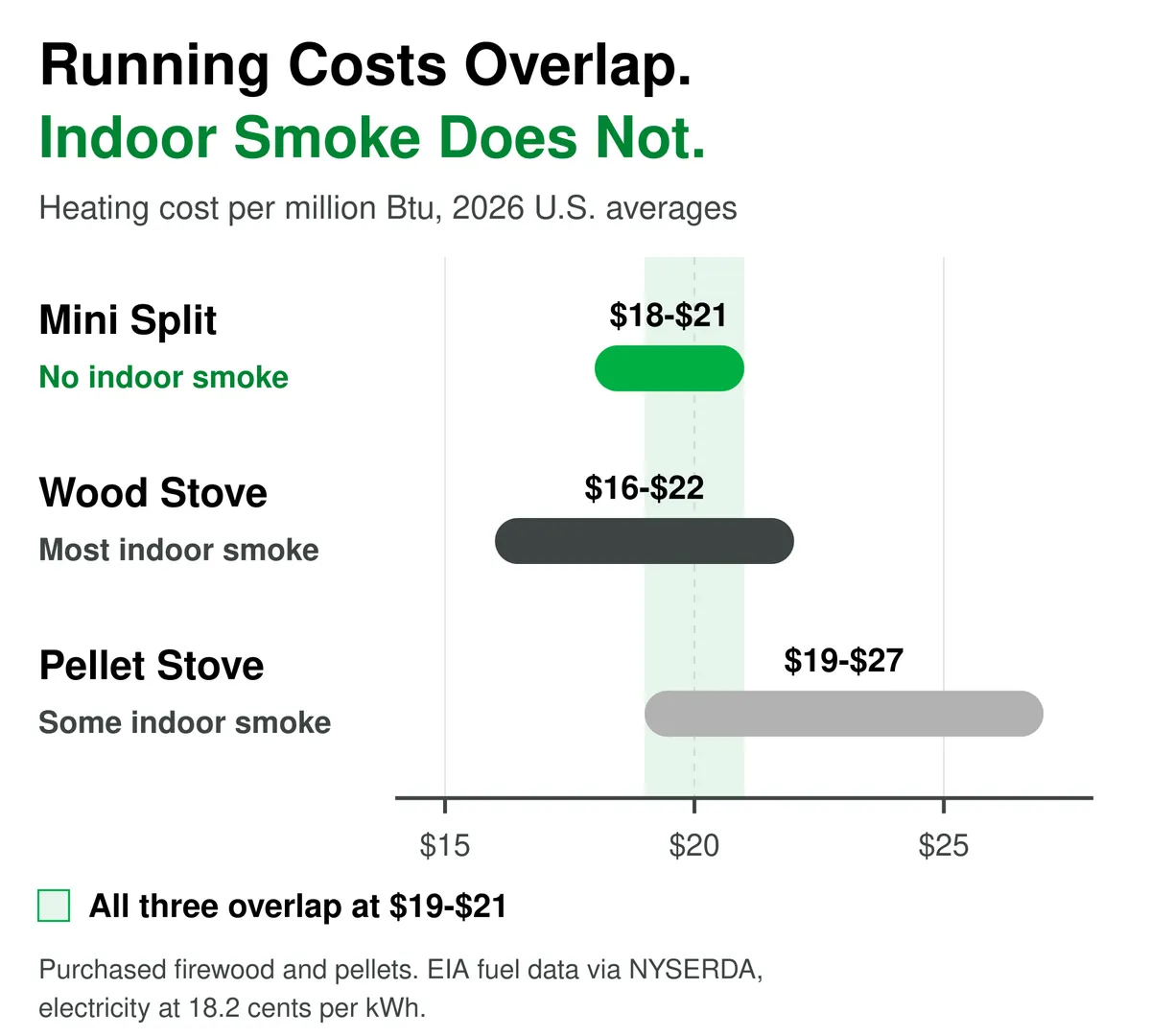
At average 2026 prices, a mini split and a wood stove cost about the same to run. The real difference is indoor air and effort. A mini split burns nothing, so it adds no smoke or carbon monoxide inside your home. A wood stove costs less when firewood is cheap and keeps working in a power outage, but it adds fine particles indoors.
Mini split: 18–21 per million Btu, steady heat plus summer cooling, no indoor smoke.
Wood stove: 16–22 per million Btu, strong radiant heat that works in outages, the most indoor smoke.
Pellet stove: 19–27 per million Btu, thermostat control, less smoke than wood but usually needs power.
Not sure which fits your home? Take the quick quiz below.
Filterbuy single-zone mini splits start at $749, with fast and free 2-day delivery to most US states and a 7-year compressor, 3-year parts warranty. Professional installation required.
Shop Mini Split SystemsAnswer a few quick questions and we'll match you to the right mini split for your space.
TL;DR
A mini split is the better choice for indoor air because it burns nothing, while wood and pellet stoves release fine particles (PM2.5) inside your home. Filterbuy's analysis puts all three close on running costs at 2026 U.S. averages, so local prices decide. If you burn wood, EPA-recommended MERV 13 filtration and a HEPA purifier capture fine smoke particles indoors.
Key Takeaways
Wood stoves raise indoor PM2.5. Studies found higher fine-particle levels in wood-heated homes, especially with older stoves.
A mini split adds no combustion pollutants. Since it burns nothing, it releases no smoke or carbon monoxide indoors.
Your electric rate settles the cost question. Below 16.2 cents per kWh, a 300%-efficient mini split heats for less than even $250-a-cord wood.
Which Is Better: a Mini Split or a Wood Stove?
A mini split wins on indoor air and upkeep. A stove wins in outages and, with cheap wood, on fuel cost.
Filterbuy sees this choice from both sides: we have made air filters in the USA since 2013, and we sell mini splits. Every winter, fireplace smoke complaints in our customer-support queue start in December and peak in January. Here is our straight answer, including where a stove beats the mini split we sell.
Mini Split vs. Wood Stove vs. Pellet Stove at a Glance
2026 U.S. examples per MMBtu delivered.
Heat Pump vs. Wood Stove Cost: What Does Each Cost to Run?
At 2026 U.S. average prices, a mini split heat pump and a wood stove cost about the same to run: roughly $18–$21 per million Btu (MMBtu) for the mini split, $16–$22 for purchased firewood, and $19–$27 for pellets. Filterbuy used U.S. Energy Information Administration (EIA) fuel assumptions published by NYSERDA, the EIA forecast of 18.2 cents per kWh for 2026, and 250%–300% mini split efficiency.
Assumes 22 MMBtu per cord at 72% efficiency and 16.5 MMBtu per ton at 78%. Sources: EIA, NYSERDA.
HomeAdvisor puts pellets at $200–$400 per ton and firewood at $150–$500 per cord. Self-cut wood costs little but takes labor. Wet wood wastes heat and is the top cause of excess smoke in Filterbuy customer reports. Most pellet stoves also need electricity.
Upfront, a single-zone mini split runs $1,800–$3,500 installed, per Filterbuy's mini split cost guide, while a pellet stove costs $1,000–$3,700, per HomeAdvisor. The federal 25C credit was terminated for systems placed in service after December 31, 2025; confirm any rebate eligibility with a tax professional.
Break-Even Rate: When Does a Mini Split Beat Wood or Pellets?
Averages can hide the answer for one home, so Filterbuy calculated the electricity rate where a mini split ties each fuel. Compare it with the rate on a recent utility bill.
Filterbuy calculation; same assumptions as the cost table.
At the 18.2-cent average, a 300%-efficient mini split beats $250-a-ton pellets and $350-a-cord wood, but still loses to $250-a-cord wood.
"The question we get is always 'which one is cheapest.' The better question is 'cheapest over how long.." – Michelle Wan, Filterbuy
Which Heats More Comfortably: a Mini Split or a Wood Stove?
A mini split holds a steady temperature and doubles as an air conditioner in summer. A wood stove gives stronger radiant warmth, but the heat rises and falls with each load and fades in far rooms. The stove's real edge is outage heat. Pellet stoves sit in between.
Cold weather changes the cost math, because a heat pump loses efficiency as temperatures drop. ENERGY STAR's cold-climate efficiency floor is just a COP of 1.75 at 5°F. At that efficiency and 18.2 cents per kWh, a mini split costs roughly $30 per MMBtu, nearly double $250-a-cord wood. See Filterbuy's best mini splits for cold climates.
Wood Stove Indoor Air Quality: How Much Smoke Gets Inside?
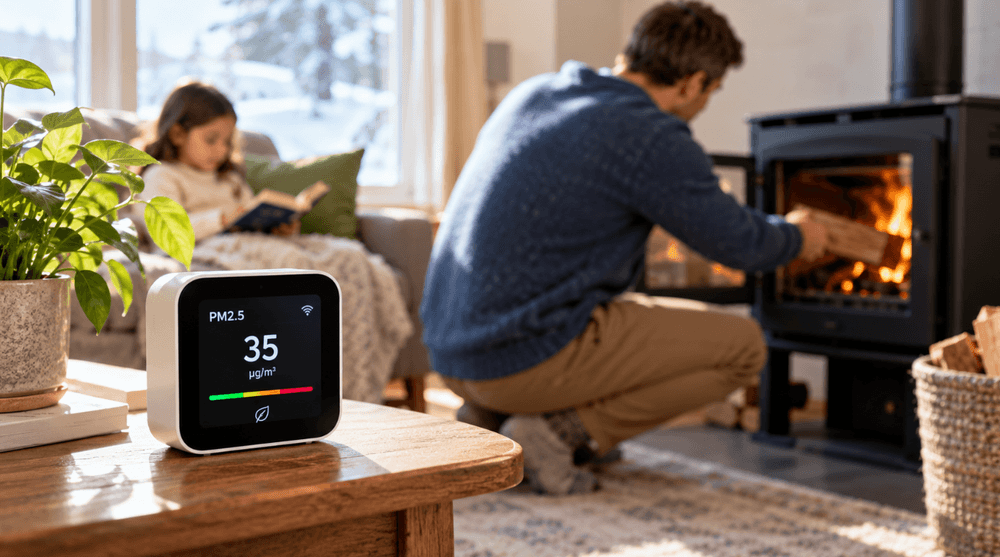
Even with a working chimney, a wood stove raises indoor fine-particle pollution. Smoke escapes each time you reload, and it drifts back in from outdoors through small leaks. A mini split, by contrast, adds none.
The pollutant that matters most in wood smoke is PM2.5, particles 2.5 microns or smaller. The EPA tracks it in wood smoke, and researchers have measured it in real homes (Oslo study, University of Montana, Indoor Air study):
Studies linked above. For context, the EPA outdoor annual PM2.5 standard is 9 µg/m³.
Since May 2020, new U.S. wood and pellet stoves must meet the EPA's limit of 2.0 grams of particles per hour. Pellet stoves usually burn cleaner but still produce some smoke.
How Much Upkeep Does Each Heating Option Need?
A mini split needs the least upkeep and a wood stove the most, with pellet stoves in between.
Ductless mini split: Rinse the washable filters every two to four weeks in heavy use, and book a yearly coil cleaning. In Filterbuy HVAC Solutions service data, a clogged filter cuts a mini split's efficiency by 5%–30%.
Wood stove: Burn only dry, seasoned wood, and book a yearly chimney inspection to keep creosote in check.
Pellet stove: Fill the hopper every day or two and clean the burn pot weekly. Once a year, have the vent and auger serviced.
Whichever stove you choose, install carbon monoxide alarms on every level and near bedrooms.
Air Filter Tips If You Heat With Wood or Pellets
If you burn wood or pellets, pair a MERV 13 filter in your HVAC system with a portable HEPA purifier near the stove. After more than a decade of building filters, this is the Filterbuy burn-season routine:
Upgrade to MERV 13. The EPA recommends MERV 13, or the highest rating your system can handle. Most systems run it without airflow problems if you change it on schedule. See Filterbuy's guide to the best MERV filter for smoke.
Run the HVAC fan while you burn. Setting the fan to "On" keeps air moving through the filter while the stove heats.
Check the fit. Air slips through gaps. Most exchanges Filterbuy processes trace back to measuring the old filter instead of the slot, so measure the opening itself.
Check filters monthly in burning season. In Filterbuy's experience, a filter that lasts 90 days off-season can turn gray within three to four weeks of regular burning.
Add a portable HEPA purifier near the stove. Pick one with a smoke CADR of at least two-thirds of the room's square footage. See Filterbuy's guide to portable air purifiers vs. HVAC filters.
Use carbon for odor. Particle filters can't trap smells, so an activated carbon filter, such as a Filterbuy Odor Eliminator filter, handles lingering odor.
Pro Tip: Keep a spare filter on hand before burning season. Filterbuy makes MERV 13 air filters in over 600 sizes at our plants in Alabama, Florida, Pennsylvania, and Utah.
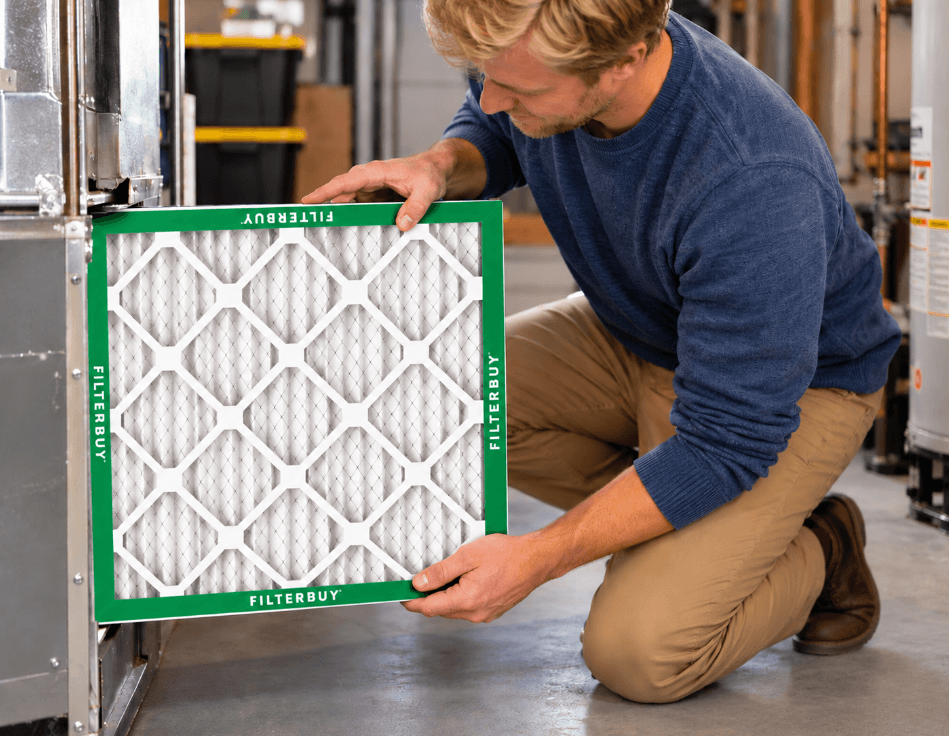
"The best filter is the highest rating your system can move air through, changed on schedule. A MERV 11 you actually replace beats a MERV 13 you leave in for six months."
— David Clark, Licensed HVAC Technician, Filterbuy HVAC Solutions
Supporting Statistics: What the Research Shows
1. Home wood smoke emits more PM2.5 than all U.S. vehicles combined.
The EPA's 2017 National Emissions Inventory found residential wood smoke releases more PM2.5 than on-road and non-road vehicles combined.
Why it matters: A wood stove is a major particle source.
Source: U.S. EPA, Burn Wise Facts & Figures
2. Air filtration cut indoor PM2.5 by 63% in wood-burning homes.
In a randomized, placebo-controlled trial in rural wood-heated homes, portable air filtration units cut indoor PM2.5 by 63% versus placebo. New EPA-certified stoves produced no significant change.
Why it matters: Filtration still matters after a stove upgrade.
Source: Ward et al., Journal of Exposure Science & Environmental Epidemiology, via NIH
3. A high-efficiency HVAC filter with the fan on can halve indoor PM2.5.
During smoke events, a high-efficiency filter with the fan on continuously may cut indoor PM2.5 by about 50%, versus roughly 24% with a low-efficiency filter.
Why it matters: Pair MERV 13 with the fan on.
Source: U.S. EPA, Strategies to Reduce Exposure Indoors
Should You Choose a Mini Split, a Wood Stove, or a Pellet Stove?
Choose a mini split if clean indoor air and low effort matter most. A wood stove fits cheap wood and frequent outages, and a pellet stove suits wood heat with less hauling.
Filterbuy's take: If you own a stove, you may not have to choose. Our advice is a hybrid: run the mini split on mild days, when it is most efficient, and save the stove for the coldest nights and outages. Fewer burn hours mean less smoke indoors. Filterbuy mini splits ship free in 2 days on in-stock systems and carry a 7-year compressor warranty. They require professional installation and are rated for reliable heating down to 5°F, so colder homes should keep a stove or other mini split backup heat.
Frequently Asked Questions
Is a mini split cheaper to run than a wood stove?
At 2026 average prices, costs are close: $18–$21 per MMBtu versus $16–$22 for purchased wood. Below 16.2 cents per kWh, an efficient mini split wins.
Do wood stoves affect indoor air quality?
Yes. Studies in Norway and the rural U.S. found higher indoor PM2.5 in wood-heated homes, especially those with older stoves.
Is a pellet stove cleaner than a wood stove?
Usually, because pellets are dry and uniform, but both release some smoke.
Does a mini split filter wood smoke?
No. A mini split's mesh filter protects the coil but misses fine smoke particles. Owners often tell the Filterbuy team the room feels comfortable but the air feels no cleaner, so add a HEPA purifier.
Can I use a mini split and a wood stove together?
Yes. Use the mini split in mild weather and the stove on the coldest nights.
Glossary
Ductless mini split: An electric heat pump that heats and cools without ductwork or combustion.
Pellet stove: A vented stove that burns auger-fed wood pellets.
EPA-certified stove: A wood or pellet stove tested to meet EPA particle emission limits.
PM2.5: Airborne particles 2.5 microns or smaller, the main fine-particle pollutant in wood smoke.
COP: Coefficient of performance, the heat a heat pump delivers per unit of electricity it uses.
HEPA: High-efficiency particulate air, a filter grade used in portable purifiers.
MMBtu: One million British thermal units of heat.
Cord: A 4-by-4-by-8-foot stack of firewood.
Creosote: Flammable tar that builds up in chimneys.
MERV: Minimum Efficiency Reporting Value, a 1–16 HVAC filter efficiency rating.
CADR: Clean Air Delivery Rate, how much filtered air a purifier delivers.
About the Author
Michelle Wan is Filterbuy's Brand Manager and Air Quality Writer and works directly with its U.S. manufacturing team. Reviewed by David Clark, Licensed HVAC Technician, Filterbuy HVAC Solutions.
Sources
U.S. EIA, Short-Term Energy Outlook: Electricity (2026 residential price forecast)
NYSERDA, Cost Compare Heating Fuels (EIA calculator assumptions)
EPA, Summary of Requirements for Woodstoves and Pellet Stoves
EPA Burn Wise, Wood-Burning Changeout Campaigns (archived program, 2009–2025)
EPA, Strategies to Reduce Exposure Indoors (Wildfire Smoke and Your Patients' Health)
Wyss et al., PLOS ONE (2016), PM2.5 and wood stove use in Norwegian homes
Indoor particulate matter in rural, wood stove heated homes (ARTIS study)
Indoor fine particulate matter among rural US homes heated with wood fuel, Indoor Air