Best Mini Splits For Cold Climates (2026), Ranked By 5°F Capacity
October 6, 2026
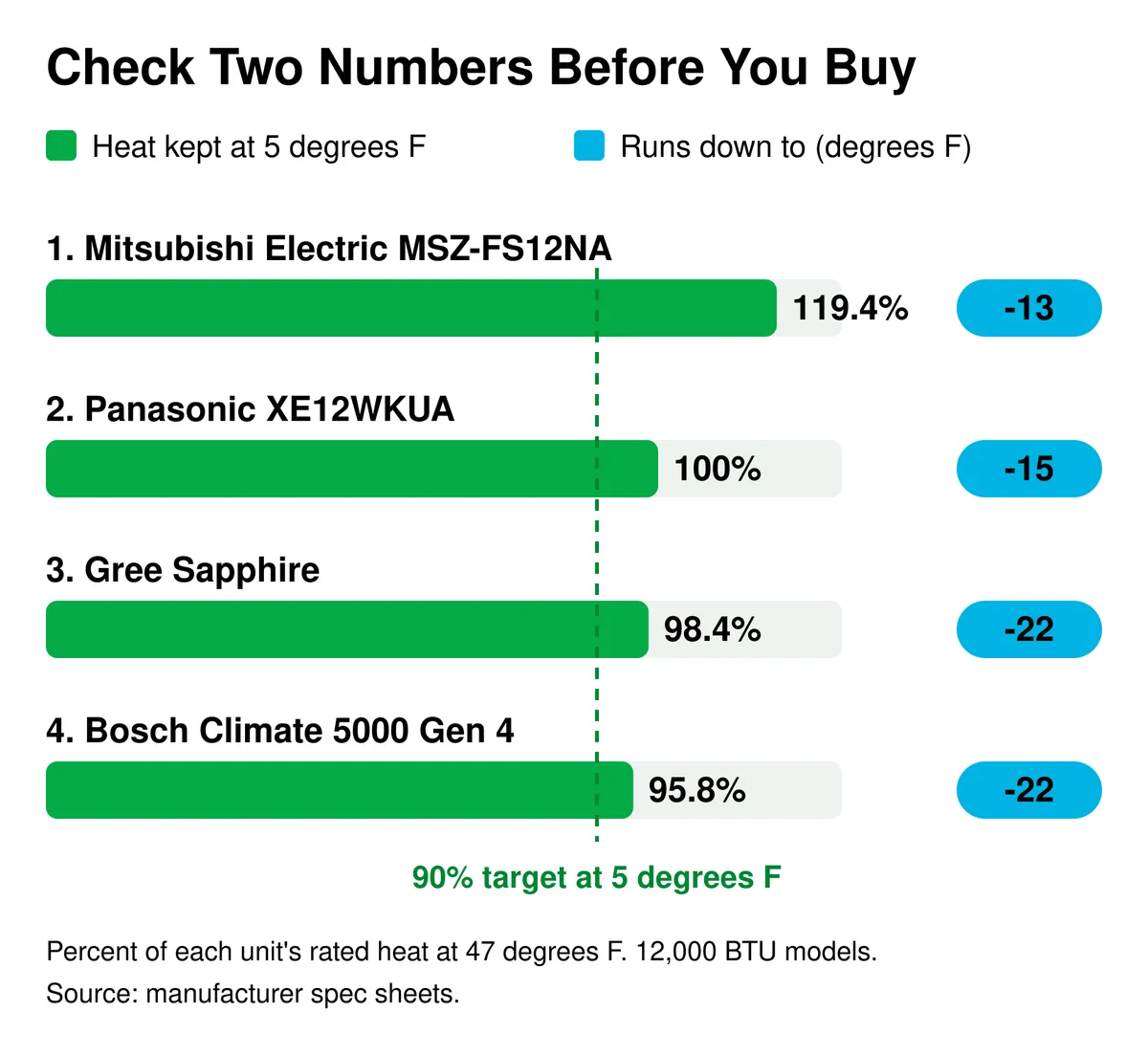
For cold climates, the Mitsubishi Electric MSZ-FS12NA Hyper-Heat ranks first because it puts out more heat at 5°F than at its 47°F rating. The Panasonic XE12WKUA, Gree Sapphire, and Bosch Climate 5000 Gen 4 follow, and each keeps at least 95% of its rated heat at 5°F. Before you buy, check how much heat a unit keeps at 5°F and how cold it is rated to run.
Mitsubishi Electric MSZ-FS12NA: 119.4% of rated heat at 5°F, runs down to -13°F
Panasonic XE12WKUA: 100% at 5°F, runs down to -15°F
Gree Sapphire: 98.4% at 5°F, runs down to -22°F
Bosch Climate 5000 Gen 4: 95.8% at 5°F, runs down to -22°F
Aim for 90% or more at 5°F with a COP of at least 1.75. Not sure which one fits your home? Take the quick match quiz below.
Heating a room where winters stay above 5°F? The Filterbuy mini split is $749 with fast and free 2-day delivery to most US states, a 7-year compressor warranty, and 3-year parts coverage. It provides reliable heating down to 5°F.
Answer a few quick questions and we'll match you to the right mini split for your home.
The best mini split for a cold climate is the one that still puts out close to its full rated heat when it is 5°F outside. We ranked four systems on that number using each manufacturer's published spec sheets. The Mitsubishi Electric MSZ-FS12NA Hyper-Heat comes out on top and delivers more heat at 5°F than its 47°F rating. The Panasonic XE12WKUA, Gree Sapphire, and Bosch Climate 5000 Gen 4 follow, each keeping at least 95% of its rated output.
TL;DR
For winters that regularly reach 5°F or colder, check two numbers before you buy: how much heat a mini split keeps at 5°F and how cold it is rated to run. Aim for 90% or more at 5°F with a COP of at least 1.75. The Mitsubishi Electric MSZ-FS12NA keeps the most heat (119.4%), while the Gree Sapphire and Bosch Climate 5000 Gen 4 run to -22°F.
Key Takeaways
Heat kept at 5°F and the heating floor are separate numbers, and the right cold-climate mini split for a home depends on both.
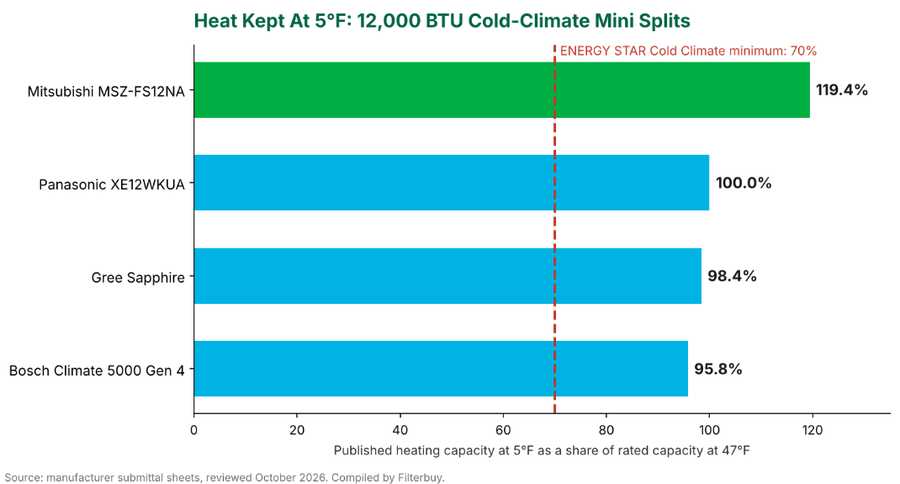
Across four 12,000 BTU cold-climate mini splits, heat kept at 5°F ranged from 95.8% (Bosch Climate 5000 Gen 4) to 119.4% (Mitsubishi Electric MSZ-FS12NA).
NEEP's cold-climate specification sets a 1.75 COP floor at 5°F but no minimum for capacity kept, so a NEEP listing alone does not show how much heat a unit delivers.
How We Ranked Cold-Climate Mini Splits
We ranked each system by one figure: its heating capacity at 5°F divided by its rated heating capacity at 47°F. That percentage, which we call heat kept at 5°F, shows how much heat a mini split holds onto as the weather turns. Every figure comes from manufacturer submittal sheets for single-zone, 12,000 BTU wall-mounted heat pumps.
We chose 5°F because it is the low-temperature test point ENERGY STAR and NEEP both use. Filterbuy didn't lab-test these units. We read the spec sheets side by side and ranked only systems whose makers publish a 5°F capacity, so you can check every number yourself.
That rule cut more models than we expected. We couldn't confirm a published 5°F capacity for current 12,000 BTU models from Fujitsu, Daikin, LG, or MrCool, so ask for their NEEP listing before you buy.
The 2026 Cold-Climate Mini Split Ranking
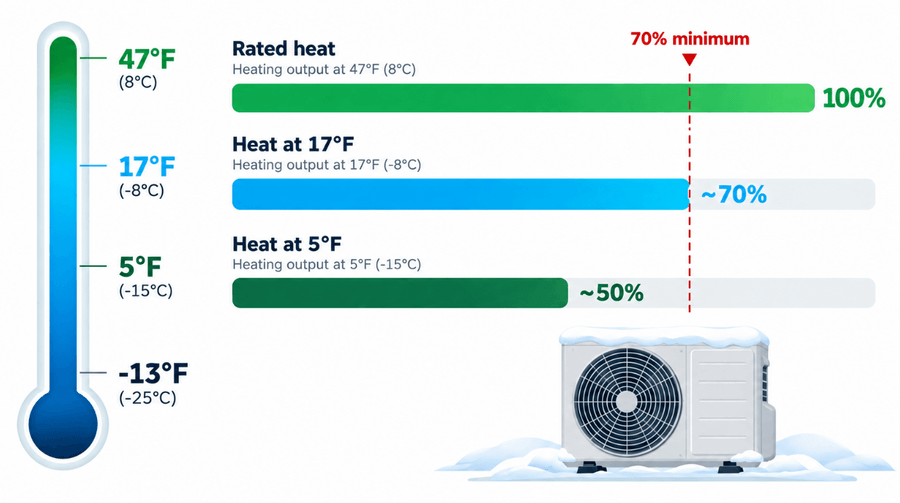
All four ranked mini splits clear ENERGY STAR's Cold Climate bars of 70% capacity and a 1.75 COP at 5°F. By our math, each one beats that 70% floor by more than 3,000 BTU/h.
Source: manufacturer submittals reviewed October 2026. Bosch labels its 5°F figure rated capacity. Panasonic COP is the low end of its range.
1. Mitsubishi Electric MSZ-FS12NA Hyper-Heat: Most Heat Kept At 5°F
Of the spec sheets we reviewed, only the Mitsubishi Electric MSZ-FS12NA lists more heat at 5°F (14,690 BTU/h) than at its 47°F rating (12,300 BTU/h), at a COP of 2.07. The catch is a -13°F heating floor. It uses R-410A refrigerant, so confirm current availability with your installer.
Best for: zone 5 and zone 6 homes where winter lows usually stay above -13°F.
2. Panasonic XE12WKUA: Full Rated Output At 5°F
The Panasonic XE12WKUA keeps its full 12,000 BTU/h rating at 5°F. Panasonic publishes a 5°F COP range of 4.15 to 2.21, and even the low end is the best figure in this ranking.
Best for: owners who want the most efficient heat on routine cold days.
3. Gree Sapphire: Best Pick For -22°F Winters
The Gree Sapphire SAP12HP230V1A holds 12,000 BTU/h at 5°F, 98.4% of its 12,200 BTU/h rating, with a COP of 2.11. Gree rates it to heat down to -22°F, which makes it our most balanced pick for the coldest regions.
Best for: zone 6 and zone 7 homes that see stretches below -13°F.
4. Bosch Climate 5000 Gen 4: A -22°F Rating With 95.8% Retention
The Bosch Climate 5000 Gen 4 lists 11,500 BTU/h at 5°F, 95.8% of its rating, and keeps heating down to -22°F. Its 5°F COP of 1.80 is the lowest of the four, and it is the only one that labels its 5°F figure as rated rather than maximum capacity, so ask for the NEEP listing.
Best for: buyers who want a -22°F rating and can accept lower efficiency at 5°F.
What Makes A Mini Split Cold Climate?
A cold-climate mini split is a ductless heat pump built to keep most of its heating output in freezing weather. ENERGY STAR's cold climate heat pump criteria require at least 70% of 47°F heating capacity at 5°F and a COP of at least 1.75 at 5°F.
The NEEP cold climate air source heat pump specification (version 4.0) requires a COP of at least 1.75 at 5°F at maximum capacity. It sets no minimum capacity percentage. A NEEP listing proves a unit runs efficiently in the cold, while its 5°F capacity tells you how much heat you'll get.
Which Winters Really Need Hyper-Heat?
You need a hyper-heat or cold-climate mini split when your winter design temperature falls near or below 5°F, or when the mini split will be a main heat source in climate zone 5 or colder. The U.S. Department of Energy treats areas with roughly 5,400 to 9,000 heating degree days as cold climates in its climate zone guidance.
Degree-day ranges per ASHRAE Standard 169. Your county sets your zone.
Mini Split For Zone 6: Size To Your Coldest Day
In climate zone 6, size a cold-climate mini split so its output at your local design temperature covers the room's heat loss,. Pacific Northwest National Laboratory's Building America guidance says to size to meet the design heating load at the design heating temperature.
Get a room-by-room heat load calculation (ACCA Manual J). Say a living room loses 11,000 BTU/h at your design temperature.
Check each unit's output at that temperature. A 12,000 BTU unit that keeps 95.8% at 5°F delivers about 11,500 BTU/h and covers the load.
By contrast, a 12,000 BTU unit that only meets the 70% ENERGY STAR floor delivers about 8,400 BTU/h at 5°F, leaving a 2,600 BTU/h gap for backup heat.
Three Questions To Ask Your Installer
These come from gaps we ran into while reading spec sheets.
Can you show me this model's NEEP listing with maximum capacity at 5°F?
How much heat does this unit deliver at our design temperature, and does that cover my room's heat load?
What carries the room below the unit's heating floor? Get the backup plan in writing before the install.
Where Filterbuy Mini Splits Fit
$749, fast and free 2-day delivery to most US states, a 7-year compressor and 3-year parts warranty, and a published price with no quote form. That's the Filterbuy 12,000 BTU mini split. It's a single-zone system rated at 17 SEER2, which clears the federal efficiency minimum, and it's built for value.
If your winter heat will come from a mini split in zone 6 or colder, choose one of the four systems above. Ours provides reliable heating down to 5°F, and Filterbuy hasn't published a 5°F capacity figure for it. It fits a garage, workshop, or room addition up to 550 sq ft in a milder climate. Professional installation is required, and the warranty is void if self-installed. For a room like that, see the Filterbuy 12,000 BTU single-zone mini split.
Filterbuy manufactures air filters in the USA, including filters for the furnaces many cold-climate homes keep as backup heat. A mini split's washable pre-filter protects the indoor coil, while your whole-home filter does the heavy lifting for air quality. Find your furnace filter size and set up auto-delivery.
"Reading the submittals side by side changed how I look at cold-climate marketing," says Michelle Wan, Brand Manager and Air Quality Writer at Filterbuy. "A unit rated to -22°F can still give up heat at 5°F, and a unit that keeps every BTU at 5°F can shut off at -13°F. Both numbers belong on every quote you get."
Supporting Statistics
About 13% of U.S. households used a heat pump as their main heating equipment in 2020, according to the U.S. Energy Information Administration's Residential Energy Consumption Survey findings.
A ductless cold-climate heat pump kept running at a COP above 1.0 at -19°F in a Minnesota field study. Cold-climate heat pumps met 71% of the space heating load in Duluth and 81% in Minneapolis, with backup heat needed below about 10°F, per the Center for Energy and Environment final report.
Maximum heating capacities generally matched manufacturer claims down to -10°F in a National Renewable Energy Laboratory field study of inverter-driven heat pumps, which supports ranking units on published capacity data.
Frequently Asked Questions
Do Mini Splits Work At 0°F?
Yes. All four ranked mini splits are rated to heat below 0°F, from -13°F (Mitsubishi Electric MSZ-FS12NA) to -22°F (Gree Sapphire and Bosch Climate 5000 Gen 4). Output usually drops below 5°F, so check NEEP data at your design temperature.
What Is A Low Ambient Mini Split?
A low ambient mini split is a ductless heat pump rated to operate at low outdoor temperatures. For heating, check its published capacity and COP at 5°F.
What Is A Good COP At 5°F?
A COP of 1.75 at 5°F is the minimum for ENERGY STAR Cold Climate and NEEP. The four ranked systems range from 1.80 to 2.21, meaning they deliver about 1.8 to 2.2 units of heat per unit of electricity.
Do I Still Need Backup Heat With A Cold-Climate Mini Split?
You need backup heat when the mini split is not sized to cover the full heat load at your design temperature, or when winter lows fall below its heating floor.
Glossary
BTU/h: British thermal units per hour, a rate of heat output.
Climate Zone 6: An IECC zone with 7,200 to 9,000 heating degree days.
COP (Coefficient of Performance): Heat delivered divided by electricity used.
Design Temperature: The local cold-weather temperature a heating system is sized for.
ENERGY STAR Cold Climate: An EPA designation requiring 70% of 47°F capacity and a 1.75 COP at 5°F.
Heat Kept at 5°F: Capacity at 5°F divided by rated capacity at 47°F.
Heating Degree Days (HDD65): A yearly measure of how far temperatures fall below 65°F.
Heating Floor: The lowest outdoor temperature at which a maker rates heating operation.
Hyper-Heat: Mitsubishi Electric's brand name for its cold-climate line.
Manual J: The ACCA method for room-by-room heating and cooling loads.
NEEP: Northeast Energy Efficiency Partnerships, the nonprofit behind the cold-climate heat pump specification.
SEER2: The federal cooling efficiency rating.