
Daikin Mini Split Review (2026): Is This Japanese Pioneer Still the Best?
Daikin Mini Split Review: Is Daikin Still Worth It In 2026?
Daikin still belongs on a serious ductless shortlist, and it beats Filterbuy on seasonal efficiency and parts warranty length. Filterbuy leads on integrated filtration, on 115V availability at 12,000 BTU, and on delivery speed. Neither brand wins every row, so the right answer depends on which rows matter in your home.
- Daikin runs 18 SEER2 on ENTRA and up to 19.8 on AURORA, with a 12-year parts warranty if you register within 60 days.
- Daikin AURORA holds full heating capacity at 5°F, which is the case for a cold region.
- Filterbuy runs 17 SEER2 line-wide, with multi-layer filtration, a self-cleaning cycle, and a change reminder built in.
- Filterbuy offers 115V or 230V at 12,000 BTU, shipped direct with the install kit in the box.
Verify the certified ratings for your exact indoor and outdoor pair before you sign either quote.
Shop Filterbuy Mini Split Systems

Answer a few quick questions and we will match you to the right mini split for your space.
I write about air quality for Filterbuy, so I would rather name my bias than bury it. Filterbuy manufactures air filters in Talladega, Alabama and now builds ductless systems, which makes Daikin a competitor. I also care more about what a mini split does to the air in a room than what it does to a utility bill, and that shaped the research. I pulled Daikin's published specifications, checked them against what large retailers advertise for the same series, then compared Daikin's filtration approach against ours. Daikin wins two of the numbers below. I left them where they fell.
Michelle Wan, Brand Manager and Air Quality Writer, Filterbuy
TL;DR
Daikin remains one of the strongest ductless brands sold in the United States, and it beats Filterbuy on two numbers, seasonal efficiency and parts warranty length. Daikin loses on the thing most buyers never check, because a Daikin head filters no better than any other mini split. Choose Daikin for cold-climate output, and choose Filterbuy if indoor air quality is why you are shopping.
Key Takeaways
Daikin Industries introduced variable refrigerant volume control in 1982, the origin point for the modern inverter-driven ductless system.
Daikin single-zone systems carry a 12-Year Parts Limited Warranty when registered online within 60 days of installation.
The 2026 United States lineup runs from the entry-level ENTRA series to the cold-climate AURORA, and QUATERNITY and LV are discontinued.
EPA states that ductless mini-split heat pumps generally do not filter fine particles, which holds for Daikin and every rival brand.
Filterbuy trails Daikin on efficiency and parts warranty length. It leads on integrated filtration, on 115V availability at 12,000 BTU, and on delivery speed.
Daikin still belongs on any serious ductless shortlist, though the lead it once held has narrowed. Daikin Industries, the Osaka manufacturer that developed variable refrigerant volume control in 1982, now competes against Mitsubishi Electric and Fujitsu at the top of the market, and against newer direct-to-consumer brands underneath, on numbers that look broadly similar on a spec sheet. This review covers the lineup, the figures worth verifying, and a straight comparison against the line Filterbuy builds.
Daikin's 2026 Mini Split Lineup At A Glance
We checked the current catalog first, because two Daikin series that still surface in search results are gone. Daikin arranges its ductless equipment by price tier and mounting style rather than around a single flagship. ENTRA sits at the entry point and OTERRA one step above it, both replacing the 17 Series and 19 Series during the SEER2 update. AURORA is the cold-climate performer and EMURA the design-forward wall unit.
QUATERNITY and the LV Series are discontinued in the United States. A contractor quoting either is working from an outdated catalog.
Where Daikin Leads And Where It Falls Short
Warranty is Daikin's strongest advantage, and it holds up against the most reliable mini split brands in the category. Daikin covers single-zone systems with a 12-Year Parts Limited Warranty when the owner registers within 60 days, though some states prohibit conditioning coverage on registration. Do not assume your installer handles that step. Ask for the registration confirmation in writing before you pay the final invoice, because a missed window is the most expensive paperwork mistake in this category.
Cold-weather output is the second strength. Daikin rates AURORA units for full heating capacity at 5 degrees Fahrenheit, with continuous operation down to minus 13. The National Renewable Energy Laboratory models a standard-performance heat pump at roughly 36 percent of rated capacity and 42 percent of rated efficiency at 0 degrees Fahrenheit. Check any specific model on the cold-climate product list before buying for a cold region.
We hit the weak spot while sourcing this review. The AURORA page Daikin publishes lists up to 19.8 SEER2 and 10 HSPF2, while several large retailers list the same series at 21 SEER2. We could not reconcile the two, so we tell every reader to pull the AHRI certificate instead of trusting either figure, a check that applies across the most energy-efficient mini splits.
Price is the other trade-off, since Daikin sits in the premium tier and a garage or bonus room reaches comparable comfort for less from Filterbuy or another mid-tier brand.
Daikin vs. Filterbuy, An Honest Head-To-Head
Ductless is no longer niche, and half of Northeast households now rely primarily on individual air conditioning units. Filterbuy entered the category from air filtration rather than HVAC manufacturing, which shows in the table below. We published the rows we lose because a comparison that concedes nothing is worth nothing.
Both clear the bar that matters for operating cost, since a certified mini split uses up to 60 percent less energy than electric resistance heating. Daikin builds the better heat pump. We build the better air system. Minnesota weighs that differently than Sacramento with two cats and a smoke season.
Green marks the stronger option on that row. Figures come from each brand's product pages. Confirm both in the AHRI directory for the exact pair you are quoted.
Why Daikin Moved To R-32 Refrigerant Ahead Of Most Brands
Daikin ductless equipment sold here runs on R-32, a refrigerant below the 700 GWP ceiling EPA's Technology Transitions program applies to new residential air conditioning and heat pump systems. Daikin built the first mass-production plant for R-32 in 1997, reaching the current regulatory line years before the industry had to.
That head start no longer separates Daikin from the field, because Filterbuy and most brands now ship R-32. What still matters is the A2L classification, meaning mildly flammable. Any contractor quoting an R-32 system should be able to explain the A2L handling and leak-detection provisions in your local code without being prompted. R-410A systems already installed remain legal to operate and repair, since the restriction applies to new systems only.
What The Daikin Comfort Pro Network Means For Buyers
Daikin sells through a dealer network rather than direct, and the top tier is branded Daikin Comfort Pro. Those dealers receive factory training and support programs, and they are the contractors most likely to register your system inside the 60-day window the 12-year warranty depends on.
Network coverage is uneven. Daikin works through regional distributors, so a dealer may be easy to find in one metro and two hours away in another. That gap is the practical argument for direct-to-consumer equipment. A Filterbuy system ships with the install kit in the box and leaves you free to hire any licensed contractor you already trust.
Ask every bidder for a room-by-room load calculation, and weigh the mini split installation plan as heavily as the badge on the outdoor unit.
How To Source Genuine Daikin Replacement Filters
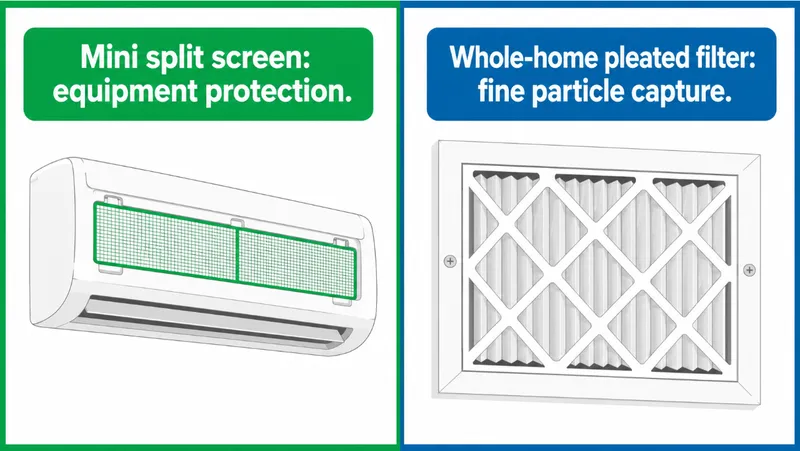
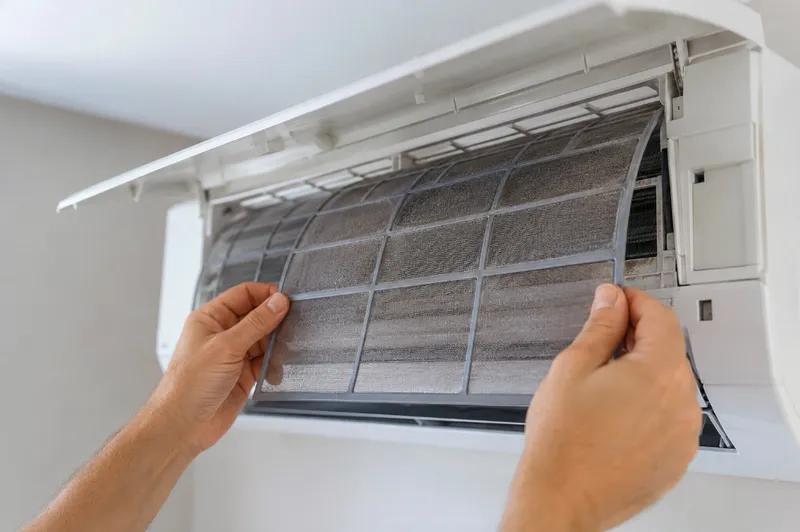
Daikin ductless indoor units do not take a pleated filter. Each wall-mounted head ships with two washable mesh screens behind the front panel, and most accept an optional titanium apatite photocatalytic filter in a separate frame. The screens are part-number specific, and the right number depends on the indoor unit model rather than the series name.
Match the part number to the model tag inside the front panel, then order through the Daikin Spare Parts Bank or an authorized distributor. Universal screens rarely seat right, and one that does not seat lets air bypass the coil.
Here is the part most Daikin reviews leave out, and we only thought to check it because filters are what we make. EPA states plainly that ductless mini-split heat pumps generally do not filter fine particles, because the filters in them exist to keep pet hair and lint off the coil rather than to clean the air you breathe. EPA's guidance for fine particles is MERV 13 or higher, and no wall-mounted head gets you there alone.
Pacific Northwest National Laboratory tested the add-on approach. Because a clip-in purifying filter covers only part of the screen area, most of the air bypasses the supplemental filter, which the lab calls minimal additional benefit. Daikin treats filtration as an accessory sold through a channel most homeowners never find. Filterbuy built its ductless line the other way around, having spent a decade making filters before making equipment. Multi-layer filtration and a self-cleaning cycle come standard, and the unit tells you when the filter needs attention.
There is a second maintenance cost nobody puts in a quote. Because ductless heads filter poorly, dust and moisture collect on the blower wheel, and Pacific Northwest National Laboratory recommends deep cleaning a wall-hung head every one to three years. That job takes disassembly plus specialist tools, so it is not a homeowner task. Budget for it on any brand you pick.
Whichever unit ends up on your wall, the whole-home return is where fine-particle filtration happens, so MERV 13 pleated media sized to your system does what no head unit can. Filterbuy makes that filter in over 600 sizes, which is the part of this problem we have actually solved.
Five Questions To Ask Before You Sign A Daikin Quote
Every question below comes out of something we found while researching Daikin for this review. Ask a dealer all five and you will know more about the install than most buyers learn after it is finished. We would want a buyer asking the same five before choosing a Filterbuy system.
What is the AHRI reference number for this exact indoor and outdoor pair? A dealer who cannot produce one is quoting a rating nobody certified.
Who registers the warranty, and when do I get written confirmation? The 12-year parts coverage depends on this happening inside 60 days.
Are you a Daikin Comfort Pro dealer? Not being one is not disqualifying, but it changes who handles a warranty claim later.
What does our local mechanical code require for A2L refrigerant handling on this job? A blank look here is the answer.
What are the replacement screen part numbers for this indoor unit? Get them in writing at install, not two years later with a flashlight.
Which Mini Split Fits Your Situation
Neither Daikin nor Filterbuy is right for every home, and the deciding factor is usually climate weighed against air quality. Settle sizing and zone count first using our guide on how to choose a mini split system.
Either way, verify the certified ratings for your exact pair before signing, and get a room-by-room load calculation.
"Most ductless brands are HVAC companies that added a filter. We came at it from the other direction. After manufacturing filters for over a decade and serving more than two million households, we knew the thing homeowners actually complain about is not the temperature, it is the air. Daikin builds excellent equipment. We built ours around the problem we already understood."
David Heacock, Founder and CEO, Filterbuy
Seven Authorities To Check Before You Buy Any Mini Split
Learn Why Your Mini Split Will Not Clean Your Air
The U.S. Environmental Protection Agency states directly that ductless mini-split heat pumps generally do not filter fine particles. Read this before assuming any wall-mounted head counts as an air quality upgrade.
Source: Do Ductless Mini-Split Heat Pumps Filter Fine Particles Out Of Indoor Air? (US EPA).
See Why Add-On Purifying Filters Get Bypassed
Pacific Northwest National Laboratory documents why a clip-in purifying filter covering part of the screen area lets most airflow around it. This is the engineering detail that settles the filtration question for every ductless brand, not only Daikin.
Source: Ductless (Mini-Split) Heat Pumps (Building America Solution Center, PNNL).
Verify The SEER2 Rating Before You Sign
The Air-Conditioning, Heating, and Refrigeration Institute maintains the public database of independently certified equipment ratings. Look up the exact indoor and outdoor pairing before accepting any efficiency number a seller quotes.
Source: AHRI Directory Of Certified Product Performance.
Confirm A Model Really Performs In Cold Weather
Northeast Energy Efficiency Partnerships publishes the cold-climate product list that state and utility incentive programs use to qualify equipment. Check your model here if winter output is the reason you are buying.
Source: ccASHP Specification And Product List (Northeast Energy Efficiency Partnerships).
Check The Federal Efficiency Minimum For Your Region
The U.S. Department of Energy publishes the efficiency standards and test procedures that govern residential ductless equipment. Use it to confirm the minimum any legally sold system must meet where you live.
Source: Consumer Central Air Conditioners And Heat Pumps (US Department of Energy).
Understand Why A Mini Split Counts As A Central System
Federal regulation classifies mini splits and multi-splits as central air conditioners rather than room air conditioners. That single classification decides which efficiency standards and which rebate programs apply to your installation.
Source: 10 CFR 430.2 Definitions (Electronic Code of Federal Regulations).
Know The Refrigerant Rules Your Installer Must Follow
The International Code Council explains the GWP limits and installation requirements governing R-32 and other A2L refrigerants. Read it before an installer tells you a code provision does not apply to your job.
Source: EPA's Technology Transitions Program Related To A2L Refrigerants (International Code Council).
Three Numbers That Put The Filtration Question In Context
1. 152.3 Million Americans Breathe Air That Fails A Health Grade
44 percent of the United States population lives in a failing county.
46 percent of American children do.
Grades use EPA monitoring data from 2022 through 2024.
Indoor filtration works against that outdoor baseline.
Source: State Of The Air 2026 Key Findings (American Lung Association).
2. 8.6 Percent Of American Adults Currently Have Asthma
8.6 percent of adults and 6.5 percent of children, as of 2024.
1.4 million emergency department visits a year.
3,722 deaths in 2024.
A washable mesh screen is not a filtration plan for these households.
Source: FastStats Asthma (CDC National Center for Health Statistics).
3. Wildfire Smoke Is Up To Ten Times More Harmful Than Other Fine Particles
Respiratory hospitalizations rose 1.3 to 10 percent per 10 micrograms of wildfire PM2.5.
The same increase from other PM2.5 sources moved them only 0.67 to 1.3 percent.
Drawn from 14 years of Southern California hospital admissions.
Smoke season is not ordinary air pollution.
Source: Aguilera et al. 2021, Nature Communications (via PubMed Central, National Institutes of Health).
Frequently Asked Questions
Is Daikin better than Filterbuy for a mini split?
Daikin is better on seasonal efficiency and parts warranty length. Filterbuy is better on integrated filtration and on getting the system to you quickly. Cold-climate buyers should lean Daikin. Buyers shopping because of allergies, pets, or smoke should lean Filterbuy.
What is the Daikin ENTRA series?
ENTRA is Daikin's entry-level single-zone wall-mount series, introduced to replace the 17 Series during the SEER2 update. ENTRA units use R-32 and carry a simpler feature set than AURORA or EMURA.
Do Daikin mini splits qualify for a federal tax credit in 2026?
No. The Section 25C credit expired for equipment placed in service after December 31, 2025. Look to state programs and utility rebates instead, since those vary by location and remain active in many areas.
Can I put a MERV 13 filter in a Daikin wall unit?
No. Daikin wall-mounted heads are built around a thin washable screen with no housing for pleated media. Handle MERV 13 filtration at your whole-home return, or use a portable air cleaner if the home has no ducts.
Does Daikin still use R-410A?
Not in new residential equipment. Daikin's current United States lineup runs on R-32, and existing R-410A systems remain legal to operate and repair.
Glossary
AHRI Reference Number: A unique identifier confirming an indoor and outdoor unit pair is tested and certified together as a matched system.
A2L: A refrigerant safety classification meaning lower toxicity and mild flammability. R-32 is an A2L refrigerant and carries installation requirements R-410A equipment did not.
GWP: Global Warming Potential, a refrigerant's climate impact relative to carbon dioxide. EPA applies a 700 GWP ceiling to new residential air conditioning and heat pump equipment.
MERV: Minimum Efficiency Reporting Value, the scale for how well a filter captures particles. EPA recommends MERV 13 or higher for fine particles.
Mini Split: A ductless system pairing an outdoor compressor with one or more indoor heads. Federal rules classify mini splits as central air conditioners rather than room air conditioners.
SEER2: Seasonal Energy Efficiency Ratio 2, the metric for seasonal cooling efficiency set under DOE energy conservation standards, measured under a tougher test than the original SEER.
VRV: Variable Refrigerant Volume, the Daikin trademark for the zoned refrigerant-flow technology introduced in 1982. Other manufacturers call the same approach VRF.