How to Heat a Sunroom in Winter (and Make It a True Four-Season Room)
October 15, 2026
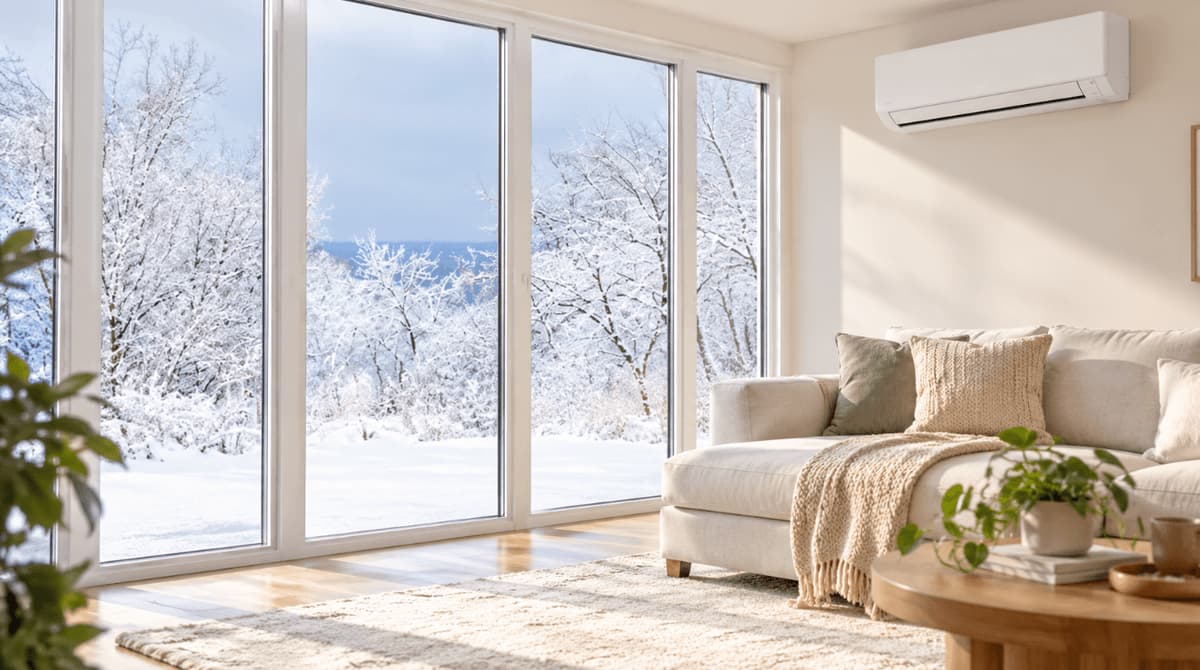
Heat a sunroom with a ductless mini split heat pump, sized to the room's glass instead of its floor area. Single-pane glass loses roughly 18 times more heat per square foot than an insulated wall. That is why a sunroom can need 25 to 80 BTU per square foot instead of the usual 20 to 25.
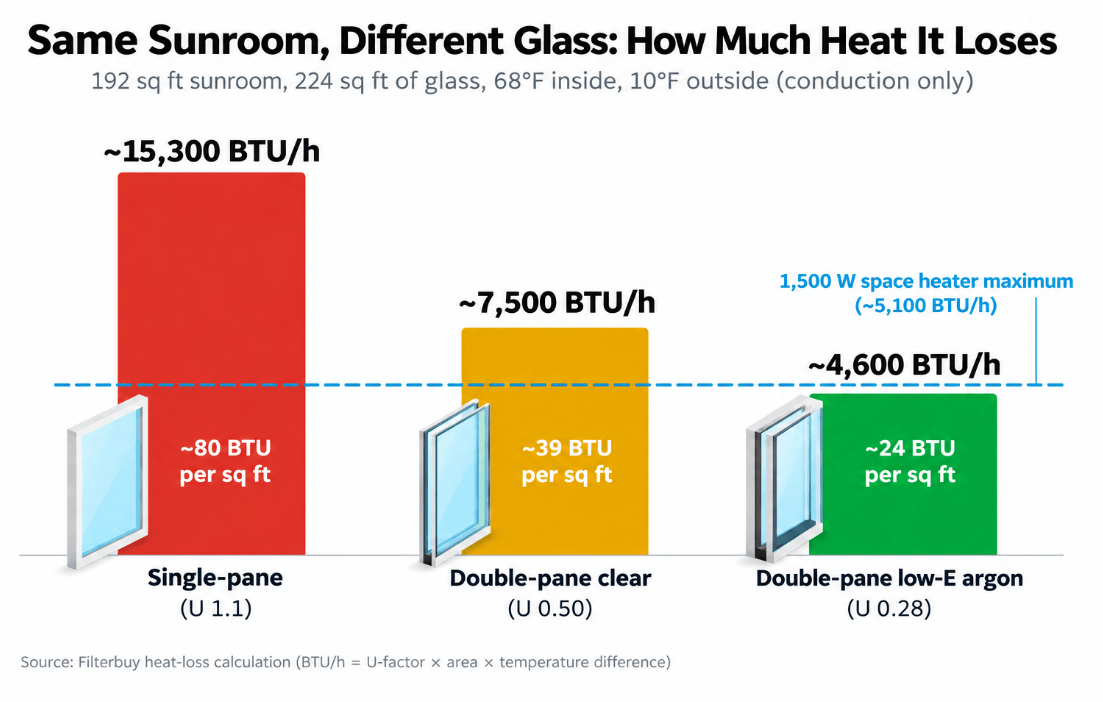
Here is how the glass changes the math in a 192 sq ft sunroom at 10°F outside:
Single-pane glass: about 15,300 BTU/h. Use a 24,000 BTU unit, or upgrade the glass first.
Double-pane clear: about 7,500 BTU/h. A 12,000 BTU unit covers it.
Double-pane low-E: about 4,600 BTU/h. A 12,000 BTU unit covers it with headroom.
A mini split heats and cools from one unit on its own thermostat. A 1,500-watt space heater makes roughly 5,100 BTU/h, which falls short in a single-pane room during a freeze.
Filterbuy single-zone mini splits come with fast and free 2-day delivery to most US states, plus a 7-year compressor and 3-year parts warranty. Professional installation keeps that warranty in force.
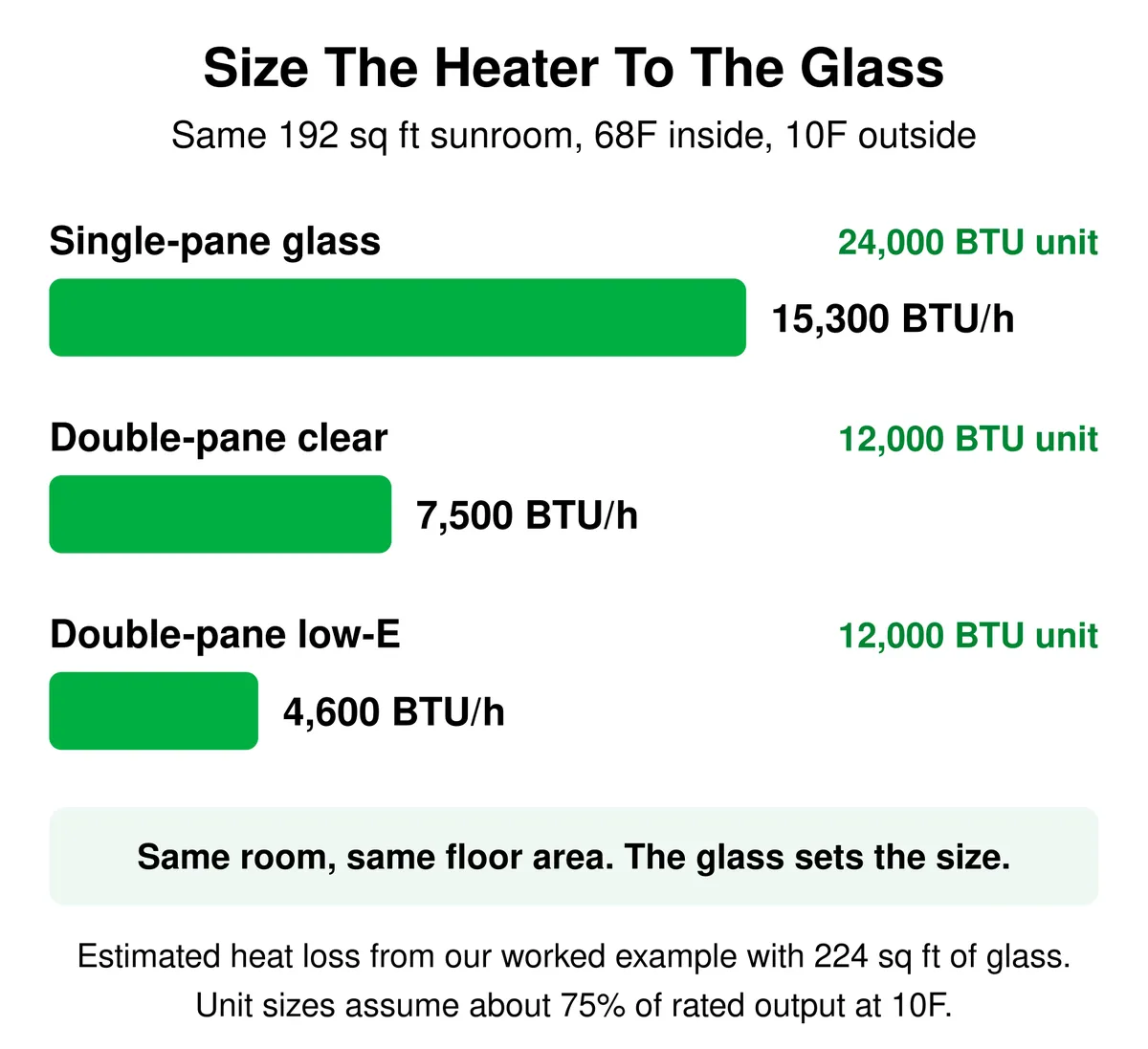
Sizes from 12,000 to 24,000 BTU. Heating and cooling in one system.
Not sure which size fits your sunroom? Answer a few quick questions and we'll match you to the right mini split.
TL;DR
The best way to heat a sunroom in winter is a ductless mini split heat pump, sized to the room's glass rather than its floor area. Because glass loses heat several times faster than an insulated wall, a sunroom can need 25 to 80 BTUs per square foot instead of the usual 20 to 25. Filterbuy's heat-loss math shows better glass lets you buy a smaller, cheaper-to-run heater.
Key Takeaways
Glass is the heat leak. Single-pane glass loses roughly 18 times more heat per square foot than an insulated wall.
A ductless mini split is the best permanent sunroom heater, with heating and cooling on a dedicated thermostat.
Size by heat loss, not square footage. In Filterbuy's 192 sq ft example, low-E glass needed 4,600 BTU/h while single-pane needed 15,300.
A space heater has a ceiling. A 1,500-watt heater makes roughly 5,100 BTU/h, too little for a single-pane room in a freeze.
Check local code before tapping house ducts. Many codes require sunrooms to have separate heating.
Why Is a Sunroom So Hard to Heat?
A sunroom is hard to heat because glass is a poor insulator. Single-pane glass has a U-factor of 1.0 to 1.3, while a code-built insulated stud wall rates near 0.06. That gap is why a sunroom feels pleasant at noon and frigid by 8 p.m.
U-factors: U.S. Department of Energy and International Energy Conservation Code (IECC) values. Multipliers: Filterbuy calculations (U-factor ÷ 0.06).
What Is the Best Way to Heat a Sunroom?
If you plan to use your sunroom all winter, a ductless mini split heat pump is the best all-around choice. A heat pump moves heat instead of making it, and ENERGY STAR reports that certified mini splits use up to 60% less energy than electric radiators.
How Do You Size a Mini Split for a Sunroom?
To size a mini split for a sunroom, estimate how much heat the room loses through its glass and solid surfaces, then pick a unit that can replace it on a cold night. Filterbuy's sizing guide uses the 20 to 25 BTU per square foot rule, which works for bedrooms and offices but not sunrooms, so we built the method below.
Heat loss formula: BTU/h = U-factor × area (sq ft) × temperature difference (°F)
Measure the glass. Total the glazed area and find its U-factor on the National Fenestration Rating Council (NFRC) label. If there's no label, hold a lit lighter to the glass. Two flame reflections mean single-pane, four mean double-pane, and a tinted reflection means low-E.
Set the temperature difference. Subtract your winter design temperature from your target indoor temperature.
Run the formula for the glass and each solid surface, then add the results.
Add margin for air leakage.
Match the unit to the cold. Compare your total to the unit's heating output at your design temperature, not its 47°F rating.
Worked example: a 12 × 16 ft sunroom (192 sq ft) with 224 sq ft of glass, insulated knee walls and roof, 68°F inside, and 10°F outside.
Filterbuy calculation, conduction only. Unit sizes assume about 75% of rated output at 10°F; check the spec sheet.
We'll be straight with you: Filterbuy mini splits heat reliably down to 5°F, but we haven't published a 5°F capacity figure. If your winters regularly drop lower, choose an ENERGY STAR cold-climate model; Filterbuy's ranking of the best mini splits for cold climates compares them. ENERGY STAR recommends a Manual J load calculation to confirm the size.
"Reading the submittals side by side changed how I look at cold-climate marketing. A unit rated to -22°F can still give up heat at 5°F, and a unit that keeps every BTU at 5°F can shut off at -13°F. Both numbers belong on every quote you get."
— Michelle Wan, Brand Manager and Air Quality Writer, Filterbuy
Filterbuy single-zone mini splits ship free in 2 days on in-stock systems, with a 7-year compressor and 3-year parts warranty. Professional installation is required; the warranty is void if self-installed. Browse Filterbuy ductless mini split systems by room size.
Can a Space Heater Heat a Three-Season Room?
A space heater can take the chill off a three-season room, but it rarely keeps one comfortable in freezing weather. A standard 1,500-watt model puts out roughly 5,100 BTU/h, about a third of what our single-pane example room loses at 10°F.
Filterbuy also compared the electricity each option needs to make that heat. A heat pump's lead is widest in mild weather and narrows as it gets colder.
Filterbuy calculation. Field COPs from the Center for Energy and Environment Minnesota study. Multiply kWh by your electric rate.
The National Fire Protection Association's Home Heating Fires report finds space heaters cause about one-third of home heating equipment fires but most of the deaths. Use a lab-listed model with tip-over shutoff, keep it 3 feet from anything that burns, plug it into the wall, and turn it off when you leave or sleep.
How Do You Turn a Three-Season Room Into a Four-Season Room?
Turning a three-season room into a four-season room works best when you fix the envelope first and add heat last. Each upgrade shrinks the heater you'll need.
Upgrade the glass. It's the biggest fix; the DOE notes low-E storm windows can cut heating and cooling costs 12–33%.
Air seal the sliders and the seam where the room meets the house.
Insulate the roof and knee walls, then the floor or crawlspace.
Add cellular shades, closed at night and open on sunny days.
Install dedicated heat, ideally a mini split.
Check your local code before you start. To qualify for lighter "thermally isolated" sunroom rules, many jurisdictions require closeable doors or windows between the sunroom and the house and a separately controlled heating and cooling system. Tying it into your house ducts can make it a regular addition under code, so call your permit office first.
How Do You Heat a Florida Room?
A Florida room needs cooling and dehumidification far more than heat, so a mini split is usually the best fit. Filterbuy's HVAC Solutions team services ductless systems in Florida, where one unit can handle summer cooling and the occasional winter cold snap.
How Does Heating a Sunroom Affect Your Indoor Air?
Heating a sunroom changes its air along with its temperature.
Unvented combustion heaters: The EPA lists unvented kerosene and gas heaters as sources of carbon monoxide and nitrogen dioxide, so install a CO alarm anywhere fuel burns.
Condensation: Cold single-pane glass fogs and drips onto the sills. Low-E glass stays warmer and drier.
Mini split filters: Filterbuy makes air filters, so we'll keep this plain: the pre-filter protects the coil, and your whole-home filter does the heavy lifting for air quality. Rinse the mesh every two weeks during heavy use with Filterbuy's guide to cleaning mini split filters, and if you extended your ducts, check your HVAC air filter more often.
The Filterbuy take: Filterbuy has built air filters in the U.S. since 2013 and now sells single-zone ductless mini splits, including those linked here. Before recommending a size, we ran the heat-loss math, and it pointed to the glass, not the floor area.
Supporting Statistics
42% of home energy goes to space heating. Heating topped home energy use in 2020, and electric-heat households spent an average of $396 a year on it, according to the U.S. Energy Information Administration.
Ducts can waste more than 30% of heating and cooling energy, according to the ENERGY STAR.
Cold-climate heat pumps met their ratings in Minnesota winters. A field study by the Minnesota nonprofit Center for Energy and Environment found they cut site energy use 35–50%.
Sunroom Heating FAQ
What is the cheapest way to heat a sunroom?
A space heater costs the least to buy, and a mini split costs the least to run, using as little as a third of the electricity on mild days.
Is a 12,000 BTU mini split enough for a sunroom?
Often. We rate the Filterbuy 12,000 BTU mini split for rooms up to 550 sq ft, but glass changes the math. A unit still putting out about 9,000 BTU/h at 10°F can cover a low-E sunroom of roughly 350 sq ft, yet only about 110 sq ft with single-pane glass.
Can I heat my sunroom with my home's furnace?
Sometimes, though rarely well. Your furnace was sized for the house, one thermostat can't balance a glass room, and many codes require separate heating controls.
Should I turn the sunroom heat down when I'm not using it?
With a mini split, usually not. ENERGY STAR advises holding a steady temperature, because heat pumps don't save energy by turning down while you're away.
Is there a federal tax credit for a sunroom mini split?
The 25C credit was terminated for systems placed in service after Dec 31, 2025; confirm eligibility with a tax professional.
Glossary
BTU (British thermal unit): The energy to warm one pound of water 1°F.
U-factor: The rate heat flows through a window or wall; lower numbers insulate better.
Low-E glass: Glass with a coating that reflects heat back inside.
Ductless mini split heat pump: A heat pump with a wall-mounted indoor unit and no ductwork.
COP (coefficient of performance): Heat delivered divided by energy used.
Cold-climate heat pump: A heat pump certified to keep 70% of its capacity at 5°F.
Three-season room: A sunroom without permanent heat.
Four-season room: A sunroom built for year-round use.
Thermally isolated sunroom: A sunroom closed off from the house with separate heating controls.
Design temperature: The local cold-weather temperature a heater is sized for.
Manual J: The Air Conditioning Contractors of America (ACCA) method for calculating heating and cooling loads.