Ductless Mini Split Systems
Ductless Mini Split Systems, Matched to Your Room
A ductless mini split heats and cools a single room without ductwork — and choosing the right one mostly comes down to your room’s square footage.
Filterbuy carries three BTU sizes, each available in 115V and 230V, so you can match the system to your space and your home’s electrical setup.
- 9,000 BTU — 150–350 sq ft: bedrooms, home offices, small additions
- 12,000 BTU — 400–600 sq ft: living rooms, studios, master suites
- 18,000 BTU — 700–1,000 sq ft: large living areas, finished garages, open-plan spaces

Not sure which size fits? Answer 5 quick questions and we’ll match you to the right mini split.
Prefer to browse first? Shop all ductless mini split systems →
Your bonus room bakes in July and freezes in January. Central air has never quite reached it. A ductless mini split was built for exactly that.
Filterbuy’s single-zone mini split heat pumps heat and cool any room without ductwork. Finishing a garage? Upgrading a bonus room? Adding climate control to an older home that was never wired for central air? These systems install where running ducts would be expensive, disruptive, or just not practical. They run quietly and operate year-round, using inverter-driven technology that adjusts output continuously rather than hammering on and off like older systems.
Every ductless air conditioner in our lineup includes a wall-mounted indoor unit that’s compact and easy to live with. Choose from three BTU sizes. The 12,000 BTU comes in both 115V and 230V; the 18,000 BTU and 24,000 BTU run on 230V. Match the right system to your room's square footage and your home's electrical setup.
And because this is Filterbuy, we’ve spent more than a decade helping millions of homeowners understand and improve their indoor air. That obsession doesn’t stop at the filter. Every mini split AC system we sell comes with the same air quality knowledge we’ve built since 2013. From the unit to the filter, we’ve got your air covered.
Shop Ductless Mini Split Heat Pumps by Room Size
Find the right mini split system for your space. Use the table below to match your room’s square footage to the right BTU output, then pick your voltage.
| BTU Size | Room Coverage | Best For | Voltage Options |
|---|---|---|---|
| 12,000 BTU | Up to 550 sq ft | Bedrooms, living rooms, home offices, studios | 115V / 230V |
| 18,000 BTU | Up to 850 sq ft | Large living areas, master suites, open-plan spaces | 230V |
| 24,000 BTU | Up to 1,100 sq ft | Large open areas, finished basements, oversized garages, workshops | 230V |
What Is a Ductless Mini Split System?
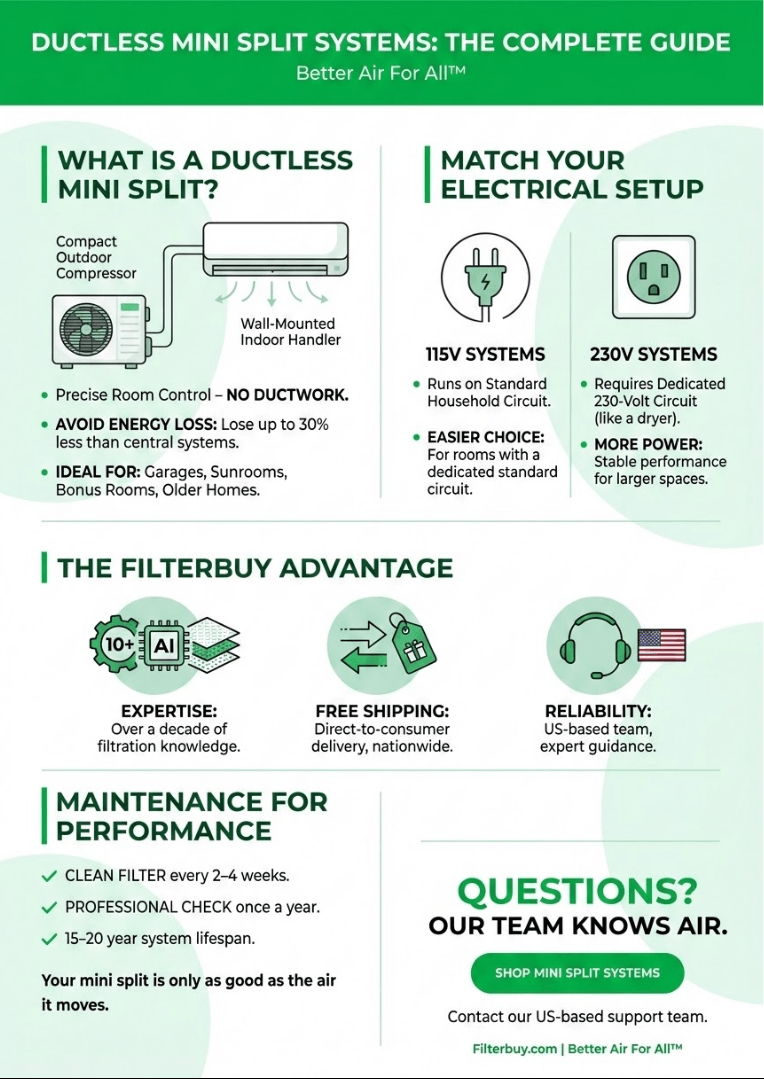
A ductless mini split connects a compact outdoor compressor to a wall-mounted indoor air handler. No ductwork required. Refrigerant moves between the two units through a small conduit in the wall, delivering precise temperature control directly to the room.
Central air systems push conditioned air through a duct network, losing energy at every joint and gap along the way. The U.S. Department of Energy estimates that duct losses account for more than 30% of energy consumption in central HVAC systems — energy that a ductless setup keeps in the room where it belongs.
Most mini split systems also function as heat pumps, which means one unit cools in summer and heats in winter. For single-room climate control, it’s one of the most practical and energy-efficient options available.
How to Choose the Right Size Mini Split
Getting the BTU rating right is the most important call you’ll make when buying a mini split. Go too small, and the unit never catches up. Go too big and it short-cycles, running in brief bursts that waste energy and let humidity build up. Use the table below to find your starting point.
| Room Size (sq ft) | Recommended BTU | Typical Rooms |
|---|---|---|
| Up to 550 sq ft | 12,000 BTU | Bedrooms, living rooms, master bedrooms, studios, sunrooms |
| Up to 850 sq ft | 18,000 BTU | Large living areas, master suites, open-plan rooms |
| Up to 1,100 sq ft | 24,000 BTU | Large open areas, finished basements, oversized garages, lofts, workshops |
Ceiling height, sun exposure, insulation quality, and local climate can all shift the math. Rooms with large windows, poor insulation, or heavy sun exposure may need a step up in capacity. If you want a precise number, a licensed HVAC professional can run a proper load calculation.
115V vs. 230V — Which Do You Need?
Your voltage depends on what’s already in your home. A 115V mini split runs on a standard household circuit, making it the easier choice for rooms that already have a dedicated circuit. A 230V mini split needs a dedicated 230-volt circuit, similar to what powers a dryer or electric range, but it delivers more stable performance for larger systems.
All three BTU sizes are available in both voltages. If you’re not sure which is right, check your breaker panel or ask your electrician before you order.
Why Filterbuy? The Air Quality Difference
Ceiling height, sun exposure, insulation quality, and local climate can all shift the math. Rooms with large windows, poor insulation, or heavy sun exposure may need a step up in capacity. If you want a precise number, a licensed HVAC professional can run a proper load calculation.
115V vs. 230V — Which Do You Need?
Your voltage depends on what’s already in your home. A 115V mini split runs on a standard household circuit, making it the easier choice for rooms that already have a dedicated circuit. A 230V mini split needs a dedicated 230-volt circuit, similar to what powers a dryer or electric range, but it delivers more stable performance for larger systems.
The 12,000 BTU is available in 115V and 230V. The 18,000 BTU and 24,000 BTU are 230V only. If you're not sure which is right, check your breaker panel or ask your electrician before you order.
Why Filterbuy? The Air Quality Difference
Most mini split retailers sell you a box and move on. We don’t.
At Filterbuy, we think about what happens after the install, because clean air doesn’t stop at the thermostat. Here’s what most people miss: mini splits use filters with lower MERV ratings than traditional central HVAC systems. Less filtration by default. Without regular cleaning and replacement, those filters clog with dust, pet dander, and allergens, cutting airflow, driving up energy costs, and compromising the air your family breathes.
That’s where more than a decade of air quality work makes the difference. We’ve helped millions of homeowners understand and improve their indoor air. We know filtration inside and out, and we bring that knowledge to every mini split we sell.
When you buy a mini split from Filterbuy, you get:
Expert guidance on mini split filter maintenance to protect performance and air quality
Access to Filterbuy’s full library of indoor air quality resources, guides, and product recommendations
A partner who stays involved after the sale, not just at checkout
Free shipping on every order
Support from a team that actually knows air quality
Your mini split is only as good as the air it moves. We make sure that air is clean.
Mini Split FAQs
Ready to Buy a Mini Split Online?
Shop Filterbuy’s full lineup of ductless mini split systems: three BTU sizes with 115V and 230V options available, free shipping on every order. And unlike any other mini split retailer, we back every purchase with the air quality knowledge we’ve spent over a decade building.
Questions? Our team knows air.