
Wildfire Smoke And Babies: A Guide To Protecting Infants And Toddlers With A Nursery Clean Room Setup
July 15, 2026
By Michelle Wan · Technically reviewed by David Clark, Licensed HVAC Technician · Published July 15, 2026 · Updated September 4, 2026
How Do You Protect A Baby From Wildfire Smoke?
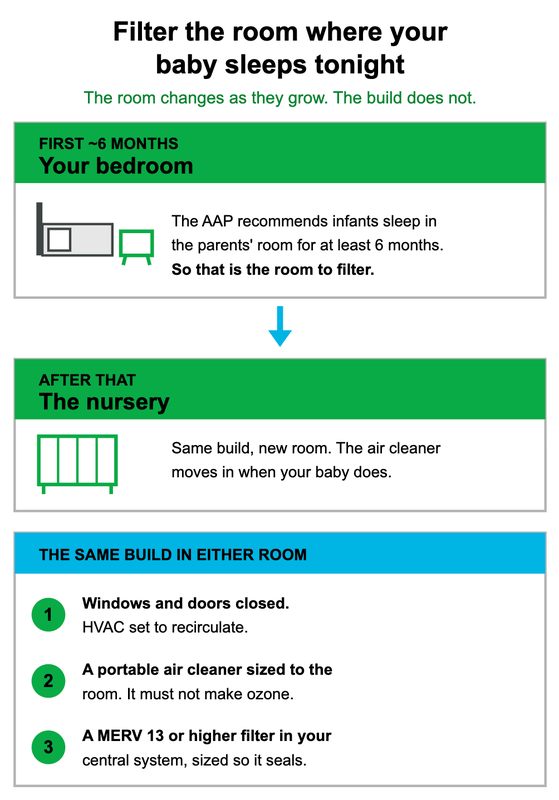
Set up one clean room where your baby sleeps: windows and doors closed, the HVAC on recirculate, and a portable air cleaner sized to the room that does not make ozone. The EPA also recommends a MERV 13 or higher filter in your central system, which captures microscopic particles and is the highest level of residential filtration — sized so it seals, because air goes around a gap instead of through the media.
For roughly the first 6 months, that room is your bedroom, not the nursery: the AAP recommends infants sleep in the parents’ room for at least that long. Masks are not an option under age 2, so clean indoor air is the whole strategy.
Not sure which filter your system takes? The quick match below will sort it out.
Answer 3 quick questions and we’ll match you to your filter.
Already know your size? Find your exact filter size at Filterbuy →
Quick answer: Babies and toddlers are more vulnerable to wildfire smoke than adults because their lungs are still developing, their airways are narrower, and they breathe more air relative to their body weight. The most effective steps are staying indoors, setting up a clean-air room with a HEPA air purifier, monitoring the Air Quality Index (AQI), and following your pediatrician's guidance on when to seek care.
Wildfire season is getting longer and more intense across the US. For parents of newborns, infants, and toddlers, a smoke advisory isn't just an inconvenience. It's a real health concern that requires a plan. The good news is that there are concrete, practical steps you can take to reduce your baby's exposure, even if you can't leave the area.
This guide covers everything you need to know: how to read the AQI, how to set up a clean-air room, what size air purifier your baby's nursery needs, what warning signs to watch for, and which popular protective measures actually don't work. Every recommendation here is grounded in guidance from the EPA, CDC, American Academy of Pediatrics (AAP), and other trusted public health sources.
Key Takeaways
Babies breathe faster and inhale more air relative to their body weight than adults, which means wildfire smoke is more harmful to them.
An AQI above 100 is considered unhealthy for sensitive groups, including young children. Infants may need extra caution even at lower levels.
A clean-air room (one designated space in your home with filtered air) is the most effective way to protect your baby indoors.
A HEPA air purifier sized correctly for the room (using smoke CADR, not just square footage) provides the most reliable particle reduction.
Your HVAC system can help, but only if the filter fits well, has a sufficient MERV rating, and is replaced when dirty or restrictive.
Masks are not safe or effective for children under two.
Know the warning signs of smoke exposure, and know when to leave.
What Should You Do Right Now to Protect a Baby From Wildfire Smoke?
If smoke is affecting your area now, work through this checklist:
Check the AQI. Use AirNow's live AQI map to see current air quality in your zip code. Conditions can change quickly.
Keep your baby indoors. Limit time outside to the shortest necessary trips. If you must go out, use a stroller canopy to reduce direct exposure.
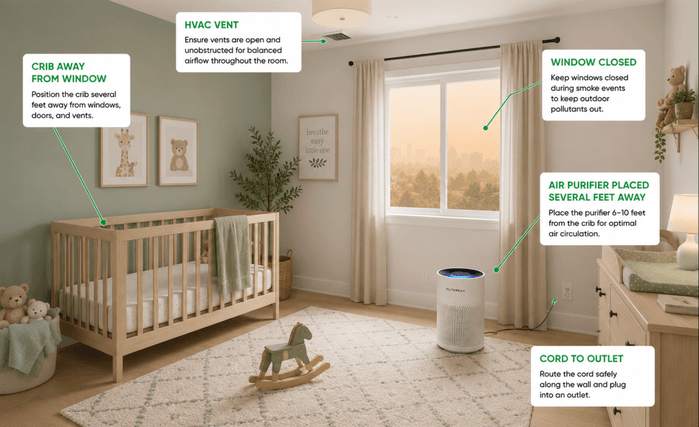
Choose one room as your clean-air room. Pick the coolest, cleanest room where your baby sleeps or spends the most time, ideally an interior room away from heavy outdoor air infiltration.
Close windows and doors. Don't rely on closed windows alone, but start here while you set up filtration.
Run a HEPA air purifier sized for the room. Place it away from walls, cribs, and any items that could block airflow. See the sizing section below.
Set your HVAC to recirculate indoor air. Switch to "recirculate" or "fan on" mode, and make sure there's a clean, properly fitting, high-efficiency filter installed. Confirm filter compatibility with your system's documentation or an HVAC professional.
Avoid creating indoor particles. Skip candles, incense, frying, vacuuming, and wood-burning fireplaces while smoke levels are elevated.
Avoid ozone-generating air devices. Ozone is a lung irritant and can be harmful, especially for infants.
Watch for symptoms. Coughing, wheezing, unusual fussiness, and difficulty feeding can all be signs of smoke exposure.
Know when to leave. If your home can't maintain clean indoor air, or if an evacuation order is issued, have a plan to go. See the evacuation section below for guidance.
Why Is Wildfire Smoke More Dangerous for Babies?
Wildfire smoke contains PM2.5, fine particles 2.5 micrometers or smaller that can travel deep into the lungs. At that size, particles are small enough to pass through the lung wall and into the bloodstream. For adults, this is serious. For babies, the risks are compounded by several factors.
Their lungs are still developing. The lungs continue to grow and mature throughout childhood. Exposure to air pollution during this critical window can interfere with that development and lead to long-term respiratory effects, according to the Pediatric Environmental Health Specialty Units (PEHSU).
Their airways are narrower. Even minor inflammation can cause noticeable breathing difficulty in an infant. There's less space to spare.
They breathe more air relative to their body weight. Babies breathe faster than adults and take in more air per pound of body weight, which means higher relative exposure to any pollutant in the air they breathe.
They can't tell you how they feel. Unlike older children, infants can't describe chest tightness, throat irritation, or headache. Smoke exposure can worsen quietly before it becomes visible.
They can't wear masks. No mask is safe or effective for children under two (more on this below), which removes a key protective option available to older children and adults.
What AQI Is Unsafe for Babies?
Quick answer: An AQI above 100 is considered unhealthy for sensitive groups, which includes babies and toddlers. Infants may need extra precautions even at moderate levels, especially those with existing respiratory conditions.
The Air Quality Index (AQI) is a 0-500 scale that measures outdoor air pollution, including PM2.5 from wildfire smoke. Here's how to interpret it for babies and toddlers:
| AQI | Category | Guidance for Babies and Toddlers |
|---|---|---|
| 0–50 | Good | Air quality is satisfactory. Normal outdoor activity is fine. |
| 51–100 | Moderate | Generally acceptable, but babies with respiratory conditions may be sensitive. Monitor for any changes. |
| 101–150 | Unhealthy for Sensitive Groups | Keep healthy babies indoors as much as possible. Limit outdoor exposure for all infants and toddlers. Run your clean-air room. |
| 151–200 | Unhealthy | Keep all babies indoors. Run air purifier continuously. Avoid opening windows or doors. |
| 201–300 | Very Unhealthy | Stay indoors with air purifier running. Avoid all unnecessary outdoor exposure. Consider relocating if smoke is expected to persist. |
| 301+ | Hazardous | Do not take babies outside. Follow all local health authority guidance. Evacuation may be the safest option. |
AQI levels can shift significantly within hours, especially during active fires or changing winds. Check AirNow frequently rather than relying on a single morning reading.
How to Create a Clean-Air Room for Your Baby
A clean-air room is a single designated space in your home where you concentrate your efforts to keep the air as clean as possible. According to EPA indoor air guidance, setting up one well-filtered room is more effective than trying to filter an entire home during a smoke event. The goal is a cooler, cleaner environment where your baby can sleep and spend most of their time safely.
Choose the Best Room
Look for a room that:
Your baby already sleeps in or spends the most time in
Has fewer windows and exterior doors (fewer potential entry points for outside air)
Is on an upper floor if smoke is ground-level, or a lower floor if smoke is airborne and your upper levels are warmer
Is cool enough to maintain a safe sleep temperature, since overheating is a significant concern for infants and heat safety always takes priority over smoke reduction
Close Windows and Limit Outdoor Air
Close all windows and doors in the clean-air room. If your home is well-sealed, this alone can reduce indoor particle levels, though it won't eliminate them. Older homes with gaps around windows, doors, and outlets will allow more infiltration. Closing windows is a necessary first step, but it is not sufficient on its own.
Use Your HVAC System for Filtration
If your home has central heating or cooling, your HVAC system can help filter particles from the air as it circulates. To use it effectively during a smoke event:
Set the system to recirculate indoor air rather than drawing in outdoor air.
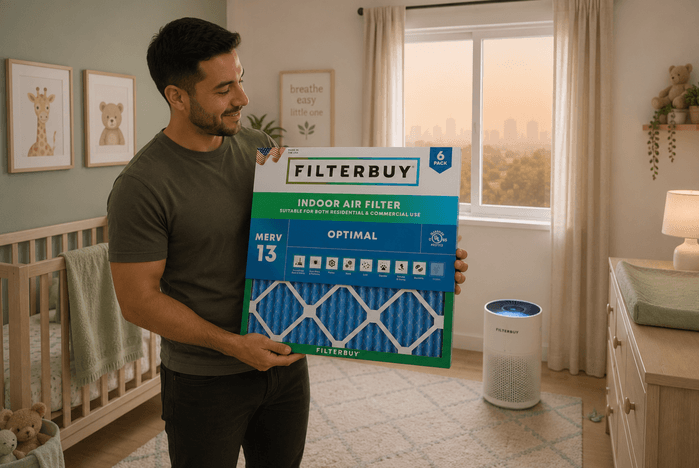
Replace your current filter with one rated MERV 13, or the highest-efficiency filter your system can safely accommodate. Check your system's documentation or consult an HVAC professional before installing a higher-rated filter, as some systems cannot handle the increased airflow resistance.
Make sure the filter fits properly. Poor fit can allow air to bypass the filter media, reducing its effectiveness.
Inspect your filter frequently during heavy smoke events. Replace it when it looks visibly dirty, smells like smoke, or is restricting airflow, or according to manufacturer guidance, whichever comes first. There's no single replacement schedule that works for every household; the right time depends on your usage, filter type, and local air quality conditions.
Use a Portable Air Cleaner
A portable HEPA air purifier is the most reliable way to reduce PM2.5 particles in a single room. Look for a unit certified by the California Air Resources Board (CARB), which maintains a list of tested air cleaners that emit little or no ozone. Avoid any air cleaner that intentionally generates ozone, which is itself a lung irritant.
Place the unit in the room where your baby spends the most time, away from the crib and any walls or furniture that could block airflow. Run it continuously during smoke events on the highest effective setting, but check noise levels if your baby is a sensitive sleeper.
Avoid Creating More Particles Indoors
While your clean-air room is running, take care not to add particles from inside the home. During elevated smoke events, avoid:
Burning candles or incense
Using a wood-burning fireplace or gas stove without ventilation
Frying or broiling food (cooking smoke contains fine particles)
Vacuuming (which can stir settled particles back into the air)
Smoking indoors
Keep the Room Cool and Safe for Sleep
Heat safety and safe sleep must remain priorities. According to AAP safe-sleep recommendations, the sleep environment should be at a safe temperature and free of loose bedding, soft objects, and other hazards regardless of air quality conditions. If keeping windows closed causes the room to become uncomfortably warm or unsafe for your baby, that overrides the benefit of keeping smoke out. Cool air comes first.
What Size Air Purifier Does a Baby's Room Need?
Air purifier coverage claims are often based on room area alone. For wildfire smoke, a better measure is smoke CADR (Clean Air Delivery Rate for smoke particles). A higher smoke CADR means the unit cleans the air more quickly and thoroughly.
How to calculate the minimum smoke CADR for your baby's room:
Room length (ft) x room width (ft) x 0.67 = minimum smoke CADR
This formula assumes an 8-foot ceiling height. Here are common nursery sizes and their corresponding minimum smoke CADR values:
| Room Size | Square Footage | Minimum Smoke CADR |
|---|---|---|
| 8 × 10 ft | 80 sq ft | 54 |
| 10 × 10 ft | 100 sq ft | 67 |
| 10 × 12 ft | 120 sq ft | 80 |
| 11 × 13 ft | 143 sq ft | 96 |
| 12 × 14 ft | 168 sq ft | 113 |
A unit with a smoke CADR at or above the calculated minimum is appropriate for that room. Keep in mind:
Speed settings matter. A unit's rated CADR typically reflects its highest speed. Lower settings produce lower effective CADR.
A unit with a much higher CADR than needed can be run at a lower, quieter speed while still providing adequate filtration.
Confirm the CADR rating on the device label or manufacturer specifications, not just a coverage claim in square feet.
The CADR should specifically reference smoke, not just dust or pollen.
Can Babies Wear Masks During Wildfire Smoke?
No. Masks are not safe or effective for children under two years old. The American Academy of Pediatrics and the CDC advise against placing any mask or respirator on an infant. The tight fit required for filtration masks to work can restrict breathing and poses a suffocation risk for young children.
For toddlers two years and older, some filtering facepiece respirators (such as those rated N95) may provide protection if properly fitted. However, most N95 masks are designed for adult faces, and fit is critical to effectiveness. If you're considering a mask for a toddler over two, talk to your pediatrician first. A poorly fitted mask offers minimal filtration. According to CDC wildfire smoke guidance, keeping children indoors in a clean-air room is generally more effective and safer than masking.
Warning Signs of Smoke Exposure in Babies
Babies can't describe how they feel, so it's important to watch for behavioral and physical cues. Common early signs of smoke irritation include:
Unusual fussiness or inconsolable crying
Coughing or wheezing that's new or worsening
Runny nose or eye irritation (red, watery eyes)
Difficulty feeding or unusual lack of interest in feeding
Faster breathing than usual
Contact Your Pediatrician
Reach out to your child's pediatrician if your baby:
Has a persistent cough that isn't getting better
Seems more tired or lethargic than usual
Is feeding significantly less than normal
Has a runny nose that persists after smoke levels drop
Seek Medical Help Immediately
Go to an urgent care or emergency room if your baby:
Is breathing noticeably faster than normal or working hard to breathe
Has a bluish tint around the lips or fingernails
Won't feed at all
Is very difficult to wake up
Shows signs of severe distress
Call 911
Call 911 immediately if your baby:
Stops breathing
Loses consciousness
Is gasping for air
Has a seizure
When Should You Leave Instead of Staying in a Clean-Air Room?
A clean-air room is a useful strategy during short-term, moderate smoke events. But there are situations where staying put is not the right call. Consider leaving, and actively make a plan, in these scenarios:
An evacuation order has been issued. This always takes priority. Do not shelter in place against an official order.
Your home is too hot to keep windows closed safely. Your baby's body temperature regulation is limited, and heat poses serious risks.
You can't maintain a clean-air room due to poor insulation, aging HVAC, or no air purifier.
AQI remains above 200 for an extended period with no sign of improvement.
Your baby is showing symptoms of smoke exposure that are not improving indoors.
You have no power and can't run filtration or maintain safe temperatures.
Your pediatrician advises you to leave, particularly if your baby has a pre-existing respiratory condition.
If you need to evacuate, contact local emergency management or 211 for information on smoke-safe shelters and cooling centers in your area. When traveling with a baby during a smoke event, keep the car's ventilation set to recirculate until you reach a cleaner-air location.
Can You Use a DIY Box-Fan Air Cleaner Around a Baby?
A DIY air cleaner (typically a box fan with a HEPA or high-MERV furnace filter taped to the back) is a low-cost option that can help reduce indoor particle levels. The EPA has published guidance on how to build one. When made correctly, these units can provide meaningful filtration in a single room.
That said, there are important safety considerations when using a DIY air cleaner around a baby:
Use only a fan with a UL (Underwriters Laboratories) safety certification. Uncertified fans can pose fire risks.
Do not leave a DIY unit running unattended in an infant's room overnight. Unlike commercial air purifiers, box fans are not designed for continuous unattended use.
Secure the filter firmly so it cannot come loose or fall.
Place the unit away from the crib and out of reach.
Check the filter often. DIY units can load up faster than commercial purifiers, especially during heavy smoke events.
A DIY air cleaner is a reasonable option if a commercial unit isn't available or affordable, but it is not a direct substitute for a tested and certified air purifier. If you can access a certified HEPA air purifier, that remains the preferred choice for your baby's room.
Lower-Cost Ways to Protect a Baby From Wildfire Smoke
Full-home HVAC filtration and high-end air purifiers aren't accessible to every family. Here are options arranged from lowest to highest cost:
Close windows and doors — Free. Reduces infiltration, especially in tighter homes.
Switch HVAC to recirculate mode — Free if you have central HVAC. Keeps outdoor air from being drawn in.
Make a DIY box-fan air cleaner — Typically 20-50. Follow EPA guidance and observe all safety precautions.
Upgrade your HVAC filter to a higher MERV rating — Filter costs vary by size, typically 10-30. Requires HVAC compatibility check first.
Spend time at an air-conditioned public building — Free. Libraries, community centers, and cooling centers often provide clean indoor air during smoke events.
Purchase a mid-range certified HEPA air purifier — Typically 80-200. Look for CARB certification and appropriate smoke CADR for your room size.
Apply weatherstripping and door sweeps — Typically 10-40 per door. Helps seal gaps that allow smoky air to infiltrate, providing longer-term benefit beyond a single event.
What Should You Ask Your Child's Daycare?
If your baby attends daycare during a wildfire smoke event, it's worth understanding their policies in advance. Use these questions as a starting point:
Do you monitor the AQI, and at what level do you keep children indoors?
Does your HVAC system have high-efficiency filtration? What MERV rating are the filters?
Do you have portable HEPA air purifiers? If so, where are they located?
How do you ventilate classrooms: do you use outdoor air or recirculated air?
At what AQI level would you cancel outdoor play?
Do you have a smoke event policy or emergency plan for air quality?
How will you notify families if air quality worsens during the day?
Can I provide my own air purifier for my baby's room or group area?
Is there a designated clean-air room or indoor shelter space for high-AQI days?
Who should I contact if I have concerns about my child's environment during a smoke event?
What Does Not Protect Babies From Wildfire Smoke?
Some commonly used items provide little to no protection against smoke particles, and a few can make things worse:
Humidifiers. Adding moisture to the air does not filter or reduce PM2.5. Humidifiers may benefit a baby's dry or irritated airways in other contexts, but they are not a smoke protection measure.
Wet washcloths over the face. Cloth does not filter particles at the PM2.5 level, and placing anything over a baby's face poses a safety risk.
Cloth masks or surgical masks for babies. These materials do not filter fine particles effectively and are not safe for infants.
Ozone generators. These devices intentionally produce ozone, which is a lung irritant that can worsen respiratory symptoms, especially in young children.
Air fresheners and fragrance devices. These mask odors without filtering particles and may add additional irritants to the air.
Closing windows without filtration. Closing the house reduces air infiltration but does not eliminate it. Without active filtration, indoor PM2.5 levels can still rise during heavy smoke events, especially in older or less sealed homes.
Judging air quality by smell. Wildfire smoke odor does not reliably indicate PM2.5 levels. Air can smell relatively clean while still containing particles at concentrations that are harmful to infants.
What Should You Do After the Smoke Clears?
Once AQI returns to a safe level (typically Good or Moderate with a stable trend), take these steps before returning to normal routines:
Ventilate your home gradually. Open windows when outdoor AQI is consistently low, ideally in the early morning.
Replace or inspect HVAC filters. Check whether the filter looks dirty, smells smoky, or seems restrictive. Replace if needed, following manufacturer guidance.
Clean or replace your air purifier's filter. Check the manufacturer's instructions for when to replace HEPA and pre-filters.
Wipe down hard surfaces. PM2.5 can settle on counters, shelves, and furniture. Use a damp cloth to capture rather than spread particles.
Wash soft items. Wash any blankets, clothing, or stuffed toys that were in areas with smoke infiltration.
Wash your baby's hands and face before feeding or sleeping.
Monitor your baby for a few days. Respiratory symptoms from smoke exposure can sometimes appear or worsen a day or two after the event. Contact your pediatrician if symptoms persist or develop.
Restock supplies. Replace any filters, purifier cartridges, or emergency supplies you used so you're ready for the next event.
Review what worked. If your clean-air room worked well, note what you did so you can replicate it faster next time.
Protecting Your Baby When Smoke Arrives
You don't need a perfect setup to make a meaningful difference. One well-filtered room, a working HVAC filter, and a consistent eye on the AQI are more than enough to substantially reduce your baby's smoke exposure during most events.
Start with what you have. Check your current HVAC filter. If it's dirty, overdue for replacement, or rated lower than your system can handle, now is a good time to address it.
Retailers like Filterbuy offer a range of HVAC filters in various sizes and MERV ratings, which can make it easier to find the right fit for your system.
Preparing before smoke arrives makes it easier to protect your home when conditions change. Measure your filter slot carefully and confirm your system's recommended rating with a professional or your system documentation before purchasing a replacement.
If you have specific concerns about your baby's respiratory health or how to manage a chronic condition during wildfire season, your pediatrician is your best resource.
Medical disclaimer: This guide provides general wildfire-smoke safety information and is not a substitute for advice from your child's healthcare professional. Follow local evacuation instructions and seek urgent medical help for severe symptoms.
Frequently Asked Questions
Can Newborns Be Around Wildfire Smoke?
No. Newborns are among the most vulnerable to wildfire smoke due to their undeveloped lungs and inability to communicate distress. Any smoke exposure should be minimized. If you have a newborn and smoke is affecting your area, setting up a clean-air room and consulting your pediatrician are the most important immediate steps.
What Aqi Is Unsafe For Babies?
An AQI above 100 is considered unhealthy for sensitive groups, including babies and toddlers. For healthy infants, most pediatric health organizations recommend limiting outdoor exposure when AQI exceeds 100. Infants with existing respiratory conditions may need to take precautions at even lower levels. Check AirNow for current conditions in your area.
Should The Air Purifier Go In The Nursery Or The Parents' Bedroom?
Place the air purifier in the room where your baby spends the most time, typically the nursery. If your baby sleeps in your room, place it there. The goal is to keep the air cleanest where your baby is breathing most.
Does A Baby Need An Air Purifier During Wildfire Smoke?
A HEPA air purifier significantly reduces indoor PM2.5 levels and is recommended by the EPA during wildfire smoke events, particularly for sensitive groups like infants. Closing windows and running HVAC filtration help, but a portable HEPA air purifier in your baby's room provides the most direct protection.
Is A Hepa Air Purifier Safe For A Baby?
Yes. A HEPA air purifier is safe to use in a baby's room when placed correctly. Keep it away from the crib, ensure it is certified (look for CARB certification), and avoid any unit that generates ozone. Run it on the lowest effective setting if noise is a concern.
Can Wildfire Smoke Make A Baby Cough?
Yes. Coughing is one of the most common signs of smoke irritation in babies. A persistent or worsening cough, especially paired with wheezing, fast breathing, or difficulty feeding, warrants a call to your pediatrician. According to HealthyChildren.org (AAP's parenting resource), respiratory symptoms following smoke exposure should be evaluated promptly.
Should I Open The Windows After Wildfire Smoke?
Only when the AQI has returned to Good or consistently Moderate levels. Check AirNow before opening windows, and ventilate gradually. Avoid airing out the home during times of day when AQI is higher (often in the afternoon or evening during fire season).
References
US Environmental Protection Agency. Create a Clean Room to Protect Indoor Air Quality. epa.gov
US Environmental Protection Agency. Wildfire Smoke: A Guide for Public Health Officials. epa.gov
US Environmental Protection Agency. Do-It-Yourself (DIY) Air Cleaners. epa.gov
Centers for Disease Control and Prevention. Wildfire Smoke and Children. cdc.gov
American Academy of Pediatrics / HealthyChildren.org. Wildfires: Information for Parents. healthychildren.org
AirNow / US EPA. Air Quality Index (AQI) Basics. airnow.gov
Pediatric Environmental Health Specialty Units (PEHSU). Children and Wildfire Smoke. pehsu.net
California Air Resources Board. List of CARB-Certified Air Cleaning Devices. arb.ca.gov
American Academy of Pediatrics. Safe Sleep Recommendations. healthychildren.org