The short answer
Get smoke-ready before smoke arrives by doing four things: install a MERV 13 filter in your HVAC system and stock two to three spares, keep NIOSH Approved N95 respirators on hand, set up one cleaner air room with a portable or DIY air cleaner, and seal the obvious leaks around doors and windows. The EPA is blunt about timing — buy the equipment before an event, because during one, supplies sell out and shipping slows. Most items cost under $20. Three don't, and those are the ones worth budgeting for now.
The shopping list is short and mostly boring. The timing is the hard part. Every year the same thing happens: smoke rolls in, everyone reaches for the same twelve items on the same weekend, and the people who bought in July are the ones breathing easier in September.
The National Interagency Fire Center's most recent Significant Wildland Fire Potential Outlook projects above-normal fire potential through August across much of the Northwest, northeast California, the northern Great Basin, the southern Plains, and parts of the Southeast. If you live near — or downwind of — those areas, which is most of the country, this is your window. Smoke doesn't respect distance: Canadian wildfire smoke has drifted thousands of miles into the U.S., so a smoky sky with no fire nearby is normal. Here's how far smoke can travel if you're wondering where yours is coming from.
The 12-Item Wildfire Season Checklist
Grouped by what each item does, not by price. Work down in order — the filtration group does the most for the least money. Tap an item to check it off.
Filtration: your first and best line of defense
1. A MERV 13 filter for every return grille. MERV 13 is the minimum rating the EPA points to for wildfire smoke, because smoke's fine particles slip through the MERV 8 fiberglass filters most homes ship with. Most systems built after 2000 handle MERV 13 fine — check your manual or ask a technician first. Shop MERV 13 filters.
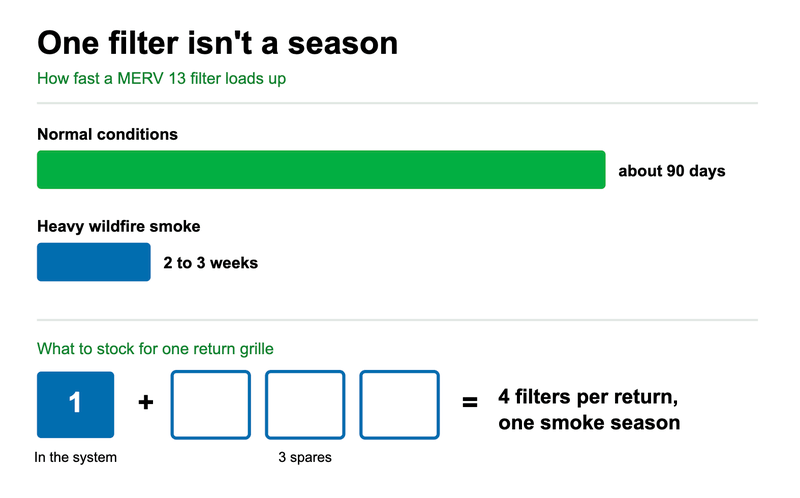
2. Two to three spare filters per return. The item almost everyone skips. A filter that lasts 90 days normally can load up in two to three weeks of heavy smoke. The EPA says to swap filters when they look dirty or smell like smoke — during an event, that can mean every few weeks or days. Set up auto-delivery so spares restock themselves.
3. A portable air cleaner and its replacement filters. Size it for the room you'll actually use, and pick a model that produces little or no ozone — California's Air Resources Board publishes a list of certified devices. Buy the replacement filters at the same time; this is the item that vanishes from shelves first.
4. DIY box-fan air cleaner materials — the $40 backup. The EPA endorses building a DIY air cleaner from a box fan and high-efficiency HVAC filters. Match the arrows to airflow, use a new fan (old ones can be a fire hazard), and never run it unattended. Note: a filter sold as 20x20 actually measures about 19.5 inches per side, so tape the seams or size up. Full walkthrough: how to build a Corsi-Rosenthal box.
Personal protection
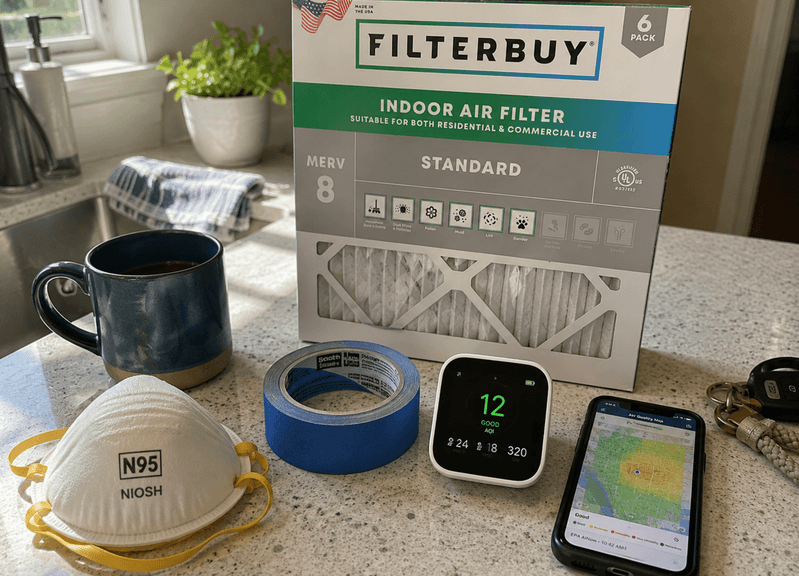
5. NIOSH Approved N95 respirators, several per person. The EPA is direct: don't rely on dust masks or bandanas. Only NIOSH Approved respirators filter fine particles, and only when sealed to your face. Try one on now — fit-checking during a red-AQI day is a bad plan. See our N95 guide.
6. Several days of medications. If anyone in your household has asthma, COPD, or heart disease, a smoke event is exactly when you don't want to be driving to a pharmacy. Keep a buffer supply, and talk with your provider before season about what to do when it's smoky out.
7. No-cook, no-refrigeration food for a few days. Cooking with a stove or oven adds particles to the air you just paid to filter. The EPA recommends meals you can prepare cold or in a microwave, plus food that doesn't need refrigeration in case a fire takes out power.
Sealing the envelope
8. Weatherstripping and door sweeps. Smoke enters through the same gaps that leak your conditioned air, so this pays you back twice. Start with exterior door frames — that's where the biggest gaps usually are.
9. Painter's tape or removable window film. For the leakiest windows, temporary sealing is fine and painter's tape comes off cleanly. You're not chasing perfect — you're chasing meaningfully less.
10. A plan to stay cool without opening windows. The EPA flags this: heat and smoke together are worse than either alone. If your cleaner air room depends on an open window, you have a problem. A window AC with the fresh-air intake closed, or central air on recirculate, solves it.
11. A low-cost PM2.5 air sensor. An indoor sensor tells you whether your filtration is actually working — it turns "I think this is helping" into a number, and it's how you'll know when it's safe to open up again after the smoke clears.
Which filter rating actually stops wildfire smoke?
MERV 13 is the lowest rating that reliably captures the PM2.5 in wildfire smoke, which is why the EPA names it the recommended minimum. MERV 8 and MERV 11 — the most common ratings in American homes — are built for dust and pollen and let most smoke particles pass through.
| Filter rating |
What it captures |
Right for smoke? |
| MERV 1–4 (fiberglass) |
Lint and large dust. Protects equipment, not your lungs. |
No |
| MERV 5–8 |
Household dust, pollen, mold spores. |
No |
| MERV 9–12 |
Finer dust and some smoke particles. |
Partial |
| MERV 13 |
PM2.5 fine particles, including wildfire smoke. |
Yes — EPA recommended |
| HEPA (MERV 17–20) |
Highest efficiency available. |
Portable units only |
MERV is defined by ASHRAE Standard 52.2. True HEPA is too restrictive for most residential HVAC systems — use it in a portable air cleaner, not your ductwork. Source: U.S. EPA, Wildfires and Indoor Air Quality guidance.
How many spare filters do you actually need?
Multiply your return grilles by four: one installed, three spares. That covers roughly 90 days of heavy smoke at a two-to-three-week replacement pace. The EPA reports that a high-efficiency filter plus continuous fan operation can cut indoor PM2.5 by about 50%.
| Your home |
Returns |
Spares to stock |
Season total |
| Small home or condo | 1 | 3 | 4 |
| Typical single-story | 2 | 6 | 8 |
| Two-story | 3 | 9 | 12 |
| Larger home | 4 | 12 | 16 |
Method: assumes a 2–3 week filter life during sustained heavy smoke, based on EPA guidance to replace filters when dirty or smoke-scented, across a 90-day peak season. Count one filter per return grille. Light-smoke areas can stock the lower end.
Why buy now instead of when smoke arrives?
Because supply and shipping both break down exactly when demand spikes. AirNow puts it plainly: if you wait until smoke is in the air, supplies may be out of stock or arrive too late to help. Air cleaners and N95s vanish from shelves first, and everyone in a three-state radius is ordering the same filter on the same day.
There's a second reason: prep done under pressure is prep done badly — the wrong filter size ordered in a hurry, a respirator that doesn't seal, a box fan taped backwards. Doing this on a clear Saturday means you get it right once, then stop thinking about it. That's the whole goal.
Three things not to buy
Fire season brings a specific kind of upsell. Three are worth naming before someone sells you one in a panic.
- An ozone generator, or any "purifier" that makes ozone on purpose. The EPA states no federal agency has approved these for occupied spaces. Ozone is the other pollutant your AQI tracks — buying a machine that makes it to solve a smoke problem swaps one pollutant for another. "Ionizer" and "activated oxygen" are the same conversation.
- Duct cleaning, as smoke prep. The EPA is direct: duct cleaning has never been shown to prevent health problems, and isn't recommended routinely. Real reasons exist — visible mold, vermin, debris. "Fire season is coming" isn't one. Spend the money on spare filters instead.
- The highest MERV number you can find. More MERV isn't more protection. A MERV 16 filter in a system designed around MERV 8 gives you less airflow, and a filter only cleans the air it can pull through. MERV 13 is the EPA balance point between capture and airflow, not the ceiling.
Filterbuy doesn't sell ozone generators or duct cleaning, so the first two cost us nothing to say. The third one does cost us something. We're saying it anyway.
Frequently asked questions
When should I start preparing for wildfire season?
Before your region's fire potential rises — for most of the West, late spring to early summer. If you're reading this mid-season, prepare now anyway. NIFC projects above-normal fire potential through August across much of the Northwest, northeast California, and the northern Great Basin.
Is MERV 13 enough, or do I need HEPA?
MERV 13 is the EPA-recommended rating for HVAC systems; true HEPA is too restrictive for most residential equipment. The practical answer: MERV 13 in the HVAC system, plus a HEPA portable air cleaner in your cleaner air room.
How often should I change my filter during a smoke event?
Check it weekly and replace it when it looks dirty or smells like smoke. The EPA notes that during smoke events, filters may need changing every few weeks or even every few days — far faster than the usual 60–90 days.
Does MERV 13 help if the fire is hundreds of miles away?
Yes. Distant fires still raise local PM2.5, and the same filtration that handles nearby smoke handles drifting smoke.
What if I can't find my filter size?
Odd-size returns are common in older homes. Filterbuy stocks 600+ standard sizes and makes custom filters to order, so a strange size isn't a reason to skip step one.
More About Wildfires and Filters
Buy your filters before the smoke, not during it. A MERV 13 filter captures the microscopic particles found in wildfire smoke, and it is the rating the EPA points to for smoke events.
The catch is timing. A filter that lasts about 90 days in normal conditions can load up in two to three weeks of heavy smoke, so one filter is not a season. Plan on one filter in the system plus three spares for every return grille, and buy them on a clear day, because Filterbuy ships them faster in July than anyone can in September.
Running a ductless mini split instead of central ducts? Your filter is a different shape and a different schedule. Answer a few quick questions and we will match you to the right one.
TL;DR Quick Answer
Get smoke-ready before smoke arrives by doing four things: install a MERV 13 filter in your HVAC system and buy two to three spares, keep NIOSH Approved N95 respirators on hand, set up one cleaner air room with a portable or DIY air cleaner, and seal the obvious leaks around doors and windows. The EPA's guidance is blunt about timing: buy the equipment before a smoke event, because during one, supplies sell out and shipping slows down. Most of this list costs under $20 an item. Three things do not, and those are the ones worth budgeting for now rather than discovering in September.
Key Takeaways
7/17/2026. Upgrading your HVAC filter and running the fan continuously can cut indoor PM2.5 by roughly 50%, according to the EPA.
Smoke loads a filter far faster than dust. The EPA advises changing filters every few weeks, or even every few days, during a smoke event, which is why spares matter more than a single good filter.
Only NIOSH Approved N95 respirators protect your lungs from smoke. Dust masks, surgical masks, and bandanas don't filter fine particles.
A cleaner air room beats whole-home perfection. Pick one room, ideally a bedroom with an attached bathroom, and concentrate your filtration there.
Timing is the whole point. The EPA says to buy air cleaners and replacement filters before a smoke event, not during one.
Fire season isn't just a Western problem. Smoke from a fire hundreds of miles away can push your local AQI into the orange or red for days.
What Should Homeowners Do Before Wildfire Season Starts?
Before wildfire season, install a MERV 13 filter, stock two to three spares, buy NIOSH Approved N95 respirators, set up a cleaner air room with a portable or DIY air cleaner, seal leaky doors and windows, and download the AirNow app. The EPA recommends buying air cleaners and filters before a smoke event, because once smoke arrives, stores sell out and shipping stretches from days into weeks, right when you need the filter most.
Here's the part nobody tells you: the shopping list is short and mostly boring. The timing is the hard part. Every year the same thing happens. Smoke rolls in, everyone reaches for the same twelve items on the same weekend, and the people who bought in July are the ones breathing clean air in September.
The National Interagency Fire Center's most recent Significant Wildland Fire Potential Outlook projects above-normal significant fire potential through August across much of the Northwest, northeast California, the northern Great Basin, the southern Plains, and parts of the Southeast. If you live near those areas, or downwind of them, which is most of the country, this is your window. Smoke doesn't respect distance either: Canadian wildfire smoke has drifted thousands of miles into the U.S..
Where Filterbuy Is Coming From, Including the Part That Costs Us Money
Filterbuy has built air filters in the United States since our first one sold in 2013, in our own plants in Alabama, Florida, Pennsylvania, and Utah. So here's the conflict, stated up front: Filterbuy sells the thing this checklist tells you to buy. Here's the honest version anyway.
One filter, bought the week the sky turns orange, does almost nothing. A filter is a consumable. In heavy smoke it loads up and stops working long before the smoke stops coming, which means the thing that actually carries a household through a season is the stack behind the first one. And half of this list isn't filters at all. That's a worse sales pitch than the one our competitors are running. We think it's a better checklist.
The other reason Filterbuy can be specific here: we make more than 600 stock sizes and cut custom filters to order because odd-size returns are genuinely common in American homes. We see the sizes people actually need. When we say don't let a strange return grille become the reason you skip step one, that's not a slogan, it's the whole reason our size catalog looks the way it does.
The 12-Item Wildfire Season Checklist
These twelve items are grouped by what they do, not by price. Work down the list in order. The filtration group does the most work for the least money.
Filtration: Your First and Best Line of Defense
1. A MERV 13 filter for every return grille in your home. MERV 13 is the minimum efficiency rating the EPA points to for wildfire smoke, because smoke's fine particles slip straight through the MERV 8 fiberglass filters most homes ship with. Most systems built after 2000 handle MERV 13 without trouble, but check your manual, or ask a technician, before you upgrade. Filterbuy builds MERV 13 in more than 600 stock sizes and cuts custom filters to order, so an odd-size return isn't an excuse to skip step one. Shop MERV 13 filters, or see which MERV rating to use on high-AQI days.
2. Two to three spare filters per return. This is the item we would most like you to take seriously, and the one almost everyone skips. A filter that lasts 90 days in normal conditions can load up in two to three weeks of heavy smoke. The EPA says to change filters when they look dirty or start releasing a smoke odor, which during a smoke event can mean every few weeks or even days. Spares are what turn one good filter into a season of protection. Set up auto-delivery so the spares restock themselves.
3. A portable air cleaner and its replacement filters. Buy one sized for the room you'll actually use it in, and choose a model that produces little or no ozone. California's Air Resources Board publishes a list of certified air cleaning devices worth checking against. Buy the replacement filters at the same time. This is the item that vanishes from shelves first. The EPA has step-by-step guidance on setting up a cleaner air room.
4. DIY box fan air cleaner materials, the $40 backup. The EPA endorses building a do-it-yourself air cleaner from a box fan and one or more high-efficiency HVAC filters. A 20x20 MERV 13 filter, a new box fan, and a roll of tape gets you real filtration for a fraction of a portable unit's price. Two safety notes: match the arrows on the filter to the direction of airflow, and use a new fan, because older box fans can pose a fire hazard and should never run unattended. One detail we learned the hard way building these at Filterbuy, and now put in writing every time: a filter sold as 20x20 actually measures about 19.5 inches per side, because nominal sizes aren't actual sizes. Tape the seams carefully or size up. Our full walkthrough is here: how to build a Corsi-Rosenthal box for wildfire smoke.
Personal Protection
5. NIOSH Approved N95 respirators, several per person. The EPA is direct on this point: don't rely on dust masks or bandanas for protection from smoke. Only NIOSH Approved respirators filter fine particles, and they need to seal against your face to work. Buy them now, and try one on now, because learning to fit-check a respirator during a red-AQI day is a bad plan. See our guide to N95 masks for wildfire smoke for fit and selection.
6. Several days of medications. If anyone in your household has asthma, COPD, or heart disease, a smoke event is exactly when you don't want to be driving to a pharmacy. Keep a buffer supply, and talk with your provider before season about what to do when it's smoky out.
7. No-cook, no-refrigeration food for a few days. Cooking with a stove or oven adds particles to the air you just spent money filtering. The EPA recommends having meals on hand you can prepare cold or in a microwave, plus food that doesn't need refrigeration in case a fire takes out power.
Sealing the envelope
8. Weatherstripping and door sweeps. Smoke enters your home through the same gaps that leak your conditioned air, so this one pays you back twice. Focus on exterior door frames first. That's where the biggest gaps usually are.
9. Painter's tape or removable window film. For the leakiest windows in the house, temporary sealing is fine. Painter's tape comes off cleanly. You're not chasing perfect, you're chasing meaningfully less.
10. A plan to stay cool without opening windows. The EPA flags this specifically: heat and smoke together are worse for your health than either alone. If your cleaner air room depends on an open window for airflow, you have a problem. A window AC unit with the fresh air intake closed, or a central system on recirculate, solves it.
11. A low-cost PM2.5 air sensor. An indoor sensor tells you whether your filtration is actually working. It turns "I think this is helping" into a number, and it's how you will know when it's safe to open up again after the smoke clears.
12. The AirNow app, alerts, and a Fire and Smoke Map bookmark. Free, and it takes four minutes. The AirNow Fire and Smoke Map, a joint EPA and U.S. Forest Service project, shows PM2.5 from wildfires in near real time, and AirNow.gov will send you email air quality notifications. You can also check smoke levels in your area on our live map.
What If I Rent, or My Place Has No Central HVAC?
Then skip items 1 and 2 and make item 3 or item 4 your entire plan. A portable air cleaner or a DIY box fan filter protects one room without touching the building system, which is the only realistic option in most apartments, in condos with wall units, and in homes running window ACs or ductless mini-splits. A cleaner air room isn't the renter's consolation prize. It's the same strategy the EPA recommends for everyone, minus the ductwork.
Millions of American households rent, and millions more have no ducts at all, yet nearly every wildfire checklist online is written as though everyone owns a furnace. If you can't change a filter you don't own, or there's no return grille to change one in, your list is shorter and it still works: a portable or DIY air cleaner sized to one room, N95s, weatherstripping you can peel off when you move out, and the AirNow app. Four items, and most of the protection.
Two specifics worth knowing. A window AC unit usually has a vent or fresh-air lever. Close it, so the unit recirculates indoor air instead of pulling smoke in. A ductless mini-split recirculates room air by default and has a washable filter, which helps a little, but it isn't a smoke filter. Don't let the mini-split talk you out of the air cleaner.
And to be straight about the business math: this is the section where we sell you nothing. Filterbuy makes HVAC filters. A renter with a mini-split isn't a filter customer. The advice is the same anyway, because the alternative is quietly telling a huge share of the country that this checklist isn't for them. If you do have one accessible return, measure it before you assume it's a weird size. Odd is normal.
Which Filter Rating Actually Stops Wildfire Smoke?
MERV 13 is the lowest rating that reliably captures the PM2.5 in wildfire smoke, which is why the EPA names it as the recommended minimum for smoke events. MERV 8 and MERV 11 filters, the two most common ratings in American homes, are built for dust and pollen and let most smoke particles pass straight through. Anything below MERV 8 is protecting your equipment, not your lungs. For the full comparison, see MERV 13 vs. HEPA for wildfire smoke and our guide to the best air conditioner filter for wildfire smoke.
| Filter rating |
What it captures |
Right for wildfire smoke? |
| MERV 1–4 (fiberglass) |
Lint and large dust. Protects the equipment, not your lungs. |
No |
| MERV 5–8 |
Household dust, pollen, mold spores. |
No |
| MERV 9–12 |
Finer dust and some smoke particles. |
Partial |
| MERV 13 |
PM2.5 fine particles, including wildfire smoke. |
Yes, EPA recommended |
| HEPA (MERV 17–20) |
Highest efficiency available. |
Portable units only |
MERV is defined by ASHRAE Standard 52.2. True HEPA is too restrictive for most residential HVAC systems, so use it in a portable air cleaner rather than your ductwork. Source: U.S. EPA, Indoor Air Filtration and Wildfires and Indoor Air Quality guidance.
How Many Spare Air Filters Do You Actually Need?
Multiply the number of return grilles in your home by four: one filter installed, plus three spares. That covers roughly 90 days of heavy smoke at a two-to-three-week replacement pace, which is what the EPA's guidance implies during active smoke events. A single-return home needs four filters for the season. A three-return home needs twelve. The payoff is measurable: the EPA reports that a high-efficiency filter plus continuous fan operation can cut indoor PM2.5 by about 50%.
| Your home |
Returns |
Spares to stock |
Season total |
| Small home or condo |
1 |
3 |
4 |
| Typical single-story |
2 |
6 |
8 |
| Two-story |
3 |
9 |
12 |
| Larger home |
4 |
12 |
16 |
Method: assumes a 2–3 week filter life during sustained heavy smoke, based on EPA guidance to replace filters when they look dirty or start releasing a smoke odor, across a 90-day peak season. Count one filter per return grille. Homes in light-smoke areas can stock the lower end.
What Actually Protects Your Lungs From Smoke?
A NIOSH Approved N95 respirator is the only common face covering that meaningfully filters wildfire smoke, and only when it seals tightly to your face. The EPA advises against relying on dust masks or bandanas, and the American Thoracic Society notes that surgical and simple dust masks don't protect against particulate exposure. Fit matters as much as the filter: a finger-width gap at the cheek gives smoke a free path around the material.
| Face covering |
Filters PM2.5? |
What to know |
| NIOSH Approved N95 |
Yes, with a tight seal |
Two straps that go around the head. The EPA’s recommendation for smoke exposure outdoors. |
| NIOSH Approved P100 |
Yes |
Step up to this for ash cleanup or extended time in heavy smoke. |
| KN95 or KF94 |
Partial |
Not NIOSH Approved, and fit varies by model. A reasonable fallback when N95s are sold out. |
| Surgical mask |
No |
The material helps a little, but it gapes at the cheeks and chin, so smoke slides around the sides. |
| Dust mask |
No |
The EPA says plainly: don't rely on dust masks for protection from smoke. |
| Cloth mask or bandana |
No |
The weave is far too open to catch PM2.5. The EPA advises against relying on bandanas. |
A respirator only works if it seals, so check the fit before smoke season rather than during it. The EPA notes that respirators are not sized for children, and advises anyone with heart or lung disease, or who is pregnant, to ask a doctor before using one.
Will a MERV 13 Filter Hurt My HVAC System?
Most residential HVAC systems handle a MERV 13 filter without issue, provided the filter is replaced frequently and it's a well-constructed pleated filter rather than a cheap one that collapses. Older systems with PSC blower motors are the exception worth checking. If you're unsure, an HVAC technician can measure static pressure across the filter and tell you in one visit, which is well worth doing in July rather than September.
Two settings do most of the work once the filter is in. Switch your thermostat fan from Auto to On so air keeps cycling through the filter even when the system isn't heating or cooling. And if your system has a fresh air intake, know where it's and how to close it before you need to.
Why Buy Now Instead of When Smoke Arrives?
Because supply and shipping both break down exactly when demand spikes. AirNow puts it plainly: if you wait until smoke is in the air, supplies may be out of stock or may not arrive in time to be helpful. Air cleaners and N95s are the first things to disappear from local shelves, and everyone in a three-state radius is ordering the same filter you are, on the same day. The EPA makes the same point in its Prepare for Wildfire Smoke fact sheet.
There's a second reason that's easy to miss. Prep done under pressure is prep done badly: the wrong filter size ordered in a hurry, a respirator that doesn't seal, a box fan taped to a filter backwards. Doing this on a clear Saturday means you get it right once, and then you stop thinking about it. That's the whole goal. Clean air without the hassle is the Filterbuy promise, and it isn't a line we picked because it sounded nice. It's what a prepared house feels like in September, while everyone else is refreshing a shipping page.
Three Things Not to Buy
Skip ozone generators, skip routine duct cleaning, and skip any filter rated higher than your system can actually move air through. The EPA states that no federal agency has approved ozone-producing air cleaners for occupied spaces, and that duct cleaning has never been shown to prevent health problems. A MERV number above what your blower can handle reduces airflow instead of adding protection.
This checklist is short partly because we cut things. Fire season brings a specific kind of upsell, and three of them are worth naming before somebody sells you one in a panic.
1. An ozone generator, or any "purifier" that makes ozone on purpose.
The EPA states that no federal agency has approved these devices for use in occupied spaces. California's Air Resources Board goes further and recommends they not be used at all outside approved industrial settings, because they're ineffective at cleaning indoor air and inhaling ozone harms lungs. Notice the trap: ozone is the other pollutant your AQI tracks. Buying a machine that manufactures it to solve a smoke problem swaps one pollutant for a second one. If a device is marketed as an ionizer or says it produces "activated oxygen," that's the same conversation.
2. Duct cleaning, as smoke prep.
The EPA is unusually direct here: duct cleaning has never been shown to prevent health problems, and the agency doesn't recommend it routinely, only as needed. It also warns you not to hire anyone who pitches duct cleaning as routine maintenance. Real reasons exist: visible mold, vermin, debris actually blowing out of your registers. "Fire season is coming" isn't one of them. Spend the money on spare filters instead, where the evidence actually is.
3. The highest MERV number you can find.
More MERV isn't more protection. A MERV 16 filter in a system designed around MERV 8 doesn't give you cleaner air, it gives you less airflow, and a filter only cleans the air it can actually pull through. MERV 13 is the EPA recommendation because it's the balance point between capture and airflow, not because it's the ceiling. This is the question Filterbuy fields most every fire season, and the answer disappoints people every time.
Filterbuy doesn't sell ozone generators, and Filterbuy doesn't sell duct cleaning, so the first two cost us nothing to say. The third one does cost us something. We're saying it anyway.
Supporting Statistics
Three findings from federal and national health authorities. Each is linked to its primary source and verified against it.
1. Asthma ER visits rose 17% on smoke days, nationwide.
17% above expected across 19 smoke days, April 30 to August 4, 2023.
Drawn from roughly 4,300 emergency departments.
Smoke reached 9 of the 10 federal HHS regions.
Hit hardest: ages 5–17 and 18–64.
CDC's own advice matches this checklist: watch the AQI, filter indoor air, wear a fitted N95 outdoors.
Backs items 5, 6, and 12. Source: CDC, MMWR 2023;72(34):926-932.
2. 61.5 million Americans live where particle pollution spikes to failing grades.
61.5 million people in counties graded F for short-term particle pollution.
Roughly 75% above the 2018 record low of 35.1 million.
Worst metros: Fairbanks-College, Alaska, then Eugene-Springfield, Oregon. Not California.
Short-term spikes are what wildfire smoke causes, and what MERV 13 is rated to capture.
Backs the TL;DR and the filter rating table. Source: American Lung Association, State of the Air 2026 (2022-2024 data).
3. A DIY box fan cleaner cut indoor PM2.5 by 56% to 99% in a real smoke event.
About 56% in a larger room, within 90 minutes.
About 99% in a smaller room, within 60 minutes.
Measured during an actual wildfire smoke event (May et al., 2021).
The EPA reports DIY cleaners are safe and effective in lab testing. Thicker or multiple filters perform better.
Glossary
Wildfire: An unplanned, uncontrolled fire in an area of combustible vegetation. Between 80% and 90% of wildfire smoke by mass is fine particulate matter 2.5 micrometers or smaller, which is exactly the size class a MERV 13 filter is rated to capture. Background: Wildfire (Wikipedia).
AQI (Air Quality Index): The EPA's 0-500 scale for reporting daily air quality. Values above 100 are unhealthy for sensitive groups; above 150 are unhealthy for everyone.
PM2.5 (fine particulate matter): Airborne particles 2.5 micrometers or smaller, the primary health hazard in wildfire smoke, small enough to reach deep into the lungs and enter the bloodstream.
MERV (Minimum Efficiency Reporting Value): The 1-16 industry scale rating how effectively an HVAC air filter captures particles, defined by ASHRAE Standard 52.2. Higher numbers capture smaller particles.
MERV 13: The filter rating the EPA identifies as the effective minimum for capturing wildfire smoke particles in a residential HVAC system.
NIOSH Approved N95 respirator: A respirator certified by the U.S. National Institute for Occupational Safety and Health to filter at least 95% of airborne particles when properly fitted. The only common mask type the EPA recommends for wildfire smoke.
Cleaner air room: A single room in a home, ideally a bedroom with an attached bathroom, set up with filtration and sealed against outside air, where household members reduce their smoke exposure during an event.
DIY air cleaner: A box fan fitted with one or more high-efficiency HVAC filters. An EPA-endorsed low-cost alternative to a commercial portable air cleaner.
AirNow Fire and Smoke Map: A joint EPA and U.S. Forest Service tool at fire.airnow.gov showing near-real-time PM2.5 levels from wildfires and other sources.
Fresh air intake: A duct that draws outdoor air into an HVAC system. During a smoke event it should be closed, or the system set to recirculate.
Static pressure: The resistance to airflow in an HVAC system. Measuring it across a filter tells a technician whether a higher-MERV filter is safe for that specific system.
NIFC (National Interagency Fire Center): The federal interagency body in Boise, Idaho that publishes the monthly Significant Wildland Fire Potential Outlook used to forecast fire season severity.
Frequently Asked Questions
When should I start preparing for wildfire season?
Start before your region's fire potential rises, which for most of the West means late spring to early summer. If you're reading this mid-season, prepare now anyway. NIFC's outlook projects above-normal fire potential continuing through August across much of the Northwest, northeast California, and the northern Great Basin, so there's still season left to protect.
Is MERV 13 enough for wildfire smoke, or do I need HEPA?
MERV 13 is the EPA-recommended rating for HVAC systems, and true HEPA filters are too restrictive for most residential HVAC equipment. The practical answer for whole-home protection is MERV 13 in the HVAC system, plus a HEPA portable air cleaner in your cleaner air room.
How often should I change my air filter during a smoke event?
Check it weekly and replace it when it looks dirty or starts to smell like smoke. The EPA notes that during smoke events, filters may need changing every few weeks or even every few days, far faster than the 60 to 90 days most homeowners are used to.
Does a MERV 13 filter help if smoke is coming from a fire hundreds of miles away?
Yes. Distant fires still raise local PM2.5, and the same filtration that handles nearby smoke handles drifting smoke.
What if I can't find my filter size?
Odd-size returns are common in older homes. Filterbuy stocks 600+ standard sizes and makes custom filters to order.
Do I really need an air quality sensor?
It's the one optional item on this list. A sensor doesn't clean anything; it tells you whether what you're doing is working, and when the air is safe again. Useful, but the filters come first.
Get the Checklist
Ready in about ten minutes: find your filter size, order your MERV 13s plus spares, and set up auto-delivery so the next set shows up before you think about it.
Shop MERV 13 filters for smoke protection | Check smoke levels in your area
About the author and reviewer
MW
Michelle Wan, Author
is Brand Manager and Air Quality Writer at Filterbuy, where she turns MERV ratings, filtration, and HVAC efficiency into plain-English advice for homeowners, and fronts much of the brand's educational video content (B.A., University of California, Santa Cruz). She works directly with Filterbuy's U.S. manufacturing teams in Alabama, Florida, Pennsylvania, and Utah. Learn more on her author page.
DC
David Clark, Reviewer, Licensed HVAC Technician
This article was technically reviewed by David Clark, a Licensed HVAC Technician, who verified this guide's claims on MERV ratings, airflow, filter compatibility, and box fan safety.
Published by Filterbuy, an American air-filtration company that has manufactured HVAC filters in the U.S. for over a decade and shipped them to millions of households.
Sources
U.S. EPA, Prepare for Wildfire Smoke fact sheet (EPA-452/F-26-001, June 2026)
U.S. EPA, Protect Your Lungs From Wildfire Smoke and Ash fact sheet (June 2026)
U.S. EPA, Wildfires and Indoor Air Quality (IAQ)
U.S. EPA, Strategies to Reduce Exposure Indoors - source of the ~50% PM2.5 reduction figure
U.S. EPA, Create a Clean Room to Protect Indoor Air Quality During a Wildfire
AirNow.gov, Be Smoke Ready (EPA / U.S. Forest Service)
National Interagency Fire Center, National Significant Wildland Fire Potential Outlook (July 2026 issuance)
American Thoracic Society, Wildfires Disaster Guidance - surgical and dust mask limitations
CDC, Asthma-Associated Emergency Department Visits During the Canadian Wildfire Smoke Episodes, MMWR 2023;72(34):926-932 (DOI 10.15585/mmwr.mm7234a5)
American Lung Association, State of the Air 2026 (27th annual report, 2022-2024 data)
California Air Resources Board, list of certified air cleaning devices
U.S. EPA, Ozone Generators that are Sold as Air Cleaners
California Air Resources Board, Hazardous Ozone-Generating Air Purifiers
U.S. EPA, Should You Have the Air Ducts in Your Home Cleaned?