
Canadian Wildfire Smoke In The United States: A Complete Guide To East Coast And Midwest Air Quality Impacts And Indoor Protection
July 16, 2026
By Michelle Wan · Reviewed by David Clark, Licensed HVAC Technician
Published: July 17, 2026 | Updated: July 17, 2026
Canadian Wildfire Smoke in the United States: What It Is and What Your Filter Catches
Canadian wildfire smoke reaches the U.S. East Coast and Midwest most summers, and you do not need a fire anywhere near you to breathe it. Smoke from fires in Ontario and Quebec travels hundreds to thousands of miles, then sinks to ground level when the weather pattern allows it.
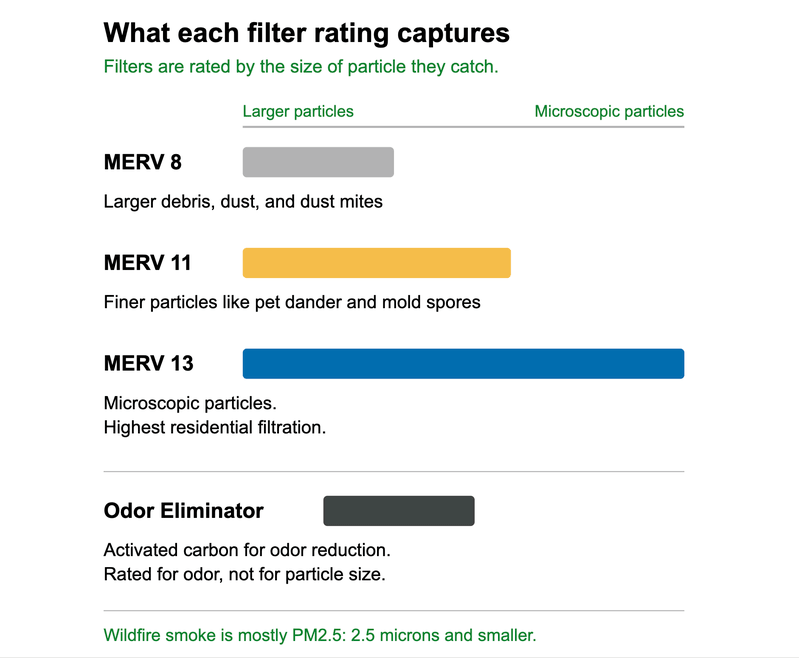
Wildfire smoke is mostly PM2.5: particles 2.5 microns and smaller. Air filters are rated by the size of particle they capture, so the rating matters. Here is what each one catches:
MERV 8: larger debris, dust, and dust mites
MERV 11: finer particles like pet dander and mold spores
MERV 13: microscopic particles; highest residential filtration
Odor Eliminator: activated carbon for odor reduction
Not sure which rating your system takes? Shop air filters at Filterbuy, or use the quiz below.
Have a ductless mini split? Answer a few quick questions and we will match you to the right filter for your unit.
TL;DR Quick Answer
Canadian wildfire smoke now reaches the U.S. East Coast and Midwest most summers, and you do not need a fire anywhere near you to breathe it. Smoke from fires in Ontario, Quebec, and the Prairies travels hundreds to thousands of miles and sinks to ground level when the weather pattern allows it. Your best protection is not sealing yourself in. It is filtration: a MERV 13 filter in your HVAC if you have one, a portable HEPA cleaner in one room if you do not. Roughly half of Northeast homes fall in the second group. Either way, set it up before the smoke arrives.
Key Takeaways
Canadian wildfire smoke is now a recurring East Coast and Midwest problem, not a Western one. As of July 16, 2026, smoke from Canadian fires had pushed Detroit's air quality among the worst of any major city in the world, with alerts stretching from the Great Lakes to New England.
The June 2023 event was the benchmark. New York City's AQI peaked at 465, a level NYC Emergency Management still uses as its reference point for hazardous smoke.
Staying indoors is not the same as breathing clean air. In a study of Boston-area homes during the 2023 smoke season, median indoor PM2.5 nearly tripled on smoke days (9.9 µg/m3) versus the non-smoke days right before them (3.5 µg/m3).
The EPA recommends upgrading to a MERV 13 or higher HVAC filter during smoky periods. Most residential furnaces and HVAC systems can handle MERV 13 without equipment problems, provided the filter gets replaced often.
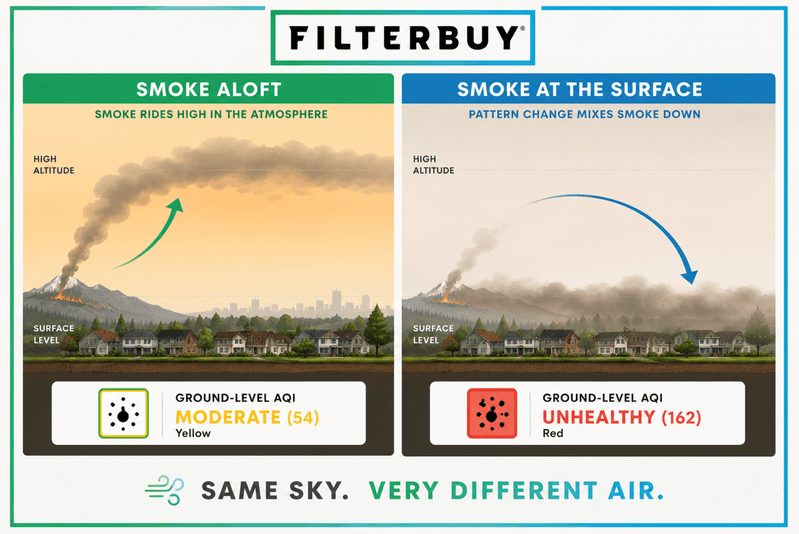
A hazy sky does not reliably mean bad air, and a clear sky does not mean good air. Smoke can ride high in the atmosphere and look dramatic while barely affecting what you breathe, or sink to the surface with almost no visual warning.
Roughly half of Northeast homes cannot use a MERV 13 at all. Window and wall units outnumber central systems across the region, per the EIA's 2020 Residential Energy Consumption Survey. If you have no filter slot, a portable HEPA cleaner in one room is your primary defense, not a backup.
Timing is the whole game. Eastern and Midwestern smoke events arrive with about a day or two of notice and last a few days. That is not enough time to order a filter after the fact.
Why Is There Canadian Wildfire Smoke In The United States Right Now?
Canadian wildfire smoke reaches the United States when large boreal fires in Canada inject smoke high into the atmosphere and prevailing winds carry it south and east. The way a wildfire builds, crowns, and lofts its plume is what puts smoke high enough to travel: it then moves hundreds to thousands of miles intact. In mid-July 2026, more than 100 wildfires burning in Canada, plus fires in northern Minnesota, pushed smoke across the Great Lakes into the Northeast, with air quality alerts affecting roughly 100 million people.
This is not a fluke, and it is not new. It is now the pattern.
The current event is a textbook version. A stalled high-pressure system parked over the region and trapped smoke from dozens of Canadian and northern Minnesota fires near the ground, according to the National Weather Service. Pennsylvania declared a Code Red air quality day. Massachusetts issued alerts statewide. In Canada, roughly 3,500 fires have burned more than 4.8 million acres so far this summer, with a cluster of new blazes flaring in Ontario, the province closest to the Great Lakes, and therefore the one whose smoke reaches Chicago, Detroit, and Cleveland fastest.
The distances involved are the part that surprises people. Smoke from a fire in northern Quebec can degrade air quality in Philadelphia without a single ember crossing the border, because a plume can drift across most of a continent before it settles. There is no evacuation order, no fire crew on your street, no smell of a neighbor's brush pile. There is just a sky that looks wrong and a headache by three in the afternoon.
What Happened In 2023, And Why It Changed The Calculation For Eastern Homes
The 2023 Canadian wildfire season burned approximately 15 million hectares (about 37 million acres), more than double the previous record and roughly seven times the national average, according to the peer-reviewed post-season analysis in Nature Communications. On June 7, 2023, smoke from Quebec's fires drove New York City's AQI to a peak of 465, a level NYC Emergency Management still cites as its reference point for hazardous smoke. It was the worst air the city had seen since the 1960s.
For most East Coast and Midwest homeowners, 2023 was the first time wildfire smoke was ever a personal problem.
The health signal from that week was not subtle, and it was measured. During the June 6 to 8, 2023 smoke episode, New York State's asthma-associated emergency department visits jumped from a baseline average of about 81 per day to 147 statewide on June 7 alone, per the state's syndromic surveillance data published by the CDC. Nationally, asthma-associated ED visits ran 17% higher than expected across the 19 wildfire smoke days between April 30 and August 4, 2023, with the sharpest increases in regions where smoke exposure had previously been uncommon.
That last clause is the important one. The regions hit hardest were the ones that had never had to think about this before.
The Eastern Smoke Gap: Three Reasons These Events Hit Harder Than The AQI Suggests
Homes in the East and Midwest are structurally less ready for wildfire smoke than homes in the West. Not because they are built worse, but because they were never built for this. At Filterbuy, we call this the Eastern Smoke Gap, and it has three parts: you cannot trust your eyes, you cannot trust your filter, and you do not get enough warning to fix either one mid-event.
1. You Cannot Trust Your Eyes
A hazy, yellow-brown sky is a smoke signal, not an air quality signal. Smoke that stays high in the atmosphere can turn the sun orange and barely touch ground-level PM2.5. Smoke that mixes down to the surface can arrive with far less drama and be much worse to breathe. During this week's event, one plume largely stayed aloft while the next sank to the surface after a weather pattern change. Same fires, same region, very different air.
The practical rule: check the number, not the sky. The EPA and Forest Service smoke map and Filterbuy's live map of what your area is breathing today both report ground-level readings, which is the only thing your lungs care about.
2. You Cannot Trust Your Filter
Most homes run a 1-inch fiberglass or basic pleated filter rated MERV 8 or below. That filter is doing an honest job on lint, carpet fibers, and visible dust. It is not designed to capture PM2.5, the fine particles that make up the bulk of wildfire smoke and are small enough to reach deep into the lungs.
Filterbuy manufactures every residential tier from MERV 8 to MERV 13, so take this as the opposite of a pitch for the top of the range: MERV 8 is the right filter for a lot of homes on a lot of days. It is simply the wrong filter for the three days a summer when Canada is burning.
In the West, swapping to MERV 13 before fire season is a normal spring chore. In Ohio and Connecticut, it is not on anyone's list, because until recently there was no reason for it to be.
3. Closing The Windows Is Only Half The Job
Here is the finding that should reframe how you think about this. When researchers monitored eastern Massachusetts homes through the 2023 smoke season, median indoor PM2.5 was 9.9 µg/m3 on smoke days versus 3.5 µg/m3 on the non-smoke days immediately before. Nearly triple, indoors, in real Northeastern homes. Houses are not sealed containers. They breathe through gaps, sills, outlets, and every door you open.
So "just stay inside" is incomplete advice. Inside is better than outside. Inside with filtration running is meaningfully better than inside alone.
What To Do When Canadian Wildfire Smoke Reaches Your Area
When smoke arrives, your goal is simple: stop bringing more of it in, and clean what is already inside. What federal guidance actually asks you to do indoors comes down to six actions.
Source: U.S. EPA guidance on reducing wildfire smoke exposure indoors.
One caution, and we would rather be straight with you about it: a MERV 13 filter helps because air passes through it. A MERV 13 filter caked with a week of smoke restricts airflow and can strain your system. During heavy smoke, check the filter monthly or more often. The EPA notes that a smoke-loaded filter should be replaced when it looks dark brown or black, which may be sooner than the manufacturer's normal schedule. Keep a spare on hand.
When To Stop Managing It Yourself
Filtration is a comfort and exposure measure, not a medical one. Wildfire smoke can push a healthy person into coughing and stinging eyes, and it can push someone with asthma, COPD, or heart disease somewhere worse. New York City Emergency Management lists the warning signs to watch for during a smoke event: coughing, wheezing, shortness of breath, tightness or pain in the chest, and unusual fatigue.
If symptoms are severe, and particularly if there is difficulty breathing or chest pain, get medical attention right away or call 911. That advice does not change based on what filter is in your system. No air filter treats a symptom, and nothing on this page is a reason to wait one out.
If you want the longer version of this checklist, we walk through seven steps for sealing a house before the haze arrives, including door gaps, window units, and the cleanup afterward.
What MERV Rating Do You Need For Wildfire Smoke?
The EPA recommends a MERV 13 filter or higher in your HVAC system during smoky periods, and notes that most furnaces and HVAC systems can accommodate MERV 13 without creating equipment problems as long as the filter is replaced frequently. MERV 13 is the practical answer for most homes: it captures the fine PM2.5 particles in wildfire smoke, and it fits standard residential systems.
MERV ratings describe filter efficiency. The EPA recommends MERV 13 or higher in HVAC systems during smoky periods.
What A 90-Day Filter Rating Actually Assumes
Filterbuy builds its MERV 13 filters in Talladega, Alabama, and rates them at 98% capture of airborne particles down to 0.3 microns, with a 90-day service life. That 90-day number is not marketing. It is an engineering assumption about a normal household load: dust, lint, dander, pollen, the ordinary stuff a house makes. A smoke event is not a normal household load.
This is why the replace-early advice above is not an upsell, and it is worth being explicit about that. The 90-day figure and the check-it-monthly advice come from the same assumption, applied honestly. Change the input and the interval changes with it. A filter that has taken three days of wildfire PM2.5 is not three percent through its life.
It also explains the airflow caution. A pleated MERV 13 works by holding particles in the media. The better it works during a smoke event, the faster it loads, and the sooner it starts costing you airflow. Those are the same property, not a defect.
The One Product We Will Talk You Out Of
Filterbuy's Odor Eliminator pairs activated carbon with MERV 8 media. It is built for smells: pets, cooking, and the campfire odor smoke leaves behind in soft furnishings after the air clears. It is not the filter for wildfire PM2.5, and its MERV 8 media is exactly the tier this page has already called ineffective against fine particles. We would rather say that plainly than sell you the wrong box during an air quality alert. During a smoke event, MERV 13 is the answer. Save the carbon filter for the week after, when the particles are gone and the smell is not.
If your system is older or you are unsure whether it can handle MERV 13, ask an HVAC technician. A pro can check your static pressure and tell you the highest-efficiency filter your specific system will run safely. The EPA recommends exactly this.
We compare the ratings side by side in our guide to which rating actually holds back smoke particles, and you can browse American-made MERV 13 filters in 600+ sizes if you already know what your system takes.
What If You Do Not Have Central Air?
About half of Northeast households cannot use a MERV 13 filter at all, because they have no central system to put one in. Window and wall air conditioners outnumber central air across the region. The EIA's 2020 Residential Energy Consumption Survey counts about 9.2 million Northeast homes running primarily on a window or wall air conditioner against about 8.6 million on central air, plus another 2.4 million using no AC at all. If that is your home, most of the advice above does not apply to you, and you should know that up front. Here is what works instead.
Filterbuy sells HVAC filters. If you do not have an HVAC system, we are not your answer this week, and pretending otherwise would waste your money during the exact days it matters. A portable air cleaner is your primary defense, not a supplement to one.
Close the fresh-air vent on the window unit. Most window ACs have a small lever or slide marked "vent," "fresh air," or "exhaust." Shut it. Open, it is a hole in your wall during a smoke event, and the EPA calls this out specifically.
Seal around the unit itself. The accordion side panels are the leakiest part of most apartments. Foam, weatherstripping, or painter's tape across the gaps does more than any setting on the machine.
Put a portable HEPA cleaner in the room where you sleep. Match it to the room, not the apartment. EPA guidance suggests a smoke (tobacco) CADR of at least two-thirds the room's square footage, and avoiding anything that generates ozone.
If a purifier is not available or affordable, build the box-fan version. A 2012-or-newer box fan plus MERV 13 panels. EPA has tested this design and published the plans. It is not a compromise you should feel bad about.
Mini-split owners: you have a filter, but it is not this kind of filter. The washable panel in a ductless head is a pre-filter built to protect the coil from lint, not to capture PM2.5. Rinse it so airflow stays up, then rely on a portable HEPA for the actual smoke.
The pattern is the same as the rest of the page. Stop the smoke you can stop, then filter the air you already have. Only the equipment is different.
The Honest Part: Preparation Beats Reaction
The most useful thing we can tell you about Canadian wildfire smoke is inconvenient: the window to act is before the smoke arrives, not during. These events give you a day or two of forecast warning and last two to four days. Ordering a filter when the sky turns yellow means it shows up as the air is already clearing.
Filterbuy has built filters in the United States for over a decade and shipped them direct to millions of homes. We would still rather you buy one in April than panic-buy one in July, because the April filter is the one that is actually in your system when the smoke hits.
Practically, for anyone east of the Rockies, that means: put a MERV 13 in before fire season starts, keep one spare in the closet, and know where your thermostat's fan setting lives. That is it. It is a fifteen-minute chore in the spring that determines what your family breathes for three days in July.
Supporting Statistics
Three numbers support the advice on this page about Canadian wildfire smoke and indoor air. All three come from U.S. federal agencies or a national health nonprofit. Each one answers a fair objection to what this page recommends.
Sources: U.S. EPA, Report on the Environment (epa.gov/report-environment/indoor-air-quality); U.S. EPA, Strategies to Reduce Exposure Indoors (epa.gov/wildfire-smoke-course/strategies-reduce-exposure-indoors); American Lung Association, State of the Air 2026 (lung.org/research/sota/key-findings).
What the three numbers add up to:
You are indoors for nearly all of a smoke event.
Sealing the house still leaves most of the smoke inside.
Filtration is the one step with a measured effect. The EPA puts a high-efficiency filter plus a continuously running fan at roughly a 50% cut in indoor PM2.5.
That is the case for MERV 13, made in other people's numbers rather than ours.
Glossary
AQI (Air Quality Index): The U.S. Environmental Protection Agency's 0 to 500 scale for reporting daily air quality. Above 100 is Unhealthy for Sensitive Groups; above 300 is Hazardous.
PM2.5: Fine particulate matter 2.5 micrometers in diameter or smaller. PM2.5 is the primary health hazard in wildfire smoke because the particles are small enough to reach deep into the lungs and enter the bloodstream.
MERV (Minimum Efficiency Reporting Value): The industry rating scale (1 to 16 for residential filters) for how effectively an air filter captures particles. Higher MERV means finer particles captured.
MERV 13: The filter efficiency rating the EPA recommends for HVAC systems during wildfire smoke events. MERV 13 captures fine PM2.5 particles and fits most residential systems.
HEPA (High-Efficiency Particulate Air): A filter standard capturing at least 99.97% of particles at 0.3 microns. HEPA is used in portable air cleaners; most residential HVAC systems cannot accommodate a true HEPA filter.
Infiltration: The unintentional flow of outdoor air into a home through gaps in the building envelope. Infiltration is why indoor PM2.5 rises during smoke events even with every window closed.
Smoke aloft: Wildfire smoke suspended high in the atmosphere. Smoke aloft discolors the sky and sun but may not significantly raise ground-level PM2.5.
Recirculate mode: An HVAC or air conditioner setting that recycles indoor air rather than drawing in outdoor air. Recirculate mode is the recommended setting during a smoke event.
Clean room: An EPA strategy of designating one room, ideally where you sleep, and keeping its air as clean as possible with closed windows and a portable air cleaner.
CADR (Clean Air Delivery Rate): A rating for how much filtered air a portable air cleaner delivers. For smoke, EPA guidance suggests matching a unit whose smoke (tobacco) CADR is at least two-thirds of the room's square footage.
Mini-split (ductless heat pump): A heating and cooling system with a wall-mounted indoor head and no ductwork. A mini-split's washable panel is a pre-filter that protects the coil, not a MERV-rated particle filter.
Fresh-air vent: A small damper on many window air conditioners that draws in outdoor air. It should be closed during a smoke event.
Code Red: An air quality alert level indicating air is unhealthy for everyone, not just sensitive groups.
CIFFC (Canadian Interagency Forest Fire Centre): The Canadian agency that coordinates wildfire management resources across provinces and reports national fire statistics.
Frequently Asked Questions
Is Canadian wildfire smoke dangerous even if I cannot smell it?
Yes. The health hazard in wildfire smoke is PM2.5, fine particles you cannot see or reliably smell. Smell and visibility are poor indicators of exposure. Ground-level AQI readings from AirNow or a live AQI map are the reliable measure.
Should I run my air conditioner during a wildfire smoke event?
Yes, with one adjustment. Run it, but make sure any fresh-air intake is closed or the system is set to recirculate. The EPA specifically advises closing the fresh-air option on central systems and window units during smoke events. Central AC with a MERV 13 filter and the fan set to ON is your best whole-home tool.
Will a MERV 13 filter damage my HVAC system?
For most homes, no. The EPA notes that most furnaces and HVAC systems can accommodate a MERV 13 filter without equipment problems, provided the filter is replaced frequently. The risk is a clogged filter, not the rating itself. If your system is older, have an HVAC technician confirm the highest-efficiency filter it can safely run.
How often should I change my filter during a smoke event?
More often than usual. Check it monthly during fire season, and replace it when the media looks dark brown or black. The EPA notes this may be sooner than the manufacturer's standard schedule. Keep a spare so you are never choosing between a clogged filter and no filter.
I rent, and I only have a window AC. What can I actually do?
Three things, in order. Close the fresh-air vent on the unit. Seal the accordion side panels with foam or tape, since they leak more than anything else in the room. Then run a portable HEPA cleaner sized for the room where you sleep. You have no filter slot, so the portable unit is your primary defense rather than a supplement. If a purifier is out of reach, the EPA has tested and published plans for a box fan with MERV 13 panels.
Does the filter in my ductless mini-split handle smoke?
No. The washable panel in a mini-split head is a pre-filter designed to keep lint off the coil, not to capture PM2.5. Keep it clean so airflow stays up, then use a portable HEPA cleaner for the smoke itself.
How long does a Canadian wildfire smoke event usually last?
Most East Coast and Midwest events run about two to four days. They end when the weather pattern that carried the smoke moves on, or when rain washes particles out of the air. The fires themselves can burn for months, so a plume clearing does not mean the season is over. A second wave a week later is normal.
What symptoms mean I should get help?
Coughing, wheezing, shortness of breath, chest tightness or pain, and unusual fatigue are the warning signs New York City Emergency Management flags during smoke events. If symptoms are severe, especially difficulty breathing or chest pain, seek medical attention immediately or call 911. Filtration reduces exposure. It does not treat symptoms.
Do I need a MERV 13 filter if I already have an air purifier?
They do different jobs. A portable HEPA air cleaner protects one room very well. Your HVAC system moves far more air and covers the whole house. The EPA's guidance uses both: MERV 13 in the central system for a whole-home baseline, plus a portable cleaner in a designated clean room.
Is Canadian wildfire smoke going to keep happening every summer?
Recent history says plan for it. 2023 set the record, 2025 was Canada's second-worst season on record, and smoke reached the Midwest and Northeast again in 2026. Treat it as a seasonal risk you prepare for, the way you would prepare for allergy season.
What AQI level should I actually worry about?
Above 100, sensitive groups (children, older adults, pregnant people, and anyone with asthma, COPD, or heart disease) should limit outdoor exertion. Above 150, everyone should. Above 300 is Hazardous. During the June 2023 event, New York City hit 465.
Check Your Air, Then Check Your Filter
Canadian wildfire smoke is a permanent item on the East Coast and Midwest summer checklist now. The good news is that the response is genuinely simple and mostly one-time: know your real AQI, put a MERV 13 in before the season, and set your fan to ON when the smoke comes.
Set up auto-delivery so a fresh filter shows up before fire season
Sources
U.S. EPA, Strategies to Reduce Exposure Indoors (linked in body)
U.S. EPA, Preparing for Smoke and Heat: epa.gov/wildfire-smoke-course/preparing-smoke-and-heat
U.S. EPA, Create a Clean Room During a Wildfire: epa.gov/emergencies-iaq/create-clean-room-protect-indoor-air-quality-during-wildfire
CDC MMWR, Asthma-Associated ED Visits, United States, April to August 2023: cdc.gov/mmwr/volumes/72/wr/mm7234a5.htm
CDC MMWR, Notes from the Field: Wildfire Smoke Event, New York, June 2023 (linked in body)
Nature Communications (2024), Drivers and Impacts of the Record-Breaking 2023 Wildfire Season in Canada (linked in body)
Ambient smoke exposure and indoor air quality in eastern Massachusetts during the 2023 wildfire season (linked in body)
NYC Emergency Management, Wildfire smoke advisories, July 2026: nyc.gov/site/em
AirNow, Fire and Smoke Map (linked in body)
Wikipedia, Wildfire (linked in body)