May 5, 2026
The short answer
Wildfire smoke routinely travels hundreds to thousands of miles. Smoke from Canadian fires has reached the Gulf Coast, and smoke from Western fires regularly reaches the East Coast.
Distance is the wrong thing to judge by. What matters is whether the plume is at ground level where you are — because a plume passing high overhead can leave the sky milky while the air you breathe stays fine, and a plume that has mixed down to the surface can push air quality into unhealthy territory a thousand miles from any flame.
"How far can smoke travel" collapses three unrelated problems into one question. Here's what each distance actually looks like from the ground.
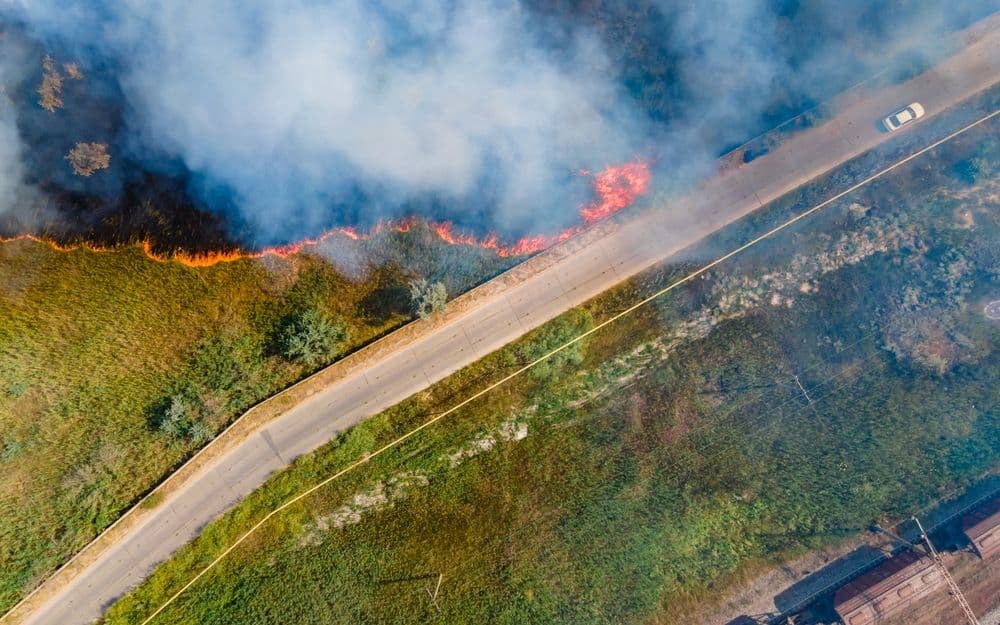
On a clear day a tall, dark smoke column is visible from roughly ten to twenty miles out. Terrain, buildings, and existing haze all make a plume look farther away than it is, so a visible column is not a reliable distance gauge.
If you can see a plume or smell smoke outdoors, that's a fire-proximity question, not an air quality one. Check your local emergency management agency and county alert system for evacuation orders and follow their direction. Nothing on this page substitutes for that.
No plume in sight, no flames anywhere near you, and air quality readings climbing anyway. This is the range where smoke does the most to ground-level air quality across the widest area, because the plume is still low enough to mix down into where people live.
What you'd notice: flat grey or brown haze that doesn't lift during the day, a campfire smell indoors and out, reduced visibility toward the horizon, and a sun that looks dimmed rather than sharp.
Smoke lofted high by an intense fire gets picked up by upper-level winds and carried across the continent. It arrives in discrete plumes, days after it was produced, which is why air quality in a distant city can improve and then deteriorate again with no change in the fire itself.
What you'd notice: a milky or whitish sky rather than brown haze, unusually red or orange sunrises and sunsets, a sun you can look at directly near the horizon — and, often, no smell at all. Whether it affects the air you're breathing depends entirely on whether that plume mixes down to the surface.
This is the part most coverage skips: a dramatic sky and a bad air quality reading are two different things, and you can have either one without the other.
A fire generates enormous heat, and that heat lifts its own smoke. The more intense the fire, the higher the plume gets. Height is what makes distance possible: near the ground, smoke runs into terrain, vegetation, and friction, and particles settle out. Several thousand feet up, there's nothing to settle onto and the winds are much faster than anything you feel at the surface. That's the mechanism behind cross-continental transport — not strong surface winds.
Daytime: smoke rises
Heating through the day deepens the mixing layer, so smoke lifts and dilutes upward. Local air often improves through the afternoon even while the fire burns.
Overnight: smoke sinks
As the surface cools, a shallow stable layer forms and smoke drains into valleys and low ground. This is why smoke frequently measures worst in the early morning, well away from any fire.
Aloft: smoke travels
Plumes that reach upper-level flow move fast and far. Predicting where and when that smoke comes back down is one of the hardest parts of smoke forecasting.
For the science behind why these forecasts are difficult, the EPA covers it in its smoke course: challenges in predicting smoke concentrations. NOAA's satellites track plume position from above — see their coverage of Canadian wildfire smoke transport.
Wildfire smoke is a mix of gases and particles across a range of sizes. The larger material drops out close to the fire. What travels is the fine fraction — PM2.5, particles 2.5 micrometers across and smaller. For scale, the EPA notes a human hair is roughly 70 micrometers across, about thirty times wider than the largest of these particles. EPA: particulate matter basics
At that size, particles have very little mass relative to their surface area, so gravity acts on them slowly and normal air motion keeps them suspended. It's the same property that makes them travel long distances and makes them the fraction air quality agencies track during smoke events. California's air regulator makes the same point about distance: particles can reach people who aren't near an active fire at all. CARB's Smoke Ready California
Public health agencies identify some groups as more sensitive to particle pollution, including children, older adults, people who are pregnant, and people with existing heart or lung conditions. If that includes you, the useful step is a conversation with your healthcare provider before smoke season rather than during one. CDC: wildfire smoke risk factors
Different distances call for different tools. Looking out the window is the least reliable of them.
| Your question | What to check |
|---|---|
| Is there a fire near me? | Your county or state emergency management agency and local alert system. Evacuation decisions come from them. |
| Is the air bad where I am right now? | The AirNow Fire and Smoke Map. It combines regulatory monitors with low-cost sensors, so coverage during smoke events is better than the standard AQI map. |
| Is smoke heading my way? | Smoke forecast layers and satellite imagery. Position aloft doesn't tell you surface concentration, but it tells you what's coming. |
| Is it bad inside my house? | An indoor PM2.5 monitor. Outdoor readings don't tell you what's indoors, and indoor air lags outdoor air in both directions. |
The 150 threshold gets quoted a lot, and it's the wrong number for a lot of people. These are the EPA's actual categories; the color band matches what you'll see on AirNow.
| AQI | Category | Who it applies to |
|---|---|---|
| 0–50 | Good | Normal activity. A good window to air out the house. |
| 51–100 | Moderate | Most people are unaffected. Anyone unusually sensitive to particle pollution may want to shorten long, strenuous time outdoors. |
| 101–150 | Unhealthy for sensitive groups | This is the band the "150 rule" skips. Sensitive groups should be taking action here, not waiting for 151. |
| 151–200 | Unhealthy | Everyone. Close the house up, keep indoor air cycling through a filter, and skip outdoor exertion. |
| 201+ | Very unhealthy and above | Follow guidance from your local health department. Set up one room to keep cleanest, and check filters daily. |
General information only. If you develop symptoms that concern you during a smoke event, seek medical attention — and call emergency services for anything severe, such as chest pain or difficulty breathing.
Smoke in your area? Get a guide for your home.
Answer five quick questions about your space and we'll put together an air quality guide for your situation — including what to prioritize when smoke drifts in from a distance.
The response is the same whether the fire is twenty miles away or two thousand, because what you're managing is the air in your house:
For the full version, including how to set up one clean room and what to skip: what to do during a smoke event.
On filtration
For smoky periods, the EPA recommends upgrading to an HVAC filter rated MERV 13 or higher, and notes most systems can accommodate one provided the filter is replaced frequently. MERV describes the size range of particles a filter captures as air passes through it — and a filter only acts on air that actually moves through it, which is why the fan setting matters as much as the rating. Which rating to run during smoke season.
Check your system's documentation or ask a technician before moving up a rating.
How far can wildfire smoke travel?
Hundreds to thousands of miles. Smoke lofted high by intense fires rides upper-level winds across the continent, so hazy air can arrive in a place with no fire within a thousand miles — sometimes from another country.
How far away can you see a smoke column?
On a clear day, a tall dark plume is generally visible from about ten to twenty miles. Terrain, buildings, and haze distort that, so treat a visible plume as a reason to check official alerts rather than as a distance measurement.
Why does the sky look smoky but the air quality reading is fine?
Because the plume is passing overhead rather than at the surface. High-altitude smoke scatters light — milky skies, red sunsets, a dimmed sun — without necessarily affecting ground-level concentrations. The reverse happens too: air can measure poorly on a day that looks clear.
Why is smoke worst in the morning even though the fire is far away?
Overnight cooling creates a shallow stable layer near the ground, and smoke drains into valleys and low-lying areas. Daytime heating mixes it back upward. So the same plume can produce a bad early-morning reading and a much better afternoon one.
How close is too close to a wildfire?
That isn't an air quality question and the AQI can't answer it. Proximity, evacuation zones, and evacuation timing are determined by your local fire authority and emergency management agency. Sign up for your county's alert system, and follow their instructions rather than your own read of the smoke.
Does distance from the fire make the smoke less of a concern?
Not on its own. The fine particle fraction that travels farthest is the same fraction agencies monitor. What determines your exposure is the concentration where you are, which is what a monitor tells you — not the mileage to the fire.
Related reading
This page is general information about air quality and filtration. It isn't medical advice, and it isn't emergency guidance. During an active wildfire, follow direction from your local fire authority and emergency management agency. For questions about your own health or a specific condition, talk to a qualified healthcare professional. For questions about what your HVAC system can handle, talk to a licensed HVAC technician.
Wind can push wildfire smoke very far. Experts say it can travel hundreds or even thousands of miles. Just recently, it was all over the news that smoke from Canada reached Florida and left the sky gray for days.
Smoke travels far. Wind can push wildfire smoke hundreds or thousands of miles. It can reach places with no fire nearby.
Small dust is the big problem. PM₂.₅ stays in the air for weeks and can enter your lungs and bloodstream.
Bad air can last. Without rain or strong wind, dirty air can stay for many days and keep air quality low.
Health effects are real. Smoke causes irritation and worsen migraines, asthma, and heart disease.
Check the AQI. 150 is unhealthy and dangerous.
Protect yourself. Do not go out, filter your indoor air, wear a good mask, and hydrate.
The biggest problem in smoke is PM₂.₅. Dust so small that thirty pieces could fit across one hair. Because each bit is light, the wind keeps it floating for a long time. California’s air-quality experts warn that these particles can affect people even they are not near an active fire.
On clear days, one can spot a tall, dark smoke column from 10–20 miles away.
Hills, haze, or city buildings can hide how close it really is. If the column looks near or you smell smoke, treat the air as unsafe and head for cleaner ground.
Hot air rises, so fresh smoke climbs upward. After sunset the air cools, and the cooler air pushes older smoke back down into low spots such as valleys. High‐altitude winds can then grab the smoke and carry it across miles. That is why people far from any flames can still wake up to hazy, smoky air.
Outdoors, speed follows wind. A steady wind of 20 miles per hour can push smoke about 100 miles in as fast as five hours. Indoors, hot smoke from a small fire can race 10 meters per second and fill a big room in under a minute.
If rain or strong wind does not arrive, the tiny smoke bits can stay in the air for many days. Large fires and dry weather can leave smoke hanging for weeks, so you might still breathe bad air after news reports show clear skies
Wildfire smoke is filled with:
Tiny particles (PM₂.₅)
Irritating gases such as nitrogen oxides and formaldehyde
Carbon monoxide
These can burn your eyes and throat, hurt your lungs, and cut the oxygen your body needs
Even healthy people may start coughing, while anyone with asthma, heart trouble, or other lung problems can get much worse. Another evidence revealed that more heart attacks, strokes, and early deaths on heavy-smoke days.
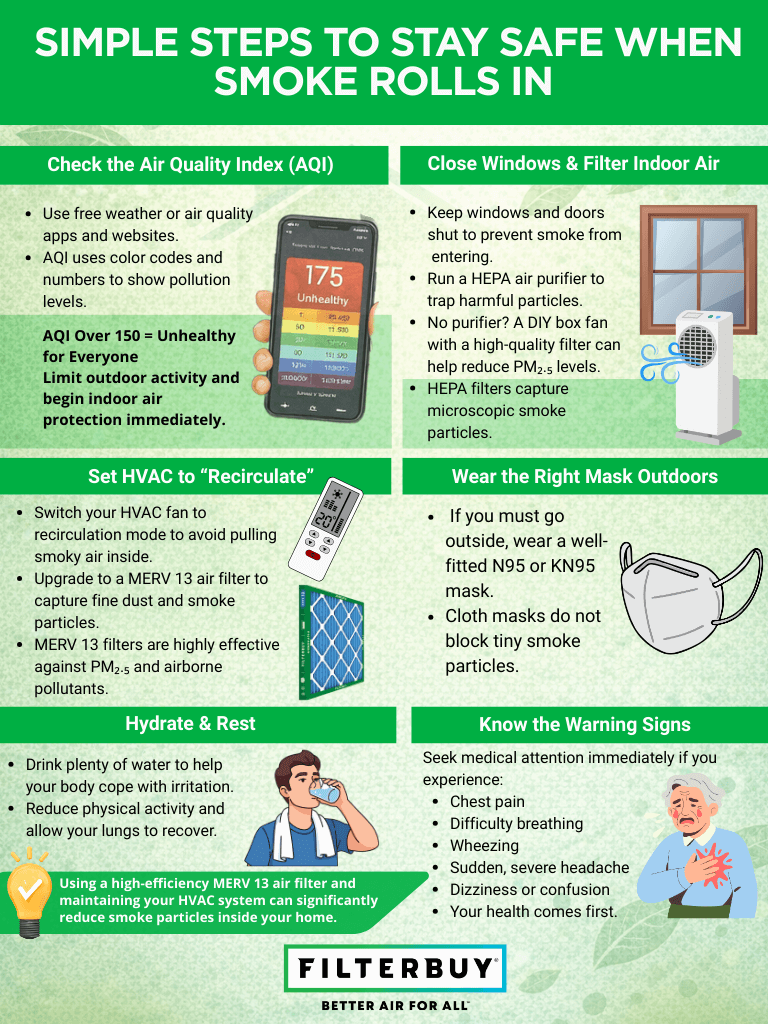
Check the Air Quality Index (AQI). Free apps and websites use colors and numbers. An AQI over 150 means the air is bad for everyone.
Close your windows and run a HEPA air purifier. Even a DIY box-fan filter helps trap PM₂.₅.
Switch your HVAC system to “recirculate.” Use a MERV-13 filter to catch fine dust.
Wear a mask outdoors. Cloth masks do not stop tiny dust.
Hydrate and rest.
Watch for danger signs. Call a doctor if you feel chest pain, hard breathing, or a sudden severe headache.
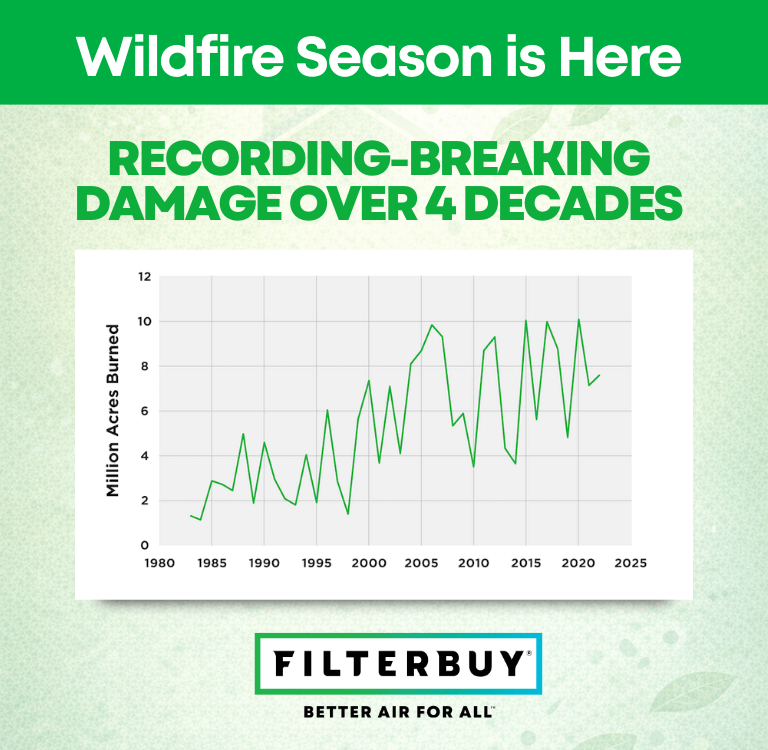
Wildfire smoke travels fast. Avoid its serious side effects by being informed and prepared. Always check the Air Quality Index. If it is high, close your windows, run a HEPA or MERV-13 air filter, and wear a mask when you go outside. These simple steps help keep your lungs safe until the air turns clear again.

Smoke can ride high winds for hundreds, sometimes thousands, of miles. You might breathe hazy air even if the fire is in another state—or another country.
On a clear day, a tall, dark plume can be visible 10 – 20 miles from the fire. Hills, buildings, or haze can hide the true distance, so if you smell smoke, treat the air as unsafe.
The speed depends on the wind. A 20-mile-per-hour breeze can push smoke roughly 100 miles in about five hours.
Hot smoke rises during the day. When evening air cools, older smoke sinks into valleys or low spots, making morning air dirty even far from the flames.
Without rain or strong wind, tiny smoke particles can float for days or even weeks, keeping air quality poor long after the fire starts—or ends.
Indoor smoke spreads fast. Hot smoke from a small fire can move about 10 meters per second, filling a large room in less than a minute.
If the Air Quality Index (AQI) rises above 150, the air is unhealthy for everyone, even if you cannot see flames. Stay indoors or move to cleaner air.
Tiny dust (PM 2.5), sharp gases, and carbon monoxide ride the smoke plume. They irritate eyes and throats, damage lungs, and cut oxygen in the blood—risks that travel with the smoke no matter how distant the fire.
