
Furnace Not Keeping Up in Extreme Cold? Common Causes and Fixes
October 28, 2026
When it’s colder than your furnace was sized for, even a healthy one can run nonstop and lose a few degrees. If it shuts off or blows cool air instead, the cause is usually fixable, so start with the air filter. Most furnaces are sized to hold about 70°F down to your area’s design temperature, a cold mark the weather dips below only about 1% of the year.
Need a fresh filter before the next cold snap? Shop Filterbuy air filters, made to order in the USA in more than 600 sizes.
Furnace losing heat in a cold snap?
Not sure which MERV rating your system can handle? Answer a few quick questions and we’ll match you to the right filter.
When a cold snap hits and the house won't warm up, one of two things is usually going on. Either the furnace is running flat out against more heat loss than it was sized for, or something fixable, like a clogged filter or a blocked vent pipe, is robbing it of capacity.
Start with the air filter. After more than a decade of making filters in the USA, Filterbuy knows the simplest check belongs first.
TL;DR
A furnace sized with ACCA's Manual J method is designed to hold about 70°F indoors down to the local design temperature, a cold mark the weather dips below only about 1% of the year. On colder nights, even a healthy furnace can run nonstop and lose a few degrees. If yours shuts down or blows cool air instead, the cause is usually fixable. Filterbuy, a U.S. air filter manufacturer, recommends starting with the filter and the outside vent pipes.
Key Takeaways
Right-sized furnaces hold 70°F at the local 99% heating design temperature, not at record lows.
A steady indoor shortfall below design temperature signals a capacity limit. A growing one signals a fault.
Filterbuy sees filters that look fine in October choked by December, so check yours monthly through winter.
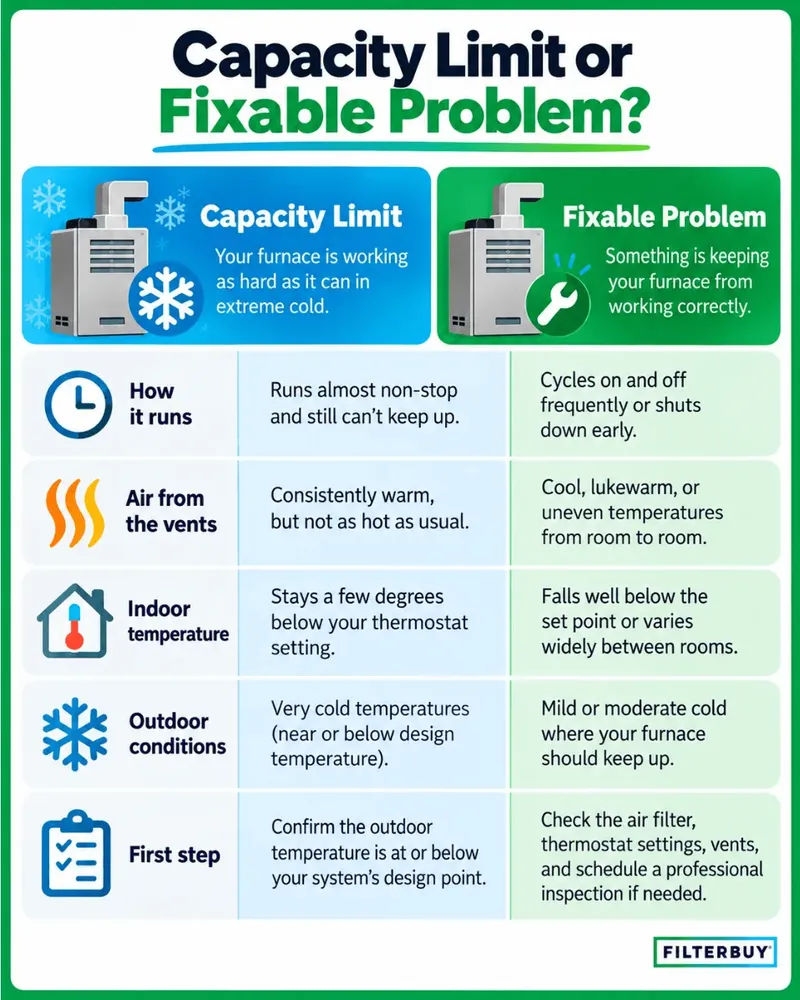
Broken Furnace or Just Outmatched? A Quick Triage Table
From indoors, a capacity limit and a fault feel the same. Filterbuy built this table to help you tell them apart before you call for service.
Two At-Home Tests That Show Which Problem You Have
Filterbuy designed these checks to quantify the table. You need a weather app and a digital thermometer.
The overnight gap log. At bedtime and dawn, write down the outdoor temperature, your thermostat setting, and the indoor temperature. If the shortfall holds steady while it's below your design temperature, the furnace has hit its capacity limit. If the gap keeps growing, or shows up in milder weather, something else is wrong.
The temperature-rise check. After 10 minutes of heating, measure the air at a supply register near the furnace and at the return grille, then subtract. The rating plate lists an acceptable range, such as the 35°F to 65°F in Contracting Business's Manual S example. A rise above that range usually means restricted airflow, so start with the filter. A rise well below it means weak heat output, a job for a technician.
Why Does a Furnace Stop Keeping Up When It Gets Really Cold?
A furnace stops keeping up in extreme cold because a home loses heat faster as the indoor-outdoor gap widens, while the furnace's output stays the same. HVAC contractors size furnaces with the ACCA Manual J load calculation, which plans for the local 99% heating design temperature. Many furnaces are oversized and hold out longer, but a right-sized one hits its limit there. Per Green Building Advisor's furnace sizing guide, only 1% of hours in an average year are colder. On those nights, as technician Vernon Rathert of All Comfort Service told Channel 3000, "it's not that your furnace is not working, it's just so cold outside."
The companion standard, ACCA Manual S, lets a furnace's output range from 100% to 140% of the calculated heating load, as Contracting Business explains in its introduction to Manual S.
How Much Harder a Furnace Works Below Design Temperature
Filterbuy ran the numbers for a home with a 0°F design temperature and a 70°F setting, assuming heat loss rises in step with the indoor-outdoor gap. Drafts and wind push real homes higher.
A furnace sized right at 100% of the load starts falling behind just below 0°F, while one near the 140% ceiling can hold 70°F down to roughly -28°F. Filterbuy's takeaway: losing a few degrees in a deep freeze is normal for a healthy furnace.
Common Causes of a Furnace Not Keeping Up in Extreme Cold
When the furnace cycles off or falls behind on milder nights, the usual culprits are a clogged air filter, blocked vent pipes, thermostat problems, leaky ducts, low propane pressure, or an aging furnace.
A Clogged or Overly Restrictive Air Filter
A clogged air filter is one of the most common fixable reasons a furnace falls behind in a cold snap. When airflow drops, the heat exchanger runs hot until the high-limit switch shuts the burners off, and the house never catches up.
As a filter manufacturer, Filterbuy sees the same pattern every winter. A filter that looks fine in October can be choked by December, right when heating demand peaks, which is why the ENERGY STAR maintenance checklist recommends checking filters monthly.
"On a no-heat call in January, the first thing I pull is the air filter, because a clogged filter can shut a furnace down."
David Clark, Licensed HVAC Technician, Filterbuy HVAC Solutions
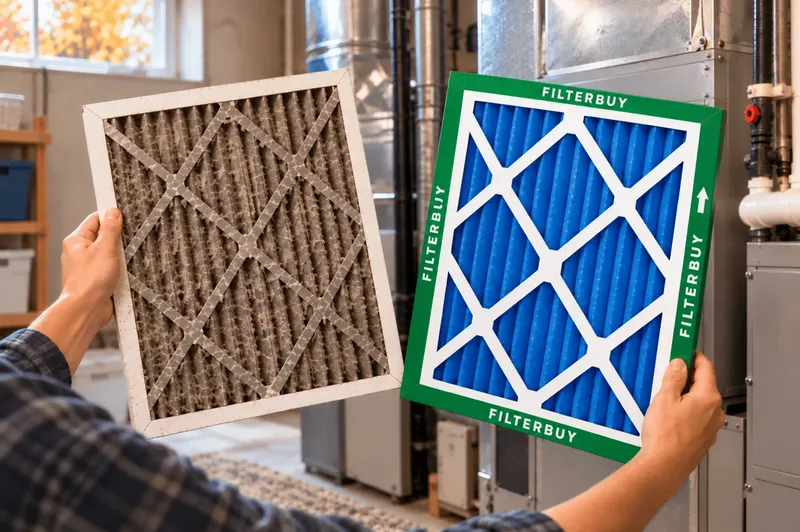
Pro Tip: Filterbuy's two-check test. Write the install date on the filter frame. After 30 days, hold the filter against white paper. If it looks gray and matted, replace it and stay on a 30-day cycle all winter.
Filterbuy often sees two other filter problems:
Too restrictive. A filter rated higher than your system was designed for can choke airflow, so confirm the minimum efficiency reporting value (MERV) your manual allows.
Poor fit. A filter that doesn't fill its slot lets air slip around the edges. Measure your air filter before you reorder.
"The best filter is the highest rating your system can move air through, in the deepest size your cabinet will take, changed on time."
Michelle Wan, Brand Manager, Filterbuy
See Filterbuy's guides to signs of a clogged furnace filter and how often to change your furnace filter in winter.
Blocked Intake or Exhaust Vent Pipes
A high-efficiency, or condensing, furnace vents through plastic PVC pipes on an outside wall or roof. When snow or ice covers those pipes, the furnace shuts itself down, and a frozen condensate line can do the same. See Filterbuy's guide to clearing a frozen furnace vent pipe safely. If a carbon monoxide alarm sounds, get everyone outside and call 911.
Thermostat Settings and Fan Mode
During an arctic blast, hold a steady setting rather than a deep setback. The U.S. Department of Energy credits 7°F to 10°F setbacks with up to 10% yearly savings, but a furnace running at full output may not recover until the weather warms.
A thermostat on a drafty exterior wall reads colder than the rest of the house. With the fan on ON, the blower moves air between cycles that can feel cool, and it loads the filter faster, a change many Filterbuy customers don't expect. If you prefer ON, check the filter monthly and see Filterbuy's guide to furnace fan ON or AUTO in winter.
Leaky or Uninsulated Ductwork
Healthy furnaces lose ground to leaky ducts. ENERGY STAR's duct sealing guidance estimates 20% to 30% of the air in a typical duct system escapes before it reaches your rooms.
Low Propane Tank Pressure
As temperatures fall, propane's vapor pressure drops, which can starve the furnace even with fuel in the tank. Suppliers such as Paraco recommend keeping the tank at least 30% full.
An Aging or Undersized Furnace
If your furnace struggles every winter, even on nights warmer than design temperature, it may be worn or undersized. HVAC equipment typically lasts 15 to 20 years, and many furnaces were sized by rule of thumb rather than a load calculation. See Filterbuy's guide to replacing a furnace in winter.
What to Check First When Your Furnace Can't Keep Up
Start with safety; most checks take minutes. For storm prep, see Filterbuy's cold snap furnace checklist.
Check your carbon monoxide alarm. If it's sounding, get outside and call 911.
Confirm the thermostat is on HEAT with the fan on AUTO and fresh batteries.
Replace the air filter if light barely passes through it.
Clear the outside vent pipes of snow and ice by hand.
Open every register and move rugs and furniture off the return grilles.
Check the breaker and furnace switch, plus the tank level if you heat with propane.
When to Call an HVAC Technician
Call a licensed HVAC technician if the furnace still short cycles after a filter change, blows cool air, shows a flashing error code, or leaves rooms cold on nights warmer than your design temperature. If you smell gas, leave the house and call your gas utility from outside.
Keep the Right Filter on Hand All Winter
A fresh filter is cheap insurance against a cold-snap shutdown, and Filterbuy cuts, pleats, and frames every MERV 8, MERV 11, and MERV 13 filter to order in its U.S. plants, in more than 600 sizes. Shop air filters by exact size or set up filter auto-delivery.
Supporting Statistics
1. Heating Is 42% of Home Energy Use
Average cost: $519 a year (2020).
Propane-heated homes: $1,010 a year on heating.
Filterbuy's take: A furnace running nonstop drives this bill up fastest.
Source: U.S. Energy Information Administration, 2020 RECS release
2. Older Homes Lose Heat Faster
27% of Midwest homes built before 1970 report poor or no insulation, versus 11% of newer homes.
Filterbuy's take: Leaky homes are the first to fall behind in extreme cold.
Source: U.S. Energy Information Administration, Today in Energy
3. Carbon Monoxide Deaths Peak in Winter
More than half happen November through February.
Consumer-product CO deaths hit a record 254 in 2019.
Filterbuy's take: Clear vent pipes and test CO alarms before every cold snap.
Source: U.S. Consumer Product Safety Commission, 2024 winter safety release
Frequently Asked Questions
Is It Normal for a Furnace to Run Constantly in Extreme Cold?
Yes, if it's below your design temperature and the vents still blow warm air. Cool air or a steadily falling indoor temperature points to a fault.
How Do I Find My Area's Design Temperature?
Your HVAC contractor uses it in the Manual J calculation, and many local building departments publish it in their code tables. Richland, Washington, for example, lists a Manual J winter heating temperature of 11°F.
Can a Dirty Air Filter Make a Furnace Stop Working in Cold Weather?
Yes. A clogged filter restricts airflow, the heat exchanger overheats, and the high-limit switch shuts the burners off.
Should I Turn My Thermostat Down at Night During a Cold Snap?
Not during extreme cold. A furnace at full output may not recover from a deep setback until the weather warms, so hold a steady setting.
Will a Bigger Furnace Fix the Problem?
Not always. An oversized furnace can short cycle in normal weather. Ask for a Manual J load calculation first, and have leaky ducts sealed.
Glossary
ACCA Manual J: The Air Conditioning Contractors of America method for calculating a home's heating load.
99% Heating Design Temperature: The outdoor temperature a location stays above 99% of the year.
Condensing Furnace: A high-efficiency gas furnace that vents cool, wet exhaust through PVC pipes.
High-Limit Switch: A safety control that shuts off the burners when a furnace overheats.
Temperature Rise: The difference between supply-air and return-air temperature while a furnace heats.
MERV: Minimum Efficiency Reporting Value, a 1-to-16 rating of how well a filter captures particles.
Short Cycling: A furnace turning on and off in short, incomplete heating cycles.