
Can You Run A Furnace Without A Filter? What Happens And How Long Is Safe
October 20, 2026

Yes, you can run a furnace without a filter for a few hours, and a single night rarely does lasting harm. At Filterbuy, an American air filter manufacturer, we treat an empty filter slot as a countdown measured in blower hours, not days. Every hour the blower runs, dust and pet hair the filter would have caught go straight into the blower and evaporator coil, and winter piles those hours up fast.
Yes, for a few hours, and one night rarely does lasting harm. After that, every hour the blower runs pushes dust onto the blower and coil, parts a new filter can’t clean.
In freezing weather, keep the heat on, set the fan to AUTO, and slide in any filter in your exact size today.
Not sure which filter to keep on hand? Take the quick match quiz below.
Answer a few quick questions and we’ll match you to your filter.
TL;DR
A few hours without a furnace filter is low risk, but days of winter runtime coat the blower and coil with dust that a new filter cannot remove. Keep the heat on in freezing weather, set the fan to AUTO, and slide in any correctly sized filter until your preferred one arrives.
Key Takeaways
A furnace runs without a filter, but nothing then keeps dust out of the blower and coil.
Count blower hours, not calendar days: one night is generally fine; a week is not.
Never shut off the heat in freezing weather to protect the furnace. Frozen pipes cost far more than dusty parts.
The cheapest filter in your exact size beats an empty slot, while homemade substitutes can make things worse.
How Long Can You Run A Furnace Without A Filter?
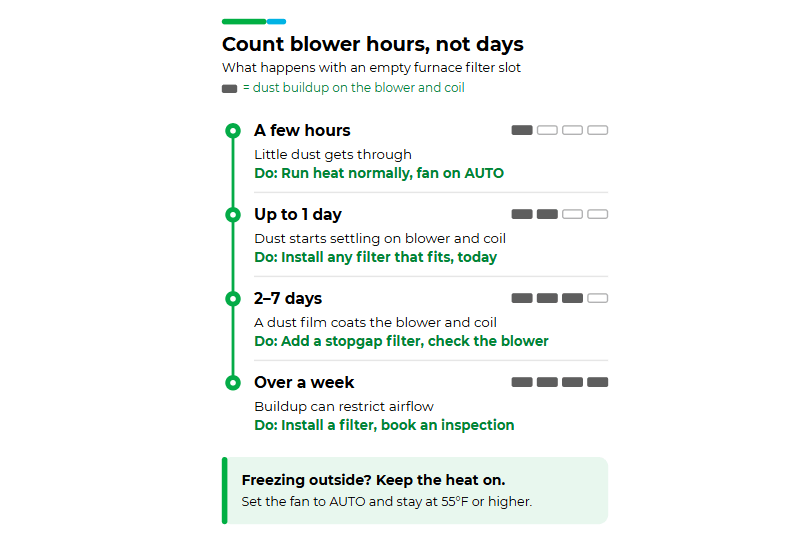
A few hours is generally low risk, and one night rarely causes lasting harm. After about a day of winter runtime, dust starts settling on the blower and coil, so fill the empty slot the same day if you can.
Filterbuy's rule of thumb is to count blower hours, not calendar days. A furnace cycling through a cold January night in a home with pets moves far more debris than it does on a mild October afternoon. If you have a smart thermostat, its runtime history shows how many heating hours have passed.
Furnace Runtime Without A Filter: What Happens And What To Do
| Time | What Happens | What To Do |
|---|---|---|
| A few hours | Little dust gets through | Run heat normally, fan on AUTO |
| Up to 1 day | Dust starts settling on the blower and coil | Install any filter that fits today |
| 2–7 days | A dust film coats the blower and coil | Add a stopgap filter, then check the blower |
| Over a week | Buildup can restrict airflow | Install a filter and book an inspection |
What Happens Inside Your Furnace Without A Filter?
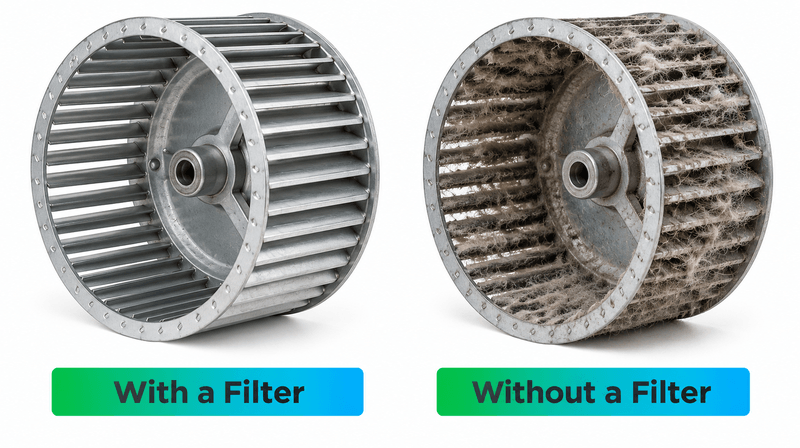
Without a filter, whatever a furnace's return vents pull in lands on the blower wheel and evaporator coil, then moves into the ducts. Unlike a filter, none of these parts can be swapped out.
The blower wheel loses airflow. Dust packed onto its curved fins cuts how much air it moves, so the furnace delivers less warmth per hour of runtime.
The coil collects a dust layer. The U.S. Department of Energy's air conditioner maintenance guidance notes that a clean filter keeps the coil from soiling quickly, and that coil dirt reduces airflow and insulates the coil.
More dust reaches your rooms. Debris that clears the equipment blows back out of the supply vents. The EPA's overview of air cleaners and air filters in the home describes central furnace filters as designed to filter air throughout a home, and that work stops when the slot is empty.
First-start smells can get stronger. Extra dust can intensify the faint burning smell common at a furnace's first fall startup. If the smell lingers or turns electrical or chemical, shut the system off and call a licensed technician. Filterbuy's guide on whether a dirty filter can cause a furnace fire explains the overheating risk.
Why Winter Makes A Missing Filter More Costly
A missing filter does the most damage in winter because that is when the furnace runs the most. A gap that barely matters in spring can load the system with debris over one cold week.
Closed windows keep pet dander and fireplace particles inside, where return vents pull them in.
Winter storms can slow deliveries, turning a one-day gap into several.
Should You Turn Off The Furnace Until A New Filter Arrives?
Not in freezing weather. A cold house puts your plumbing at risk, and the American Red Cross advises leaving the heat on in cold weather, even when you are away, set no lower than 55°F. Instead, cut how much air moves through the system:
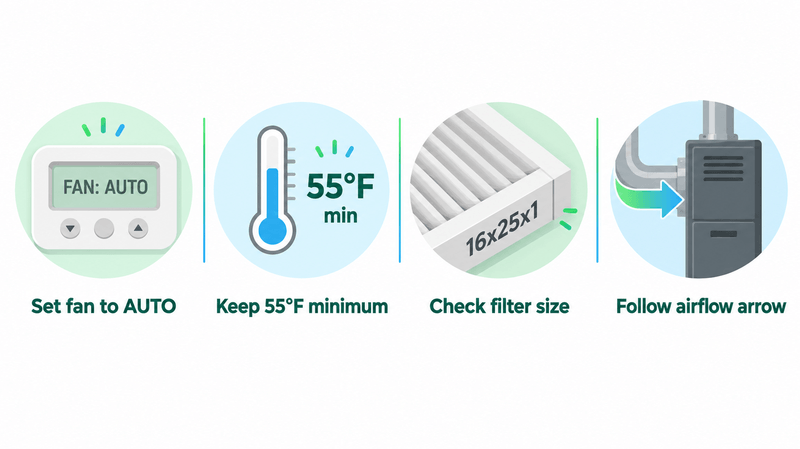
Set the fan to AUTO, not ON, so the blower runs only during heating cycles. Turn off any CIRCULATE mode too.
Lower the thermostat a few degrees for fewer heating cycles, staying at or above 55°F.
Keep the filter slot cover closed so the system does not pull air straight from the furnace room.
Pause the heat only in mild weather, when temperatures stay well above freezing.
Safe Stopgaps Until A New Filter Arrives
The best stopgap is any disposable filter in your exact size, even a basic one from a hardware store. It may be surprising advice from a filter company, but at Filterbuy we would rather you run the cheapest correct-size filter for three days than run nothing for one.
Check every filter location. Some homes hold the filter behind a wall or ceiling return grille, and some have more than one. An empty grille lets debris into the return duct too.
Buy the printed size, not the measured size. Filterbuy builds every filter slightly smaller than its nominal size, such as 16x25x1, so it slides into the slot. If the old frame is gone, measure the filter slot and round to the nearest inch.
Use a basic filter as a bridge. A fiberglass or entry-level pleated filter works for a few days.
Reinstall the old filter if it is intact. If it is not torn or visibly clogged (see what a dirty furnace filter looks like), it can go back in for a day or two.
Point the airflow arrow toward the furnace, and write the date on the frame so the stopgap does not quietly become permanent.
Avoid homemade substitutes. Cheesecloth and paper towels can collapse or get pulled toward the blower. Never force an oversized filter into the slot or wash a disposable one. Our step-by-step guide to replacing a furnace filter walks through the full swap.
What To Do After The New Filter Is In
Most short gaps need nothing more than the new filter. If the furnace ran several days without one, take three extra steps to clear the dust that got through.
Vacuum the return grilles and wipe down the area around the filter slot.
Watch for weaker airflow or longer heating cycles, both signs of a dirty blower or coil.
Mention the gap at your next tune-up so the technician checks the blower wheel and coil, and test your carbon monoxide alarms. The U.S. Consumer Product Safety Commission recommends CO alarms on every level of the home and outside sleeping areas.
For the replacement, Filterbuy makes pleated filters in three ratings. MERV 8 filters handle everyday dust and lint, MERV 11 filters capture more particles such as pet dander, and MERV 13 filters have the highest capture level in our residential lineup. Check your furnace manual before moving to a higher rating. Our guide to which MERV rating fits your home compares all three.
"On service calls, a furnace that has run for weeks without a filter shows it right away: lint packed into the blower wheel fins and a gray film across the coil. In winter, I tell homeowners to keep the heat on and get any filter that fits into the slot that same day."
David Clark, Licensed HVAC Technician
Supporting Statistics
1. Heating is the biggest energy job in your home.
Space heating accounted for 42% of U.S. residential energy use in 2020, so winter is when your blower logs the most hours.
Source: Space Heating Consumed the Most Energy of Any End Use in Homes, According to Latest Data
2. Frozen pipes cost more than dusty parts.
Water damage and freezing claims averaged $15,400 each from 2019 to 2023, which is why we say keep the heat on while you wait for a filter.
Source: Facts + Statistics: Homeowners and Renters Insurance
3. Annual service is a safety step, not an upsell.
More than 400 Americans die each year from unintentional carbon monoxide poisoning not linked to fires, and the CDC advises yearly service for gas-burning heating systems. A filterless stretch is a good reason to book that visit early.
Source: Carbon Monoxide Poisoning Basics
Frequently Asked Questions
Is It Worse To Run A Furnace With A Dirty Filter Or No Filter?
Both cause damage in different ways. A clogged filter restricts airflow, which the Department of Energy notes significantly reduces a system's efficiency, while no filter keeps air moving but lets debris coat internal parts. For a day or two, an intact, lightly used filter beats an empty slot.
Can I Run My Heat Pump Without A Filter In Winter?
Briefly, yes. A heat pump heats through its indoor coil, so dust on that coil cuts into the warmth you feel. Get a correctly sized filter back in within the day.
Can I Use A Smaller Filter Temporarily?
Yes, for a day or two, and it beats no filter. Air slips through the gaps around a smaller filter's edges, though, so switch to your exact nominal size as soon as possible.
How Often Should I Change My Furnace Filter In Winter?
Filterbuy recommends that you check your furnace filter every 30 days in winter, in line with ENERGY STAR's monthly filter inspection guidance. Most 1-inch air filters need replacing every one to three months, while 4-inch air filters and 5-inch filters last longer. Our guide on how often to change your furnace filter breaks it down by thickness.
Never Run Your Furnace Without A Filter Again
A few hours without a filter is manageable, but days of winter runtime leave dust where it does real damage, so keep a spare in your exact size next to the furnace. Shop your exact filter size from Filterbuy, including custom sizes we make to order, with fast and free 2-day delivery to most US states, or set up filter auto-delivery so a fresh filter arrives before the next cold snap.
Glossary
Furnace Filter: A replaceable media panel in a furnace's return air path that captures particles before they reach the blower and coil.
Blower Wheel: The cylindrical fan inside a furnace that pushes air through the ducts.
Evaporator Coil: The indoor coil of an air conditioner or heat pump, also called the A-coil, located beside the furnace.
MERV: Minimum Efficiency Reporting Value, a 1 to 16 rating under ASHRAE Standard 52.2 for how well a filter captures particles.
Nominal Size: The rounded dimensions printed on a filter frame, such as 16x25x1. Actual dimensions are slightly smaller.
Fan AUTO Setting: A thermostat setting that runs the blower only during heating or cooling cycles instead of continuously.