
What Is the Polar Vortex? How a Collapse Sends Arctic Air South
October 15, 2026
TL;DR
The polar vortex is a permanent band of cold air and strong west-to-east winds circling the Arctic. When its high-altitude layer weakens or collapses during a sudden stratospheric warming, Arctic air can spill into the US days to weeks later. A collapse raises the odds of a cold outbreak without guaranteeing one, so treat it as an early warning to prepare your home.
Key Takeaways
The polar vortex is a normal feature around both poles, not a storm and not a new phenomenon.
A "collapse" is a sudden stratospheric warming (SSW), which happens roughly six times per decade.
Cold can reach the surface within days or take up to two months, and some collapses bring little US cold.
US cold outbreaks follow a weak or disrupted vortex; a strong vortex keeps Arctic air near the pole.
Use the warning window to check your furnace filter, protect pipes and test CO alarms.
What Is a Polar Vortex?
A polar vortex is a large area of low pressure and cold air that circles each of Earth's poles, held in place by counterclockwise winds. The National Weather Service notes that it has always been present; only the name is new. When a forecast says "the polar vortex is coming," it means a lobe of Arctic air has broken away and is moving south.
Scientists track two layers. The tropospheric vortex sits in the weather layer near the polar jet stream. The stratospheric vortex forms only in winter, 5 to 30 miles above the surface, and it is the one that "collapses."
What Is a Polar Vortex Collapse?
A polar vortex collapse is a major sudden stratospheric warming (SSW): the air over the pole heats rapidly and the vortex's west-to-east winds slow or reverse. NOAA reports SSWs happen about six times per decade.
Meteorologists call an SSW "major" when the stratospheric jet reverses from westerly to easterly at 60°N and about 18 miles up. Large atmospheric waves rising from below trigger the event, and the disrupted vortex is either pushed off the pole or split into smaller lobes.
How Does a Weak Polar Vortex Send Arctic Air South?
A weakened stratospheric vortex can buckle the jet stream below it, letting lobes of Arctic air plunge south while warm air surges north. NOAA notes that US cold intrusions occur when the vortex weakens, not when it strengthens.
Where the cold lands varies by event, though the eastern US, Europe and Asia are most often hit. Many Arctic outbreaks also come from ordinary jet-stream meanders with no stratospheric trigger at all.
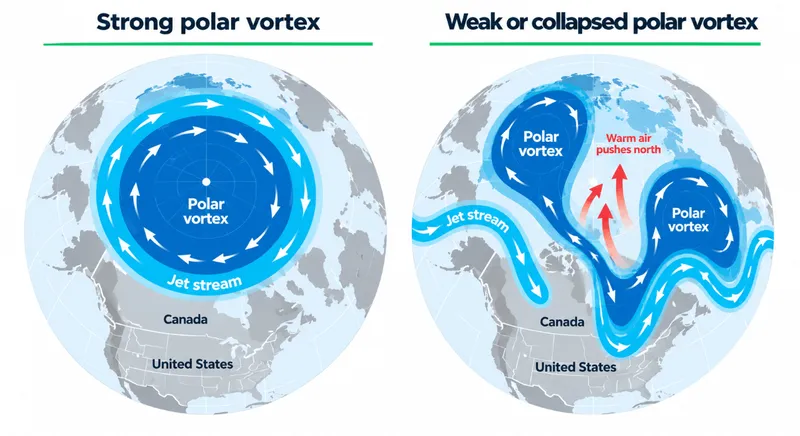
Strong vs. Weak Polar Vortex: What Each Usually Means
Patterns are typical, not guaranteed. Sources: NOAA Climate.gov; National Weather Service.
How Long After a Polar Vortex Collapse Does the Cold Arrive?
Cold usually reaches the surface a few days to several weeks after a collapse, and NOAA says effects can take up to two months. Once it arrives, the pattern can last days to weeks.
A collapse does not guarantee extreme cold. After the January 2021 SSW, one study found the warming had little effect on February's record cold, while a Science study tied that cold wave to a stretched stratospheric vortex. For your home, follow the local forecast, not the vortex headline.
Recent Polar Vortex Events in the US
NOAA lists cold air outbreaks after the SSWs of January 2013, February 2018, January 2019 and January 2021. Most recently, NASA's Earth Observatory said the late January 2026 cold spell stood out for its severity, longevity and geographic scope, with Alliance, Nebraska, setting a record low of −26°F on January 24.
Is Climate Change Making the Polar Vortex Weaker?
Scientists don't yet agree. A 2021 Science study reports that vortex-stretching events have increased over the satellite era, while NOAA's Amy Butler notes no robust trend in SSWs and climate models disagree. What is settled: polar vortex outbreaks are not new, with major ones in 1977, 1982, 1985 and 1989.
The Polar Vortex Countdown: How to Prepare Your Home
The weeks between a stratospheric warning and the first cold morning are your prep window. Filterbuy built this countdown because a filter that looked fine in the fall is often choked by the time the cold arrives.
Timings are typical ranges, not guarantees. Always follow your local NWS forecast.
Why Your Air Filter Matters More During a Cold Snap
During an Arctic outbreak, your furnace runs far longer, so its filter loads with dust faster and can restrict airflow. Filterbuy designs filters for about 90 days of typical use, but one cold snap can fill a filter well ahead of schedule. ENERGY STAR recommends you inspect, clean or change filters once a month in heavy-use seasons.
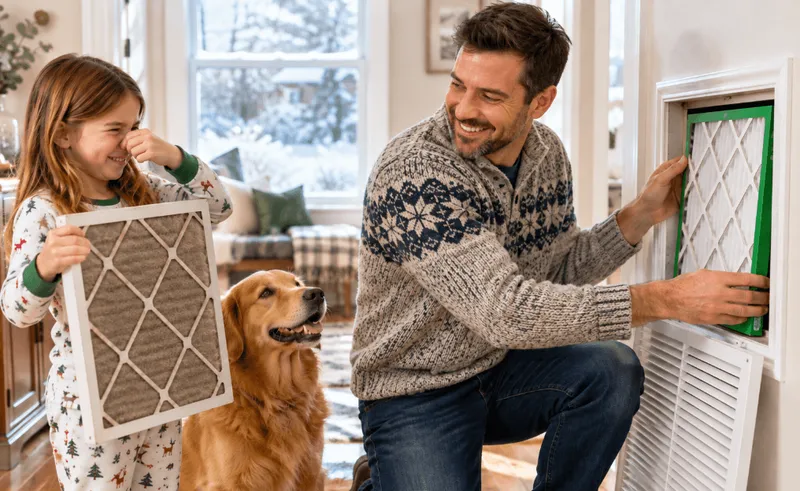
Check the filter against white paper, not a light; the gray shows right away. Depth helps, too: our 4-inch filters use 8 deep pleats per foot that hold more dust than a 1-inch filter's 14 shallow ones. For timing by filter type, see how often to change your furnace filter in winter.
A furnace running nonstop in deep cold is often normal. As this page's reviewer puts it:
"If it's colder than the home's design temperature, nonstop running is the furnace doing its job. If it isn't, I start at the filter slot."
David Clark, Licensed HVAC Technician, in our guide to a furnace running constantly in extreme cold
How to Protect Pipes and Stay Safe
Freezing pipes and carbon monoxide are the two biggest home risks in a polar vortex cold snap. Homes built for mild winters face the most risk: in February 2021, temperatures ran more than 40°F below normal from Nebraska to Texas.
Keep the thermostat at one setting day and night, drip faucets on exposed pipes and never set the heat below 55°F when away, as the American Red Cross advises.
Insulate pipes in garages, crawl spaces, attics and exterior-wall cabinets, and test your main water shutoff.
Never heat with a gas oven, grill or generator indoors; the CDC says to keep generators at least 20 feet from doors, windows and vents.
Keep battery-backed CO alarms near every sleeping area, and if the power fails, gather everyone in one closed room.
How to Read the Temperature Anomaly Map
A temperature anomaly map shows how much warmer or colder it is than normal for that place and date. Blue means colder than normal and red means warmer. During a polar vortex event, a blue mass pushing south from Canada paired with red over the Arctic or Alaska means Arctic air has been displaced.
Our take: At Filterbuy, we make air filters, not forecasts, so the science here comes from NOAA, the National Weather Service and NASA. What we add is the view from inside the house: after more than a decade of making filters at our US plants, we've learned that winter is the season homeowners underestimate most.
Supporting Statistics
$24.0 billion and 226 deaths: The February 2021 cold wave was the costliest US winter storm on record, according to NOAA's National Centers for Environmental Information.
42% of home energy: Space heating is the largest energy use in US homes, according to the US Energy Information Administration, which makes the furnace filter a frontline part during a cold snap.
$15,400 per claim: Water damage and freezing claims average $15,400, and about 1 in 60 insured homes files one each year, according to the Insurance Information Institute.
Frequently Asked Questions
Is the polar vortex a storm?
No. The polar vortex is a permanent circulation of cold air around the poles. It can steer storms and Arctic air toward you, but it is not a storm itself.
What does "polar vortex collapse" mean?
It is the popular term for a major sudden stratospheric warming, when the stratospheric vortex's winds reverse and the vortex is displaced or split.
Which US states get hit hardest by the polar vortex?
NOAA says a disrupted vortex most often raises the odds of cold in the eastern US, and Arctic air has reached as far south as Florida.
Can forecasters predict a polar vortex collapse?
Usually only 1–2 weeks ahead. NOAA's Amy Butler notes that breakdowns generally cannot be predicted more than 10–15 days in advance.
Should I change my air filter before the polar vortex hits?
Check it as soon as a collapse is confirmed and change it if it looks gray against white paper, since a cold snap can load a filter well ahead of schedule.
Glossary
Sudden stratospheric warming (SSW): A rapid winter warming of the polar stratosphere that slows or reverses the vortex's winds.
Jet stream: A fast river of wind near cruising altitude that separates cold polar air from warmer air.
Temperature anomaly: The difference between the observed temperature and the long-term average for that place and date.
Design temperature: The outdoor temperature an area stays above about 99% of the year; furnaces are sized to it.
Get Your Home Ready with Filterbuy
Filterbuy makes more than 600 filter sizes in its US plants and ships them free. Find your exact filter size or set up auto-delivery so a fresh filter is in your furnace before the next Arctic blast.