
How to Ventilate a House in Winter Without Losing Heat
November 5, 2026

You can ventilate a house in winter without losing heat by combining short bursts of window airing, bathroom and kitchen exhaust fans, and (where installed) a heat or energy recovery ventilator. These methods bring in fresh air while limiting heat loss. Pair ventilation with a clean, properly fitted furnace filter to support better indoor air between air exchanges.
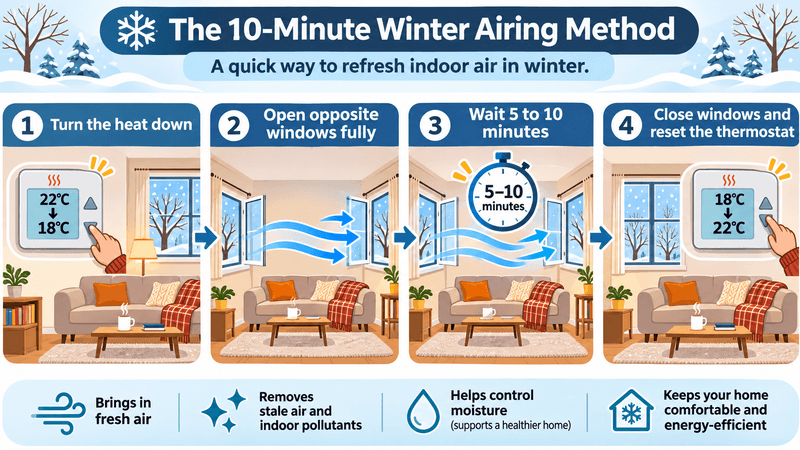
Ventilate in short bursts: open windows for 5–15 minutes a few times a day, and run bathroom and kitchen exhaust fans that vent outdoors. Most of your home’s warmth is stored in its walls, floors, and furniture, so a quick air swap won’t undo it.
Between airings, a clean, snug-fitting furnace filter cleans the air your system recirculates. Take the quick quiz below to find your filter match.
Swap the air, not the heat
A quick air swap won’t undo your home’s warmth.
- 1Open windows 5–15 minutesA few times a day, on opposite sides.
- 2Run the bathroom fanDuring and about 15 minutes after showers.
- 3Use a hood that vents outsideClears cooking moisture at the source.
- 4Keep a fresh furnace filterCleans recirculated air between airings.
Find your filter match
Answer a few quick questions and we’ll match you to the right filter for your home this winter.
Already know your size? Shop furnace filters at Filterbuy →
Why Does Your House Still Need Ventilation in Winter?
Every home generates moisture and pollutants through everyday living. Showering, cooking, doing laundry, and even breathing all add water vapor to indoor air. Without a way for that moist, stale air to leave and fresh air to come in, humidity and indoor pollutants can build up.
This is especially true in newer or recently upgraded homes. Insulation and draft proofing make a house more airtight, which is great for energy efficiency, but it also makes it harder for stale air to escape and fresh air to enter. That is why ventilation becomes more, not less, important as a home becomes more energy efficient.
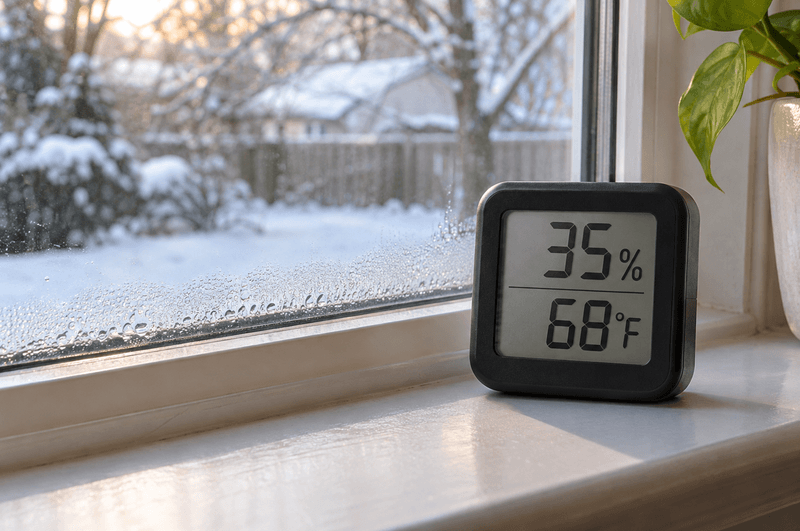
Indoor humidity that stays too high during cold weather can lead to condensation on windows and cold surfaces. Over time, ongoing condensation can contribute to mold growth and even damage to window frames, sills, and wall cavities. The U.S. Department of Energy's Building America Solution Center notes that the goal is to keep relative humidity in a home generally between 35% and 50%, since higher levels can encourage mold, mildew, and dust mites.
Ventilation also helps dilute biological contaminants like mold spores, dust mites, and pollen that build up indoors. The U.S. Environmental Protection Agency identifies ventilation, alongside source control and filtration, as one of three key strategies for reducing exposure to these contaminants.
7 Ways to Ventilate Your House in Winter Without Losing Too Much Heat
Winter ventilation works best when you combine a few of these methods rather than relying on just one.
1. Open windows briefly
Opening windows for short periods, even in winter, is one of the simplest ways to exchange indoor and outdoor air. Most of the heat stored in a home is held in the structure itself, including walls, floors, and furniture, not just the air. Because of this, a brief burst of fresh air will not undo your home's warmth the way a window left open all afternoon might.
A good approach: open a few windows for roughly five to fifteen minutes, then close them again. Choose a time when the sun is warming that side of the house if possible, since the incoming air will be slightly less cold.
2. Use cross-ventilation when conditions allow
Opening windows on opposite sides of the house, even briefly, lets air move through the home more efficiently than a single open window. This technique, sometimes called cross-ventilation, helps fresh air reach more rooms in less time, which can shorten how long windows need to stay open.
3. Run bathroom exhaust fans
Bathroom exhaust fans remove moisture-heavy air right at the source, before it has a chance to spread through the house. Run the fan during a shower or bath and let it continue for about 15 minutes afterward to clear lingering humidity. It is important that bathroom exhaust fans discharge outdoors rather than into an attic or crawlspace, where trapped moisture can cause its own problems.
4. Use externally vented kitchen range hoods
Cooking produces moisture, odors, and combustion byproducts if you use a gas range. A kitchen range hood or exhaust fan that vents to the outdoors removes these pollutants directly, rather than letting them circulate through the house. As with bathroom fans, kitchen exhaust must discharge outside the home, not just recirculate air back into the kitchen.
5. Consider an HRV
A heat recovery ventilator (HRV) continuously brings in fresh outdoor air while exhausting stale indoor air, using a heat exchanger to transfer warmth from the outgoing air to the incoming air. This tempers the fresh air before it enters your living space, which can reduce the heating load compared to simply opening windows. An HRV reduces heat loss from ventilation; it does not eliminate it entirely, since some energy exchange is always needed to move air through the system.
6. Consider an ERV
An energy recovery ventilator (ERV) works similarly to an HRV, but it also transfers some moisture between the outgoing and incoming air streams. This helps keep indoor humidity more stable, which can be useful in very dry winter climates where incoming cold air tends to lower indoor humidity once it is heated. Choose an ERV over an HRV if your winters bring very low indoor humidity and you want some moisture retained; choose an HRV if moisture control is less of a concern for your climate and home.
7. Maintain designed ventilation pathways
Homes with trickle vents, wall vents, or a whole-house ventilation system are designed to provide a steady, controlled flow of fresh air. These should generally stay open year-round, including in winter, so the home receives a consistent supply of fresh air rather than relying only on manual window opening. Avoid sealing or blocking any vent or opening that was intentionally designed for ventilation or combustion air, since doing so can create indoor air quality and safety issues.
Which Winter Ventilation Method Is Best for Your Home?
There is no single ventilation schedule or method that works for every house or climate. The right combination depends on your home's airtightness, local climate, and whether you already have mechanical ventilation installed. The table below compares common options to help you think through what fits your situation.
| Method | Heat Loss Impact | Best For | Maintenance Needed |
|---|---|---|---|
| Brief window airing | Low, if kept short | Any home, especially on milder winter days | None |
| Cross-ventilation | Low to moderate | Homes where multiple windows can be opened safely | None |
| Bathroom exhaust fan | Low | Removing moisture after showers and baths | Periodic cleaning of fan and grille |
| Kitchen range hood | Low | Removing cooking moisture and odors | Regular filter cleaning per manufacturer instructions |
| HRV | Moderate heat recovery, continuous fresh air | Cold, dry climates with low humidity concerns | Annual inspection, periodic filter and core cleaning |
| ERV | Moderate heat and moisture recovery, continuous fresh air | Climates with low indoor humidity in winter | Annual inspection, periodic filter and core cleaning |
| Trickle vents and wall vents | Minimal, by design | Homes with vents already installed | Occasional cleaning to prevent blockages |
How Do You Ventilate a House in Winter Without Raising Heating Bills Too Much?
The goal is not to avoid ventilation. It is to make it efficient. Three concepts work together here: controlled airing, air sealing, and heat recovery.
Controlled airing means ventilating on your terms, in short, intentional bursts, rather than through random gaps and drafts. A five-to-fifteen-minute window airing session, done a few times a day, exchanges stale air for fresh air without draining your home's stored warmth.
Air sealing addresses unwanted, uncontrolled air leakage, such as gaps around wiring, ducting, and other penetrations through walls and ceilings. Sealing these gaps helps prevent warm, moist indoor air from leaking into wall cavities or attics, where it can condense against cold surfaces and contribute to mold and rot over time. Air sealing should never include blocking vents or openings that were intentionally installed for ventilation or combustion air.
Heat recovery, through an HRV or ERV, is the most energy-efficient way to provide continuous ventilation in winter, since it captures a portion of the heat that would otherwise be lost through the exhaust air stream. It is a meaningful upgrade for homes that need more ventilation than windows and exhaust fans alone can comfortably provide, though it does represent an upfront investment and is not a fit for every home or budget.
Together, these three approaches let you manage indoor air quality and humidity without needing to choose between fresh air and a reasonable heating bill.
How Your Furnace Filter Supports Better Indoor Air During Winter
Ventilation and filtration solve different problems. Ventilation brings in fresh outdoor air and removes stale indoor air. Filtration, including the filter in your furnace or HVAC system, cleans the air that is already recirculating through your home as the system heats it. Furnace filtration does not replace the need for outdoor-air ventilation; the two work together as part of a broader indoor air strategy.
That said, your furnace filter plays a meaningful supporting role. As your HVAC system circulates air through the home, the filter traps particles like dust, pet dander, and pollen before that air returns to your living spaces. Three things affect how well this works:
Proper fit. A filter needs to fit snugly in its slot. If it is too small or installed loosely, air can leak around the edges instead of passing through the filter media, reducing how much it can capture. Filterbuy's furnace filters are available in standard and custom sizes to help homeowners get a proper fit for their system.
MERV rating. MERV, or Minimum Efficiency Reporting Value, measures how effectively a filter captures particles of different sizes. Generally, a MERV 8 filter is a solid choice for everyday residential use; MERV 11 offers a step up in capturing smaller particles like pet dander and mold spores, and MERV 13 is designed to capture even finer particles. Not every furnace can accommodate every MERV level. Higher-MERV filters are often denser, and using one that restricts airflow beyond what your system is designed for can strain the blower motor. If you are unsure what your system can handle, a professional HVAC technician can help confirm the highest-rated filter your furnace fan and filter slot can accommodate.
Regular replacement. A dirty, overloaded filter cannot do its job well, and it can also restrict airflow through your system. Manufacturers commonly recommend replacement every 60 to 90 days, though homes with pets, more occupants, or nearby construction may need more frequent changes. Check your filter monthly during heavy heating season and hold it up to the light. If you can no longer see light through it clearly, it is time for a new one.
Changing your filter regularly is a simple habit that supports the air quality work your ventilation strategy is already doing.
How to Tell if Your House Needs Better Ventilation in Winter
Some signs of poor ventilation are easy to spot. Others are not, since many indoor pollutants have no color or smell. The table below outlines common signs and what they may indicate.
| Sign | Possible Cause | Suggested Action |
|---|---|---|
| Condensation on windows most mornings | Excess indoor humidity | Increase window airing and run exhaust fans longer after showers |
| Visible mold around windows, ceilings, or furniture | Ongoing moisture buildup | Clean mold promptly and improve ventilation in that area |
| Musty or stale odors that linger | Inadequate air exchange | Increase cross-ventilation and check that exhaust fans vent outdoors |
| Cooking smells that take hours to clear | Kitchen not adequately vented | Confirm range hood vents outside, not just recirculates |
| High readings on a home air quality monitor | Elevated CO2, VOCs, or particulate matter | Increase ventilation frequency and check HVAC filter condition |
| Frequent static shocks or very dry skin in winter | Indoor humidity too low | Consider an ERV or a humidifier, and monitor humidity levels |
When Should You Avoid Opening Windows in Winter?
Opening windows is not always the right call, even in winter. There are times when keeping windows closed and relying on exhaust fans or mechanical ventilation instead is the safer choice.
Poor outdoor air quality. Check a resource like Filterbuy's Air Quality Map before opening windows, especially if you live near wildfire smoke, heavy traffic, or industrial activity. Avoid ventilating with outdoor air when outdoor air pollution is high.
Extreme cold or severe weather. During periods of extreme cold, opening windows for extended periods can create safety risks and allow pipes to approach freezing temperatures in nearby walls. Keep window-airing sessions brief, and rely more heavily on exhaust fans and any mechanical ventilation system you have installed during these stretches.
Combustion safety. Never block or seal combustion-air openings for a furnace, water heater, fireplace, or wood stove to try to save heat. These openings supply the air combustion appliances need to operate safely, and interfering with them can create a serious safety hazard.
Your 5-Minute Winter Ventilation and HVAC Checklist
Run through this list on a cold morning to keep your home's air fresh and your furnace working the way it should.
Open two or three windows on different sides of the house for 5 to 15 minutes.
Confirm trickle vents or wall vents, if installed, are open.
Run the bathroom exhaust fan during and 15 minutes after each shower.
Confirm your kitchen range hood vents outdoors, not just back into the room.
Check your furnace filter against a light source. Replace it if you cannot see light through it clearly.
Glance at any combustion-air openings near your furnace or water heater to confirm they are clear and unobstructed.
If you have an HRV or ERV, confirm it is running and check the manufacturer's maintenance schedule for filter and core cleaning.
Keep Your Home Comfortable and Your Air Cleaner This Winter
Ventilating a house in winter without losing heat comes down to being intentional rather than avoiding fresh air altogether. Short window-airing sessions, exhaust fans that vent outdoors, and, where it fits your home, an HRV or ERV, all work together to keep indoor air fresh without undoing the work your furnace is doing to keep you warm.
Your furnace filter plays a quieter but important supporting role in this picture. A properly sized, correctly rated filter that gets changed on schedule helps keep the recirculated air in your home cleaner between ventilation cycles. Browse Filterbuy's furnace filters to find the right size and MERV rating for your HVAC system this winter.
A fresher, more comfortable home does not require a tradeoff between air quality and heating costs. With a few consistent habits, you can have both this winter.
Frequently Asked Questions
Does ventilating my house in winter really waste a lot of heat?
Brief, intentional ventilation wastes relatively little heat, since most of a home's warmth is stored in its structure rather than the air alone. Leaving windows open for extended periods, on the other hand, can meaningfully increase heating costs.
How long should I keep windows open in winter?
Around 5 to 15 minutes per session, a few times a day, is a reasonable starting point. The right amount depends on your home's size, airtightness, and local climate, so adjust based on how quickly condensation or odors return.
Is an HRV or ERV worth the investment for my home?
It depends on your climate, your home's airtightness, and your budget. Homes that are already very airtight, or that struggle with condensation and stale air despite regular window airing, tend to see the most benefit from continuous mechanical ventilation.
Can a high-efficiency furnace filter replace the need to ventilate?
No. A furnace filter cleans recirculated indoor air, but it does not bring in fresh outdoor air or remove excess humidity and gases the way ventilation does. The two should work together.
What if I live somewhere with poor outdoor air quality in winter?
Check a source like Filterbuy's Air Quality Map before opening windows. On days with poor outdoor air quality, lean more heavily on exhaust fans, mechanical ventilation, and filtration instead of window airing.
How do I know what MERV filter my furnace can handle?
Check your furnace's manual or manufacturer specifications, or consult an HVAC technician. Installing a filter with a higher MERV rating than your system is designed for can restrict airflow more than intended.