
La Niña Winter Forecast 2026–27: Why El Niño Is in Charge This Year and What It Means for Your Home's Air
November 4, 2026

No. NOAA expects El Niño, not La Niña, to shape winter 2026–27. Forecasters give a strong to very strong El Niño better than 83% odds through January–March 2027. That tilts the season toward a warmer North and a wetter South and East Coast.
La Niña may return later in 2027, but your plan at home stays the same: check your furnace filter every month.
Source: NOAA Climate Prediction Center, October 2026 ENSO update.
Find Your Winter Filter Match
Answer a few quick questions and we’ll match you to the right MERV rating for your home.
TL;DR
Don't expect a La Niña winter this year. NOAA is forecasting a strong to very strong El Niño through January–March 2027, which tilts the season toward a warmer North and a wetter South. La Niña may return later in 2027, but your plan at home stays the same: check your furnace filter once a month.
Key Takeaways
No La Niña this winter: El Niño should last through early 2027.
NOAA's 2026–27 outlook: Warmer North; wetter South and East Coast.
Typical La Niña winters: Warmer, drier South; colder, wetter North.
Home air prep doesn't change: Filterbuy recommends a monthly filter check.
Is There a La Niña Winter Forecast for 2026–27?
No. The Climate Prediction Center (CPC), the National Oceanic and Atmospheric Administration (NOAA) office that tracks the El Niño–Southern Oscillation (ENSO), has an El Niño Advisory in effect. In its NOAA CPC October 2026 ENSO diagnostic discussion, CPC put the odds of a strong to very strong El Niño through January–March 2027 at greater than 83%.
CPC also says this event will likely become the strongest El Niño on record since 1950. That's a fast turnaround from last winter's La Niña (FOX Weather on NOAA's 2025–26 La Niña winter outlook).
What Does NOAA's 2026–27 Winter Outlook Say?
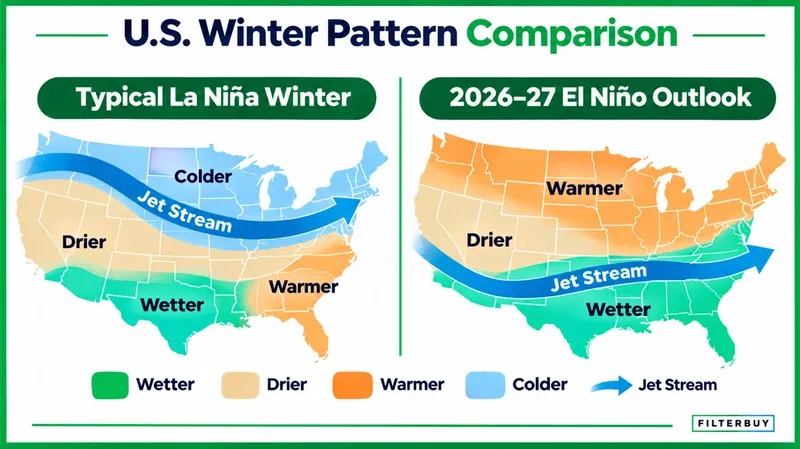
NOAA's 2026–27 U.S. Winter Outlook for December through February leans warmer than average across the northern U.S. and wetter from California to Florida and up the Eastern Seaboard.
The jet stream explains why. Ken Graham, director of NOAA's National Weather Service, said a very strong El Niño will likely push it south and east, tilting the odds toward a stormier South.
La Niña vs. El Niño Winter Forecast by Region
The table lines up NOAA's 2026–27 outlook against a typical La Niña winter. La Niña usually brings a warmer, drier southern tier, a colder north-central Plains and a wetter Pacific Northwest (NOAA Climate.gov La Niña winter patterns). The Ohio and Tennessee valleys can also see extra rain and snow (NPR via KPBS).
Compiled by Filterbuy from the NOAA U.S. Winter Outlook (October 15, 2026) and NOAA Climate.gov typical La Niña winter patterns. Seasonal outlooks show shifted odds, not guarantees.
Will La Niña Return in 2027?
It could, but no official forecast says so yet. CPC's latest ENSO status and predictions update expects El Niño to hold on through March–May 2027, with ENSO-neutral conditions favored by April–June.
History leans toward a flip. CPC has noted that La Niña tends to follow strong El Niño events (Reuters via Inquirer), and the FOX Forecast Center found that four of the five super El Niños since 1970 were followed by La Niña (FOX Weather on super El Niño and La Niña).
How to Tell When a La Niña Forecast Is Real
La Niña headlines often run ahead of the science. Filterbuy's team watches two official signals:
A La Niña Watch. CPC issues a Watch when conditions favor La Niña within the next six months (CPC ENSO alert system) and is the earliest official sign.
NOAA's October winter outlook. This regional forecast turns ENSO odds into a local temperature and precipitation lean.
Our advice: treat a Watch as a cue to plan, not a local forecast.
What Does This Winter Forecast Mean for Your Home's Air?
At Filterbuy, we make air filters in our own U.S. plants and help homeowners with filter questions every heating season. What we've learned is that the forecast changes which indoor air problem you'll face, not whether you need to prepare.
If your winter looks wet (South, Southwest, East Coast): Watch the moisture. The EPA advises keeping indoor humidity below 60%, and ideally between 30% and 50%, to help prevent mold (EPA Mold House Tour). Window condensation often signals high humidity, and anything soaked by a leak or flood should dry within 24–48 hours. Filterbuy's guide on how an air filter helps with mold spores explains why moisture comes first.
If your winter looks mild but still cold (North, Midwest, Northeast): Your furnace will still run plenty. ENERGY STAR recommends checking your filter monthly in heavy-use seasons and changing it at least every three months (ENERGY STAR Heat & Cool Efficiently). In a central system, the furnace and AC share one filter, and our guide on how often to change your HVAC filter covers the schedule.
If your winter looks dry (Northern Rockies, parts of the Great Lakes): A humidifier helps when heated air dips below 30%; keep levels under 50%. Before airing out the house, check Filterbuy's live USA air quality map.
"Every fall, people ask me if La Niña or El Niño means they need a different filter. My answer doesn't change. The forecast changes the weather outside, but your furnace recirculates the same indoor air all winter. Date your filter, check it against a sheet of white paper each month, and keep the humidity comfortable," says Michelle Wan, Brand Manager and Air Quality Writer at Filterbuy.
Your Winter Home Air Checklist
Work through this list in November, before the coldest weeks.
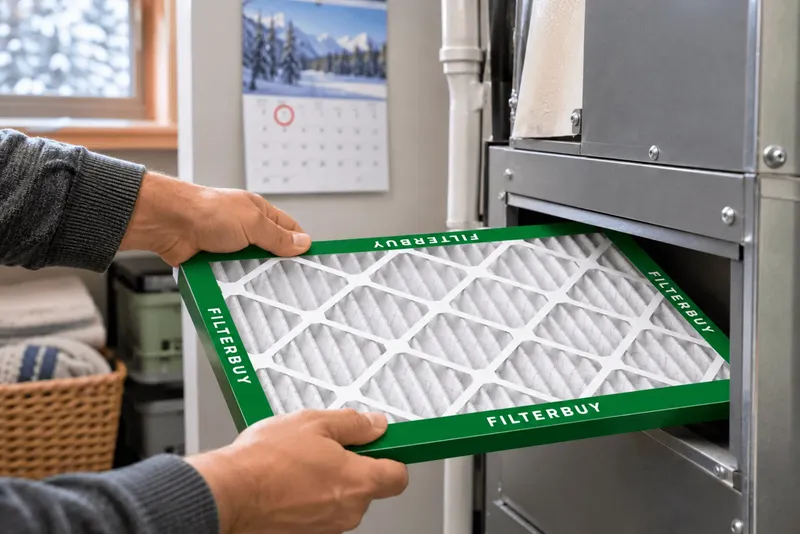
Check your HVAC filter now. The American Lung Association suggests comparing it to a white sheet of paper and replacing it if it looks dirty (American Lung Association air cleaning guidance). Most home systems take a one-inch-thick filter, but measure all three dimensions before you reorder; our guide on how to measure your air filter walks you through it.
Date it and set a reminder. Write the install date on the frame. The American Lung Association suggests a change about every two months, or sooner if it's dirty, and Filterbuy auto-delivery can ship on that schedule.
Choose the right MERV rating. The EPA suggests at least MERV 13 or as high a rating as your system fan and filter slot can accommodate; an HVAC technician can confirm. Compare options in Filterbuy's MERV rating chart.
Book a heating tune-up. The CDC recommends yearly service of your heating system and other fuel-burning appliances by a qualified technician (CDC carbon monoxide guidance).
Test your carbon monoxide (CO) detectors. The CDC recommends battery-operated or battery back-up CO detectors near every sleeping area. Check batteries when clocks change.
Plan for outages. If storms knock out power, the CDC says to run generators outside, more than 20 feet from windows, doors and vents.
Track indoor humidity. Aim for 30–50% on a hygrometer.
Filterbuy's guide on why indoor air quality gets worse in winter goes deeper on cold-weather air.
Supporting Statistics
La Niña patterns are not guaranteed.
Since 1950, 8 of 11 strong and moderate La Niña winters brought cooler conditions to the Northern Great Plains.
Heating and cooling use nearly half of home energy.
Why it matters: Winter is the busiest season for a furnace filter.
Source: ENERGY STAR (U.S. EPA and DOE), Heat & Cool Efficiently
Carbon monoxide sends 100,000+ Americans to the ER each year.
Unintentional CO poisoning not linked to fires also causes 400+ deaths and 14,000+ hospitalizations a year.
Common sources: Furnaces and generators.
Frequently Asked Questions
Will Winter 2026–27 Be a La Niña Winter?
No. NOAA expects El Niño to shape this winter through at least January–March 2027.
What Is the La Niña Winter Forecast for California?
Typical La Niña winters run dry in Southern California, but NOAA's El Niño outlook favors a wetter winter there this year.
Does La Niña Mean More Snow?
Sometimes. La Niña can bring extra snow to the Northwest, northern Rockies and Upper Midwest (NPR via KPBS), though NOAA doesn't forecast seasonal snowfall.
When Will We Know If La Niña Is Coming Back?
The first official sign would be a La Niña Watch from CPC. CPC posts ENSO updates on the second Thursday of each month.
How Often Should I Change My Furnace Filter in Winter?
Check it monthly, and change it at least every three months or sooner if it looks dirty.
Glossary
ENSO (El Niño–Southern Oscillation): A Pacific climate cycle with warm, cool and neutral phases.
El Niño: The warm ENSO phase; in U.S. winters it often brings a wetter South and milder North.
La Niña: The cool ENSO phase; in U.S. winters it often brings a warmer, drier South and colder North.
Climate Prediction Center (CPC): The NOAA office that issues official ENSO updates and seasonal outlooks.
La Niña Watch / El Niño Advisory: A Watch means conditions may develop within six months; an Advisory means they are present.
MERV (Minimum Efficiency Reporting Value): A 1–16 rating of how well an air filter captures particles. Filterbuy makes MERV 8, 11 and 13 filters.