
Can An Air Filter Help with Mold?
May 5, 2026
Yes, a correctly rated air filter can substantially reduce airborne mold spores. Airborne mold spores range from 2 to 10 microns, large enough for both a MERV 11 – 13 HVAC filter and a true HEPA purifier to trap. A MERV‑rated pleat installed in your furnace or air‑handler removes spores every time the system runs. For rooms that need extra protection, such as nurseries, bedrooms of allergy sufferers, finished basements, a portable purifier with a true HEPA cartridge delivers near‑total spore removal right where you breathe.
Key Takeaways
A MERV 11–13 HVAC filter captures most spores without stressing the blower.
A portable true HEPA purifier removes > 99% of spores in high‑priority rooms.
Fix leaks, dry damp areas, and keep indoor humidity below 60
%. Filtration alone can’t stop growth.
Filters work only while the fan or purifier is on; set the blower to circulate several times a day and replace filters on schedule.
Why Mold Becomes A Problem
Mold continuously releases dry, microscopic spores outdoors. When doors, windows, or even tiny gaps around wiring are open, those spores drift inside and circulate on air currents.
Indoors, two outcomes are likely. If a spore settles on a surface that remains damp for roughly 48 hours, such as in a bathroom drywall, an unvented attic, or a condensate pan. It germinates, forming a colony that damages building materials and emits musty VOCs.
If the spore is pulled into the HVAC return, it can be intercepted by the system’s air filter. Otherwise, it recirculates to other rooms and raises the overall spore load.
Uncontrolled indoor moisture turns harmless outdoor spores into a persistent health and maintenance problem, making effective filtration and moisture control essential.
Why Removing Mold Matters
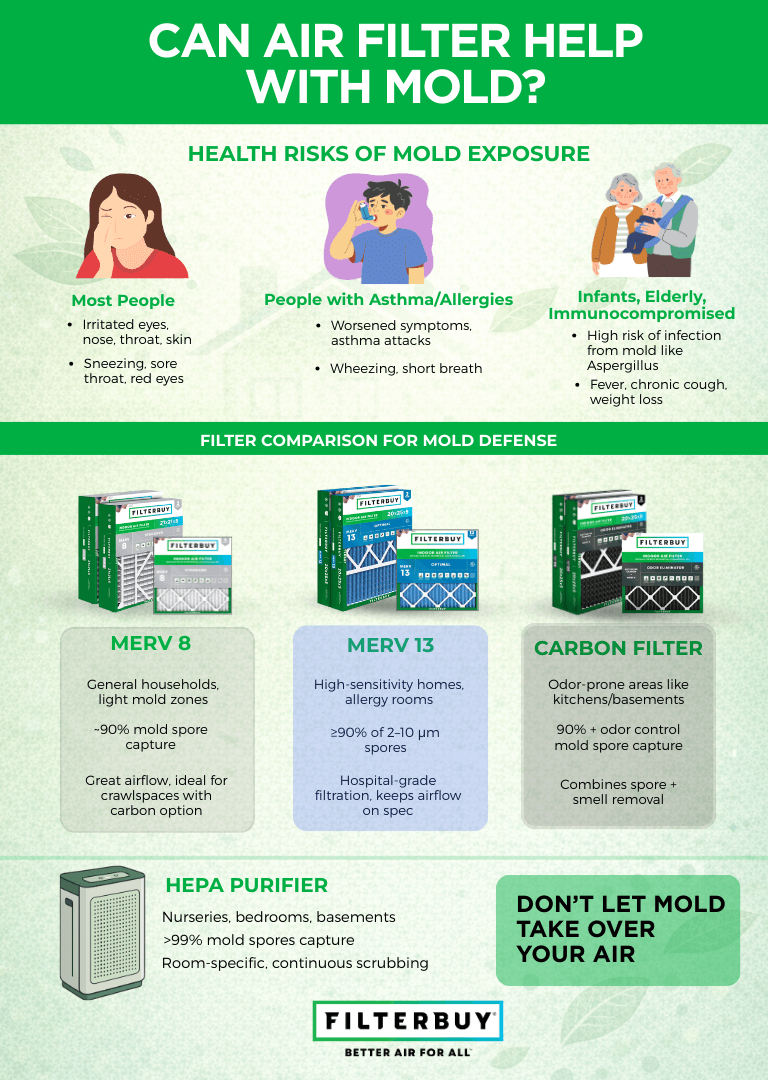
Lowering indoor mold and its airborne spores protects everyone—especially children, seniors, and anyone with asthma, allergies, or weakened immunity.
How Air Filters Help with Indoor Mold
Mold spreads by releasing microscopic spores that ride indoor air currents until they settle on another damp surface and start a new colony. A pleated HVAC filter forces that same air through a dense fiber mat; the fibers snag the spores by sieving (pores smaller than the particle), interception (spores brush and stick), and electrostatic attraction. Fewer spores circulating means fewer land on walls, carpets, or ductwork, slowing both the growth and the odor that active mold produces.
Filter options for different mold situations:
HVAC return filter (MERV 11–13)
Begin by confirming the exact length, width, and thickness printed on your current cartridge, then select the same size in a higher‑efficiency pleat. Most modern residential blowers handle MERV 13 with no trouble. If airflow drops or rooms feel stuffy, switch to MERV 11 or raise the fan speed one setting. Inspect the filter every month and plan on replacement about every 90 days or sooner whenever the filter appears visibly gray.
To keep air moving through the media long enough to matter, use an “Auto + Circulate” or timed‑circulation setting that runs the blower 15–20 minutes of every hour, even when heating or cooling is idle.
Portable HEPA purifier
A room unit complements the duct filter by scrubbing the air continuously where you spend the most time. Choose a model whose Clean Air Delivery Rate (CADR) matches the square footage of the space, set it near the center of the room or close to the known mold source (not tight against a wall or curtain), and let it run on its highest setting for the first hour to clear the load quickly.
After that, a lower speed maintains cleanliness with less noise. Follow the manufacturer’s guidance on the lifespan. Most true‑HEPA cores last six to twelve months before efficiency or airflow begins to fall off.
Why combine the two approaches?
The in‑duct filter removes spores every time conditioned air circulates, protecting the whole house, while the HEPA purifier delivers hospital‑grade cleanup in bedrooms, nurseries, or home offices where sensitive occupants need the lowest possible spore count around the clock.
Controlling Mold at the Source
Filtration removes spores from the air; it cannot stop new growth on damp surfaces. Keep humidity in check by repairing roof, plumbing, or window leaks as soon as they appear and by venting bathrooms and kitchens directly outdoors with properly sized exhaust fans.
In basements or in humid climates, run a dehumidifier to maintain indoor relative humidity at or below 60 percent. Wipe or wash hard, non‑porous materials with detergent and water; discard drywall, carpet padding, or other porous items that stay wet for more than forty‑eight hours.
When moisture sources are eliminated, the filters and purifiers described above can do their work without fighting a constant influx of fresh spores.
Important: Filters deal only with airborne spores. Mold already growing on walls, carpets, or inside ducts will recur until the moisture source is eliminated.
Upgrade Your Mold Defense with Filterbuy
| Why Filterbuy? | What it does for you |
|---|---|
| High-MERV rating | A Filterbuy MERV 13 pleated filter captures ≥90% of 2–10 µm spores on each HVAC cycle while keeping airflow on spec. |
| Odor Eliminator option | A MERV 11 pleat plus activated carbon that tackles musty smells and spores in one cartridge. This is ideal for basements and crawlspaces. |
| Made in the USA | Manufactured in the U.S. for consistent quality and fast, free shipping. |
| Any size, ready to ship | Standard or custom dimensions ship within 24 hours—no extra freight charges. |
Mold Quick Action Plan
Measure your HVAC slot and install a Filterbuy MERV 11 and 13 filters for odor elimination and whole‑house spore removal, respectively.
Add room‑level backup, such as a portable true‑HEPA purifier in nurseries, allergy bedrooms, or finished basements.
Fix moisture: repair leaks, vent humid areas, and keep indoor RH ≤ 60 % to prevent mold from regrowing.
A few minutes of filter maintenance plus moisture control keeps mold—and its symptoms—out of your indoor air year‑round.

Frequently Asked Questions
Does a portable air purifier remove mold?
A true‑HEPA purifier can strip virtually every airborne mold spore from the room where it runs.
Can my furnace filter do the same job?
A MERV 13 pleated filter captures most spores each time the HVAC cycles, protecting the whole house.
Do filters eliminate mold already growing on walls or carpets?
No. Colonies keep returning until you fix the moisture source and clean or replace the surface.
Which is better for mold, HEPA or MERV 13?
Use MERV 13 for broad coverage and add a true‑HEPA purifier when you need near‑total removal in a specific room.
How often should I change these filters?
Swap HVAC filters at least every 90 days and replace HEPA cartridges every 6–12 months, following the maker’s guidance.
Will running the HVAC fan longer help?
Yes, more airflow means more spores pass through the filter, though it will raise energy use slightly.
Does a “HEPA‑type” purifier work as well as a true‑HEPA unit?
No,HEPA‑type media are not held to the 99.97% efficiency standard and let many spores slip through.
Can filters remove that musty mold smell?
They can lessen it by trapping spores, but the odor persists until damp materials are dried or replaced.
Are ozone or ionizer gadgets good substitutes for filters?
EPA warns they may emit lung irritants and are far less effective at removing spores, so stick to mechanical filtration.
Will a higher‑rated filter choke my HVAC airflow?
Most systems handle MERV 13 without issues, but if rooms feel stuffy you can step back to MERV 11 or run the fan at a higher speed.
Do washable electrostatic filters catch mold spores?
They trap large dust but miss many fine spores, so they’re not the best choice for mold control.
Should I pair filtration with a dehumidifier?
Yes, keeping indoor humidity below 60% starves mold of the moisture it needs to grow.