
Youth Sports Air Quality Guidelines: When Practice Should Move Indoors
September 22, 2026
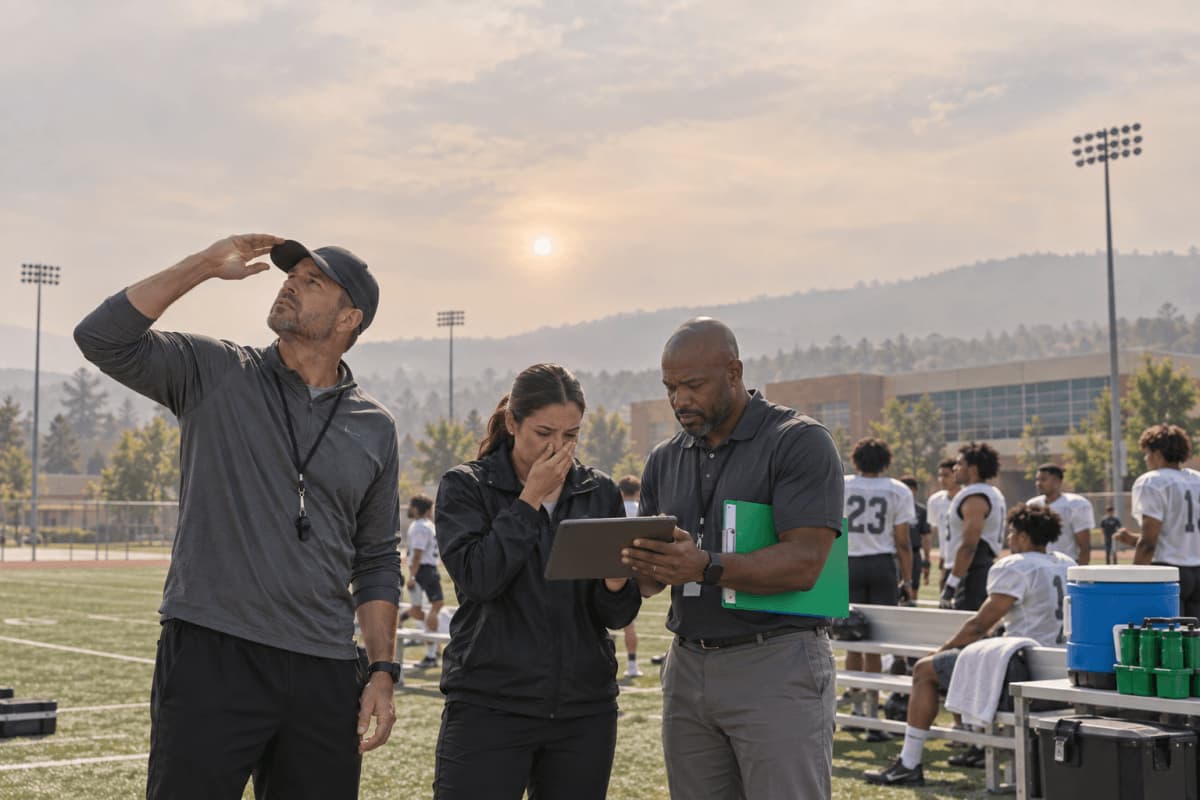
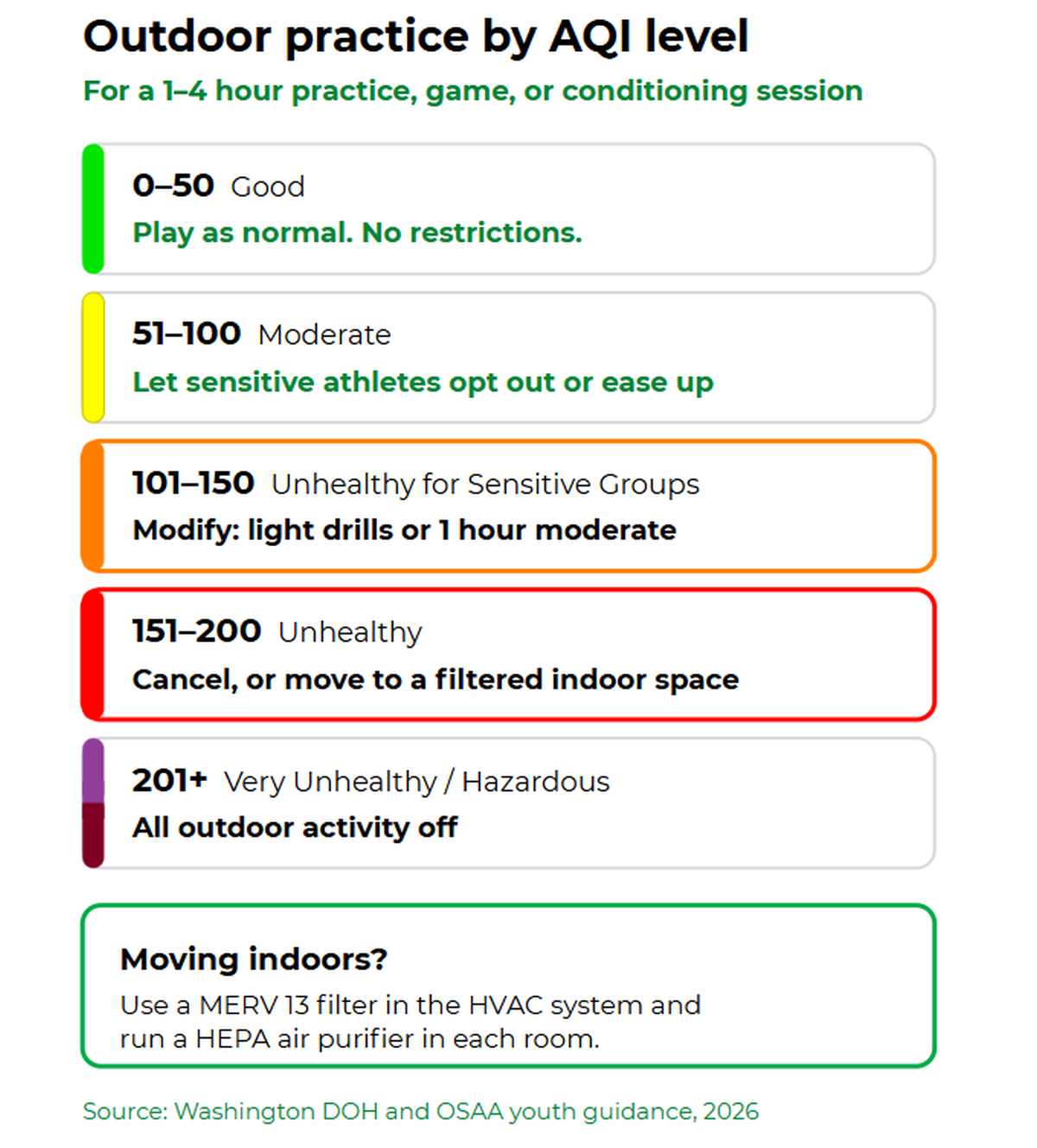
Start modifying outdoor practices and games once the AQI passes 100, and cancel them or move indoors at 151 or higher. Athletes with asthma or heart or lung conditions should be able to opt out as early as AQI 51.
Moving indoors? Use a MERV 13 filter in the HVAC system and a HEPA air purifier in each room. Take the quiz below to match your building to the right filter.
Answer a few quick questions and we'll match you to your perfect filter.
Already know your filter size? Filterbuy makes MERV 13 filters in 600+ standard sizes, plus custom dimensions.
Shop air filters at FilterbuyBy Michelle Wan | Reviewed by David Clark, Licensed HVAC Technician | Published September 22, 2026 | Updated September 22, 2026
TL;DR:
Coaches and league officials should start modifying outdoor practices and games once the Air Quality Index (AQI) passes 100, then cancel or move them indoors at 151 or higher. Indoor space should have a MERV 13 HVAC filter and HEPA air purifiers in each room. High-intensity sessions need tighter limits. Before smoke season, name one decision-maker and put the rules in writing.
Key Takeaways
AQI 151 ("Unhealthy") is the most common cutoff for canceling outdoor youth practices and games.
At AQI 101–150, Washington State guidance limits 1–4 hour sessions to light intensity or one hour of moderate activity.
High-intensity sports raise a young athlete's breathing rate more than eight times above resting.
Filterbuy's rule: once the AQI goes over 100, switch any HVAC system to MERV 13 and run a HEPA air purifier in each room.
What AQI Cutoffs Should a League Use for Practices and Games?
A league should modify practices and games at AQI 101–150 and cancel or relocate them at 151 or higher. Those cutoffs match current youth guidance from the Washington State Department of Health and the Oregon School Activities Association (OSAA). Athletes with asthma or heart or lung conditions should be able to opt out as early as AQI 51.
Source: Washington Children and Youth Activities Guide for Air Quality (May 2026); OSAA Air Quality Guidelines (revised July 2026).
Confirm readings on the AirNow Fire and Smoke Map. For a quick overview, see Filterbuy's live AQI map and its Oregon, Washington, and California views.
How Do State Athletic Associations Set AQI Policy?
Most association policies turn on two numbers. At AQI 100, at-risk athletes sit out. Between 150 and 200, outdoor activity moves indoors or stops. The National Federation of State High School Associations (NFHS) tells schools to follow state or local health department thresholds in its position statement on air quality.
Current as of September 2026. Confirm with your state association.
One gap stood out in Filterbuy's review. Of the Oregon, California, Michigan, and NFHS statements, only Oregon's names a filter rating (MERV 13).
How Should Practice Plans Change by Sport Intensity?
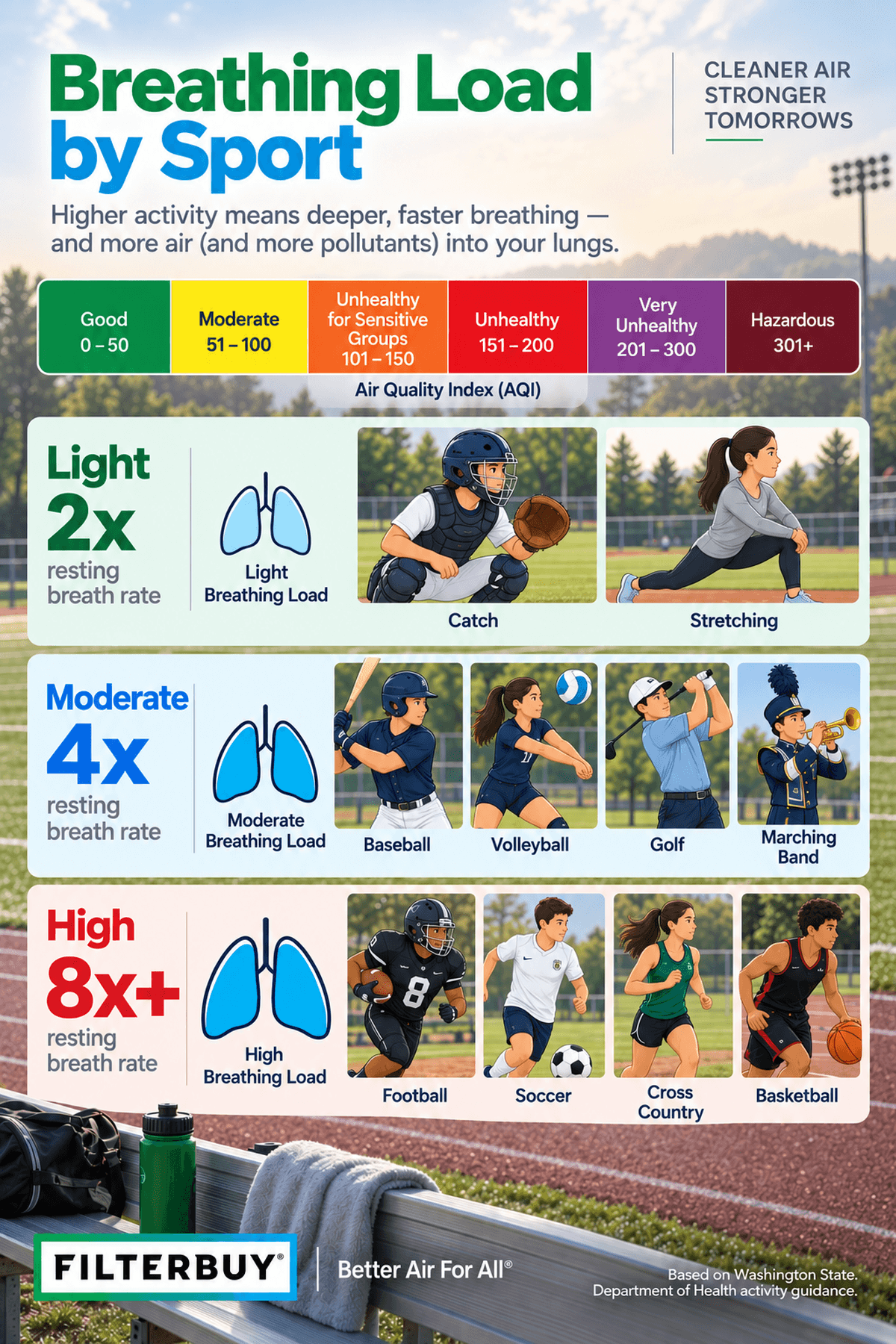
Practice plans should scale with intensity, because the harder athletes breathe, the more polluted air reaches their lungs. According to the Washington State Department of Health, a child's breathing rate climbs past two times resting during light activity, four times during moderate activity, and eight times during high-intensity work.
Filterbuy grouped common sports into three breathing-load tiers:
Tiers follow Washington DOH activity intensity examples.
Filterbuy's breathing-budget shortcut: A minute of high-intensity work draws roughly as much air as two minutes of moderate work or four minutes of light work. So cutting 15 minutes of sprints saves about as much inhaled air as cutting 30 minutes of moderate drills. On orange days, trim the hardest minutes first, then add rest and substitutions.
Football Practice and Conditioning
Conditioning is football's heaviest breathing load, and the NFHS notes that western smoke often arrives as fall camp opens. At AQI 101–150, cut conditioning first, and apply your heat policy, since smoke and heat compound.
Cross Country AQI Rules
Cross country follows the same thresholds, but its long runs sit in the high-intensity tier. At AQI 101–150, replace them with a light jog or a short indoor workout. Meet directors should check readings along the entire course.
Who Makes the Call, and When?
One designated person should make the call on a set timeline. The OSAA requires schools to name that monitor, and the California Interscholastic Federation (CIF) prefers an athletic trainer, school nurse, or team physician.
Adapted from OSAA, NFHS, Washington DOH, and Seattle Youth Soccer Association guidance.
Edge cases:
Different readings at host and visiting sites? Go with the monitor nearest the venue on the AirNow Fire and Smoke Map, as OSAA directs.
Deciding hours ahead? The Washington DOH suggests planning for whichever is worse, the forecast or the current reading.
No monitor nearby? Visibility under 5 miles suggests orange-level air; under 3 miles, red.
Ozone, not smoke? Ozone peaks in the late afternoon, per the NFHS, so practice early. Smoke can spike any time.
Skip uncorrected consumer sensors. Per the CIF, masks don't make hazardous air safe.
Worked example: At 1 p.m., the forecast for your field is AQI 135, but the current reading is 142 and rising. Varsity football runs 3:30 to 5:30, including 20 minutes of conditioning.
Plan around 142, the worse number.
That puts you in the 101–150 range, where two hours of high-intensity work doesn't qualify.
Cap practice at 60 minutes of walkthroughs and moderate position work, and drop conditioning. Or move to an approved filtered gym.
Recheck at 3:00. If AirNow's 30-minute Trending AQI hits 151, cancel outdoor activity.
What Should a League AQI Policy Include?
A good league policy settles these points in advance:
Thresholds by intensity and duration.
An official data source and a rule for which monitor applies. See AirNow's guidance for schools.
A named decision-maker, plus a backup for every venue.
A decision deadline. The Seattle Youth Soccer Association makes its weekday practice calls by 3 p.m.
An opt-out rule that doesn't cost playing time.
Approved indoor facilities with confirmed filtration and heat limits.
Rescheduling and forfeit rules.
A communication chain reaching coaches, officials, opponents, and families.
Records. Log readings and decisions, and review the policy each off-season.
The NFHS also expects preparticipation screening and an Emergency Action Plan for every venue. For parents, share Filterbuy's guide to kids and outdoor air pollution.
When Is an Indoor Facility a Good Smoke-Day Backup?
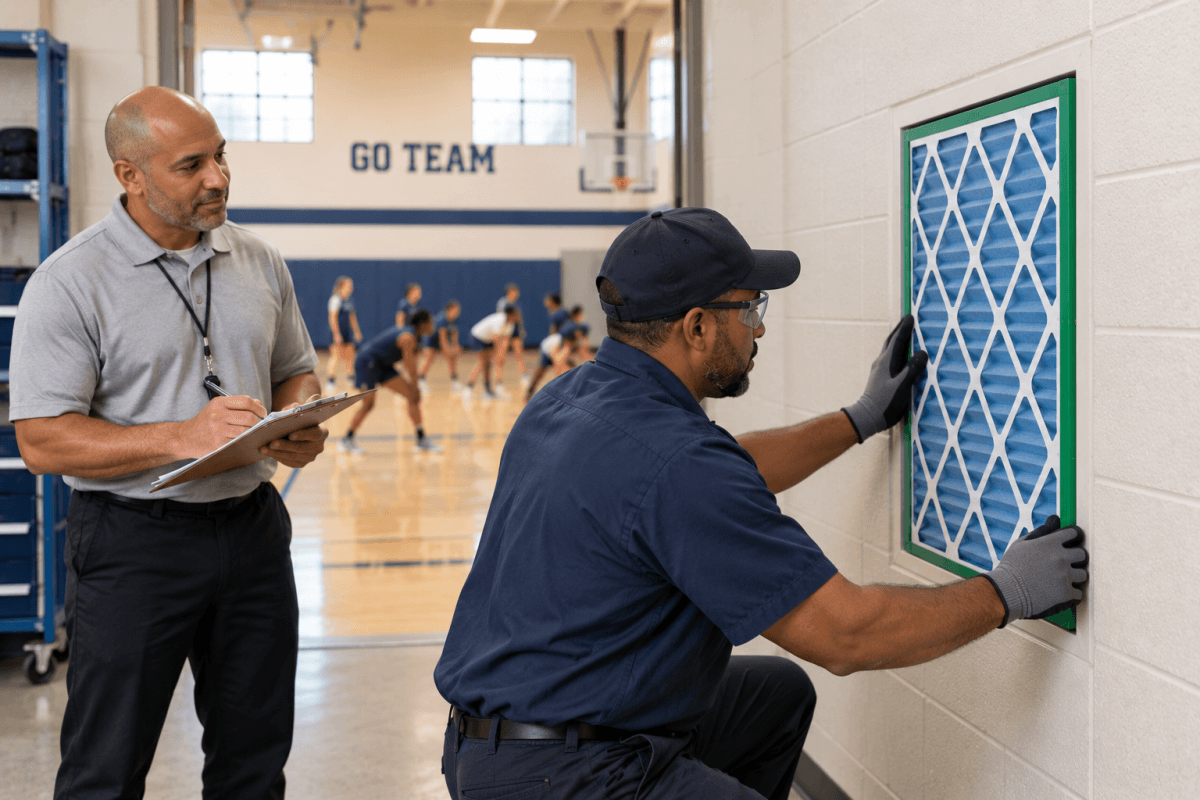
An indoor facility beats an orange or red field only when its air is filtered. The NFHS warns that if a building's HVAC system can't handle smoke particles, the air inside may be worse than outside. First, follow AirNow and your local air agency.
EPA recommends a MERV 13 or higher filter in the HVAC system during smoke events, and notes that most systems can use one without equipment problems when it's replaced often (EPA smoke preparation guidance). Filterbuy's rule adds a trigger: once the AQI goes over 100, switch any HVAC system to MERV 13 and run HEPA air purifiers in each room. The trigger is ours; the MERV 13 rating is EPA's recommendation. That means four steps:
Switch the HVAC to MERV 13. Check the fit like a size; a Filterbuy nominal 20x25x1 measures 19½ × 24½ × ¾ inches.
Thermostat fan set to On. On Auto, the system only filters while heating or cooling.
Run a HEPA air purifier in each room, including the gym and locker rooms. Size it by smoke CADR (clean air delivery rate) of at least two-thirds of the floor area, per EPA. A 300 sq ft team room needs a CADR of about 200. Skip any unit that produces ozone. Why HEPA goes in portable units only.
Close the building up. Keep doors and windows shut, and don't add indoor pollution, like frying or burning candles.
During smoke, check the HVAC filter often and replace it once it looks dark brown or black, which can be well before the normal interval. Keep spares on hand.
If a facility has no HVAC system, HEPA air purifiers in each room are the primary defense, not a supplement. A DIY box-fan cleaner built with MERV 13 filters is a reasonable stopgap until a certified unit arrives. EPA advises using a certified box fan from 2012 or newer. Don't leave one running unattended.
Filterbuy makes MERV 13 air filters in 600+ standard sizes, plus custom dimensions.
Supporting Statistics
1. 6.5% of U.S. children have asthma
The CDC's 2024 health interview survey reports it.
On a 25-player roster, that's one or two athletes who may need the AQI 51–100 opt-out.
Source: CDC FastStats: Asthma
2. Wildland fires produced 52% of U.S. fine-particle (PM2.5) emissions
EPA's 2020 National Emissions Inventory estimate. Smoke is the largest single source.
3. Better HVAC filtration may cut indoor PM2.5 by about 50%
Assumes a high-efficiency filter and a continuously running fan.
Without air cleaners, indoor PM2.5 typically runs 55% to 60% of outdoor levels in smoke, and up to 100% in some homes.
Frequently Asked Questions
What Aqi Cancels High School Football Practice?
Most state guidance cancels or relocates football practice at AQI 151. Oregon requires it; Minnesota moves practices indoors at 150.
What Filter Should An Indoor Practice Space Use During Smoke?
MERV 13 in the HVAC. Once the AQI goes over 100, Filterbuy also recommends a HEPA air purifier in each room.
Glossary
Air Quality Index (AQI): The EPA's 0–500 scale for daily air pollution, in six color categories.
PM2.5: Fine particles 2.5 micrometers or smaller and the main harmful pollutant in smoke.
Unhealthy for Sensitive Groups (USG): The orange AQI category, 101–150.
MERV: Minimum Efficiency Reporting Value, a 1–16 rating of filter efficiency.
NFHS: National Federation of State High School Associations.
Sources
Washington DOH, OSAA, NFHS, CIF, MSHSL, MHSAA, SYSA, CDC, EPA fire research, EPA indoor strategies, EPA schools guidance.
About the author: Michelle Wan is Filterbuy's Brand Manager and Air Quality Writer. She works with Filterbuy's U.S. manufacturing teams.
General guidance, not medical or legal advice. Follow your state association and health department.