
Signs Your Air Filter Is Clogged From Smoke (And How Fast It Happens)
September 22, 2026
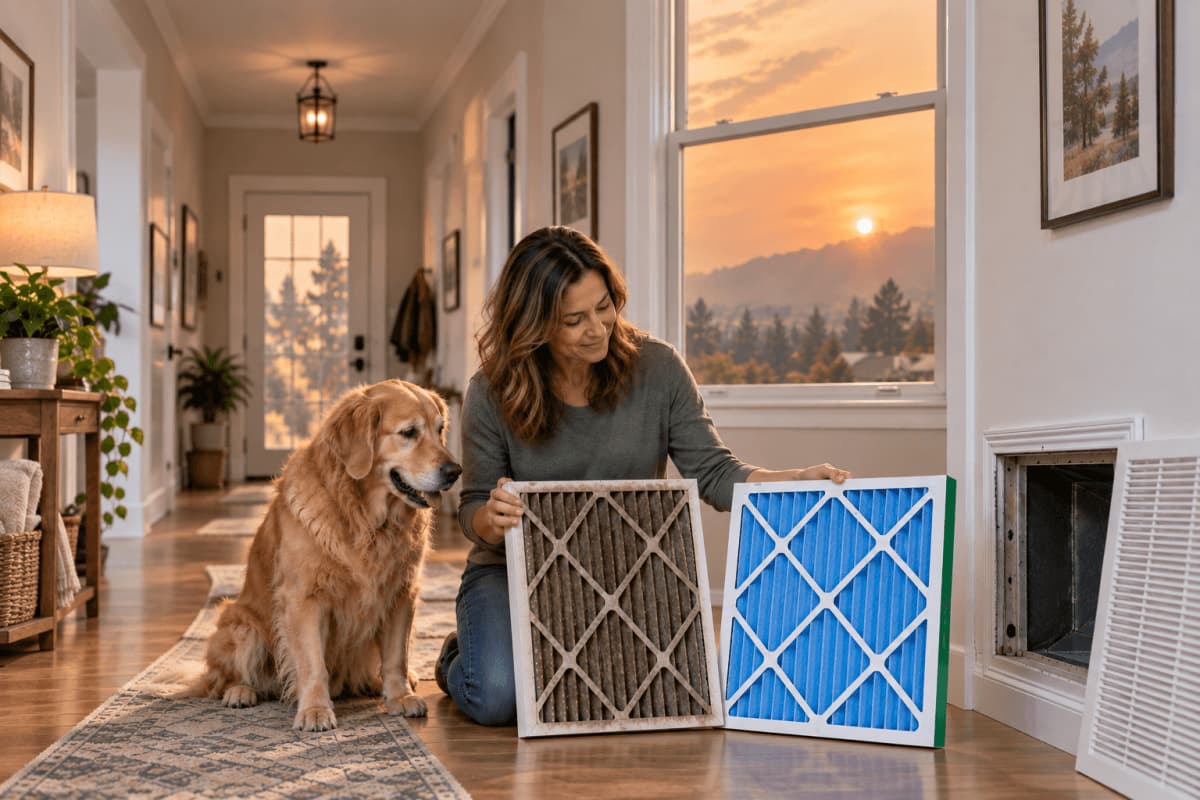
A smoke-clogged filter turns dark brown or charcoal, your vents smell smoky, and airflow feels weaker. Smoke can load a high-efficiency filter in days, not months. Some filters stop catching fine smoke particles before they look clogged, so check often and replace at the first sign of loading. The quick quiz below matches you to your filter.
Answer 3 quick questions and we'll match you to the right filter for smoke season.
Already know your size? Shop Filterbuy air filters
By Michelle Wan · Reviewed by David Clark, Licensed HVAC Technician · Published September 22, 2026 · Updated September 22, 2026
TL;DR
Wildfire smoke can wear out a high-efficiency air filter in a matter of days. The telltale signs are a dark brown or charcoal filter, a smoky smell at the vents, and weaker airflow. Because some filters stop catching smoke before they look clogged, Filterbuy, a U.S. air filter manufacturer, recommends checking often during smoke and replacing at the first sign of loading.
Key Takeaways
EPA recommends a filter rated MERV 13 or higher during smoke events and says to replace it once it looks dark brown or black.
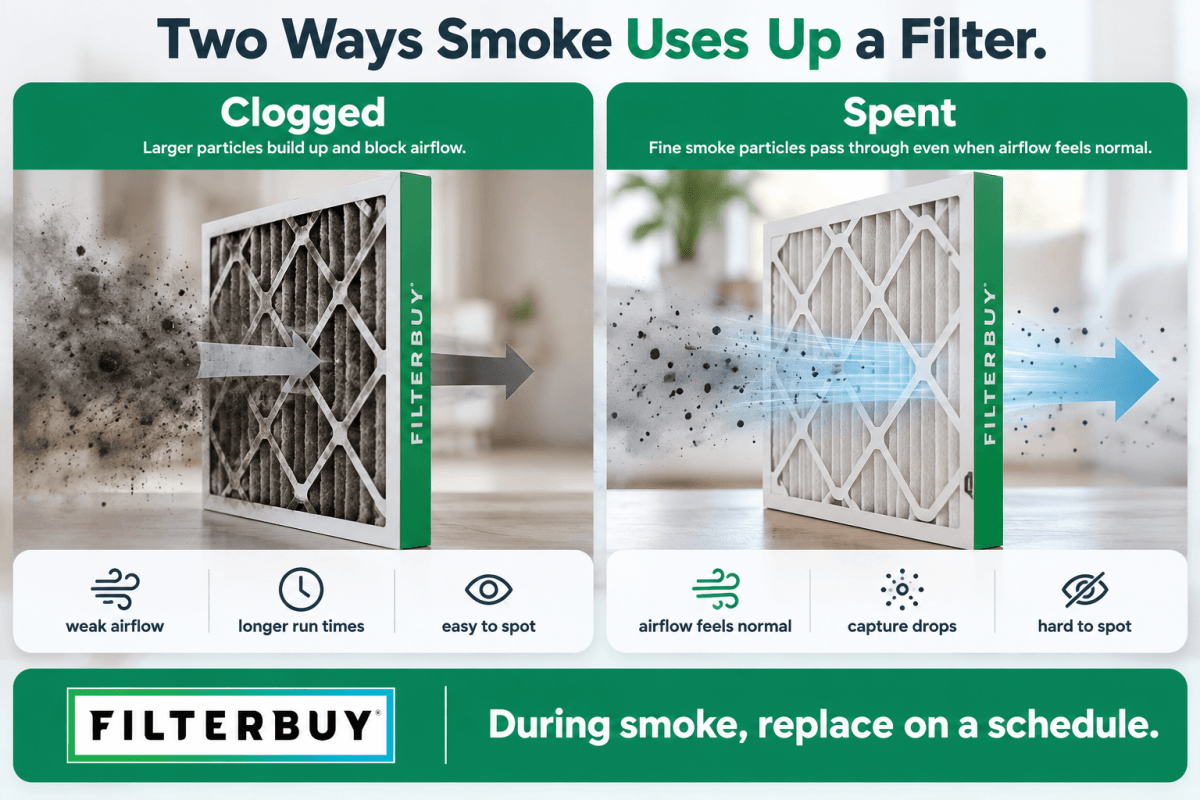
In smoke, a filter can fail by clogging, which you can see, or by quietly losing its grip on fine particles, which you can't.
Once the AQI rises above 100, Filterbuy recommends switching to a MERV 13 filter if you have central HVAC and running a HEPA air purifier in each room. MERV 13 is the rating EPA recommends during smoke events.
Nothing wears out an air filter faster than smoke. Every smoke season, customers ask us the same thing: "Is my filter done?" Here's the answer from a filter maker that has built filters in its own U.S. factories since 2013.
What are the signs your air filter is clogged from smoke?
A smoke-clogged filter gives itself away in two places: on the filter and in the way your system runs. If you spot two or more of the signs below during or after smoke, replace the filter. (For everyday clogs, see clogged furnace filter symptoms.)
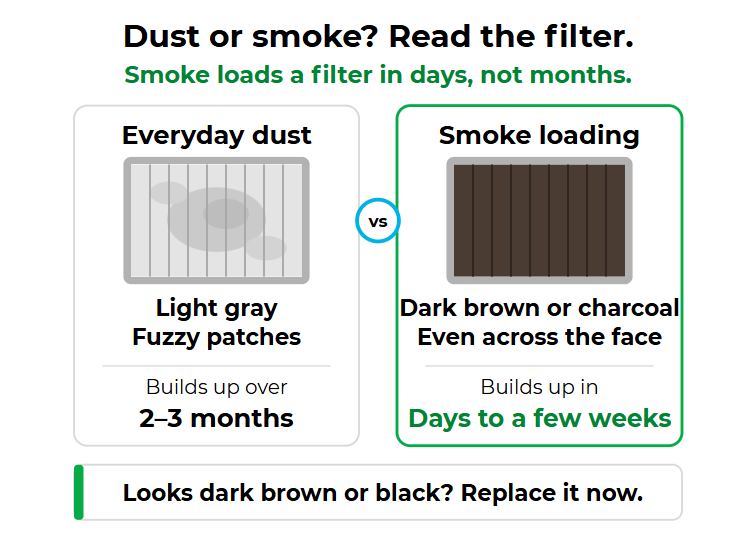
Dark, even discoloration. Smoke turns the whole face dark brown or charcoal, while dust tends to collect in fuzzy patches.
Smoke smell from the vents. If a burnt odor lingers after the outdoor air clears, the filter or ducts may still hold smoke residue. A pleated filter captures particles, not the gases behind the smell.
Weak airflow at the registers. Air at a supply vent feels weaker than usual.
Longer run times. Rooms at the far end of the ductwork struggle to reach the thermostat setting.
Whistling or a bowed filter. A loaded filter can whistle at the return grille or bow inward toward the blower.
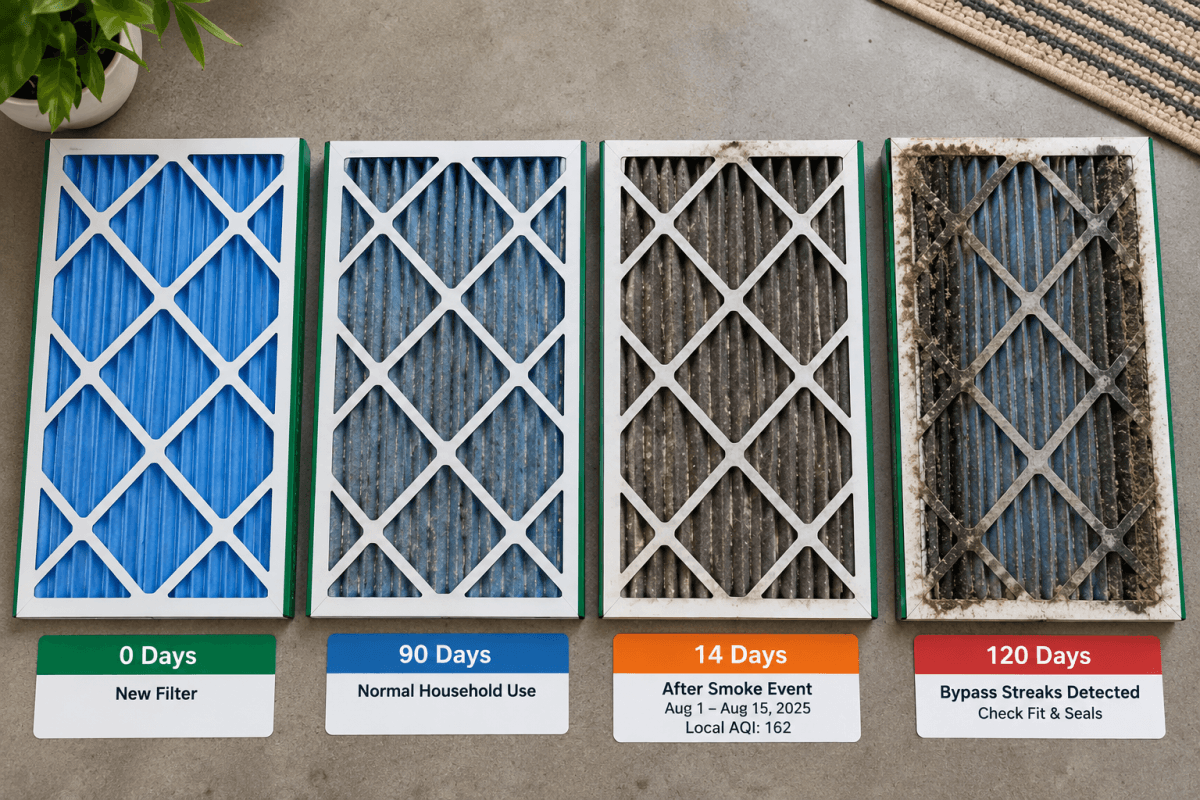
Dark streaks around the frame. Soot lines along the edges mean smoky air is bypassing the filter; Lawrence Berkeley National Laboratory researchers estimated a loose filter lets about 10% of the air slip past. Measure your slot and order an exact match, since the EPA stresses a snug fit.
“Every smoke season the filters come back to us visibly darker and heavier than the ones from clean-air months.”
How do you tell smoke loading from normal dust?
Everyday dust builds up slowly, leaving a filter light gray and fuzzy after two or three months. Smoke works faster. Within days it can leave the media darker, flatter, and more even in color, often with a campfire smell.
Compare the filter's intake side with a new filter or a sheet of white paper in daylight.
If you're unsure, hold the intake side next to white paper in daylight.
Why can a smoke-loaded filter stop working before it looks clogged?
Smoke can disarm a filter without clogging it. In lab tests, fine smoke particles sharply cut the capture efficiency of electrostatically charged media, common in high-MERV filters, while airflow resistance barely moved. It can look fine and breathe easily while letting smoke through.
A peer-reviewed 2026 study in Urban Science found this across 17 filter media, MERV 10 to 15, while uncharged mechanical media held efficiency but grew harder to breathe through.
The tests used small swatches at heavy smoke levels, and the authors work for a filtration company, but the lesson matches EPA guidance: in heavy smoke, don't wait for airflow symptoms.
That includes Filterbuy's MERV 13 filters, which use charged synthetic media because it catches fine particles without choking your blower. It's why Filterbuy's smoke-season rule is to check on a schedule and replace at the first sign of loading, rather than waiting for airflow to drop. To keep track, write the install date on the frame and add a tally mark each day your AQI tops 150.
A filter that still looks clean after a week of heavy smoke isn't proof it's still working. As the people who make it, we'd rather you check it often than trust its color.
How fast does smoke clog an air filter?
Smoke can use up a high-efficiency filter in days, not months. Several unhealthy days in a row can exhaust a 1-inch MERV 13 long before its usual 90 days. EPA's test is simple: replace the filter when it looks dark brown or black, which may be well before the manufacturer's normal interval.
Let the outdoor AQI set how often you check:
Filterbuy check-cadence guidance. Take action once the AQI rises above 100. EPA category names and ranges are EPA's.
Check your reading on the AirNow Fire and Smoke Map or Filterbuy's live AQI maps for Washington and Oregon. For the full season, see Filterbuy's guide on how often to change your air filter when AQI is high.
Check sooner than the table suggests if:
You run a 1-inch filter. A thin filter holds far less smoke than a 4- or 5-inch one.
Someone at home is at higher risk. That includes children, older adults, pregnant women, and anyone with heart or lung disease, who should also follow their clinician's advice.
What should you do when the AQI rises above 100?
Start with official guidance: check AirNow and follow your local air agency. Then, once the AQI rises above 100, Filterbuy recommends four steps:
If you have central HVAC, switch to a MERV 13 filter. It's the whole-home layer. EPA recommends MERV 13 or higher during smoke events and notes that most furnaces and HVAC systems handle MERV 13 without equipment problems when the filter is replaced often.
Set the thermostat fan to On. On filters all the time, as EPA advises during smoke; Auto filters only while heating or cooling. Expect faster loading, so check more often.
Run a HEPA air purifier in each room, starting with bedrooms. EPA's sizing rule: choose a smoke CADR of at least two-thirds of the room's square footage, so a 300-square-foot bedroom needs about 200. Skip ozone-producing cleaners, which EPA advises against. HEPA never goes in your furnace; see MERV 13 vs. HEPA for wildfire smoke.
Close the house up. Keep windows and doors shut, and skip candles, frying, smoking, and vacuuming without a sealed HEPA vacuum.
No central HVAC? In apartments and homes with window units, HEPA air purifiers in each room are your primary defense, not a backup. A DIY box-fan cleaner with a MERV 13 filter works as a stopgap, not a certified unit. EPA's safety guidance calls for a UL- or ETL-certified fan made in 2012 or later, and don't leave it running unattended.
At AQI 201 and above, follow AirNow and local guidance first, including any advice to relocate. Set up one clean room and spend most of your time there. Filtration is one layer, not the whole answer.
What does a clogged filter cost you during smoke season?
According to the U.S. Department of Energy, routinely replacing air filters can lower an air conditioner's energy use by 5% to 15%.
Your air and equipment. In EPA testing, box-fan air cleaners became almost completely ineffective once their filters were dirty. Badly restricted airflow can also freeze the coil and strain the blower.
What should you do after a wildfire smoke event?
Once the smoke clears, put in a fresh filter, since the old one may have lost efficiency while it loaded. Then:
Look over the filter slot and frame edges for soot lines, and make sure the new filter fits exactly.
Stay on MERV 13 air filters or return to your usual tier once the season ends.
Restock two or three spares before the next smoke event.
Book a service visit if the coil froze, the blower sounded strained, or a smoky smell lingers in the ducts.
For cleanup, follow Filterbuy's wildfire smoke recovery checklist. To keep smoke out next time, read how to keep wildfire smoke out of your house and our guide to the best MERV filter for wildfire smoke.
Supporting statistics: why smoke-season filter checks matter
1. 145 million Americans had a red-or-worse air day
145.0 million people had at least one Unhealthy-or-worse particle pollution day, up from 133.4 million.
Why it matters: wildfire smoke was a key factor, and those days match the 151+ rows above.
Source: American Lung Association, State of the Air 2026
2. Asthma ER visits ran 17% high on smoke days
Asthma ER visits ran 17% above expected across 19 smoke days in April–August 2023.
Why it matters: CDC counted a smoke day as AQI 101 or higher, the same point where Filterbuy recommends acting, and lists air filtration as a step clinicians can recommend.
Source: CDC, Morbidity and Mortality Weekly Report, 2023
3. About 90% of your time is spent indoors
Indoors, some pollutants run 2 to 5 times higher than outdoors.
Why it matters: your HVAC filter handles the air you breathe most.
Source: U.S. EPA, Report on the Environment: Indoor Air Quality
Check your reading on the AirNow Fire and Smoke Map or Filterbuy's live AQI maps for Washington and Oregon. For the full season, see Filterbuy's guide on how often to change your air filter when AQI is high.
Check sooner than the table suggests if:
You run a 1-inch filter. A thin filter holds far less smoke than a 4- or 5-inch one.
Someone at home is at higher risk. That includes children, older adults, pregnant women, and anyone with heart or lung disease, who should also follow their clinician's advice.
Frequently asked questions
What MERV Rating Do I Need For Wildfire Smoke?
MERV 13. It's the tier Filterbuy recommends for smoke, and EPA recommends a filter rated MERV 13 or higher in a central system during smoke events.
Is A Gray Air Filter A Sign Of Smoke Damage?
It can be. Dust alone turns a filter light gray over several months, but during or after smoke, EPA researchers say to change any filter that turns dark brown or gray or smells like smoke. If yours went gray in days, replace it.
How Often Should I Change My Air Filter During Smoke Season?
Check it weekly during multi-day smoke and replace it when it looks dark brown or black. That can be well before the normal interval.
Get ahead of the next smoke event
Get your filter in before smoke arrives. Find Filterbuy MERV 13 filters in your size (measure your slot if you're unsure), made to order in our U.S. factories and shipped free, or set up auto-delivery so spares arrive on time.
About the author and reviewer
Michelle Wan is Brand Manager and Air Quality Writer at Filterbuy (B.A., University of California, Santa Cruz). She works with Filterbuy's U.S. manufacturing teams in Alabama, Florida, Pennsylvania, and Utah and writes from how filters are built and used in real homes.
Reviewed by David Clark, Licensed HVAC Technician, Filterbuy HVAC Solutions. His review covers the HVAC, filtration, and airflow guidance on this page. Health guidance follows EPA and CDC consensus and is not medical advice.
Disclosure: Filterbuy manufactures and sells the air filters discussed here. This page also explains where those filters fall short during smoke.
Glossary
MERV (Minimum Efficiency Reporting Value): The 1–16 rating from ASHRAE Standard 52.2 that measures how well an HVAC filter captures particles from 0.3 to 10 microns.
PM2.5: Fine particles 2.5 microns or smaller, the main health threat in wildfire smoke.
AQI (Air Quality Index): The EPA's daily air quality scale. It runs from Good (0–50) to Hazardous (301+).
HEPA: A filter standard used in portable air purifiers, not in residential furnace or HVAC slots.
CADR (clean air delivery rate): How much filtered air a portable air purifier delivers.
Electrostatic (electret) media: Charged fibers that attract particles with little airflow resistance.
Mechanical media: Uncharged filter fibers that capture particles by physical contact alone.
Filter bypass: Air that slips around a filter's edges, often leaving dark streaks on the frame.
ASHRAE: The American Society of Heating, Refrigerating and Air-Conditioning Engineers, which sets filter testing standards.