
How Schools Decide To Cancel Recess For Air Quality
September 22, 2026

Do Schools Cancel Recess for Air Quality?
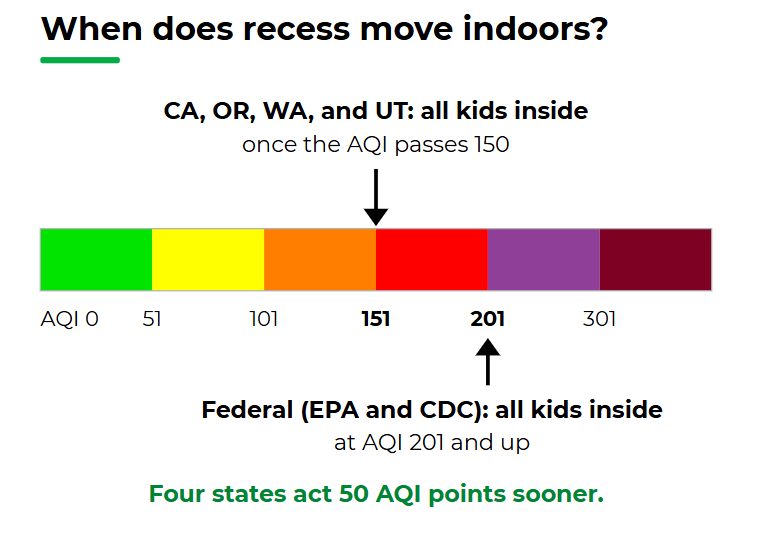
Yes, but most schools move recess indoors rather than skip it. Under federal EPA and CDC guidance, all students come inside once the Air Quality Index (AQI) reaches 201. California, Oregon, Washington, and Utah bring them in sooner, once the AQI passes 150.
Indoor recess only helps if the building's air is cleaner than the air outside. That's why California and Washington point schools to MERV 13 filters. Take the quick quiz below to find the right filter for your home.
Answer a few quick questions and we'll match you to the right filter for your home.
Already know your filter size?
By Michelle Wan, Brand Manager and Air Quality Writer | Technically reviewed by David Clark, Licensed HVAC Technician | Published September 22, 2026 | Updated September 22, 2026
TL;DR
Most U.S. schools decide on outdoor recess by checking the Air Quality Index (AQI) against a color-coded flag chart based on EPA and CDC guidance. Under that federal chart, short recess can continue with lighter play until the AQI turns purple at 201, when everything moves indoors. California, Oregon, Washington, and Utah act sooner and bring every student inside once the AQI passes 150. Indoor recess only helps if the building's air is cleaner than the air outside, and that depends on filtration.
Key Takeaways
Federal school guidance from the EPA and CDC sets the baseline. It moves all outdoor activity indoors once the AQI reaches 201.
California, Oregon, Washington, and Utah bring all students inside above 150, and Oregon and Washington updated their guidance in 2026.
Indoor recess lowers exposure only when the indoor air is cleaner, so California and Washington point schools to MERV 13 filters and HEPA air cleaners.
Yes, schools do cancel outdoor recess when the air is poor, though most move it indoors rather than skip it. Before recess, someone at the school, often the principal, checks the AQI and compares it with the district's chart.
Filterbuy makes air filters, so we read these charts from the indoor side, asking whether the gym air is cleaner once recess moves indoors.
How The School AQI Flag System Works
The school AQI flag system is a daily signal anyone can read. Each day, a school raises a flag in the color of the EPA's Air Quality Index and adjusts outdoor activity to match. The index runs from 0 to 500. The AirNow Air Quality Flag Program uses five colors, from green to purple.
Readings of 301 and up turn maroon. That is the Hazardous category, covered in Filterbuy's guide to what to do when the AQI turns hazardous.
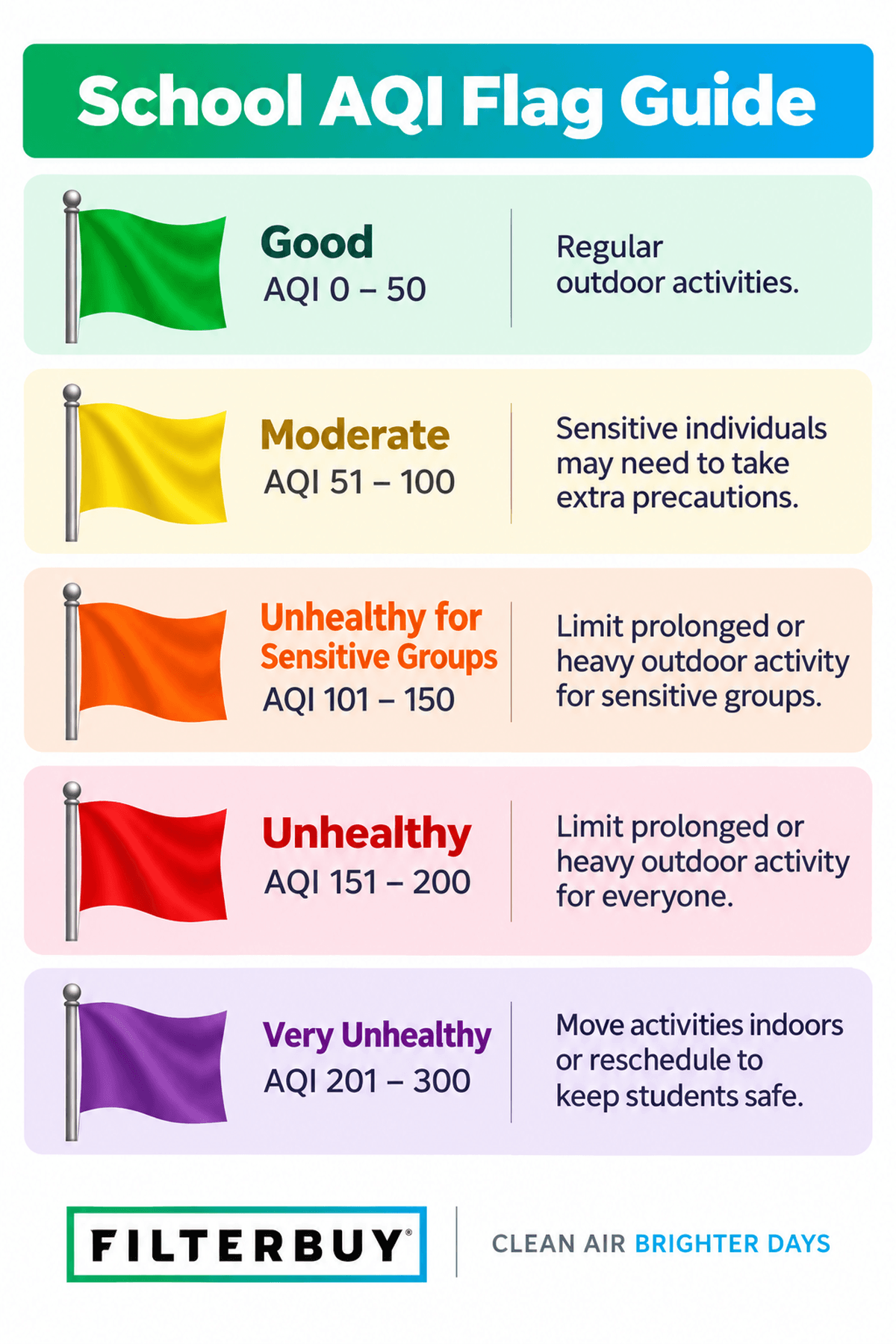
School Flag Colors And What Happens Next
Maroon (301 and up) is Hazardous, and local officials' guidance comes first. Most HVAC systems take MERV 13 when the filter is changed often, so confirm your size and rating as a normal fit check.
Do Schools Cancel Recess For Air Quality?
Rather than cancel recess, most schools move it indoors or trade running games for calmer play. The EPA and CDC Air Quality and Outdoor Activity Guidance for Schools keeps recess and PE outdoors at orange, calls for more breaks and lighter activity at red, and moves everything indoors or reschedules it at purple.
District AQI policies build on the federal chart, state guidance, or both, which is why nearby schools can make different calls. In a state without its own school chart, the federal version is the usual starting point.
How Recess Air Quality Thresholds Vary By State
California, Oregon, Washington, and Utah all set the indoor-recess line lower than the federal chart does. The reason is age: children breathe more air for their body weight than adults do, and their lungs are still developing.
Where The Indoor Recess Line Sits
California's School Outdoor Air Quality Activity Recommendations move recess, PE, and athletics indoors at 151 and treat all children as sensitive once the AQI tops 100.
Oregon's June 2026 update to its youth air quality guide cancels or relocates outdoor activity for all children above 150, however long the activity lasts. Oregon tied the change to evidence that smoke harms children at lower exposures than once thought.
Washington's Children and Youth Activities Guide for Air Quality groups recess and PE with activities lasting 15 minutes to an hour, and at 151 and above it moves them to a filtered indoor space or another location.
The Utah Recess Guidance uses the concentration of PM2.5, the fine particles found in smoke, rather than the AQI, because fine particles trapped by winter inversions are the state's main recess concern.
What We Noticed Lining Up Five School Charts
When Filterbuy put the federal chart and the four state guides side by side, two patterns stood out that no single chart shows on its own.
All four states bring kids in sooner than the federal chart does. The gap is 50 AQI points, 201 federally versus about 151 in all four states.
Oregon moved its line earlier in 2026. Its all-youth cancel line dropped from Very Unhealthy to anything above 150, so older district charts may be out of date.
Why Indoor Recess Depends On Indoor Air
Indoor recess only reduces exposure if the air inside is cleaner. Federal school guidance expects indoor particle levels to be lower when a building's forced-air system filters particles and that filtration is well maintained.
Washington's guide is more cautious. Unless a sensor shows otherwise, it tells schools to assume indoor air matches outdoor air. It also sets an indoor PM2.5 target of 35.5 µg/m³ or lower during smoke.
California and Washington point to two fixes. The first is MERV 13 or higher filtration in the HVAC system, with the fan running continuously during smoke. The second is portable HEPA air cleaners sized by smoke Clean Air Delivery Rate (CADR). Washington sets the size at a smoke CADR of at least two-thirds of a room's square footage, so a 900-square-foot classroom needs at least 600. AHAM's wildfire smoke guidance suggests going up to the full square footage when smoke is heavy.
Skip any air cleaner that advertises ionizers, ozone, or plasma. California and Washington both warn that these technologies can add harmful pollutants to indoor air.
Beyond Recess: Bus Rides, Hot Days, And School Closures
The trip to school counts. Oregon and Washington both treat walking to school and bus rides with open windows as outdoor time. CDC guidance also advises limiting activity near idling cars and buses, so a no-idling pickup line helps on smoky days.
Hot, smoky days are the hardest call. Washington notes that without air conditioning, schools that open windows to cool down also let smoke in. Its guide says learning spaces should stay no hotter than 79°F.
Closures come after recess changes. California lets districts consider closing above AQI 200. Washington advises weighing closure when a school cannot keep indoor PM2.5 below 125.5 µg/m³, the level that equals AQI 201.
Questions To Ask Your School About Indoor Air
Before the next smoke day, ask your school these five questions.
Which air quality guidance does the district follow, and at what AQI does recess move indoors?
Who checks the air quality before recess, and which source do they use?
What MERV rating are the HVAC filters, and how often are they changed in smoke season?
Do classrooms, the gym, and portables have HEPA air cleaners sized for the room?
How can I tell the school my child should come inside at a lower AQI?
Supporting Statistics
46% of U.S. children live where the air earns a failing grade.
33.5 million kids live in counties that failed at least one air pollution measure.
Source: American Lung Association State of the Air 2026 findings.
Wildfire smoke raised children's respiratory visits 30%.
Each 10 µg/m³ rise in wildfire PM2.5 lifted emergency and urgent care visits for breathing problems by 30.0%.
The same rise from other PM2.5 sources lifted visits by only 3.7%.
Children ages 0 to 5 were affected most.
San Diego County study, Pediatrics, 2021. Source: Aguilera et al., Pediatrics (2021), via PubMed.
About 36,000 U.S. schools need HVAC updates.
An estimated 41% of school districts need to update or replace HVAC in at least half their schools.
That gap is why Filterbuy's checklist asks about filters.
Source: GAO-20-494 school facilities report.
What Families Can Do At Home On High AQI Days
Official guidance comes first. Check AirNow and your local air agency, and follow any advice to stay indoors or evacuate. Filterbuy's action line is any AQI over 100, where the orange range begins. At that point, if you have an HVAC system, switch to the EPA-recommended MERV 13 filter, and run HEPA air purifiers in each room.
Switch your HVAC filter to MERV 13. Most systems take it when the filter is changed often, so confirm the size and rating in your manual like any fit check.
Set the thermostat fan to On. Auto only filters while the system heats or cools, and On filters continuously.
Run HEPA air purifiers in each room, starting with bedrooms.
Close the house up. Keep windows and doors shut, and skip candles, frying, smoking, and vacuuming without a HEPA vacuum while smoke is in.
The EPA's clean room guidance recommends MERV 13 or higher in a central HVAC system during smoke, with the fan set to On instead of Auto. The over-100 trigger and a purifier in every room are Filterbuy house recommendations.
During smoke, check the filter often and replace it when it looks dark brown or black, which can be well before its normal interval. Keep a spare on hand.
Measure the slot rather than the old filter. A MERV 13 that sits loose lets smoky air slip around its edges.
In a home without ductwork, like one with window units, mini splits, or baseboard heat, HEPA air purifiers in each room are the primary defense. Size them the way schools do: a 300-square-foot room needs a smoke CADR of at least 200. Filterbuy's cost comparison of portable purifiers and HVAC filters breaks down what each layer costs.
Our guides to choosing a MERV rating for high-AQI days and how MERV 13 and HEPA compare for smoke go deeper, as does our look at what each AQI band means for your home. For the numbers your school sees, check Filterbuy's live AQI and smoke map.
How We Built This Guide
At Filterbuy, we checked every threshold here against each agency's current guidance on September 21, 2026. David Clark, Licensed HVAC Technician, technically reviewed the filtration and air cleaner sizing guidance.
Get Your Home Ready Before The Next Orange Flag
Fire season runs May through October in much of the West, so get MERV 13 in before smoke arrives and keep a spare. Find your size in Filterbuy's MERV 13 air filters with fast and free 2-day delivery to most US states. With auto-delivery, the next filter arrives on time.
Frequently Asked Questions
Is Indoor Recess Safer During Wildfire Smoke?
Indoor recess is safer only if the building's air is cleaner than the air outside. That takes filtered HVAC air and closed windows, and often HEPA air cleaners.
Can My Child Stay Inside At A Lower AQI Than Other Students?
Usually, yes. Guidance in Utah, Washington, and California lets schools bring students with asthma or other health conditions inside sooner. Talk with your child's health care provider and the school nurse about a plan.
Why Does My Weather App Show A Different AQI Than My School?
Sensor maps often show 10-minute averages, while AirNow's NowCast averages roughly 3 to 12 hours. California's guidance also notes that consumer-grade sensors tend to read high at an AQI of 150 or more.
Does Ozone Affect Recess The Same Way As Smoke?
No. Ozone usually peaks on hot afternoons, so morning recess can often stay outdoors. Smoke can rise at any hour and drift indoors, which makes filtration more important.
Glossary
Air Quality Index (AQI): The EPA's air pollution scale. It runs from 0 to 500 across six color-coded categories.
NowCast: AirNow's method for reporting current AQI, weighted toward the most recent hours.
PM2.5: Fine airborne particles 2.5 microns or smaller, the main pollutant in wildfire smoke.
Sensitive Groups: People more affected by air pollution, including children and people with asthma.
MERV 13: An HVAC filter rating that California and Washington school guidance recommends during smoke.
HEPA: High-efficiency particulate air filtration used in portable air cleaners.
CADR: Clean Air Delivery Rate, the filtered airflow a portable air cleaner delivers, with a separate smoke rating.