
Is It Safe To Take A Baby Outside When Air Quality Is Bad?
September 22, 2026
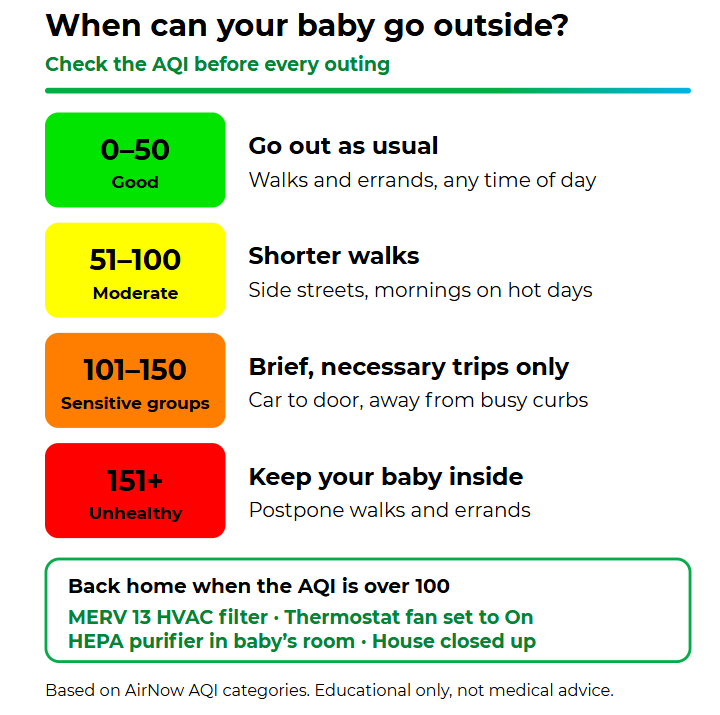
Yes, a healthy baby can go outside when the Air Quality Index (AQI) is 50 or below, and shorter outings are usually fine up to 100. Over 100, keep trips brief and necessary. Over 150, keep your baby inside.
Back home, the EPA recommends a MERV 13 filter in your HVAC system during smoky periods. Take the quick quiz below to find the size and rating your system needs.
Educational only, not medical advice. If your baby was born early or has a breathing condition, ask your pediatrician about a lower cutoff.
Answer a few quick questions and we’ll match you to the right filter for your system.
Already know your filter size?
Shop Air Filters
By Michelle Wan · Technically reviewed by David Clark, Licensed HVAC Technician · Published September 22, 2026 · Updated September 22, 2026
A healthy baby can safely go outside when the Air Quality Index (AQI) is 50 or below, and shorter outings are usually fine up to 100. Once the AQI goes over 100, keep time outdoors to brief, necessary trips, and above 150, keep your baby inside.
Filterbuy makes filters for homes and cars, and past that number, we see three levers every parent controls: the curb, the clock, and the cabin.
TL;DR
Check the AQI before every outing. Between 0 and 100, most healthy babies can go out, ideally in the morning and away from busy curbs. Over 100, keep trips short and take the car, with windows up and vents on recirculate. At home, switch to an EPA-recommended MERV 13 filter if you have HVAC, and run HEPA air purifiers in each room.
Key Takeaways
Children count as a sensitive group on the U.S. AQI. Over 100, Filterbuy says to keep a baby in except for short, necessary trips.
Pollution runs higher at stroller height beside busy roads, but an Edinburgh study found the gap gone about 8 feet from the curb.
Recirculation mode sharply cuts outside particles in the car, but carbon dioxide builds up on long drives.
Why Does Outdoor Air Hit Babies Harder Than Adults?
Babies feel bad air quality more than adults do because they breathe faster and take in more air for their body weight while their lungs are still growing. AirNow, the EPA-led air quality program, lists children among the sensitive groups who feel ozone and particle pollution first.
The AAP's wildfire guidance for parents limits masks and respirators to children 2 and older, so babies can't wear them.
What AQI Is Safe For Babies To Be Outside?
An AQI of 0 to 50 is safe for a healthy baby to be outside. Between 51 and 100, most babies can still go out for shorter walks away from traffic. At 101 and above, which AirNow calls Unhealthy for Sensitive Groups, keep outings brief and necessary, and at 151 and above, stay in.
Readings change hourly, so check the live AQI map for your area before you leave. If your baby was born early or has a breathing condition, ask your pediatrician about a lower cutoff.
Over 100, Filterbuy's rule adds two layers. Homes with HVAC switch to an EPA-recommended MERV 13 filter, and every home runs HEPA air purifiers in each room. For adult thresholds, see which AQI levels are unsafe for sensitive groups.
Four steps: an EPA-recommended MERV 13 filter if you have an HVAC system, thermostat fan On, HEPA air purifiers in each room, and the house closed up. Filterbuy planning guidance based on AirNow AQI categories, which list children as a sensitive group. Not medical advice. Confirm your filter size and rating before you order.
What If You Can't Get An AQI Reading?
Look at the horizon. The Oregon Health Authority matches each AQI band to how far you can see:
More than 5 miles, no haze: Good
5 to 15 miles with haze: Moderate
3 to 5 miles: Unhealthy for Sensitive Groups
1 to 3 miles: Unhealthy
1 mile or less: Very Unhealthy or Hazardous
If the number and the sky disagree, Oregon says to trust the worse one. Filterbuy's read is that haze can confirm bad air, but a clear sky can't confirm clean air, so check a reading.
Does Stroller Height Change How Much Pollution A Baby Breathes?
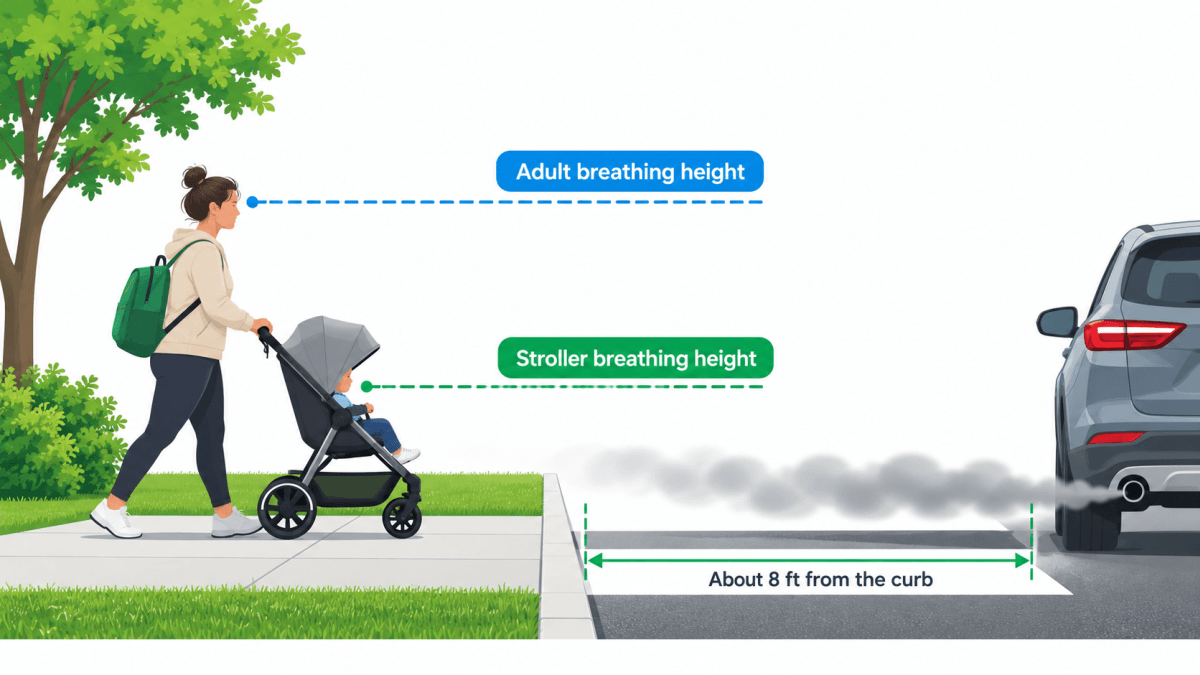
Yes, especially near busy roads. A stroller seat puts a baby's nose roughly 2 to 3 feet off the ground, close to tailpipe height. A curbside study of nitrogen dioxide at child and adult breathing heights from the University of Edinburgh found levels 5 to 15 percent higher at child height within about 4 feet of the curb, with no height difference 8 feet or more from the road.
That is why Filterbuy's curb rule puts route ahead of gear. Walk on the building side of the sidewalk, pick side streets and parks set back from main roads, and wait a step back from the curb at crosswalks. A front carrier lifts your baby nearer your breathing height.
Smoke days are different. Wildfire smoke and summer ozone spread across a whole region, so
What Time Of Day Is Best For A Baby's Walk?
On hot, sunny days, morning is the best time for a walk. Ground-level ozone builds with sunlight and heat, so it usually peaks in the afternoon and early evening. AirNow's air quality guide for ozone tells families to plan outdoor time for the morning.
Filterbuy's clock rule is simple: walk before lunch on hot days, and let the AQI make the call on smoke days.
Where Do Babies Pick Up The Most Exhaust On Everyday Errands?
Exhaust is thickest wherever cars sit idling, such as pickup lines, parking lots, drive-throughs, and busy intersections, right at stroller and car-seat height. Keep the stroller back from idling vehicles, carry the car seat instead of setting it down, and turn off your own engine while you buckle your baby in.
How Do You Protect A Baby In The Car On A Bad Air Day?
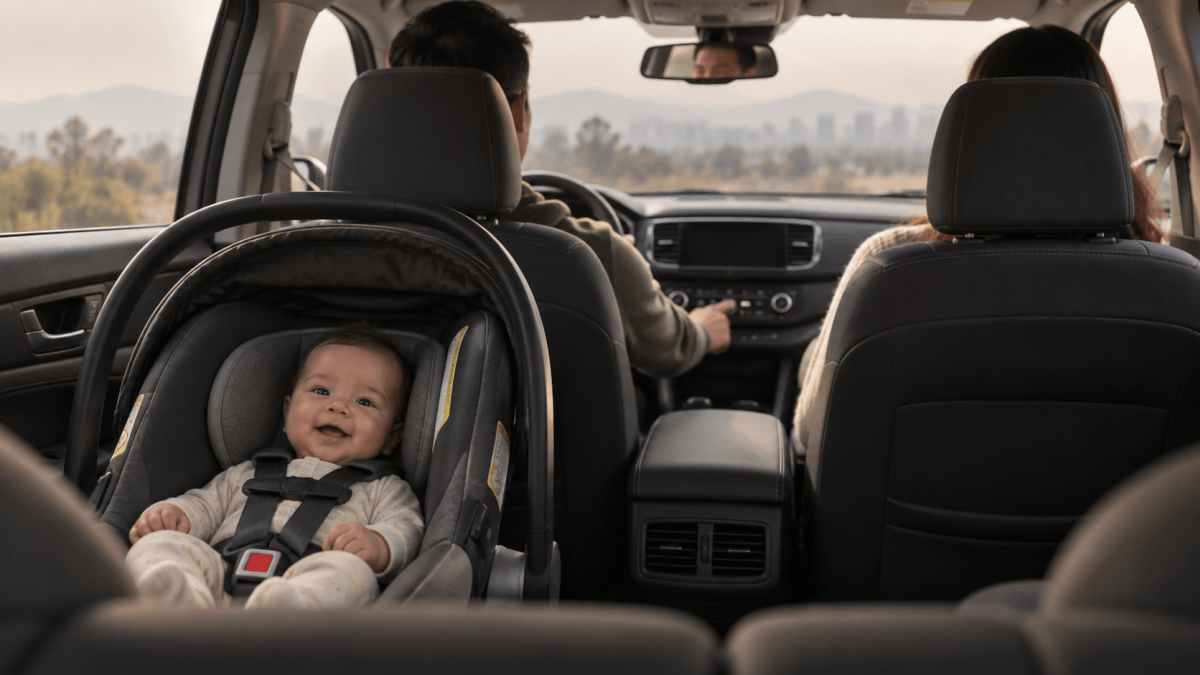
Keep the windows up and set the ventilation to recirculate while you drive through traffic or smoke. A NIOSH-funded UCLA study archived in the CDC research library reports that recirculation can cut ultrafine particles inside the car by 80 to 95 percent, while typical cabin air filters catch only 40 to 60 percent of them.
The trade-off is carbon dioxide: the same research cites typical cabin levels of 2,500 to 4,000 ppm on recirculate. On longer drives, switch to fresh air for a few minutes once you're clear of traffic or smoke.
Because Filterbuy makes cabin air filters, its cabin rule is to check yours before smoke season starts. Here is how to find and replace your cabin air filter, or browse Filterbuy auto cabin air filters.
What Should You Do When You Bring A Baby Back Inside?
Check AirNow and your local air agency first, and follow any order to stay put or leave. Then, when the AQI is over 100, use Filterbuy's four-step rule in this order:
If you have an HVAC system, switch to EPA-recommended MERV 13 air filters in the size your system takes.
Set the thermostat fan to On. Auto filters only while the system heats or cools.
Run HEPA air purifiers in each room, starting with your baby's room.
Close the house up, and skip candles, frying, smoking, and vacuuming while smoke is in.
MERV 13 treats the whole house and a HEPA air purifier treats its room, so use both. Without central HVAC, HEPA air purifiers are your main defense.
EPA's smoke preparation guidance recommends a filter rated MERV 13 or higher during smoky periods and notes that most home systems handle one well when it's replaced often. EPA also advises replacing the filter once it looks dark brown or black, which can be well before the usual interval, so keep spares on hand.
For sizing, EPA's clean-room rule calls for a smoke CADR of at least two-thirds of the room's square footage. A 300 sq ft bedroom wants about 200. EPA advises against air cleaners that make ozone, so skip ionizers and ozone generators.
Our nursery clean room guide for wildfire smoke covers the full setup.
7 Essential Resources For Protecting Babies From Outdoor Air Pollution
Oregon Health Authority: Outdoor Activity Guidance For Infants And Children. Outdoor limits by AQI and outing length.
Vermont Department Of Health: Activities Guide For Air Quality. A 2026 chart for short and long outings.
Minnesota Department Of Health: Outdoor Air Guidance For Child Care. How daycares adjust outdoor time.
California Air Resources Board: California Smoke Spotter App. Smoke forecasts and alerts.
Mount Sinai: Protecting Children From Wildfire Smoke. Smoke-day advice for kids and car trips.
Child Care Aware Of America: Air Quality Guidance For Child Care. Planning outdoor time around the AQI.
Health Effects Institute: Traffic-Related Air Pollution Review. The largest review of traffic pollution and health.
3 Supporting Statistics On Babies And Outdoor Air
46% of U.S. children live with unhealthy air.
Nearly 2.4 million kids with asthma live in counties graded F for at least one pollutant.
Why it matters: Our outing planner starts at the AirNow sensitive-group line.
Source: American Lung Association: How Poor Air Quality Is Putting Half Of America's Youth At Risk (State of the Air 2026)
More than 45 million Americans live within 300 feet of major roads or transport hubs.
Why it matters: It backs the curb advice above.
Source: U.S. EPA: Research On Near Roadway And Other Near Source Air Pollution
Infants breathe up to 3 times as fast as adults.
Infants: 30 to 60 breaths a minute at rest. Adults: 12 to 20.
Why it matters: More breaths mean more outdoor air on every walk.
Source: MedlinePlus: Normal Breathing Rates For Infants And Adults
Final Thoughts And Opinion
Filterbuy's take is that most of a baby's outdoor exposure gets decided before you leave home.
As we document in our smoke-season HVAC settings guide, Filterbuy filter orders spike within hours of a fire starting. Outings run on the same clock, so look at tomorrow's AQI forecast the evening before, since AirNow forecasts usually post by 4 p.m.
As your baby grows, our guide to protecting kids from outdoor air pollution picks up where this one leaves off.
Frequently Asked Questions
Is It Safe To Drive With A Newborn Through Wildfire Smoke?
Short, necessary drives are fine with windows up and vents on recirculate. Follow any evacuation order right away.
Should I Cover The Stroller On A Bad Air Day?
A cover isn't a filter. A 2020 University of Surrey study found covers lowered fine particles on school-run walks, but a covered stroller can trap heat. Never drape a blanket over it, and skip the cover on warm days.
Does Secondhand Smoke Outdoors Count As Bad Air For A Baby?
Yes. The CDC states there is no risk-free level of secondhand smoke exposure, and infants exposed to it face a higher risk of sudden infant death syndrome (SIDS). Steer your baby clear of smokers, and keep your car smoke-free.
When Should I Call The Doctor After My Baby Was Outside In Smoky Air?
Call your pediatrician if your baby has a cough that won't go away, wheezing, or symptoms that don't ease in cleaner air. Get medical help right away for severe trouble breathing, unusual sleepiness, or refusal to eat or drink, and call 911 in an emergency.
Get Ready Before The Next Bad Air Day
Find the size printed on your HVAC filter frame and confirm the rating your manual lists. Then shop Filterbuy air filters by size. Filterbuy orders ship with fast and free 2-day delivery to most US states.
Glossary
Air Quality Index (AQI): A daily outdoor air scale from 0 to 500. The EPA publishes it through AirNow.
PM2.5: Fine particles 2.5 micrometers or smaller.
Ultrafine Particles: Particles under 0.1 micrometers, common in fresh exhaust.
Ozone: A sunlight-driven gas that peaks in the afternoon.
Nitrogen Dioxide (NO2): A traffic gas concentrated near busy roads.
Recirculation Mode: A car setting that reuses cabin air.
Cabin Air Filter: The filter that cleans air coming into a car.
MERV 13: The HVAC filter rating the EPA recommends as a minimum for smoky periods.
HEPA: High-efficiency particulate air, a purifier filter standard.