
AirDoctor Air Purifier Filters: A Homeowner’s Guide
October 9, 2026
TL;DR
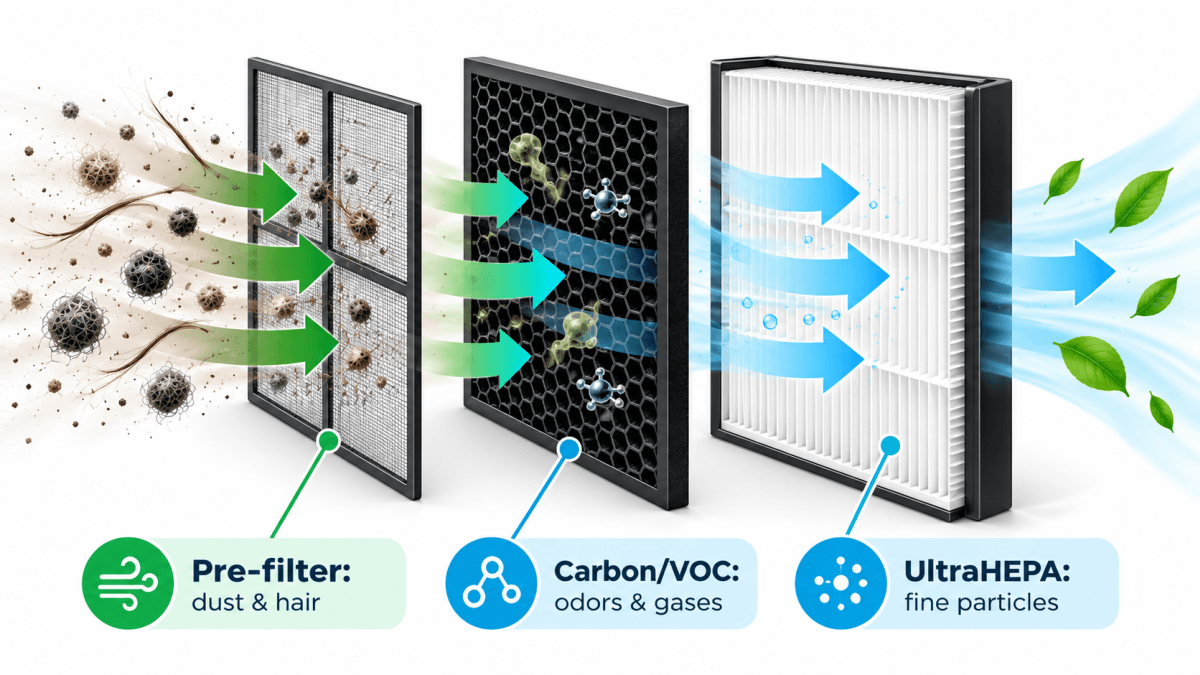
Every AirDoctor air purifier cleans the air in three stages: a pre-filter for dust and hair, a Carbon/VOC filter for odors and gases, and an UltraHEPA filter for fine particles. On most models, the Carbon/VOC filter needs replacing every 6 months and the UltraHEPA filter every 12 months. The AD1000, AD1500 and AD4000 need one filter change every 6 months. Between changes, vacuum the pre-filter monthly and never wash the main filters.
Key Takeaways
Standard schedule: Carbon/VOC every 6 months and UltraHEPA every 12 months for the AD2000, AD2500, AD3000/3500, and AD5000/5500.
6-month models: the AD1000 filter set and the AD1500 and AD4000 all-in-one filters are replaced every 6 months.
Compatibility rule: AD3500 filters also fit the AD3000, and AD5500 filters also fit the AD5000, but not the reverse.
Bad air days: above AQI 100, homes with HVAC should pair a MERV 13 filter, the EPA’s pick for smoky periods, with a HEPA purifier in each room you use.
Daily cost: genuine AirDoctor filters cost about 33 to 60 cents a day at October 2026 list prices.
Why trust this guide: Filterbuy has built air filters in our own U.S. factory for over a decade, including air purifier filters. In this guide, we pair AirDoctor’s official guidance with what we’ve learned making filters and answering customer questions.
What Filters Does an AirDoctor Use?
An AirDoctor moves air through three filter stages, and each one handles a different kind of pollutant. The pre-filter catches large debris like dust and pet hair. Next, the Premium Carbon/VOC filter adsorbs odors and gases, including volatile organic compounds (VOCs). Last, the UltraHEPA filter traps fine particles such as pollen and mold spores.
AirDoctor schedules for most models under normal use.
The Carbon/VOC filter (sometimes labeled Carbon/Gas Trap/VOC) uses activated carbon treated with potassium permanganate, which helps break down gases like formaldehyde and ozone. The Filterbuy team often reminds customers that spent carbon looks exactly like fresh carbon, so trust the calendar or your nose rather than its color. For more, see do carbon filters remove VOCs.
What “UltraHEPA” means. AirDoctor states the UltraHEPA filter is independently tested to capture 99.99% of airborne particles as small as 0.003 microns (AirDoctor). A standard “true HEPA” filter, as defined by the U.S. Department of Energy, captures at least 99.97% of particles at 0.3 microns (EPA). Filterbuy’s carbon vs. HEPA filter guide explains why the two layers wear out at different rates.
Which AirDoctor Filter Do I Need?
Each AirDoctor model family uses its own filter shape, so the right filter comes down to your purifier’s model number. Find it on your unit’s label or in the manual, then match it below.
AD3500 filters fit the AD3000 and AD3500; AD5500 filters fit the AD5000 and AD5500. Original AD3000 and AD5000 filters do not fit the newer 3500 and 5500 units. AD1500 timing follows AirDoctor's 6-month filter subscription.
Sources: AirDoctor filter FAQ, AirDoctor support, AirDoctor AD2500 filters, AirDoctor 1500.
What a Year of AirDoctor Filters Costs
Filterbuy math from AirDoctor list prices on October 8, 2026. Prices change, so check before you buy.
How to Spend Less on AirDoctor Filters
Skip extra pre-filters. Every new Carbon/VOC filter ships with a pre-filter attached, so you already get a fresh one every 6 months (AirDoctor support).
Replace only what the light names. On models with separate filters, the panel shows either an UltraHEPA light or a Carbon light, so you only need the filter that’s lit (AirDoctor support).
Buy the 1-year combo pack. On separate-filter models, it bundles one UltraHEPA with two Carbon/VOC filters, matching the schedule.
Keep spares sealed. Carbon starts absorbing room odors as soon as it’s unwrapped, so wait until install day to open a new filter (Filterbuy’s carbon vs. HEPA guide).
How Long Do AirDoctor Filters Last?
Under normal use, AirDoctor filters last 6 to 12 months, depending on the model (AirDoctor support). Filterbuy’s 12-month routine below fits most models.
When to Replace Your AirDoctor Filter Early
Don’t wait for the calendar if you notice any of these signs it’s time for a new air purifier filter:
The change-filter indicator lights up.
Cooking or pet odors linger, which usually means the carbon is saturated.
Airflow feels weaker. Filterbuy’s support team checks by holding a tissue at the outlet on high. If it barely moves, airflow is restricted.
The pre-filter still looks gray after vacuuming.
The purifier has run through wildfire smoke or a long stretch on high.
What the Filterbuy team has learned: on most purifiers we see, the change-filter light runs on a timer rather than a sensor that checks the filter. A purifier in a pet-filled living room loads its filters faster than one in a guest room, so check the filter itself.
How to Change an AirDoctor Filter
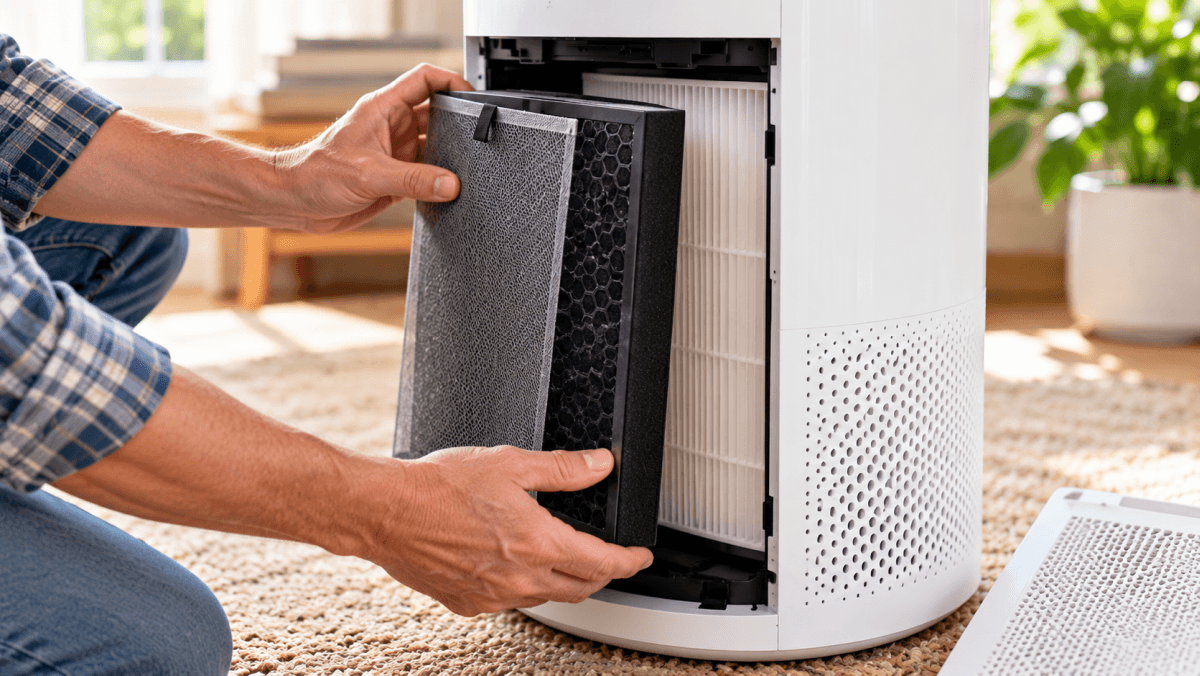
Changing an AirDoctor filter takes a few minutes and no tools. On models with separate filters, the UltraHEPA filter goes in first and the Carbon/VOC filter goes in front of it, with its pre-filter facing out.
Turn off and unplug the purifier.
Remove the filter cover.
Unwrap the new filters.
Pull out the old filters using the grip tab on each one.
Insert the UltraHEPA filter first, following the arrows on top of the filter.
Insert the Carbon/VOC filter next, with the attached pre-filter facing toward the cover.
Replace the cover and plug the unit back in.
Reset the change-filter alert (see below).
Filterbuy team tip: Write the install date on the filter frame, and make sure all plastic wrap is off. A wrapped filter blocks nearly all airflow, and it’s a common cause of the “no airflow” calls we get.
How to Reset the AirDoctor Filter Indicator
On AD3000- and AD5000-style units, press and hold the Auto and Dim buttons together until the alert light flashes three times and turns off (AirDoctor support). For other models, AirDoctor posts step-by-step videos in its Help Center. If the light stays on, see Filterbuy’s air purifier troubleshooting guide.
Can You Wash AirDoctor Filters?
You can clean the AirDoctor pre-filter, but never wash the UltraHEPA or Carbon/VOC filter. AirDoctor recommends vacuuming the pre-filter about once a month(AirDoctor support). Filterbuy makes HEPA-style media, so we know why: HEPA traps particles deep in its fibers rather than on the surface, so washing can’t clean it and can damage it. Spent carbon can’t be refreshed.
To clean the pre-filter, run a vacuum with a brush attachment over it on low. AirDoctor says a hand wash also works, as long as you lay the pre-filter flat and let it dry completely before putting it back (AirDoctor support).
Genuine vs. Compatible AirDoctor Replacement Filters
While your purifier is under warranty, genuine AirDoctor filters are the safe choice. AirDoctor’s product listings state that aftermarket filters void the warranty (AirDoctor AD1000 listing), and the company reports that most knockoff filters it tested failed the minimum HEPA standard or restricted airflow enough to strain the motor (AirDoctor support).
AirDoctor sells genuine AirDoctor filters on its website and through retailers like Amazon and The Home Depot. Third-party compatible filters cost less. Once your warranty has expired, look for an exact model fit, a published efficiency rating such as true HEPA or H13, and an included pre-filter. Filterbuy’s HEPA replacement filter buying guide explains those ratings.
Keep an Eye on Filterbuy Air Purifier Filters
Filterbuy makes air purifier replacement filters in our own U.S. factory, backed by more than 85,000 five-star customer reviews. Each filter pairs HEPA-style media with an activated carbon layer in a single drop-in unit and ships within 24 hours. With auto-delivery, your next one arrives right on schedule.
Our air purifier filter line is still growing. We don’t carry AirDoctor-compatible filters yet, but we’re adding new models, so check back. Every filter we add will meet the same standard: American-made quality at a factory-direct price.
In the meantime, an AirDoctor cleans one room, while your HVAC filter cleans the air moving through the whole house. Filterbuy’s rule of thumb: if you have an HVAC system and the outdoor AQI passes 100, switch to a Filterbuy MERV 13 air filter, the rating the EPA recommends during smoky periods (EPA), and set the thermostat fan to On. Then run a HEPA air purifier, like your AirDoctor, in each room you use.
Supporting Statistics
90% of time indoors. Most people spend about 90% of their time inside. (U.S. EPA)
2–5x more VOCs inside. EPA studies found about a dozen common organic pollutants at 2 to 5 times higher levels indoors than outdoors. Carbon/VOC filters target them. (U.S. EPA)
106 million+ Americans have allergies. That is about 1 in 3 people, including 82 million with pollen allergies, a key target for UltraHEPA filters. (AAFA)
AirDoctor Filter FAQ
Why Is My Airdoctor Filter Light Still On After I Changed The Filters?
The AirDoctor change-filter light doesn’t reset on its own. On AD3000- and AD5000-style units, hold Auto and Dim until it flashes three times. On app-connected models, reset filter life in the AirDoctor app.
What Happens If I Don’t Replace My Airdoctor Filters?
A clogged UltraHEPA filter slows airflow, so the purifier cleans less air. Saturated carbon also stops absorbing odors.
Glossary
AirDoctor: A brand of portable air purifiers from Ideal Living.
Filterbuy: A U.S. maker of HVAC and air purifier filters, based in Talladega, Alabama.
UltraHEPA: AirDoctor’s trademarked main particle filter.
HEPA (High-Efficiency Particulate Air): A filter standard requiring at least 99.97% capture of 0.3-micron particles (EPA).
Pre-filter: A cleanable mesh layer that traps large debris first.
Carbon/VOC filter: AirDoctor’s activated carbon filter for odors and VOCs.
VOC (volatile organic compound): A gas released by products like paint and new furniture (what are VOCs).
AQI (Air Quality Index): The EPA’s 0–500 daily air quality scale. Readings above 100 are unhealthy for sensitive groups (AQI above 100).
Micron: One millionth of a meter; a human hair is about 70 microns wide (EPA).
MERV (Minimum Efficiency Reporting Value): A 1–16 rating of how well an HVAC filter captures particles (EPA).