
What's the Best MERV Filter for Mold Spores?
May 5, 2026
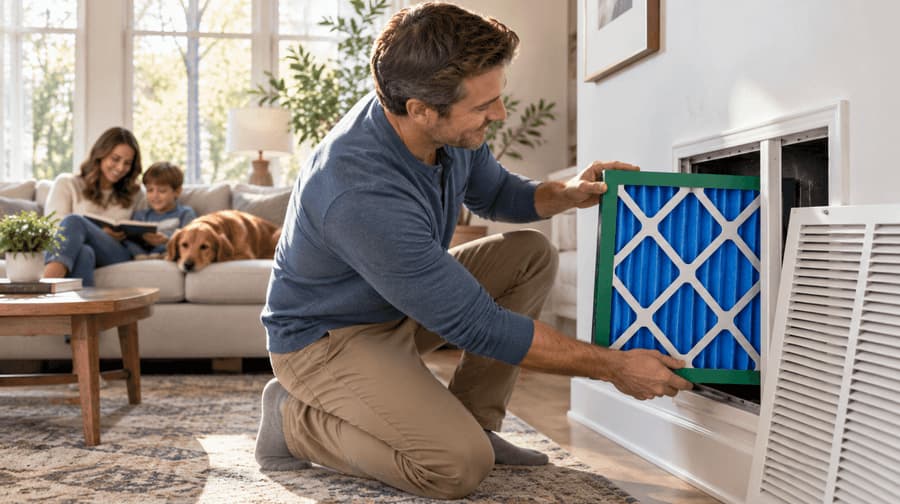
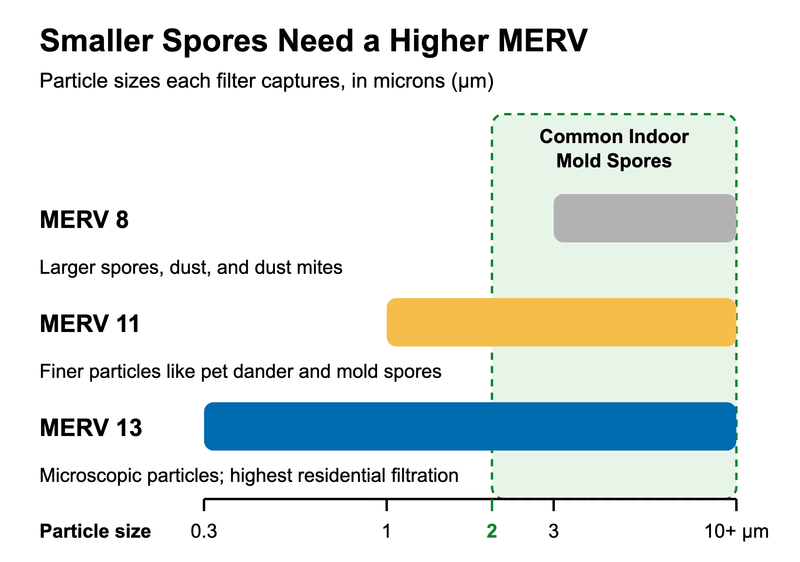
MERV 11 captures most mold spores, and MERV 13 captures the smallest ones. MERV 8 only catches larger spores, so step up if mold spores are your focus.
MERV 8: Larger debris, dust, dust mites, and larger spores (3–10 microns).
MERV 11: Finer particles like pet dander and mold spores, down to about 1 micron.
MERV 13: Microscopic particles down to 0.3 microns. The highest residential filtration.
Higher MERV ratings can reduce airflow, so check your HVAC manual first. Not sure which fits your system? Take the quick match quiz below.
Find Your Filter Match
Answer a few quick questions and we'll match you to the right filter.
TL;DR
For most homes, MERV 13 is the best air filter for mold spores, and MERV 11 is the minimum. A MERV 13 filter must catch at least 85% of mold-sized particles (1 to 3 microns), while MERV 8 only has to catch 20%. Filters clean the air, but stopping mold takes moisture control, starting with 30–50% indoor humidity per the U.S. EPA.
Key Takeaways
MERV 13 is the best HVAC filter for mold, capturing at least 85% of 1–3 micron particles.
MERV 11 is the minimum for mold, at 65% or more.
Filterbuy lab data: a 4-inch MERV 13 resists airflow about as much as a 1-inch MERV 8.
Mold can grow on an AC filter. Turn the system off, then fix the moisture source.
Moisture control stops mold growth; filters can't.
What MERV Rating Do You Need for Mold Spores?
For mold spores, use at least a MERV 11 air filter, and choose MERV 13 if your system can run it. The ratings pull apart at 1 to 3 microns. Under ASHRAE Standard 52.2, per the EPA MERV rating chart, MERV 8 must capture 20% of those particles, MERV 11 must capture 65%, and MERV 13 must capture 85%.
Minimums under ANSI/ASHRAE Standard 52.2. Real-world capture also depends on fit.
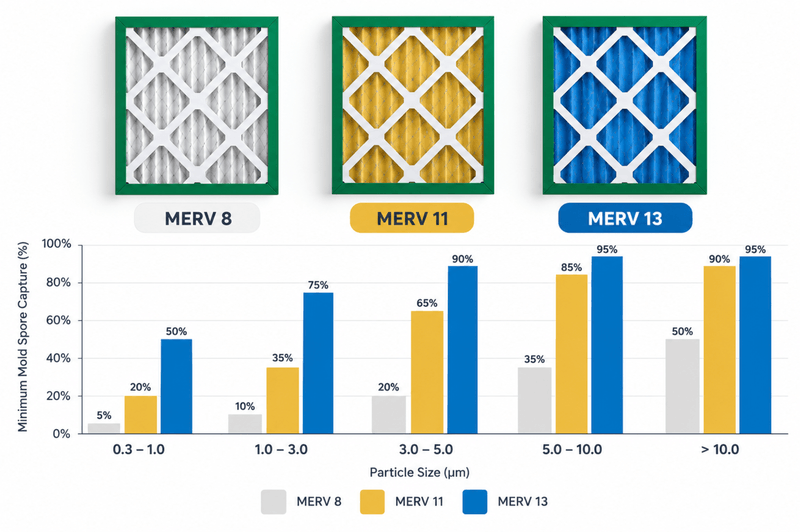
What the label won't tell you: a MERV rating is a floor, not an average. A filter that barely passes and one that passes easily carry the same number, so Filterbuy watches that margin on its own line.
Another way to look at it: at their minimums, a MERV 8 filter can let up to 80% of 1–3 micron particles through on each pass, compared with 35% for MERV 11 and 15% for MERV 13. Air cycles all day, so the gap adds up.
What Size Are Mold Spores?
Mold spores range from about 2 to 100 microns across, according to the U.S. EPA mold course. The ones that stay airborne indoors are small, though: research in Applied and Environmental Microbiology found they typically measure 2 to 4 microns, right where filter ratings start to differ.
The same study measured Penicillium spores at about 2 microns and Cladosporium at about 3, so 1 to 3 micron capture is the number to watch. See also can an air filter help with mold.
Is MERV 11 Good Enough for Mold?
MERV 11 is good enough for most homes where no one has asthma and mold hasn't been a problem. It must capture at least 65% of 1 to 3 micron particles, more than three times the 20% required of MERV 8, which is fine for dust but weak against mold.
Best for: homes with pets or mild allergies. Shop MERV 11 air filters, or compare MERV 8 vs MERV 11. Without mold concerns, MERV 8 air filters handle everyday dust.
Is MERV 13 the Best HVAC Filter for Mold?
Yes. MERV 13 is the best HVAC filter for mold that most home systems can run. It must capture at least 50% of particles 0.3 to 1 micron, 85% of particles 1 to 3 microns, and 90% of particles 3 to 10 microns. That covers the full range of common airborne spores.
Best for: asthma and humid or mold-prone homes. Shop MERV 13 air filters.
MERV 11 vs MERV 13 for Mold: Which Should You Choose?
Go with MERV 13 if your HVAC system can handle it, and MERV 11 if it can't. The deciding factor is capture at 1 to 3 microns, where MERV 13 must trap at least 85% of mold-sized particles and MERV 11 must trap 65%.
Licensed HVAC technician David Clark puts it simply: "The best filter is the highest rating your system can move air through, changed on schedule. A MERV 11 you actually replace beats a MERV 13 you leave in for six months."
What Filterbuy's Lab Testing Shows
Filterbuy's lab data points to an upgrade many homeowners overlook. A 20x25x4 MERV 13 filter measured 0.11 in. w.g. of resistance, about the same as a 1-inch MERV 8 in the same face size (0.10). Going deeper raises minimum 1–3 micron capture from 20% to 85% with almost no added strain. See the full MERV pressure drop chart.
Clean-filter pressure drop at 1,000 CFM, in. w.g. (Filterbuy lab data).
Can Mold Grow on an Air Conditioner Filter?
Yes. Mold can grow on an air conditioner filter whenever it has food and moisture. A dust-loaded filter supplies the food, while high humidity or a clogged condensate drain supplies the water, as can a leak near the return. Use the quick check below to tell mold from dust.
Is It Mold or Just Dust on Your Filter?
If it is mold, treat it as a warning sign. Moisture is reaching the air handler, so the coil and drain pan may have mold too. As the U.S. EPA mold guide says, "The key to mold control is moisture control."
What to Do If Your AC Filter Has Mold on It
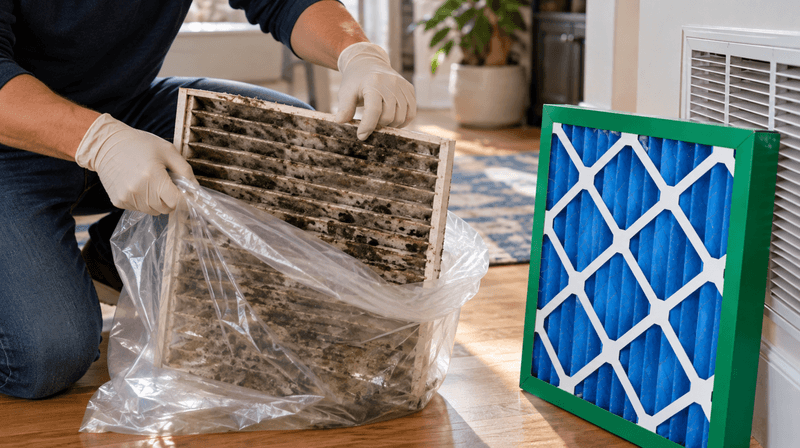
Turn off your HVAC system, bag the moldy filter, and put in a new MERV 11 or MERV 13. Then find and fix the moisture source. The U.S. EPA advises against running a system you suspect is contaminated with mold, since the blower can spread it through the home.
Turn off the system so it stops moving spores.
Protect yourself with gloves and an N-95 respirator, as the EPA recommends for mold cleanup.
Bag the filter and throw it out. Don't reuse it.
Check the coil and drain pan for mold or standing water.
Install a new MERV 11 or MERV 13 filter in the exact size. The mistake Filterbuy sees most is a filter slightly too small, letting air slip around it unfiltered.
Call a pro if mold has spread. Coil or duct mold calls for HVAC mold remediation.
How Do You Prevent Mold in Your HVAC System?
Preventing mold in an HVAC system comes down to moisture. The U.S. EPA recommends indoor relative humidity below 60%, ideally 30% to 50%, plus drain pans that flow and drying anything wet within 24 to 48 hours. Your filter can only keep up once moisture is handled.
Measure humidity with an inexpensive hygrometer.
Check your filter when cooling season starts and within 24–48 hours of any leak, then monthly in humid stretches.
Stay on schedule. Clogged filters hold moisture, especially during winter furnace season.
Add a dehumidifier if humidity stays above 50%.
Supporting Statistics: Why Filtration and Humidity Matter
Household mold is a real health issue, and the research supports this guide's two-part approach. Federal research and CDC data line up with the nation's oldest asthma patient group: filter airborne spores with the right MERV rating, and keep humidity between 30% and 50%.
21% of current U.S. asthma cases, about 4.6 million, are attributable to dampness and mold in homes, at an estimated $3.5 billion a year, according to Lawrence Berkeley National Laboratory's indoor air research.
8.6% of U.S. adults and 6.5% of children currently have asthma (2024), according to CDC FastStats. These households gain the most from MERV 13.
Mold thrives once indoor humidity climbs above 50%, according to the Asthma and Allergy Foundation of America, which recommends a central AC filter plus 30–50% humidity.
What Is the Best AC Filter for Mold Allergies?
For mold allergies, MERV 13 is the best AC filter if your system supports it, since it must capture at least 85% of 1 to 3 micron particles. If your system tops out at MERV 11, add a portable HEPA purifier in the bedroom.
Can Your HVAC System Handle a High-MERV Filter?
"Will MERV 13 restrict my airflow?" is the question Filterbuy hears most, and for most modern systems the answer is no. Older systems can struggle, so the best filter is the highest rating your system can run without losing airflow.
Check your system's age and manual. Filterbuy's rule of thumb: systems from 2015 or later handle MERV 13 (ideally 4-inch), and 2005–2014 systems handle MERV 11 at 2 inches or deeper. For older systems, ask a technician.
Use the deepest slot you have. 4-inch air filters restrict airflow less than 1-inch filters at the same rating.
Not sure? Ask a technician to measure static pressure. See MERV ratings explained.
Why Homeowners Choose Filterbuy for Mold Protection
Damp air handlers are tough on filters. Filterbuy filters pair charged synthetic media with wire backing that keeps pleats spaced, inside a frame built to handle humidity. We make them in four U.S. states (read the Filterbuy story) in 600+ sizes and custom air filters for a snug fit, and filter auto-delivery keeps replacements on time.
More than 4 million households have bought Filterbuy filters, backed by 85,000+ five-star reviews.
Frequently Asked Questions
Is a HEPA Filter Better Than MERV 13 for Mold?
A HEPA filter captures more spores, at least 99.97% of 0.3-micron particles according to the EPA. Filterbuy chooses not to make HEPA or MERV 14 home filters because most home systems can't move enough air through them.
Does a MERV 8 Filter Stop Mold Spores?
Only the larger ones. A MERV 8 filter must capture 70% of 3 to 10 micron particles but only 20% at 1 to 3 microns. For mold, start at MERV 11.
How Often Should I Change My Air Filter to Control Mold?
Replace a 1-inch filter every 90 days, or every 60 with pets or allergies and every 30 for respiratory concerns. In winter, a furnace running 10-plus hours a day can load a filter in about 30 days. See how often to change your air filter.
Can a Filter Get Rid of a Musty Mold Smell?
A pleated filter traps spores, not odors. An activated carbon odor eliminator filter can cut the smell, but the EPA notes a moldy odor suggests mold is actively growing somewhere.
Glossary
Sources
EPA, CDC, Berkeley Lab, AAFA, ASHRAE 52.2, Madsen et al. (2016), and Filterbuy lab data.