
Central Air Vs. Window Units: Which Is Worth It For Your Home?
November 26, 2026
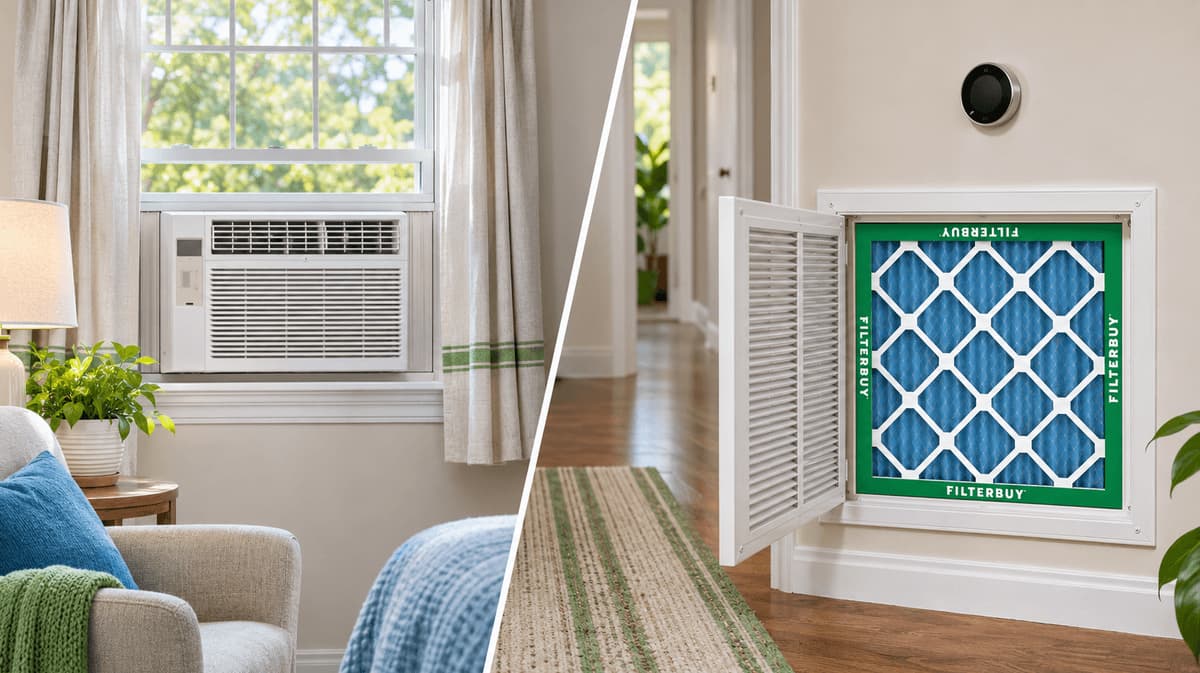
Window units cost far less to buy and are cheaper to run when you only cool one or two rooms. Central air costs more up front, but it cools the whole house evenly and filters every room's air through one pleated filter. Whether it's worth it depends on how many rooms you cool at once and whether you already have ductwork.
Filterbuy makes the pleated filters central air runs on and sells ductless mini-splits. That gives us a stake here, so we show the math behind every cost and say when a window unit is the smarter buy.
Window units cost less and make sense for cooling one or two rooms. Central air gives you more cooling per dollar for three or more rooms, as long as your ducts are sealed.
Here's the quick difference:
- Window units: 150–400 each. A fit for renters and one or two rooms. They use a mesh screen with no MERV rating.
- Central air: 3,800–12,500 to replace. Cools every room evenly and runs quieter indoors. All your air passes through one pleated MERV filter.
- Leaky ducts? They can make central air cost more to run. Test them before you buy.
Already have central air? Your filter does the work for every room. Take the quick quiz below to find your filter match.
How many rooms need cooling?
Room count decides it
1–2 rooms
Window units
150–400
per unit
Mesh screen filter
3+ rooms
Central air
3,800–12,500
to replace
Pleated MERV filter
Leaky ducts can flip the math.
Test your ducts before you buy.
Find your filter match
Answer 3 quick questions, and we'll match you to the right filter for your system.
Already know your size? Order the size printed on your old filter's frame. Custom sizes are available too.
TL;DR
Window units are the better buy if you rent or cool one or two rooms. Central air is the better long-term value if you cool three or more rooms most of the summer and have sealed ductwork, though it rarely pays for itself through lower bills. Test your ducts before you price new equipment.
Key Takeaways
Standard window units cost $150 to $400. A central air replacement costs about $3,800 to $12,500.
At 18.2 cents per kWh, a 10,000 BTU window unit costs about $40 a month to run 8 hours a day. A 3-ton central system costs about $110.
Sealed central air saves only $9 to $49 a month over three or four window units, so buy it for comfort and filtration, not savings.
Leaky ducts can make central air cost more to run than window units.
Central air filters every room's air through one MERV-rated filter you can upgrade. A window unit's mesh screen can't be upgraded.
Central Air Vs. Window Units At A Glance
Central air is a ducted, whole-home cooling system. A window unit is a self-contained air conditioner that cools one room. Window units win on price, while central air wins on most other factors.
| Factor | Window Units | Central Air |
|---|---|---|
| Upfront cost | $150–$400 per unit | $3,800–$12,500 to replace |
| Operating cost | Lower for 1–2 rooms | Lower per BTU with sealed ducts |
| Comfort | One room, hot spots elsewhere | Even temperature in every room |
| Air filtration | Mesh screen, no MERV rating | Pleated MERV 8–13 filter |
| Noise | Compressor sits in the window | Compressor sits outside |
| Home value | Rarely adds value | Expected by most buyers |
| Best for | Renters, small homes, 1–2 rooms | Owners cooling 3+ rooms |
Which Costs Less Up Front, Central Air Or Window Units?
Window units cost far less up front. A standard model sells for $150 to $400 and installs in an afternoon without a contractor. Filterbuy HVAC Solutions puts central AC replacement costs between $3,800 and $12,500 for most homes.
Homes without ductwork pay more because ducts must be designed and installed first, and a full duct replacement alone runs $1,500 to $7,000. If ductless cooling is on your list, compare these alternatives to window AC units.
The Filterbuy Take: if you rent or plan to move within a few years, a good window unit is the smarter use of your money.
Which Costs Less To Run Each Month?
Window units cost less to run when you cool one or two rooms. Sealed central air costs less per unit of cooling when you cool most of the house. The U.S. Department of Energy notes that room units are less expensive to operate because they cool individual rooms.
Filterbuy built the model below using the EIA's 2026 residential electricity price forecast of 18.2 cents per kWh and 8 hours of compressor runtime a day for 30 days.
| Setup | Cooling Capacity | Est. Monthly Cost |
|---|---|---|
| 1 window unit (10,000 BTU, CEER 11) | 10,000 BTU/h | $40 |
| 2 window units | 20,000 BTU/h | $79 |
| 3 window units | 30,000 BTU/h | $119 |
| 4 window units | 40,000 BTU/h | $159 |
| Central air, 3 tons, 14.3 SEER2, sealed ducts | 36,000 BTU/h | $110 |
| Same system, 25% duct loss | 36,000 BTU/h delivered | $147 |
To rerun it with your own numbers, divide the unit's BTU rating by its efficiency rating (CEER for window units, SEER2 for central air), then divide by 1,000 to get kilowatts. Multiply by your total hours of use, then by your utility rate.
The Room-Count Rule
Filterbuy's room-count rule is simple. Cool three or more rooms most of the summer, and sealed central air gives more cooling per dollar: $110 for 36,000 BTU versus $119 for 30,000 BTU from three window units. Cool one or two rooms, and window units win.
Leaky ducts reverse that result. A central system that loses a quarter of its cooled air costs more to run than the window units it replaced, so Filterbuy's advice is to get a duct leakage test before you price new equipment. Once the ducts check out, Filterbuy's SEER2 rating chart helps you compare systems.
Will Central Air Pay For Itself?
No, not on electricity alone. In Filterbuy's model, sealed central air saves about $9 a month over three window units and $49 over four. Over a four-month cooling season, that's roughly $36 to $196 a year against an up-front gap of $2,000 or more, so the case for central air rests on comfort and whole-home filtration.
Which Keeps Your Home More Comfortable?
Central air is more comfortable because it cools and dehumidifies every room from one thermostat. A window unit only cools the room it sits in, so hallways and upstairs bedrooms stay warm.
Both need correct sizing, since an oversized unit cools quickly but leaves humidity behind. For central air, ask your contractor for a Manual J load calculation.
How Do Central Air And Window Units Compare On Air Filtration?
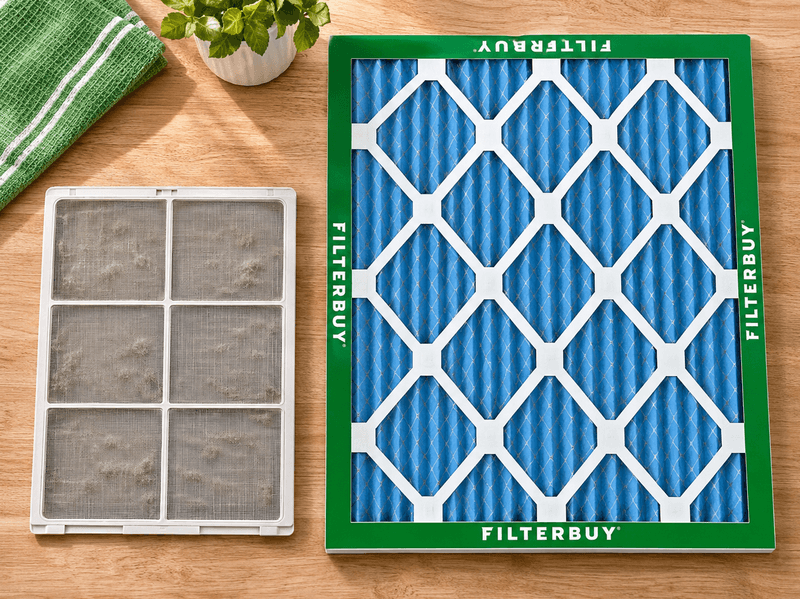
Central air filters far more of your home's air. Return air from every room passes through one pleated filter rated by MERV (Minimum Efficiency Reporting Value), while a window unit recirculates one room's air through a washable mesh screen with no MERV rating.
Because Filterbuy builds pleated MERV 8, 11, and 13 filters, we see the real difference as control. A window unit's screen can't be upgraded, but a central filter slot takes whatever rating your equipment accepts. The EPA's Guide to Air Cleaners in the Home recommends a filter rated at least MERV 13, or as high as your system will accommodate.
At Filterbuy, MERV 8 air filters are the standard choice for most homes, and MERV 11 air filters suit homes with allergies, asthma, pets, or heavy pollen. For wildfire smoke, MERV 13 air filters are the pick. Check your HVAC manual before moving up a tier.
The trade-off is cost. Central air needs a fresh 1-inch filter about every 90 days, or four a year per filter slot, so check yours monthly and see how often to change your air filter.
Which One Is Quieter, Central Air Or A Window Unit?
Central air is quieter indoors because the compressor, its loudest part, sits outside. A window unit puts the compressor and both fans in your window, so you hear it cycle in the room where you sleep or work. Inverter window units are quieter than standard models because they ramp up and down instead of switching fully on and off.
Does Central Air Add Home Value?
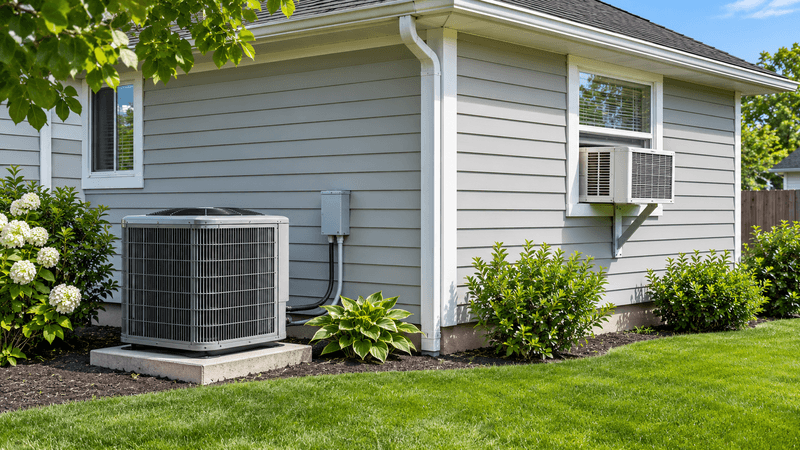
Central air generally helps resale because buyers in most U.S. markets treat it as standard equipment. Window units rarely add value and usually leave with the seller. The dollar effect depends on your market and the system's age, so ask a local appraiser.
The Filterbuy Take: install central air because you'll use it, not for resale alone.
Which Should You Choose For Your Home?
Choose window units if you rent or cool one or two rooms. Choose central air if you own your home and cool most of it through sound ductwork. If you're unsure, answer these three questions.
How many rooms do you cool at once? One or two favors window units. Three or more favor central air.
Do you have sealed ductwork? If yes, central air is cheaper to add. If not, price ductless cooling too.
How long will you stay? Central air's value builds over many summers and at resale, while window units suit shorter stays.
Backed by a 7-year compressor and 3-year parts warranty, Filterbuy's single-zone mini-split systems are worth pricing against a window unit.
"I write about indoor air for a filter company, so I look at this choice through the filter slot. A window unit gives you a mesh screen you rinse in the sink. Central air gives you one filter for every room's air, and you decide how fine it is."
Michelle Wan, Brand Manager and Air Quality Writer, Filterbuy
Supporting Statistics
98% of new single-family homes started in 2024 had central AC, according to NAHB's analysis of Census construction data.
Source: HVAC in New Construction in 2024
ENERGY STAR estimates that a typical house loses 20 to 30 percent of the air moving through its ducts to leaks.
Source: Duct Sealing
Since 2023, new split central ACs under 45,000 BTU must reach 13.4 SEER2 in the North and 14.3 SEER2 in the Southeast and Southwest.
Source: Central Air Conditioners and Heat Pumps
Frequently Asked Questions
Can Window Units Cool A Whole House?
Several window units can cool a small home, but hallways stay warmer, and each unit needs its own window and outlet. For three rooms, central air usually costs less to run and keeps temperatures more even.
Can You Use Central Air And Window Units Together?
Yes. A window unit can cover one hard-to-cool room, such as a bonus room or upstairs bedroom, instead of overcooling the rest of the house to reach it. Size that unit to the room alone, at about 20 BTU per square foot.
How Much Does It Cost To Add Central Air To A House Without Ducts?
It costs more than a replacement because ducts must be designed, installed, and sealed. Get at least two written quotes that include a load calculation and a duct design, and price ductless options alongside them.
Is Central Air Worth It In A Mild Climate?
Usually less so. Fewer cooling months shrink central air's already small savings, so window units or ductless cooling often make more sense unless you want whole-home filtration.
Get More Clean Air From Your Cooling System
If you have central air, find your exact size and shop Filterbuy air filters in MERV 8, 11, or 13 with fast and free 2-day delivery to most US states. Then set up Auto Delivery so a fresh filter arrives on schedule.
Glossary
BTU (British Thermal Unit): The unit used to rate air conditioner capacity, measured per hour.
CEER (Combined Energy Efficiency Ratio): The federal efficiency rating for room air conditioners.
EIA (U.S. Energy Information Administration): The federal agency that forecasts U.S. energy prices.
EPA (U.S. Environmental Protection Agency): The federal agency behind U.S. indoor air guidance.
HVAC: Heating, ventilation, and air conditioning.
Inverter: A variable-speed compressor that adjusts output instead of cycling fully on and off.
kWh (Kilowatt-Hour): The unit utilities use to bill electricity.
Manual J: The Air Conditioning Contractors of America method for sizing HVAC equipment.
MERV (Minimum Efficiency Reporting Value): The ASHRAE 52.2 scale rating how well an HVAC filter captures airborne particles.
SEER2: The federal seasonal efficiency rating for central air conditioners since 2023.
Ton: A cooling capacity unit equal to 12,000 BTU per hour.