
How Old Is My AC Unit? How To Read The Nameplate And Serial Number
November 25, 2026
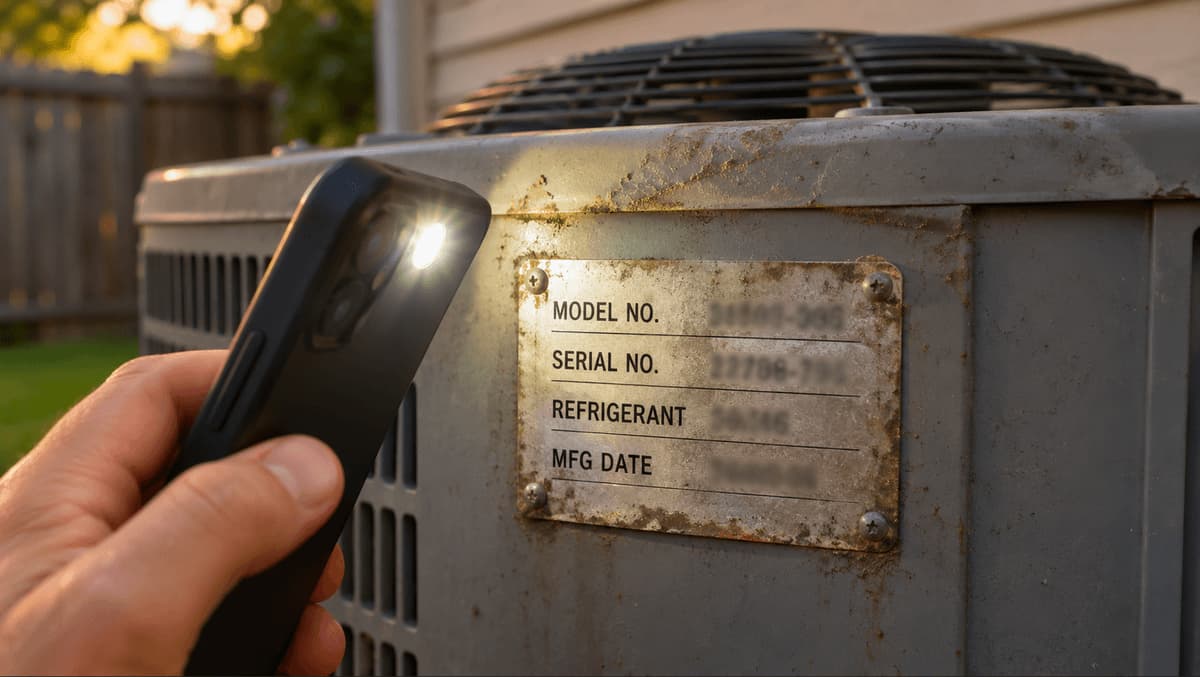
Your air conditioner's age is printed on the outdoor unit, though rarely in plain words. Most manufacturers encode the build date in the serial number on the nameplate, and at Filterbuy we treat that date as the first fact in any repair conversation.
Check the nameplate on your outdoor unit. If no manufacture date is printed, the build date is coded into the serial number.
Each brand puts the date in a different spot:
- Carrier, Bryant, Payne: digits 1–2 are the week, 3–4 the year.
- Trane, American Standard (2010 on): digits 1–2 are the year, 3–4 the week.
- Goodman, Amana: digits 1–2 are the year, 3–4 the month.
- Lennox: digits 3–4 are the year; the 5th character is the month.
- Rheem, Ruud: after the first letter, two digits for the week, then two for the year.
Cross-check with the refrigerant label. R-22 usually means it was built before 2010.
Whatever the age, your AC needs a clean filter. Take the quick quiz below to find your filter match.
Your serial number holds the age
Example: Carrier, Bryant, Payne format
SERIAL NO.
Outdoor unit nameplate
MODEL NO. = size, not age
REFRIGERANT: R-410A
Week
05
Year
2019
Built week 5
of 2019
What the age means for you
At any age: check the filter monthly.
Clues don’t match? Have a technician check.
Find your filter match
Answer 3 quick questions and we’ll match you to the right filter for your AC.
Already know your size? It’s printed on your old filter’s frame. Custom sizes are available too.
TL;DR
Look for the nameplate on the outdoor condenser, then decode the date characters in its serial number with the brand table below. Check that date against the plate's refrigerant and efficiency rating, then weigh age against repair cost.
Key Takeaways
Most central AC brands encode the build date in the serial number on the outdoor unit's nameplate.
The model number tells you the series and cooling capacity, but not the age.
Date code formats differ by brand family, so confirm the brand first.
Filterbuy's three-clue check (serial date, refrigerant, efficiency label) helps catch misreads, since all three should agree on a correctly decoded unit.
The Department of Energy lists 15 to 20 years for central air conditioners, so age weighs heavily in repair decisions.
Where Is The Nameplate On An AC Unit?
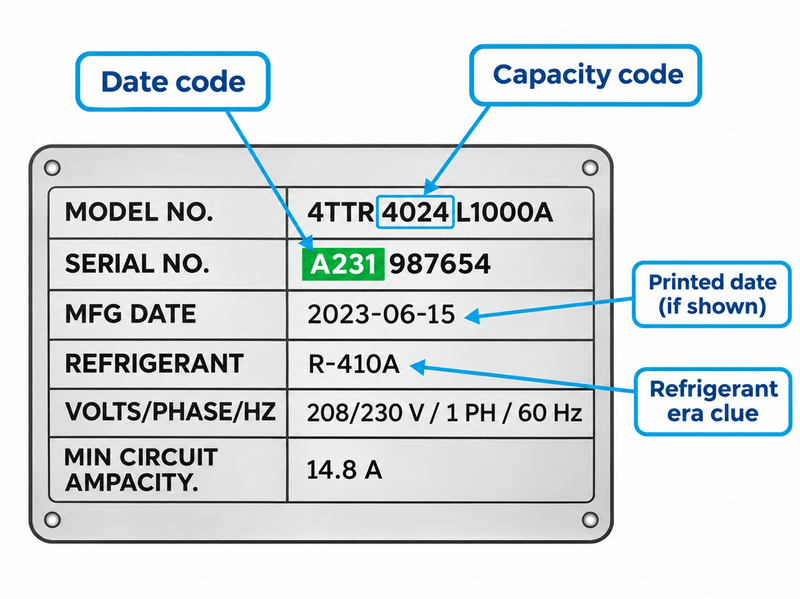
The AC nameplate, also called the rating plate or data plate, is the metal or vinyl label on the outdoor condenser, usually on a side panel near the electrical access. It lists the brand, model number, serial number, electrical ratings, and refrigerant type.
Your indoor air handler or furnace has its own nameplate and date. If the indoor and outdoor dates are years apart, one half was probably replaced, and the pair may no longer match a certified combination. Leave anything behind a service panel to a certified technician.
How Do You Read An AC Serial Number?
To read an AC serial number, find the line marked Serial No. or S/N and read the date characters in the positions your brand uses, usually within the first four or five characters.
Look for MFG Date first. Many newer plates print it outright.
Copy the full serial number, every letter included.
Confirm the brand, since sister brands share formats.
Decode it with the brand table below.
Cross-check the era against the refrigerant and efficiency rating.
Watch for three common misreads:
Reading the model number instead. Capacity codes such as 036 can look like dates.
Look-alike characters. O and 0, or I and 1, are easy to confuse, which is why several brands skip the letter I in date codes.
Trusting the compressor label. A replacement compressor carries a newer date than the cabinet around it.
How Do Major AC Brands Format The Date Code?
Most AC brands use one of a handful of date code patterns, shared across sister brands. Carrier puts the week before the year, Trane puts the year first, and Goodman uses year then month. Rheem and ICP brands such as Heil and Tempstar place the date after a plant letter, while Lennox and York mark the month with a letter.
Table 1: AC Serial Number Date Codes By Brand
| Brand Family | Where the Date Sits | Decoded Example |
|---|---|---|
| Carrier, Bryant, Payne, Day & Night | Digits 1–2 = week, digits 3–4 = year | 0519E28045 = week 5, 2019 |
| Trane, American Standard | Since 2010: digits 1–2 = year, 3–4 = week. 2002–2009: digit 1 = year | 11241KADBB = week 24, 2011 |
| Goodman, Amana, Goodman-built Daikin | Digits 1–2 = year, digits 3–4 = month | 0804237539 = April 2008 |
| Lennox, Ducane, Aire-Flo | Digits 3–4 = year, letter 5 = month (A–M, no I) | 5205J24862 = September 2005 |
| Rheem, Ruud | After the first letter: 2 digits week, 2 digits year | W421724596 = week 42, 2017 |
| York, Coleman, Luxaire (2004 on) | Letter 3 = month, digits 2 and 4 = year | N0D6653823 = April 2006 |
| Heil, Tempstar, Comfortmaker, Arcoaire | After the first letter: 2 digits year, 2 digits week | E072514528 = week 25, 2007 |
Carrier and Lennox serials look almost identical (four digits, a letter, five digits) but decode differently, so check the brand on the plate first. For older, retired formats, the Building Intelligence Center's Trane date code reference traces how serial styles changed.
How Can You Confirm Your AC's Age Without A Clear Date Code?
The most reliable way to confirm an AC's age is the three-clue check Filterbuy uses: the serial date, the refrigerant, and the efficiency label. Serial formats repeat across decades, but refrigerant and efficiency rules changed on fixed dates, so all three should agree.
Table 2: Nameplate Clues That Confirm An AC's Era
| Nameplate Clue | Likely Build Era | Why It Fits |
|---|---|---|
| R-22 (HCFC-22) | Before 2010 | New R-22 systems could not be produced after 2010 |
| R-410A | About 2010–2024 | Replaced R-22, then left new split systems in 2025 |
| R-454B or R-32 | 2024 or later | Lower-impact refrigerants for new equipment |
| SEER rating only | Before 2023 | SEER2 testing began January 1, 2023 |
| SEER2 rating | 2023 or later | Rated under current federal standards |
Table 2's efficiency dates follow the current federal efficiency standards. If the clues disagree, such as a 2016 serial date on an R-22 unit, have a technician confirm the reading.
What Does The AC Model Number Tell You?
The AC model number identifies the product series and cooling capacity, not the age. Most brands embed capacity as a two-digit code in thousands of BTUs per hour, so 24 means 24,000 BTU/h, or 2 tons.
You need the model number for parts and repair quotes, and the AHRI directory search instructions show how to find a system's certified efficiency rating from its first few characters.
“Homeowners read the outdoor plate for age and assume the filter size is there too. It never is, so after the serial number, the next label we send people to is the one on the indoor unit.”
Michelle Wan, Brand Manager and Air Quality Writer, Filterbuy
The filter sits indoors, at the air handler or a return grille. Our air filter size guide shows where its dimensions are printed, and if the frame is unreadable, Filterbuy can match a filter to your HVAC model number.
Why Does Your AC's Age Matter For Repair Decisions?
An AC unit's age sets its remaining service life against the cost of a repair, so the same compressor failure means different things on a 6-year-old unit and a 16-year-old one. Filterbuy's view: age never decides alone, but it should be the first number on the table.
Under 10 years: Check warranty status by serial number first.
10 to 15 years: Weigh the repair cost against how often the unit has needed service.
15 years or older: Get a replacement quote before any large repair.
Before calling for service, photograph the outdoor nameplate, the indoor nameplate, and your filter frame so the technician knows the age, capacity, refrigerant, and filter size in advance.
R-22 systems can legally keep running, but service depends on reclaimed refrigerant and pre-2020 stock.
How Can You Help An Older AC Last Longer?
An older AC lasts longer with clean airflow and yearly professional service. ENERGY STAR recommends inspecting the air filter monthly and booking annual pre-season check-ups, because a dirty filter makes the system work harder and can damage equipment.
The ENERGY STAR maintenance checklist lists what a technician should inspect. For the filter itself, MERV 8 air filters are the standard choice for most homes, MERV 11 suits allergies, asthma, pets, and pollen, and MERV 13 is the choice for smoke. Check your HVAC system's manual for the highest MERV rating it supports, and if you are unsure of your size, learn how to measure your air filter or decide which air filter you need.
“Before I quote any repair, I read the nameplate twice, once for the serial date and once for the refrigerant. When the serial says 2015 but the plate says R-22, I recheck the brand's date format first, because that mismatch usually means the code was misread.”
David Clark, Licensed HVAC Technician
Supporting Statistics
Central AC lifespan: The Department of Energy lists 15 to 20 years for central air conditioners.
Source: Energy Saver 101 Infographic: Home Cooling
A shorter estimate: InterNACHI, a home inspector association, places central air conditioners at 7 to 15 years, depending on usage, weather, installation, and maintenance.
Source: InterNACHI's Standard Estimated Life Expectancy Chart for Homes
R-22 supply: Since January 1, 2020, no new HCFC-22 is made or imported in the U.S., though EPA does not require replacing working R-22 equipment.
Source: Homeowners and Consumers: Frequently Asked Questions
Our read: a 14-year-old unit sits near the top of InterNACHI's estimate but mid-range in the Department of Energy's, so its condition and repair history should carry the decision.
Frequently Asked Questions
Can I Look Up My AC's Age Online With The Serial Number?
Sometimes. Some manufacturer warranty lookups return the manufacture or registration date from the serial and model numbers, but decoding the nameplate yourself is usually faster.
Is The Manufacture Date The Same As The Install Date?
No. The serial number records when the unit was built, and installation can follow weeks or months later. Permits or invoices show the in-service date.
Do Ductless Mini Splits Show A Date In The Serial Number?
Not always. Some brands print the manufacture date on the label instead, so check the label first. Filterbuy's guide on how long mini split systems last covers expected service life.
What If My AC Nameplate Is Missing Or Unreadable?
Check the indoor unit's plate or the original installation paperwork. On a faded label, an angled phone photo with the flash on often brings the characters back.
Should I Replace My AC Just Because It Is 15 Years Old?
Not automatically. A 15-year-old unit that still cools well can keep running. Age tips the decision when it pairs with a major failure or R-22 refrigerant.
Protect The AC You Have With The Right Filter
Whatever your nameplate says, a clean filter protects the system you have. Filterbuy manufactures pleated MERV 8, MERV 11, and MERV 13 air filters in hundreds of standard and custom sizes, with fast and free 2-day delivery to most US states. Shop air filters in your exact size, and check your filter every month.
Glossary
Nameplate: The rating label listing an HVAC unit's model, serial number, ratings, and refrigerant.
Serial Number: A unique code for one unit, usually containing its build date.
Air Handler: The indoor unit that moves air through the ducts and often holds the air filter.
Tonnage: Cooling capacity in tons. One ton equals 12,000 BTU/h.
SEER2: The federal cooling efficiency rating required from January 1, 2023, replacing SEER.
R-22: Also called HCFC-22, an ozone-depleting refrigerant used in older air conditioners.
R-410A: The refrigerant that replaced R-22 in most systems built from about 2010 through 2024.
AHRI: The Air-Conditioning, Heating, and Refrigeration Institute, which certifies efficiency ratings.
ICP: International Comfort Products, Carrier's maker of Heil and Tempstar.
MERV: Minimum Efficiency Reporting Value, a 1-to-16 scale for air filter particle capture.