June 16, 2026

By Michelle Wan, Filterbuy • Technically reviewed by David Clark, Filterbuy HVAC Solutions
Published June 16, 2026 • Last updated June 16, 2026
The short version: on today’s scale, a SEER2 rating of about 13.4 to 14.3 is the legal minimum for a new system (it depends on where you live), 15.2 and up is considered high-efficiency, and premium and ductless systems often run 18 to 22 or more. The breakdown below walks through the full range, and because the industry switched from SEER to SEER2 in 2023, we give you both numbers so you’re comparing apples to apples.
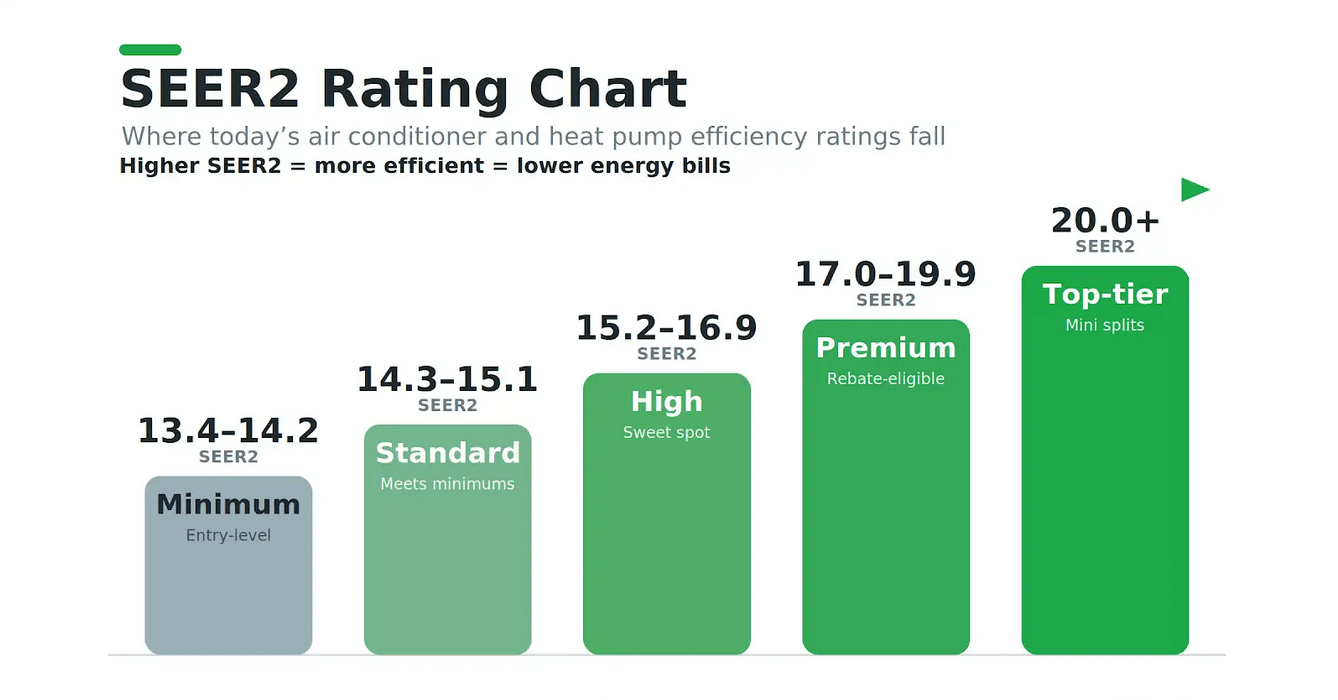
Use this as your at-a-glance reference. SEER2 is the current standard, and the older SEER number is shown alongside it because a SEER2 rating is roughly 4.5–5% lower than the old SEER figure for the same equipment.
Tiers reflect U.S. Department of Energy standards and AHRI’s 2023 efficiency guidance; the SEER-to-SEER2 conversion follows DOE’s 2023 update.
| SEER2 (current) | ≈ Old SEER | What it means |
|---|---|---|
| 13.4–14.2 | 14–15 | Entry-level or minimum efficiency. Lowest upfront cost, but the highest running cost. |
| 14.3–15.1 | 15–16 | Standard efficiency. Meets all regional minimums and is a common 2026 baseline. |
| 15.2–16.9 | 16–18 | High efficiency. The practical sweet spot for most upgrades. |
| 17.0–19.9 | 18–21 | Premium efficiency. Often qualifies for rebates or tax credits. |
| 20.0+ | 21–25+ | Top-tier. Variable-speed systems and many ductless mini splits live here. |
“Good” depends on your climate and how long you run your system, but a simple rule holds up: the more cooling hours you rack up each year, the more a higher rating pays you back.
Hot, long-summer regions like Florida, Texas, or Arizona: aim for 16 SEER2 or higher, since the extra efficiency works hard for you.
Mild or short-summer regions: 14.3–15.2 SEER2 is often the smart-money choice, since the payback on ultra-high ratings stretches out.
Any region, if you want the lowest possible bills or plan to claim incentives: look at 17+ SEER2.
One honest caveat from the field: the number on the box is only as good as the installation behind it. A correctly sized system fitted by a professional HVAC team will out-perform a higher-rated unit that was rushed in.
I’ve walked into homes with a 20 SEER2 system that was underperforming a neighbor’s 16, simply because it was oversized or the ductwork was leaking. Buy a strong rating, but spend just as much attention on getting the sizing and install right. That’s where the real comfort and savings come from.” Said by David Clark of Filterbuy HVAC Solutions.
If you’re comparing an older unit to a new one and the new number seems smaller, nothing is wrong. On January 1, 2023, the U.S. Department of Energy replaced SEER with SEER2. The new test uses tougher, more realistic conditions (higher static pressure that mimics real ductwork), so the same physical unit earns a number about 4.5–5% lower than it would have under the old SEER test.
A quick way to translate: divide an old SEER rating by about 1.05 to estimate its SEER2 equivalent. For reference:
| Old SEER | ≈ SEER2 | Quick read |
|---|---|---|
| 13 | 12.4 | Below today’s minimum |
| 14 | 13.4 | North-region minimum |
| 15 | 14.3 | South and Southwest minimum |
| 16 | 15.2 | High-efficiency threshold |
| 18 | 17.1 | Premium |
| 21 | 20.0 | Top tier; many mini splits |
Efficiency minimums are set by the DOE using three climate regions (North, Southeast, and Southwest), not by individual states. Installing a new system below your region’s minimum isn’t just inefficient. It’s a federal violation that can void warranties and disqualify you from rebates.
| DOE region | Split-system AC (under 45,000 BTU) | Examples |
|---|---|---|
| North | 13.4 SEER2 | Northern, cooler-climate states |
| Southeast | 14.3 SEER2 | Florida, Georgia, the humid Southeast |
| Southwest | 14.3 SEER2 plus EER2 rules | Arizona, Nevada, California, New Mexico |
Split-system heat pumps have their own minimum (around 14.3 SEER2, with a 7.5 HSPF2 heating minimum).
Don’t know your unit’s rating? Its age is a good clue. Federal minimums have climbed over the decades, so the year your system went in tells you roughly where it lands. These are typical ranges, not exact values, so always check your unit’s label or AHRI listing.
| Installed | Typical SEER | Notes |
|---|---|---|
| Before 1992 | 6–8 | No federal minimum existed yet |
| 1992–2005 | 10–12 | First federal minimum of 10 SEER |
| 2006–2014 | 13–14 | Minimum raised to 13 SEER |
| 2015–2022 | 14–16 | Regional standards; South required 14 |
| 2023–today | 13.4–17+ SEER2 | New SEER2 scale begins |
In our HVAC service areas, the systems our crews most often replace are 10–13 SEER units installed in the 2000s. Homeowners moving up to a modern 16–17 SEER2 system frequently tell us their home cools faster and their summer bills drop noticeably, a real-world signal of how much the scale has shifted.
Because efficiency is a ratio, moving up the scale cuts the energy needed for the same cooling. Going from 14 SEER2 to 18 SEER2, for example, trims cooling energy use by roughly 22% (1 minus 14 divided by 18).
As an illustration, take a 3-ton system running 1,500 cooling hours a year at $0.15 per kWh. Your real numbers will depend on your local climate and electricity rate (one big reason summer energy bills climb), but the pattern holds:
| SEER2 | Est. cooling cost per year | vs. 14 SEER2 | 10-year difference |
|---|---|---|---|
| 14 | $386 | baseline | baseline |
| 16 | $338 | $48 less per year | about $480 |
| 18 | $300 | $86 less per year | about $860 |
| 20 | $270 | $116 less per year | about $1,160 |
Ductless mini splits are some of the most efficient systems you can buy. Many exceed 20 SEER2 thanks to variable-speed compressors that ramp up and down instead of cycling fully on and off. That makes them a strong fit for cooling an addition or bonus room, garages, older homes without ductwork, and rooms your central system can’t keep comfortable.
For comparison, Filterbuy’s variable-speed mini split systems are rated at 17 SEER2, squarely in premium-efficiency territory, and cover 12,000 to 24,000 BTU with cooling and year-round heating in one unit. If you’re weighing a high-SEER upgrade for a specific space, a ductless system is often the most efficient dollar you can spend.
Heat pumps use the same SEER2 scale for cooling and add an HSPF2 rating for heating efficiency, so when you shop heat pumps you’ll see both numbers on the label.
Is a higher SEER rating always worth it?
Not always. In hot climates with long cooling seasons, a higher rating usually pays for itself. In milder climates, the payback on the very highest ratings can stretch past the savings, so a mid-tier SEER2 is often the smarter buy.
What is the minimum SEER2 rating in 2026?
For split-system air conditioners, 13.4 SEER2 in the North region and 14.3 SEER2 in the Southeast and Southwest. Packaged units are 13.4 SEER2 nationwide.
How do I find my current system’s SEER rating?
Check the yellow EnergyGuide label or the model number on the outdoor unit, or look it up in the AHRI Directory. If it’s missing, the install year gives you a close estimate.
Does SEER2 apply to mini splits?
Yes. All new air conditioners and heat pumps, including ductless mini splits, are rated on the SEER2 scale. Mini splits frequently rate among the highest, often above 20 SEER2.
Is a 14 SEER unit still legal?
A pre-2023 14 SEER unit is roughly 13.4 SEER2. Whether it can be newly installed depends on your region and equipment type. In the South and Southwest, new split ACs must meet 14.3 SEER2, though existing systems can keep running.
U.S. Department of Energy: residential central air conditioner efficiency standards and the SEER2 metric.
AHRI: 2023 Energy Efficiency Standards: the SEER2/HSPF2 transition and the three DOE climate regions.
AHRI Directory: look up the certified SEER/SEER2 rating of a specific make and model.
