June 25, 2026

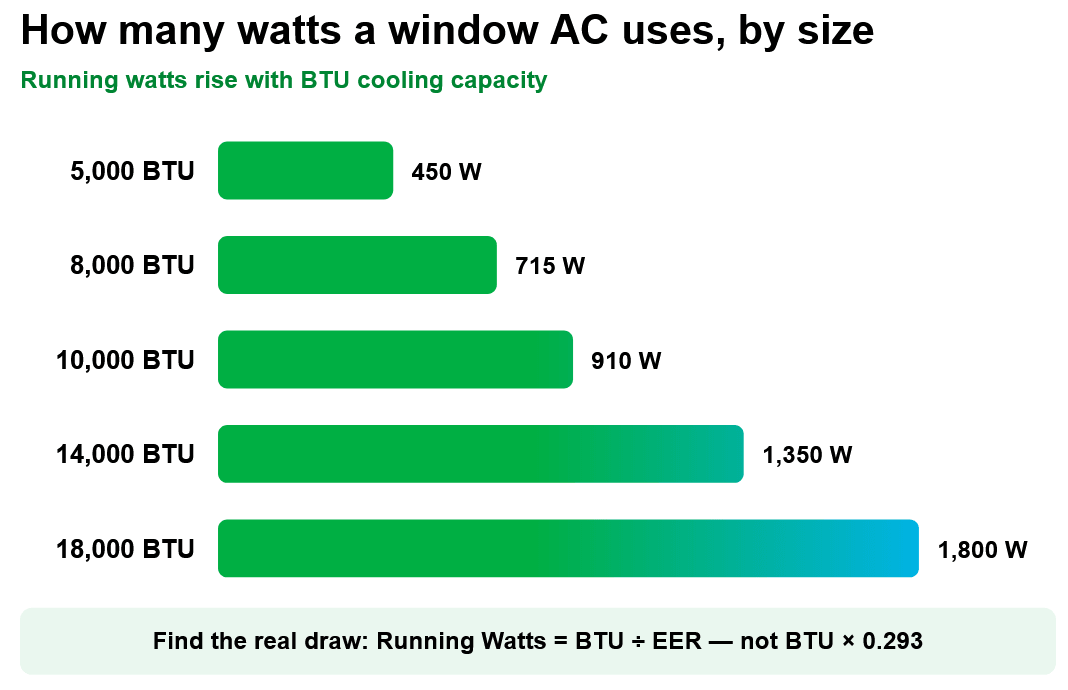
Most window air conditioners use between 450 and 1,800 watts of electricity while they run. The biggest factor by far is the unit's BTU size: a small 5,000 BTU bedroom unit draws about 450 watts, while an 18,000 BTU great-room unit can pull 1,800 watts or more.
To find your unit's real electrical draw, divide its BTU by the EER printed on the label — not BTU × 0.293, which only measures cooling output and badly overestimates the bill.
Typical running watts by size:
5,000 BTU — about 450 watts
8,000 BTU — about 715 watts
10,000 BTU — about 910 watts
14,000 BTU — about 1,350 watts
18,000 BTU — up to 1,800 watts
Window ACs are economical for cooling one room — but if you're cooling more space, or want a quieter, more efficient setup, a ductless mini split may be the better fit.
Not sure which one fits? Answer 5 quick questions and we'll match you to the right mini split system.
Most window air conditioners use between 450 and 1,800 watts of electricity while they run, and the biggest factor by far is the unit's cooling capacity, measured in BTUs. A small 5,000 BTU unit for a bedroom draws roughly 450 watts. A large 18,000 BTU unit cooling a great room can pull 1,800 watts or more.
Maybe you're comparing units before a purchase, sizing a backup generator, or staring at a higher summer bill and wondering why. That range answers the basic question, but "it depends on the size" only gets you halfway. Below, you'll find how many watts a window AC uses by BTU, what it costs to run per hour and per month, and a few honest ways to keep that number down with small maintenance habits that protect your comfort and your wallet.
Quick takeaway: Find your unit's BTU rating on the spec label, then use the chart below to estimate its running watts. If you want the real electrical draw instead of a misleading BTU-to-watt shortcut, the next section shows why those two numbers are different, and why a lot of websites get it wrong.
Here is a realistic look at how many watts a window AC uses across common BTU sizes. These figures assume a typical-to-efficient unit, with an EER in the 10 to 11 range, running under normal conditions.
Why a range instead of one number? Two units with the same BTU rating can pull noticeably different wattage. It comes down to the efficiency rating, the outdoor temperature, your thermostat setting, and how clean the unit is. An ENERGY STAR certified model sits at the low end of each range. An older, dust-clogged unit on a 98F afternoon sits at the high end.
A lot of online guides get this part wrong. The accurate version is simpler than it looks.
You'll often see this formula: BTU x 0.293 = watts. Plug in a 5,000 BTU unit and you get about 1,465 watts. That number is not how much electricity your AC pulls from the outlet. The 0.293 conversion turns BTUs into their thermal energy equivalent, the heat-moving output of the unit expressed in watts. It says nothing about electrical draw, and it will badly overestimate both your bill and your generator needs.
The accurate way to estimate the actual power a window AC consumes is:
Running Watts = BTU ÷ EER
EER (Energy Efficiency Ratio) is printed on the yellow EnergyGuide label or the spec plate. Most window units fall between EER 9 and EER 12, with newer ENERGY STAR models on the higher, more efficient end. The U.S. Department of Energy defines EER as a unit's cooling capacity (in BTU per hour) divided by its power input (in watts), which is exactly why dividing BTUs by EER returns the watts the unit actually draws.
Worked example: A 10,000 BTU unit with an EER of 11 works out to 10,000 ÷ 11, or about 910 running watts. That matches the chart above. The "x 0.293" method would have told you 2,930 watts, more than triple the real draw.
From our reviewer, David Clark, Licensed HVAC Technician: "The BTU-to-watt conversion measures cooling output, not electricity used. If you're sizing a generator or estimating a bill, always divide BTU by the EER on the label. It's the difference between buying a generator that's right-sized and one you overpaid for."
That accuracy matters most if you plan to run a window AC on backup power. Keep startup surge in mind too. The compressor briefly draws roughly 2 to 3 times its running watts the moment it kicks on. A 900-watt unit can spike to 1,800 to 2,700 watts for a second or two, so any generator or power station needs surge headroom above the running figure.
Wattage only means something once you turn it into dollars. The math is simple:
Daily cost = (Watts ÷ 1,000) x hours used x your electricity rate (per kWh)
The 2026 U.S. residential average is about $0.18 per kWh, though it ranges from roughly $0.12 in North Dakota to over $0.40 in Hawaii (source: U.S. Energy Information Administration). Check your own bill for your exact rate.
Example: 8,000 BTU unit (about 715 watts), 8 hours a day
715 W ÷ 1,000 = 0.715 kWh per hour
0.715 x 8 hours = 5.72 kWh per day
5.72 x $0.18 = about $1.03 per day, or about $31 per month
Real-world note: That example assumes the compressor runs the entire time. In practice, a properly sized window AC cycles. The compressor shuts off once the room hits temperature, so most people pay 50 to 70% of that worst-case figure. An 8,000 BTU unit in a right-sized room often costs closer to $18 to $25 a month to run.
Rough monthly cost by size (8 hrs/day, continuous-run estimate at $0.18/kWh):
Worst-case, continuous-run estimate. Cycling and ENERGY STAR efficiency typically bring real bills 30–50% lower.
If you're worried about tripping a breaker, convert watts to amps:
Amps = Watts ÷ Volts
Most window ACs run on a standard 115-volt household circuit. A 900-watt unit pulls about 8 amps (900 ÷ 115). Smaller units in the 5,000 to 8,000 BTU range typically draw 4 to 7 amps and share a standard 15-amp circuit without trouble, as long as you're not also running a microwave or space heater on the same one.
Larger units, generally 15,000 BTU and up, often need a dedicated 115V or 230V circuit. If your lights flicker when the compressor kicks on, or the breaker trips, the unit needs its own circuit. When in doubt, call a licensed electrician.
You can't change physics, but you can shave real money off what your window AC costs to run. Most of these take ten minutes or less.
Right-size the unit. An AC that's too big short-cycles and wastes energy. One that's too small runs nonstop. Match BTUs to your room's square footage using the chart above.
Clean the filter and coils. A window AC's washable filter and the coils behind it get choked with dust, which forces the unit to work harder and pull more watts for the same cooling. Rinse the filter every few weeks during cooling season. For the central system in the rest of your home, follow a regular schedule for how often to change that filter.
Seal the gaps. Use the included foam side panels and weatherstrip around the frame. Cool air leaking out is wattage wasted.
Set it to 75 to 78F. Every degree lower meaningfully increases run time. A smart or programmable model helps it run only when you need it.
Use "Eco" or "Auto" mode. These cycle the compressor instead of running it flat-out, which trims consumption without costing you comfort.
Don't forget the rest of your home's air system. If you also run central AC, a clogged HVAC filter makes that system work harder and burn more energy, the same efficiency principle that governs your window unit. A fresh, properly rated filter keeps airflow strong and your system running efficiently.
Window units are a smart, affordable way to cool a room or two without running a whole-house system. Plenty of homes use them alongside central AC: a window unit for the bonus room, central air for everything else.
Efficiency is efficiency, whichever system you're running. Whether it's the foam filter in your window unit or the filter in your central system, clean airflow is the cheapest way to keep energy use and your bills down. Filterbuy makes filters in the USA in 600+ standard and custom sizes, shipped factory-direct, with optional auto-delivery so a fresh filter shows up right when it's time to swap it. Little effort, big impact.
And before you assume the heat outside means bad air inside, check your local air quality on the live USA AQI map. On poor-air days, the filter in your central system is doing more work than you think.
How many watts does a 5,000 BTU window air conditioner use?
A 5,000 BTU window AC typically uses about 400 to 550 running watts, with most efficient models near 450 watts. Expect a brief startup surge of roughly 2 to 3 times that when the compressor first kicks on.
How many watts does a 10,000 BTU window AC use?
A 10,000 BTU unit usually draws about 800 to 1,050 running watts. Using the BTU ÷ EER method with a typical EER of 11, that works out to roughly 910 watts.
How much electricity does a window AC use per hour?
A window AC uses between 0.45 and 1.8 kilowatt-hours (kWh) per hour of continuous running, depending on its size. At the 2026 U.S. average of about $0.18/kWh, that's roughly 8 to 32 cents per hour, though real costs run lower because the compressor cycles on and off.
How many amps does a window AC use?
Most window ACs draw 4 to 12 amps on a standard 115-volt circuit. Smaller units in the 5,000 to 8,000 BTU range share a 15-amp circuit fine. Larger units of 15,000 BTU and up often need a dedicated circuit.
What size generator do I need to run a window AC?
Size the generator to the unit's running watts plus its startup surge (2 to 3 times the running watts). A small 5,000 BTU unit (about 450 running watts) needs an inverter generator of roughly 1,500 to 1,800 watts to cover the surge. An 8,000 to 12,000 BTU unit is better matched to a 3,000 to 3,600-watt model.
Do window AC units use a lot of electricity?
Compared to central air, which can pull 3,000 to 5,000 watts, window units are far more economical for cooling a single room, typically $18 to $50 a month per unit. Costs add up if you run several at once, so right-sizing and regular cleaning matter.
U.S. Energy Information Administration (EIA), Electric Power Monthly, Table 5.6.A: average residential electricity rates (2026)
U.S. Department of Energy, Energy Saver: Room Air Conditioners: EER definition (cooling capacity in BTU/hr divided by power input in watts) and circuit guidance
ENERGY STAR: Room Air Conditioners: efficiency criteria (EER/CEER) and proper sizing
Manufacturer EnergyGuide labels and spec plates (BTU, EER, voltage, amperage)
Written by Michelle Wan. Brand Manager and air quality writer at Filterbuy, specializing in indoor air quality, air filtration, and HVAC maintenance.
Reviewed by David Clark, Licensed HVAC Technician.. David reviewed this article for technical accuracy, including wattage calculations, circuit and amperage guidance, and generator sizing. (Confirm current license and credential details before publishing.)
