

1 Ton Mini Split: The Complete 2026 Buyer's Guide (Sizing, Cost & What Actually Matters)
1 Ton Mini Split: What It Cools and What It Costs
A 1 ton mini split is a single-zone ductless system rated at 12,000 BTU per hour. It cools one room of about 450 to 650 square feet and runs $2,000 to $5,500 fully installed in 2026. Most are heat pumps, so the same unit warms the room in winter and cools it in summer.
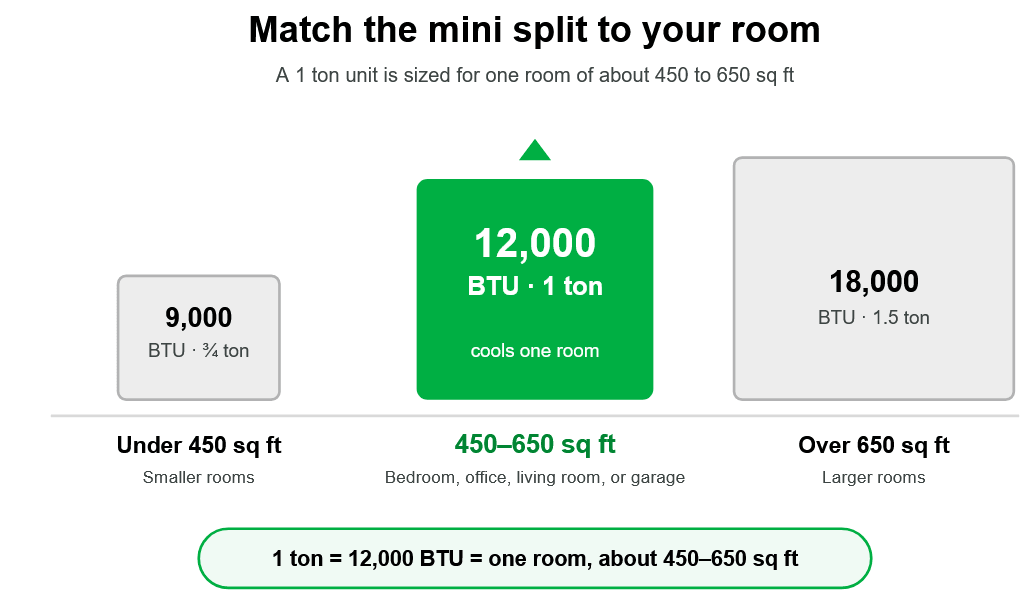
Quick size guide by room:
Under 450 sq ft → 9,000 BTU (¾ ton)
450–650 sq ft → 12,000 BTU (1 ton)
Over 650 sq ft → 18,000 BTU (1.5 ton)
Not sure a 1 ton is right for your room? Answer 5 quick questions and we’ll match you to the right mini split system.
Prefer to browse first? Shop Filterbuy mini split systems.
Reviewed by David Clark, Filterbuy HVAC Solutions · Published June 22, 2026 · Last updated June 22, 2026
A 1 ton mini split is a single-zone ductless system rated at 12,000 BTU per hour, enough to heat and cool one room of roughly 450 to 650 square feet: a bedroom, home office, living room, or finished garage. Most homeowners pay $2,000–$5,500 fully installed in 2026. It's the most popular mini split size because it fits the rooms people actually want to fix.
That's the short answer. Below is everything that goes into picking the right one. You'll get sizing, real pricing, and plain-language explanations of the specs that matter, written the way a good neighbor would explain it instead of a spec sheet.
What Is a 1 Ton Mini Split, Exactly?
A 1 ton mini split is a ductless heating-and-cooling system sized to move 12,000 BTU of heat per hour. In HVAC, "ton" has nothing to do with weight. It's a capacity measurement, and 1 ton = 12,000 BTU/hr. So a "1 ton," a "12K," and a "12,000 BTU" mini split are the same thing.
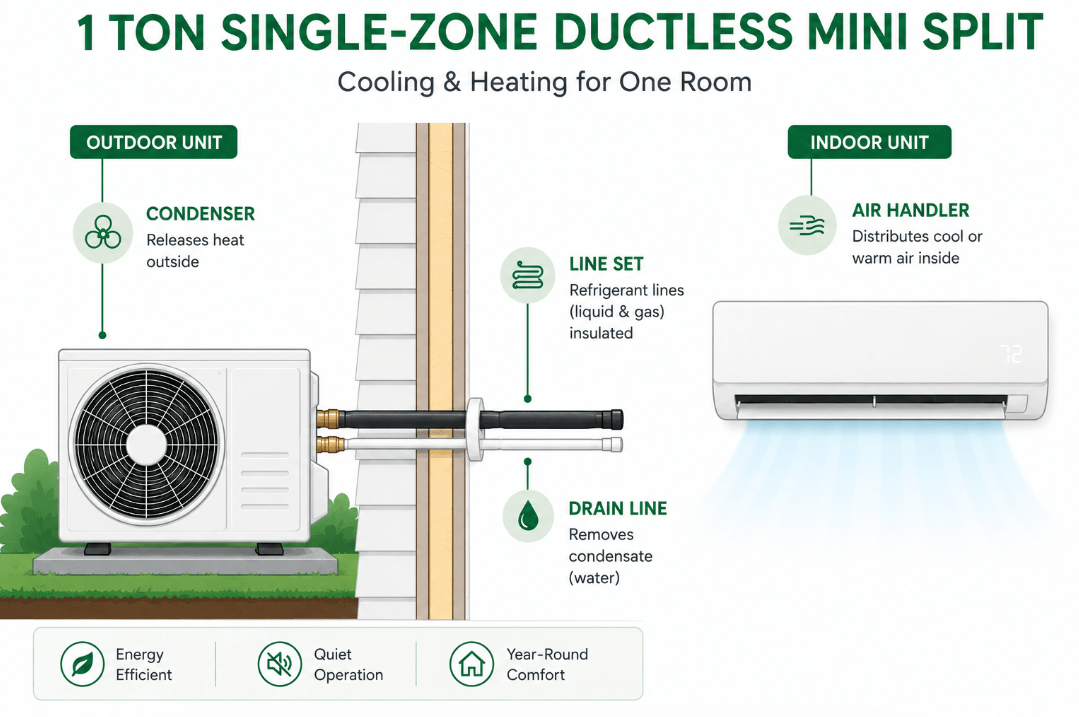
The system has two parts: an outdoor condenser (the unit that sits outside) connected by a refrigerant line set to one indoor air handler (usually wall-mounted) that delivers conditioned air straight into the room. No ducts. That's the whole point: you get precise, room-by-room comfort without the cost and leak-prone hassle of ductwork. As the U.S. Department of Energy notes on ductless systems, skipping the ducts avoids the energy losses that account for more than 30% of a typical home's space-conditioning use.
Most modern 1 ton units are heat pumps, meaning the same box that cools you in July warms you in January by running the refrigerant cycle in reverse. A few are cooling-only, and we'll cover that difference below.
What Size Room Does a 1 Ton Mini Split Cool?
A 1 ton mini split is built for a single room of about 450 to 650 square feet. Think a primary bedroom, a home office, a standard living room, a small apartment, or a converted one-car garage. Below ~450 sq ft you'll usually want a 9,000 BTU (¾-ton) unit. Above ~650 sq ft, step up to 18,000 BTU (1.5-ton).
Square footage is the starting point, not the finish line. Two rooms of identical size can need different capacity. Use this quick framework before you buy.
The 1-Ton Fit Test
Start with 450–650 sq ft as your baseline, then adjust:
| Your room has… | What it does to sizing |
|---|---|
| Lots of west- or south-facing glass | Push toward the top of the range, or size up |
| Vaulted or 9'+ ceilings | Add capacity; you're cooling more air volume |
| Poor insulation or an older home | Size up, because the room loses comfort fast |
| A kitchen or heat-producing equipment | Add capacity for the extra heat load |
| Heavy shade, tight insulation, single story | You can sit at the lower end comfortably |
| A hot-summer climate (TX, FL, AZ) | Don't undersize, or a maxed-out unit runs nonstop |
The rule that saves compressors: when you're between two sizes, size up. An undersized mini split never reaches setpoint, runs continuously, and burns out its compressor years early. A right-sized one cycles efficiently and lasts.
"The most common mistake we see on quote visits is homeowners going by square footage alone. A 500-square-foot room with two big west-facing windows in a Texas summer behaves like a much larger space, so we'll size that one up almost every time. When in doubt, we'd rather put in slightly more capacity than watch a unit run flat-out all season and fail early."
David Clark, Filterbuy HVAC Solutions
How Much Does a 1 Ton Mini Split Cost in 2026?
Expect $2,000 to $5,500 for a fully installed 1 ton mini split in 2026. The equipment alone runs $700 to $2,200, and professional installation adds $1,000 to $3,000+ depending on your home. The spread is real, so it helps to separate the two line items instead of staring at one big number. (For a full size-by-size breakdown, see our mini split installation cost guide.)
| Cost component | Typical 2026 range | What moves it |
|---|---|---|
| Equipment only (1 ton / 12K unit) | $700 – $2,200 | Brand, SEER2 rating, heat-pump vs. cooling-only |
| Professional installation (labor) | $1,000 – $3,000+ | Line-set length, mount height, electrical condition, local rates |
| Electrical (if a new circuit is needed) | $250 – $800 | Whether you have an open breaker or dedicated circuit |
| Permit (where required) | $250 – $400 | Your municipality; installer usually handles it |
| Typical fully installed total | $2,000 – $5,500 | All of the above combined |
Ranges reflect Filterbuy HVAC Solutions' own 2026 install pricing for single-zone systems. Your number lands inside this band based on your specific home.
A few things quietly drive the bill: line-set length (a long run from the outdoor unit to the indoor head costs more in copper and labor), mounting height (a second-story head is harder than a ground-floor one), and electrical condition (if there's no open breaker for a dedicated circuit, you're adding an electrician). Get a line-item, in-home estimate rather than a phone quote. That's the only way the range tightens to a real price.
Are There Tax Credits for a 1 Ton Mini Split in 2026?
No. The federal tax credit for mini splits ended on December 31, 2025. The Section 25C Energy Efficient Home Improvement Credit, which used to cover 30% of a qualifying heat-pump install up to $2,000, was terminated early by the One Big Beautiful Bill Act (Public Law 119-21, signed July 4, 2025). Systems placed in service in 2026 do not qualify for the federal credit, per the IRS Energy Efficient Home Improvement Credit page and the IRS home energy tax credits guidance, which confirm the credit applied only through 2025.
This matters because a lot of pages haven't caught up. If you read a 2026 guide promising a "$2,000 federal mini split tax credit," it's working from old information. (We keep a current rundown in our 2026 mini split tax credit and rebate guide.) Here is the accurate picture:
Federal credit (Section 25C): Gone for 2026 installs. If your system was installed and running on or before December 31, 2025, you can still claim it on your 2025 return using IRS Form 5695. The "placed in service" date is what counts, not when you paid.
State and utility rebates: Still available in many areas, and in some ZIP codes they now add up to more than the old federal credit ever paid. Programs like Mass Save and Energize Connecticut run into the thousands, and even modest utility rebates are a few hundred to a couple thousand dollars.
The catch on rebates: Most require pre-approval before installation, because contractors can't apply retroactively. Check your eligibility before you book the job.
Bottom line: Don't choose a unit based on a federal credit that no longer exists. Do check the DSIRE database and your local utility for current rebates, and confirm with a tax professional. (This isn't tax advice, just the lay of the land as of June 2026.)
1 Ton Mini Split Features That Actually Matter
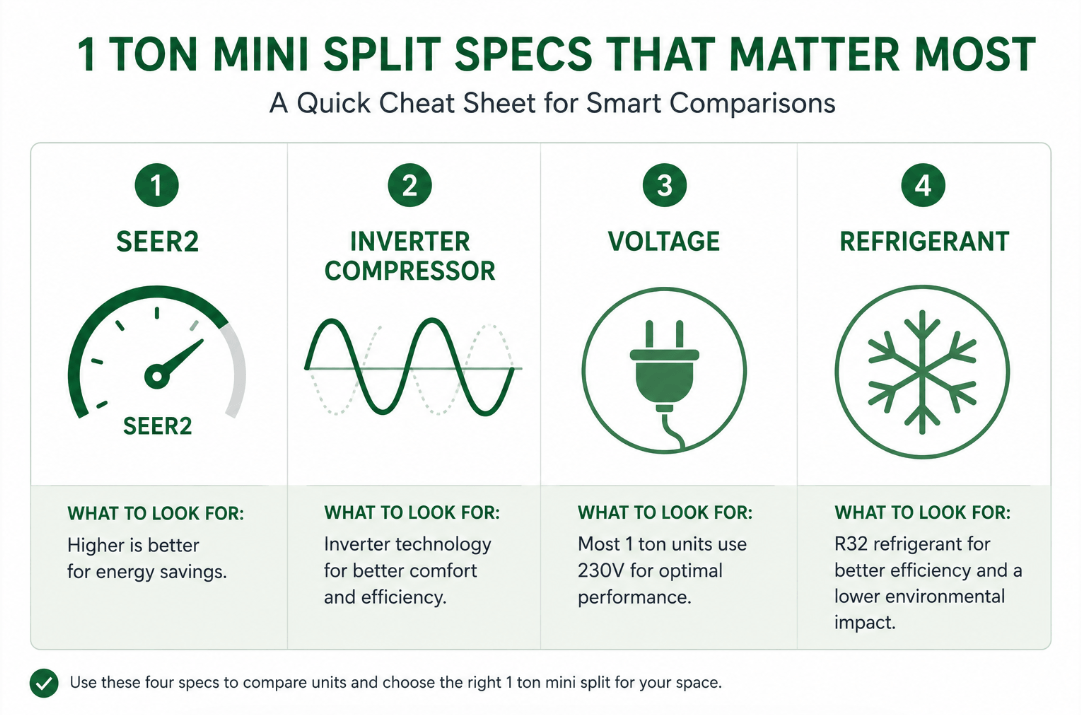
Four specs decide whether you love your unit or just tolerate it. Each one, in plain terms:
SEER2 (cooling efficiency). Think of it like miles-per-gallon for air conditioning: higher is cheaper to run. The U.S. Department of Energy notes that ductless minisplits reach SEER2 ratings from about 15.2 up to 35, well above the federal minimums. Most quality 1 ton units land in the 16–22 SEER2 range, and premium single-zone models push past 26. A jump from ~16 to ~20 SEER2 typically adds a few hundred dollars up front and pays it back on the power bill over time. (Want the math? Our guide to what a mini split costs to run per month breaks it down.)
Inverter compressor. This is the feature that separates good mini splits from cheap ones. An inverter varies its speed to hold a steady temperature instead of blasting on and off, which means quieter operation, tighter comfort, and lower bills. Look for "variable-speed inverter," and skip anything that doesn't have it.
Voltage: 115V vs. 230V. Many 1 ton units come in a 115V (110v) version that can run on a standard household circuit, and a 230V version that needs a dedicated 230-volt line. The 115V option is appealing for a garage or addition where running a new 230V circuit would mean calling an electrician. Just always confirm you have a dedicated circuit with the right amperage. (A "1 ton mini split 110v" search is usually someone trying to avoid an electrical upgrade, which is a valid move, as long as you verify the circuit.)
Refrigerant: R-32 / R-454B. The industry is moving off the older R-410A to lower-GWP refrigerants like R-32 and R-454B. If you're buying new in 2026, choose a unit on one of the newer refrigerants. It's the future-ready, more environmentally responsible pick, and it's what current models ship with.
Should You Install a 1 Ton Mini Split Yourself?
Maybe, if you buy a precharged DIY kit and you're genuinely handy. DIY can save $1,000–$3,000 in labor. But for most homeowners, professional installation is the smarter call, because a standard mini split needs refrigerant-line vacuuming, leak testing, and electrical work, and handling refrigerant legally requires EPA Section 608 certification, which is also what keeps the manufacturer warranty valid. (Weighing it seriously? Start with our DIY mini split installation guide.)
The honest trade-off:
DIY makes sense when it's a precharged, self-install-rated kit, you have a dedicated circuit ready, and you're comfortable mounting units and connecting line sets. Budget an extra $500–$1,000 for tubing, wiring, and tools.
Go pro when it's a standard (non-precharged) system, you need new electrical, the head mounts on a second story, or you want the manufacturer warranty and any utility rebate to stay intact. Many rebates require licensed installation.
The quiet risk with DIY isn't the mounting. It's the refrigerant handling and the warranty fine print. Saving $1,500 isn't a win if it voids a 5-year compressor warranty or disqualifies a $1,000 utility rebate.
Keeping Your 1 Ton Mini Split Running Clean (The Part People Skip)
A mini split is low-maintenance, not no-maintenance, and the maintenance is mostly about clean filters. Each indoor air handler has a washable pre-filter that should be rinsed every 2 to 4 weeks during heavy-use season, plus secondary filter media (where present) that needs replacing every 3 to 6 months. Skip it and you lose efficiency, air quality drops, and (like installation) neglect can affect warranty coverage.
This is where a ductless system and whole-home air quality meet. Dirty mini split filters recirculate the same dust, pollen, and pet dander you're trying to escape. Keeping them clean keeps the air you're paying to condition actually clean. Filterbuy supplies replacement filter media in custom sizes on auto-delivery, so the schedule takes care of itself and you never run a clogged unit. (Have central HVAC too? The same logic, and the same auto-delivery, applies to your furnace filters.)
Why Buy Your 1 Ton Mini Split From Filterbuy
We're not a review site pointing you elsewhere. Filterbuy sells a 1 ton mini split, so the advice on this page comes from the same people who put these units on walls. (It's also our pick for best mini split for a garage.)
The Filterbuy 1-ton (12,000 BTU) heat pump:
Available in 115V and 230V versions; pick the one that fits your circuit
17 SEER2 variable-speed inverter for quiet, efficient, even comfort
R-32 refrigerant (the lower-GWP, future-ready choice) with an Eco Mode
Rated for rooms up to 550 sq ft, with Smart WiFi control and a self-cleaning coil
ETL and AHRI certified, backed by a 7-year compressor and 3-year parts warranty
Filterbuy HVAC Solutions installation (currently Florida & Texas): licensed, insured, direct-employee technicians, not subcontractors, who handle permitting and electrical coordination start to finish, with a free, no-obligation, line-item estimate.
And because we make air filters in the USA, your unit doesn't just get installed. It stays clean, with replacement media on auto-delivery in any size.
Shop the Filterbuy 1-ton mini split on the product page
Set up filter auto-delivery so you never run a clogged unit
Frequently Asked Questions
How many BTU is a 1 ton mini split? A 1 ton mini split is 12,000 BTU per hour. One ton of cooling capacity always equals 12,000 BTU/hr, so "1 ton," "12K," and "12,000 BTU" describe the same unit.
What room size does a 1 ton mini split cool? About 450 to 650 square feet: a bedroom, home office, living room, small apartment, or one-car garage. Adjust up for lots of sun, high ceilings, or poor insulation. You can sit at the low end for a shaded, well-insulated room.
How much does a 1 ton mini split cost installed in 2026? $2,000 to $5,500 fully installed for a single-zone system (see our installation cost guide). The unit alone is $700–$2,200, and professional installation adds $1,000–$3,000+ based on line-set length, electrical, and local labor rates.
Is there a federal tax credit for a 1 ton mini split in 2026? No. The federal Section 25C credit expired December 31, 2025 under the One Big Beautiful Bill Act, so 2026 installs don't qualify. State and utility rebates may still apply (check the DSIRE database), so confirm before you install, since most require pre-approval.
Can I run a 1 ton mini split on 110v? Yes. Many 1 ton units offer a 115V (110v) version that runs on a standard household circuit, which is great for a garage or addition. Just confirm you have a dedicated circuit with adequate amperage.
Can I install a 1 ton mini split myself? Only safely with a precharged DIY kit. Standard systems need professional vacuuming, leak testing, and electrical work, and most manufacturers require licensed installation for the warranty to stay valid.
1 ton mini split AC vs. heat pump: what's the difference? A cooling-only unit only air-conditions. A heat pump both heats and cools by reversing its refrigerant cycle. For most homes a heat pump is the better value: year-round comfort from one box.
How often do I clean a 1 ton mini split filter? Rinse the washable pre-filter every 2–4 weeks in heavy-use season, and replace secondary media every 3–6 months. Clean filters protect efficiency, air quality, and warranty coverage.
Written by Michelle Wan · Content author at Filterbuy.
Reviewed by David Clark · Filterbuy HVAC Solutions.
Sources):
IRS: Home energy tax credits (confirms the 2022–2025 window and the One Big Beautiful Bill Act change)
U.S. Department of Energy: Ductless Minisplit Heat Pumps (SEER2 ranges, duct-loss figure, system overview)
ENERGY STAR: Ductless Heating & Cooling (efficiency and energy-savings benchmarks)
DSIRE: Database of State Incentives for Renewables & Efficiency (current state and utility rebates)