How Much Does a Mini Split Cost to Run Per Month? (2026 Guide)
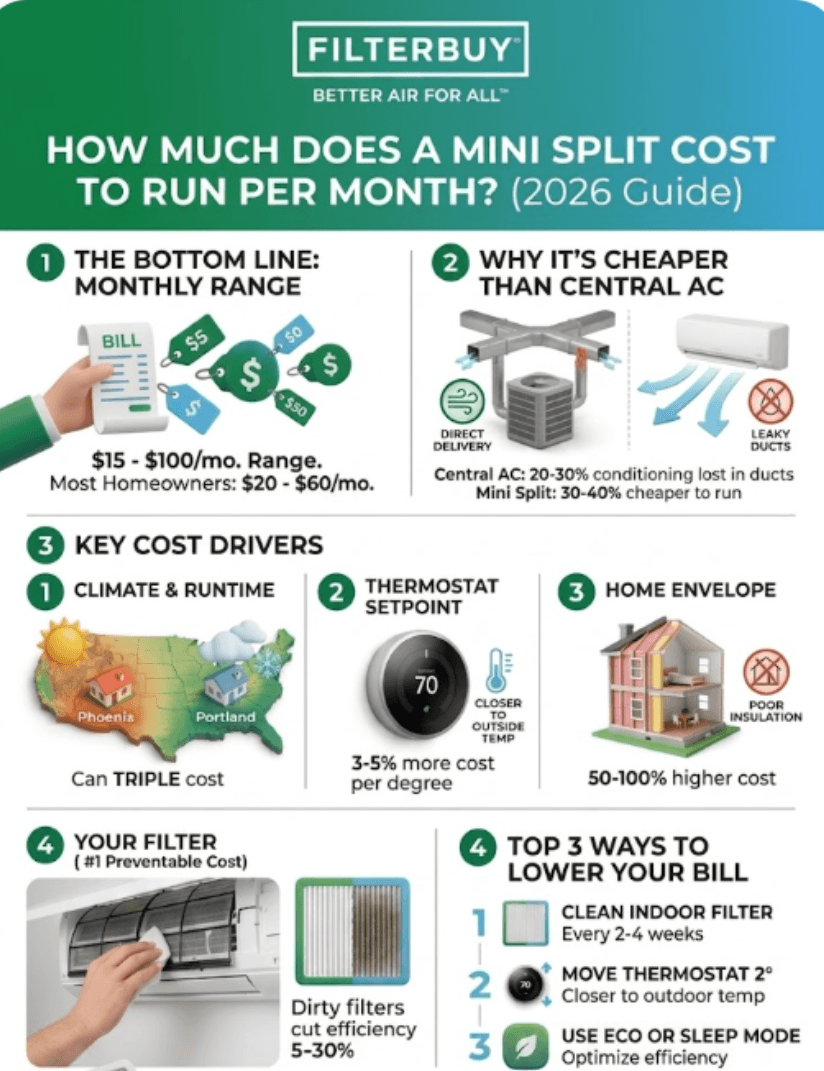
Most ductless mini splits cost $15 to $100 a month to run, and most homeowners land between $20 and $60 at the U.S. average electricity rate. Your spot in that range is set mostly by two choices you make up front: the unit's size and its SEER2 efficiency.
A right-sized, higher-efficiency system holds the low end of that range for the 15 to 20 years you'll own it, which is why the system you choose matters more than any single setting on it. See which Filterbuy mini split fits your space below.

Answer a few quick questions and we'll match you to the right Filterbuy mini split system.
A ductless mini split adds somewhere between $15 and $100 to most homeowners' monthly electric bills. Where your system lands in that range comes down to four things: how big the unit is, how efficient it is, how long you run it each day, and how clean you keep the filter. Three of those you decided on the day you bought the system. The fourth is on you every month, and it's the one most homeowners underestimate.
We've built filters in the U.S. for over a decade and have shipped millions to families like yours. Filterbuy services ductless systems in Florida and Texas homes every day. So when a homeowner asks what a mini split actually costs to run, we've got the real numbers, not a guess.
TL;DR Quick Answers
Mini Split Running Cost Per Month
How much does a mini split cost to run per month?
$15 to $100, with most homeowners paying $20 to $60 at national-average rates.
What's the formula?
Wattage = BTU ÷ SEER2. Monthly cost = (Wattage ÷ 1,000) × hours per day × 30 × your rate per kWh.
Are mini-splits cheaper than central air?
Typically, 30 to 40% cheaper, because they skip the 20 to 30% duct losses of forced-air systems.
Does SEER2 really matter?
Yes. A 22 SEER2 unit runs about 20 to 25% cheaper than a 16 SEER2 unit at the same BTU and runtime.
What's the fastest way to lower my bill?
Clean the filter. It's the most-skipped maintenance task and the highest preventable cost on any mini split.
Top Takeaways
A single-zone ductless mini split typically costs $15 to $100 a month to run. Most homeowners fall between $20 and $60 at national-average rates.
The formula: Wattage = BTU ÷ SEER2. Monthly cost = (Wattage ÷ 1,000) × hours a day × 30 × your rate.
The U.S. national average residential electricity rate was 18.05¢/kWh as of April 2026, up 5.4% year over year.
Clean filters cut operating cost by 5 to 30% compared to neglected ones. That's the highest-payoff lever you control.
Each degree closer to outdoor temperature adds 3 to 5% to your monthly bill.
Mini splits run 30 to 40% cheaper than central AC in most homes because they skip duct losses.
Higher SEER2 units (22+) typically pay back their upfront premium in 4 to 6 years in long-season climates.
Heating mode costs 20 to 40% more per hour than cooling, and still beats electric resistance heat two to three times over.
How Much Does a Mini Split Cost to Run Per Month in 2026?
The U.S. national average residential electricity rate is 18.05¢/kWh as of April 2026, up about 5.4% from last year. Those numbers come from the U.S. Energy Information Administration, and we use them as the benchmark throughout this guide. Your own rate is almost certainly different. Louisiana homeowners pay closer to 12¢, and Hawaii pays nearly 40¢. To find yours, grab your latest electric bill and look for the line labeled "price per kWh" or "supply rate."
Here's what a typical single-zone ductless mini split costs to run each month, assuming 8 hours a day of cooling at the national average rate.
| BTU Size | Typical Room | 16 SEER2 | 20 SEER2 | 24 SEER2 |
|---|---|---|---|---|
| 9,000 BTU | Bedroom, office (≤350 sq ft) | $24/mo | $20/mo | $16/mo |
| 12,000 BTU | Master bedroom (≤550 sq ft) | $33/mo | $26/mo | $22/mo |
| 18,000 BTU | Open living area (≤1,000 sq ft) | $49/mo | $39/mo | $33/mo |
| 24,000 BTU | Large open plan (≤1,500 sq ft) | $65/mo | $52/mo | $43/mo |
| 36,000 BTU | Small whole home or shop | $98/mo | $78/mo | $65/mo |
Those figures are for cooling. Heating mode generally runs 20 to 40% higher per hour because of defrost cycles and the extra wattage cold weather demands. Even so, a modern heat pump mini split beats electric baseboard heat two to three times over, which is why the switch pays back so fast in homes with resistance heat.
How to Calculate Your Own Mini Split Electricity Usage
The math is simple enough to do on a napkin. Technicians use this exact formula.
Wattage = BTU ÷ SEER2
Daily kWh = (Wattage ÷ 1,000) × hours per day
Monthly cost = Daily kWh × 30 × your electricity rate
Worked example: a 12,000 BTU, 20 SEER2 mini split running 8 hours a day at the national average rate.
12,000 ÷ 20 = 600 watts average draw.
600 ÷ 1,000 = 0.6 kWh per hour.
0.6 × 8 hours = 4.8 kWh per day.
4.8 × 30 days × $0.1805 = $26.00 per month.
Can't find your rate on the bill? Divide the total charge by the total kWh you used that month. That's your real effective rate, and it's the most honest number to plug in. It includes both supply and delivery.
Mini Split Electric Bill vs. Other Cooling Systems
Most homeowners comparing systems want to know one thing. Is a mini split actually cheaper than what I have now? In most cases, yes, and by a clear margin.
| System Type | Avg. Efficiency | Est. Monthly Cost | Notes |
|---|---|---|---|
| 12,000 BTU Mini Split | 20 SEER2 | ~$26 | Zoned, no duct loss |
| Window AC (12,000 BTU) | 10 to 12 CEER | ~$43 to $52 | Cheaper upfront, less efficient |
| Portable AC (12,000 BTU) | ~9 CEER | ~$58 | Least efficient cooling type |
| Central AC (room-equivalent) | 14 to 16 SEER | ~$38 to $48 | Duct losses add 20 to 30% |
| Electric baseboard (heat) | Resistive | 2 to 3× mini split heat-pump cost | Worst-case electric heat |
Figures based on a 550 sq ft room, 8 hours a day, at the national average rate.
For a fuller side-by-side with heat pumps, gas furnaces, and oil boilers, our heat pump heating cost guide runs the numbers across every major heating system.
The ductless design does most of the work in that comparison. Ductwork can account for more than 30% of a home's space-conditioning energy use, especially when ducts run through unconditioned attics or crawlspaces. Mini splits skip that loss entirely.
For the bigger technical picture on how every AC system works, the Wikipedia primer on air conditioning technology is a solid overview of the refrigeration cycle behind central, window, portable, and ductless systems.
What Actually Moves Your Ductless AC Energy Cost
Six things determine what your mini split costs to run each month. Two are locked in the day you buy it. Four are in your hands every day.
BTU sizing
An oversized mini split cycles on and off constantly, wastes energy, and can't pull humidity the way it should. An undersized one runs flat-out and still can't keep up. Before you buy, ask your installer to run a Manual J load calculation. That's the technical term for a right-sized math check. It costs $100 to $300, takes an afternoon, and keeps you from spending thousands on the wrong unit.
If you want the fuller walkthrough on how BTU, SEER, voltage, and refrigerant all fit together before you shop, our complete mini split buying guide covers every decision point.
SEER2 efficiency rating
Every point of SEER2 above 16 cuts about 5 to 8% off your operating cost at the same BTU and runtime. A 22 SEER2 unit typically runs 20 to 25% cheaper than a 16 SEER2 unit across a full cooling season. Whether the higher upfront price pays back depends on how many months a year your system actually runs.
Climate and runtime
Same unit, same rate. Cooling hours in Phoenix versus cooling hours in Portland can triple the monthly bill. The longer your season, the more a higher-SEER2 unit earns its price tag.
Thermostat setpoint
78°F at home and 85°F when you're out is the sweet spot for cooling. 68°F at home and 62°F when you're sleeping or away works for heating. Each degree closer to outdoor temperature adds another 3 to 5% to your monthly bill. That's free money most homeowners leave on the table.
Filter cleanliness
Here's the lever most homeowners don't know they're pulling. It's also the one with the biggest day-to-day effect on your bill. Service data shows that dirty, restricted filters cut mini split efficiency by 5 to 30%, depending on how bad the buildup is. A clogged filter starves the indoor coil of airflow, so the compressor runs longer to deliver less cooling. Clean the filter once a month. That's the whole fix. The full walkthrough is in our guide on how to maintain your mini split.
What your filter actually does inside the system, and how home air filters work. And if yours clogs faster than you expect, there are usually specific reasons behind it.
Home envelope
Poor insulation and leaky windows can push your operating cost 50 to 100% higher than it needs to be. Air sealing is cheap to do, and it helps every system in the house, not just the mini split.
7 Ways to Lower Your Mini Split Running Cost
Ranked by payoff. Start at the top and work down.
Clean the indoor filter every 2 to 4 weeks during heavy-use months. Savings: 5 to 30%.
Rinse the outdoor condenser coil and clear debris twice a year. Savings: 3 to 7%.
Move the thermostat 2° closer to the outdoor temp. Savings: 6 to 10%.
Use Eco or Sleep Mode overnight. Savings: 5 to 15% in the hours it runs.
Close interior doors so each indoor head serves its zone efficiently. Savings: 10 to 20%.
Check refrigerant line insulation for gaps and kinks. Savings: 5 to 10% if damaged.
Book one professional tune-up a year. Savings: up to 15% on a neglected system.
If you also run a central heat pump elsewhere in the home, our heat pump filter guide covers the filter strategy for that side of the system.
Most of what ends up on a surprise mini split bill traces back to one part of the system most homeowners never touch: the filter. The folks who clean theirs every month pay what the installer originally quoted. The ones who skip it end up paying 15 to 25% more for worse air, in the same home with the same hardware. Five minutes of maintenance is what separates them.
— Filterbuy Team
Essential Resources
These are the references we rely on when customers ask about mini-split operating costs. Every link was checked before we published.
1. U.S. Energy Information Administration — Electric Power Monthly
The EIA's monthly electricity data release. Current national average residential rate plus the state-by-state breakdown. Every rate figure in this guide traces back here.
https://www.eia.gov/electricity/monthly/
2. U.S. Department of Energy — Ductless Mini-Split Heat Pumps
The DOE's main consumer page on ductless systems. Covers efficiency advantages, installation considerations, and the duct-loss numbers that ductless systems sidestep. Start here if mini splits are new to you.
https://www.energy.gov/energysaver/ductless-minisplit-heat-pumps
3. U.S. Department of Energy — Heat Pump Systems
A walk-through of every heat pump type, with data on how many U.S. homes have no ductwork and guidance on picking a system for your climate zone. Useful if you're weighing ductless against air-source or ground-source.
https://www.energy.gov/energysaver/heat-pump-systems
4. ENERGY STAR — Federal Tax Credits for Energy Efficiency
ENERGY STAR's official page on the federal tax credit program for qualifying heat pump mini splits under the Inflation Reduction Act. Eligibility rules shift each year, so check the current status before you buy.
https://www.energystar.gov/about/federal-tax-credits
5. ENERGY STAR — Air Source Heat Pumps Certified Products
The certified product list for air source heat pumps, ductless mini splits included. Use it to confirm that any system you're considering clears the efficiency threshold for federal tax credit eligibility.
https://www.energystar.gov/about/federal-tax-credits/air-source-heat-pumps
6. Filterbuy — How to Maintain Your Mini Split
Our own maintenance walkthrough. Filter cleaning, coil care, what a professional tune-up actually gets you, and when to call one in. If your goal is a lower monthly bill, this is the highest-payoff page on our resources hub.
Supporting Statistics
Three numbers worth knowing when you're thinking about what your mini split costs to run.
18.05¢/kWh
The U.S. national average residential electricity rate as of April 2026 is up about 5.4% from last year. Use your own utility's rate for a tighter estimate, but this is the number behind all the national averages in this guide.
Source: U.S. Energy Information Administration — Electric Power Monthly
30%+
The share of space-conditioning energy that leaky ducts waste in a typical central-air home, especially when the ducts run through unconditioned attics or crawlspaces. Ductless mini splits skip that loss, and that's where most of their cost advantage over central AC comes from.
Source: U.S. Department of Energy — Ductless Mini-Split Heat Pumps
12 to 25%
The share of U.S. homes with no ductwork at all, which is the core market for ductless mini-splits. For those homeowners, a mini split is almost always more cost-effective than retrofitting ducts for central air, and the monthly operating cost reflects it.
Source: U.S. Department of Energy — Heat Pump Systems
Final Thoughts and Opinion
Here's our honest read on mini split operating cost, after years of servicing these systems in real homes.
The math is more predictable than most homeowners expect. Pick the right BTU size and a reasonable SEER2 rating at the time of purchase, and you've locked in roughly half of what your system will cost to run. That half is the easy half.
The other half is the part every homeowner actually controls. How you set the thermostat, how long the unit runs, and whether the filter is clean. We've watched two neighbors with the same model and the same utility rate pay 25% apart on operating cost for years running. The hardware wasn't different. One homeowner cleaned the filter every month. The other didn't.
Our opinion: a well-sized, well-maintained mini split is one of the best comfort investments a homeowner can make in 2026. Not because any given month's bill surprises you, though it usually is lower than people expect. Because the monthly cost stays where it's supposed to stay, for 15 to 20 years, as long as the filter is clean. That last part is on you. Making it easier is on us.
Next Steps
Here's how to put this guide to work.
Find your actual electricity rate. Check your latest utility bill for the "price per kWh" or "supply rate" line. Or divide your total monthly charge by your total kWh. That's your real rate.
Run the numbers on your unit. Plug your BTU size, SEER2 rating, and honest daily runtime into the formula above. Compare against the table to sanity-check the bill you already pay.
Clean your filter this weekend. If it's been longer than a month, this is where most homeowners recover the biggest chunk of wasted energy. Our maintenance guide walks you through the five-minute process, and our replacement interval guide covers cadence for every other filter in the house.
Set a recurring reminder. Every two to four weeks during heavy-use months. Every month otherwise. Put it on your phone. The system will thank you on the next bill.
Set up filter auto-delivery. For indoor air handlers that use replaceable filter media, we ship custom sizes nationwide on a schedule you set, so you never miss a change. If you've never swapped one before, our step-by-step filter replacement guide walks through the whole process.
Frequently Asked Questions
Keep Your Mini Split Running at the Efficiency You Paid For
Clean filters cut operating cost by 5 to 30%. That's the highest-payoff maintenance habit on any ductless system, and it takes five minutes.
We ship custom-size replacement filters in MERV 8, 11, and 13 fast and free, factory-direct, with auto-delivery available nationwide. Your system keeps performing the way it did on day one, and you don't have to track when the next change is due.
Have a question we didn't cover? Drop it in the comments below, or message our team directly. Real people answer every message. And for more on sizing, installation, and operating cost, our full mini split resources library has you covered.