Installation, Costs & Filter Guide (GA Climate)
Author: Michelle Wan · Reviewed by: David Clark, Licensed HVAC Technician
Published: August 11, 2026 · Updated: August 11, 2026
A ductless mini split costs $2,000 to $14,500 fully installed in metro Atlanta. A single zone for one room runs $2,000 to $4,500, and a three or four zone whole-home setup reaches the top of that range. Add $250 to $400 for the mechanical permit, plus $250 or more if the job needs a dedicated 240V circuit.
Zone count is the number that moves your price most, so it is worth settling before you call anyone. You can browse mini split systems by capacity, or take the quick match below.

Not sure how many zones you need? Answer a few quick questions and we will match you to a system.
A ductless mini split in Atlanta, GA costs roughly $2,000 to $14,500 installed in 2026, depending on zone count, capacity, and how hard the job is at your house. The federal 25C tax credit that covered 30% of the bill expired December 31, 2025, so the real money now is Georgia Power's HEIP rebate and your EMC's program. And the part nobody mentions: the washable mesh screen in a mini split is a comfort filter, not a health filter. Atlanta pollen still needs MERV 11 or MERV 13 filtration somewhere in the house.
Installed cost in Atlanta runs $2,000 to $14,500 in 2026. A single-zone system lands between $2,000 and $4,500; Atlanta HVAC labor bills $50 to $125 per hour.
The federal 25C tax credit is gone. It was terminated for equipment placed in service after December 31, 2025. Any quote showing "30% back, up to $2,000" is built on an outdated page.
Georgia's HEAR fuel-switching rebate closed to new projects on August 10, 2026.
Georgia Power's HEIP pays up to $1,000 on a ductless mini split heat pump and up to $1,500 on an air-source heat pump conversion, with many Georgia EMCs stacking rebates on top.
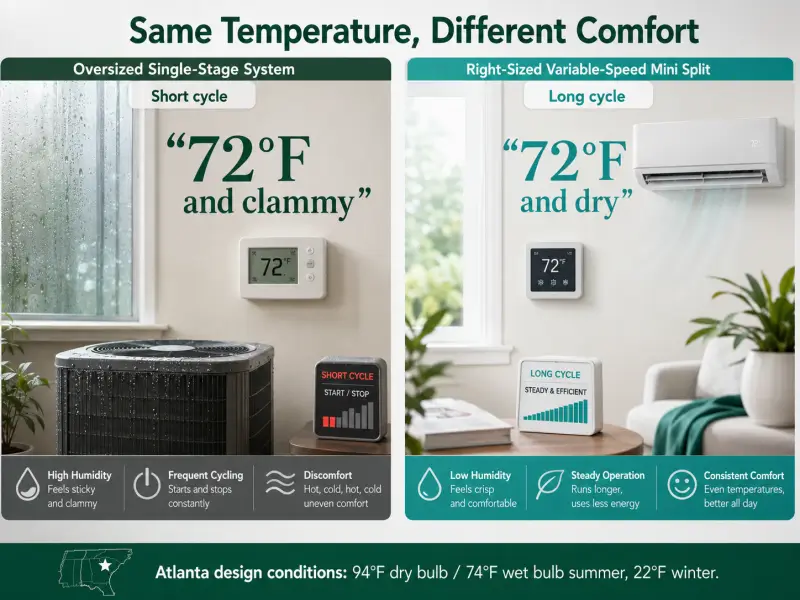
Atlanta sits in IECC Climate Zone 3A: 94°F summer, 22°F winter design temperatures. That makes an oversized mini split a humidity problem, not a comfort upgrade.
Wash the mini split's mesh filter every two to four weeks, roughly six times as often as a central system's disposable filter.
We build filters and we install ductless systems, just not in Atlanta. Filterbuy has manufactured air filters in Talladega, Alabama since 2013, now in 600+ standard and custom sizes, and our HVAC Solutions crews install ductless systems every week across South Florida and Greater Orlando. Metro Atlanta is not our service territory, so nothing here is a pitch for our own truck.
That leaves us with an unusual vantage point, and it is the reason this guide exists. We see the manufacturing side, meaning which filters actually get ordered for Georgia homes and in what sizes. We also see the field side, in a climate whose summer wet bulb runs several degrees above Atlanta’s. Humidity mistakes show up faster down here. The sizing and filtration advice below is what we have learned correcting them.
A ductless mini split costs $2,000 to $14,500 fully installed in Atlanta in 2026. A single-zone system for one room typically runs $2,000 to $4,500; whole-home multi-zone setups reach the top of the range. Atlanta technicians charge $50 to $125 per hour, and a single-zone install takes four to eight hours. Our national mini split installation cost breakdown covers how line-set length and mount height move labor.
Sources: Angi Atlanta cost data, HomeGuide, and Filterbuy mini split installation cost data. 2026 installed ranges; electrical panel upgrades quoted separately.
Two Atlanta-specific things move that number. 2026 equipment costs more than 2025 equipment. New systems use low-GWP A2L refrigerants (R-32 or R-454B), adding 10% to 15% versus the R-410A units they replaced. Older intown housing often needs panel work first, which is an electrician line item, not an HVAC one. Figures cross-checked against Angi's Atlanta cost data and HomeGuide.
One pattern shows up repeatedly in Filterbuy HVAC Solutions install work: homeowners who plan for two zones upfront, even if they only commission one at first, save roughly $1,200 to $2,000 versus adding a second zone later. The line-set path is already open, the electrical is already pulled, and the crew is already on site. Coming back in year three means paying for all of it twice.
Get three quotes. The cheapest bid is frequently the one that skipped the load calculation.
The federal Section 25C tax credit expired December 31, 2025. The One Big Beautiful Bill Act (P.L. 119-21), signed July 4, 2025, terminated it for equipment placed in service after that date, as the IRS confirms on its home energy tax credits page. A heat pump installed in Atlanta in 2026 does not qualify, regardless of purchase date. The IRS uses the "placed in service" date. Section 25D, covering geothermal and solar, ended the same day.
Much of Atlanta's HVAC marketing hasn't caught up. If a proposal nets a $2,000 federal credit against your price, ask for a re-quote.
Section 25C was terminated for equipment placed in service after December 31, 2025 (IRS). HEIP amounts are from Georgia Power's 2026 preconditions document. Georgia stopped accepting fuel-switching HEAR projects on August 10, 2026 (GEFA). Verify before signing a contract.
Worth knowing: Georgia Power's Home Energy Improvement Program lists a ductless mini split heat pump as its own rebate line, applied instantly at the invoice by an affiliated installer. The exact caps sit in the 2026 HEIP preconditions document.
The August 2026 change worth knowing: the U.S. Department of Energy issued updated Home Energy Rebates guidance on May 29, 2026 (Program Notice 26-2). To comply, Georgia stopped accepting fuel-switching HEAR projects on August 10, 2026. Swapping a gas furnace for an electric heat pump is a fuel switch. Confirm status on the state’s HEAR program update page and find a GEFA-approved contractor before signing. More in our guide to mini split rebates in Georgia.
Atlanta sits in IECC Climate Zone 3A, warm-humid, with a 1% summer design temperature of 94°F and a 99% winter design temperature of 22°F. Sizing to those two anchors, not to a July record high, is the whole job. Atlanta's cooling design also carries roughly a 74°F wet bulb, meaning a large share of the load is moisture, not heat.
That's why oversizing hurts here. An oversized system hits setpoint fast, shuts off, and leaves the humidity behind: 72°F and clammy. A right-sized variable-speed inverter runs longer at lower speeds and pulls water out of the air the whole time.
The mistake we correct most often is not an undersized system. It is the opposite. Across Filterbuy HVAC Solutions jobs in South Florida and Orlando, the callback that keeps recurring is a homeowner who bought more tonnage than the room needed, on the theory that bigger cools faster. It does. Then it stops, and the moisture stays. Atlanta is milder than our territory but sits in the same warm-humid family, and the failure mode travels.
Ask for a written ACCA Manual J load calculation before any contractor names a tonnage. If the answer is a square-footage rule of thumb, call someone else. The 22°F winter number matters too. Atlanta is heat pump territory, and a modern inverter handles a Georgia winter without strip heat in most homes. Our complete mini split buying guide covers capacity by room type.
Filterbuy sells mini splits. We would still rather you not buy one for the wrong room. Five situations where a ductless system is the more expensive answer to a problem something else solves better:
You have sound ductwork and want whole-home cooling. Central is usually cheaper per ton. Seal the ducts first and see where you land.
You want the equipment invisible. Wall heads are visible, full stop. Ceiling cassettes hide better and cost $1,000 or more per zone extra.
The room has no gravity drain path. Finished basements usually need a condensate pump, which is one more part that can fail and flood a floor.
Your electrical panel is full. Each outdoor unit wants its own 240V circuit. A panel upgrade can turn a $3,500 job into a $6,000 one.
You are in a historic district or an HOA with exterior equipment rules. The outdoor unit and the line-set cover are both visible from the yard. Get that approval before you get quotes, not after.
The washable mesh screen inside a mini split is a coil guard, not an allergen filter. It keeps hair, lint, and heavy dust off the evaporator so the system holds its capacity. It is not built to catch the fine tree pollen that coats every car in Atlanta each March.
Atlanta's pollen is not a small problem. The metro's record daily count hit 14,801 grains per cubic meter in March 2025, per Atlanta Allergy & Asthma's daily pollen count, the only National Allergy Bureau-certified station in the area. In March 2026, counts topped 6,500 on back-to-back days. AAFA's 2026 Allergy Capitals report ranked metro Atlanta 34th of 100. Not the worst in the country, but still worse than average.
The mesh screen inside a ductless head is a coil guard, not an allergen filter. It carries no MERV rating.
Here is the part a decade of building filters at Filterbuy has taught us: treat the mesh screen as the floor for your air quality, not the ceiling. It is doing the job it was designed for. That job is protecting a coil, not protecting a set of lungs.
“The mesh screen is the floor for your air quality, not the ceiling. It exists to keep the coil clean. If it were actually catching what you breathe, it would clog in a week. In a Georgia March, it would clog in a weekend.”
David Clark, Licensed HVAC Technician
If your home is mini-split-only, that mesh screen is doing all the work, which is when a room HEPA cleaner earns its keep. See mini split vs. air purifier. If you also run a central system, that filter is doing the heavy lifting for the rest of the house: Filterbuy MERV 13 air filters capture 98% of airborne particles including fine pollen and smoke, while Filterbuy MERV 11 air filters suit older systems with tighter airflow limits. Both are built in Talladega, Alabama in 600+ standard and custom sizes.
In Georgia, anyone who bids on or performs HVAC work for pay must hold a Conditioned Air Contractor license from the State Board of Conditioned Air Contractors. Verifying it takes about ninety seconds.
1. Look up the license on the Georgia Secretary of State license lookup, selecting Conditioned Air Contractors. Class I covers residential equipment up to 175,000 BTU heating and 60,000 BTU cooling; Class II is unrestricted. Either works for a home mini split.
2. Confirm EPA Section 608 certification on the technician doing the work. Federal law requires it for handling refrigerant.
3. Require a pulled mechanical permit. Georgia requires one for HVAC replacements, issued by your city or county. Only a licensed contractor can pull it.
4. Ask for the Manual J in writing, plus line-set length and whether a dedicated circuit is in the price.
5. Get three quotes and compare scope, not totals.
An Atlanta mailing address does not mean City of Atlanta jurisdiction, and that trips people up. Find your office before the work starts:
Inside city limits: the City of Atlanta Office of Buildings. A permit is required to install, repair, or replace HVAC equipment, submitted through the Accela Citizen portal.
Sandy Springs, Brookhaven, Dunwoody, Decatur, Marietta: each city runs its own planning and development office.
Unincorporated Fulton or DeKalb: the county handles it, not the city.
Two details worth knowing. Homeowners can submit their own permit application in the City of Atlanta. You do not have to wait on the contractor, and pulling it yourself is a fast way to confirm the job is actually being permitted (City of Atlanta trade permits). And permit submissions from January 1, 2026 onward fall under the 2024 International Mechanical Code with Georgia amendments, so a contractor quoting from an older code edition is quoting from a superseded book.
If Filterbuy could compress a decade of watching ductless installs into one line, it would be this: the install matters more than the brand. Premium equipment fails routinely when it is mounted badly, charged wrong, or sized off a rule of thumb. Vet the technician before you fall in love with a nameplate.
More on vetting is in our guide to finding a mini split installer near you.
Most mini split repairs in metro Atlanta land between $150 and $800. The expensive failures are rare and late; the common ones are cheap and preventable. What follows is the order Filterbuy HVAC Solutions technicians actually see things break in a warm, humid climate.
Mini split repair labor runs roughly $75 to $150 per hour. Rule of thumb: if the system is under ten years old and the repair costs less than half the price of a new one, repair. Ranges compiled from Carrier, Bryant, and 2026 HVAC repair cost guides.
Two patterns are worth stating plainly, because they change what you should ask a technician.
The condensate drain is the number one call, and it is the one you can prevent. A mini split pulls water out of Atlanta air all summer, and that water has to leave the building. Algae and dust close the line, the pan backs up, and it drips down a wall. Ask for a drain flush at every annual visit, not just a filter check.
Refrigerant leaks usually trace back to installation, not equipment. The most common leak point is a flare joint made by hand in your house on install day. That is the same reason Filterbuy keeps saying the installer matters more than the nameplate. A leak at year two is rarely the manufacturer’s fault.
Atlanta runs its mini splits harder and dirtier than most of the country: a long cooling season, a heavy tree pollen season, and summer humidity that keeps coils damp. In Filterbuy service work, the difference between a system that reaches fifteen years and one that fails around year eight is almost never the equipment. It is whether anyone touched the filters between tune-ups.
Metro Atlanta tree pollen peaks February through May. Atlanta Allergy & Asthma publishes a daily NAB-certified count.
Technique is covered in how to clean mini split filters and how often to service a mini split. For the central filter you cannot wash, auto-delivery puts a fresh one on the doorstep on schedule.

Three federal findings underpin the recommendations above.
1. Indoor air is the exposure that counts.
Americans spend about 90% of their time indoors.
Indoor levels of some pollutants run 2 to 5 times higher than typical outdoor levels.
Source: U.S. EPA, Report on the Environment: Indoor Air Quality
Why it matters: a mini split conditions the room. It does not filter that room to any measured standard. Hence the two-filter rule.
2. Ducts leak. A ductless system skips that loss.
A typical house loses 20% to 30% of the air moving through its ducts.
Cause: leaks, holes, and poorly connected ducts.
Source: ENERGY STAR, a joint U.S. EPA and U.S. Department of Energy program, Duct Sealing
Why it matters: the head sits in the room it conditions, so nothing is lost in transit. It is also why the bonus room at the end of a long duct run never gets cold.
3. Humidity has a target range, and Atlanta tests it.
Keep indoor relative humidity below 60%.
Aim for 30% to 50% to limit mold, dust mites, and other pests.
Source: U.S. EPA, Mold Course Chapter 2: Why and Where Mold Grows
Why it matters: Atlanta's 74°F design wet bulb makes that band hard to hold in July. Oversized units short-cycle and miss it; right-sized variable-speed units run long enough to reach it.
All three figures are published by U.S. federal agencies. Links to each primary source appear in the body copy above, since the anchor tag is not on the CMS allowlist.
Yes, for the right space: a bonus room over the garage, a finished basement, a 1940s bungalow with no ductwork. The head sits in the room it conditions, so you skip the duct loss. If you already have good ductwork, a central system is usually cheaper per ton. Browse Filterbuy mini split systems.
No federal credit. Section 25C ended December 31, 2025. Georgia Power's HEIP and EMC rebates are the practical paths, plus GEFA's HEAR for income-qualified, non-fuel-switching projects.
You wash it rather than replace it. Every two weeks in heavy use, about monthly otherwise. Secondary carbon or ion filters are replaced, not washed.
Partially. They control humidity well, which suppresses dust mites and mold, and no ductwork means no dust reservoir. But the stock mesh filter doesn't capture fine pollen. Pair it with MERV 13 filtration.
Yes. Atlanta's 99% winter design temperature is 22°F, well inside the range of modern inverter heat pumps rated to about 5°F.
About the author. Michelle Wan writes about indoor air quality for Filterbuy, which has made air filters in the USA since 2013. Technically reviewed by David Clark, Licensed HVAC Technician.
Filterbuy HVAC Solutions, our in-house contracting arm, serves South Florida and Greater Orlando. This guide helps Atlanta homeowners hire a local licensed contractor, and get the filtration right afterward.
Filterbuy: An American air filter manufacturer founded in Talladega, Alabama in 2013, producing 600+ standard and custom filter sizes. Its HVAC Solutions division installs and services HVAC systems in South Florida and Greater Orlando.
Mini split (ductless mini split): An outdoor compressor connected by refrigerant lines to one or more indoor head units, requiring no ductwork.
Zone: One indoor head and the room it conditions.
MERV: Minimum Efficiency Reporting Value, the ASHRAE 1–16 scale rating particle capture. MERV 13 is the EPA threshold for fine particles.
Mesh pre-filter: The washable screen behind a mini split's front panel. It guards the evaporator coil; it is not an allergen filter.
Manual J: The ACCA-standard room-by-room load calculation used to size equipment.
IECC Climate Zone 3A: The warm-humid designation covering Atlanta and the Georgia piedmont; 94°F summer and 22°F winter design temperatures.
Section 25C: The federal Energy Efficient Home Improvement Credit, terminated after December 31, 2025.
HEAR: Home Electrification and Appliance Rebates, run in Georgia by GEFA, the Georgia Environmental Finance Authority.
HEIP: Georgia Power's Home Energy Improvement Program, which rebates ductless mini split heat pumps and heat pump conversions.
EPA Section 608: The federal certification required for any technician who handles refrigerant.
A2L refrigerant: The low-GWP class (R-32, R-454B) in 2026 equipment, replacing R-410A.