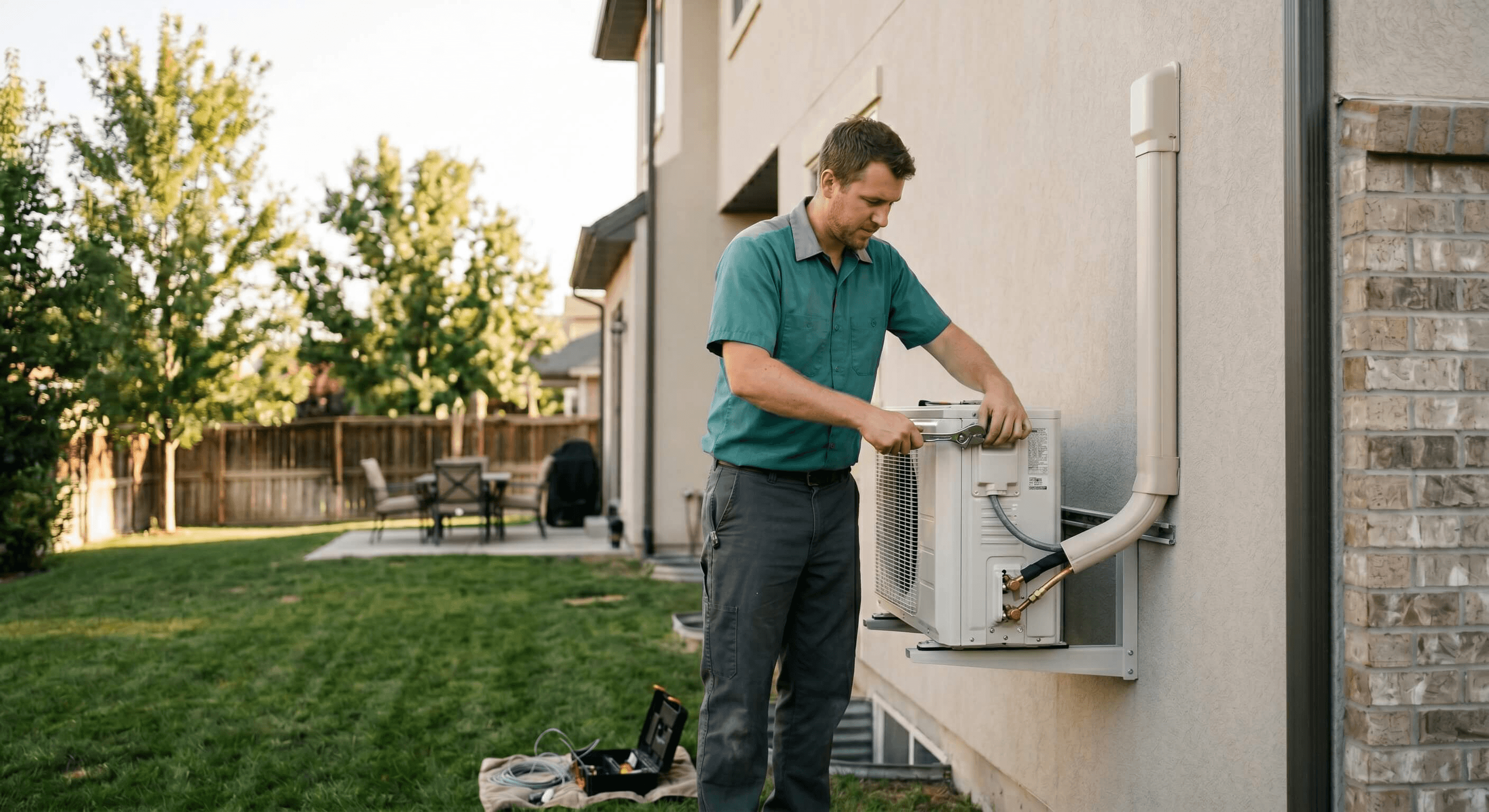
Find Mini Split Installation Near You
How to Hire the Right HVAC Pro
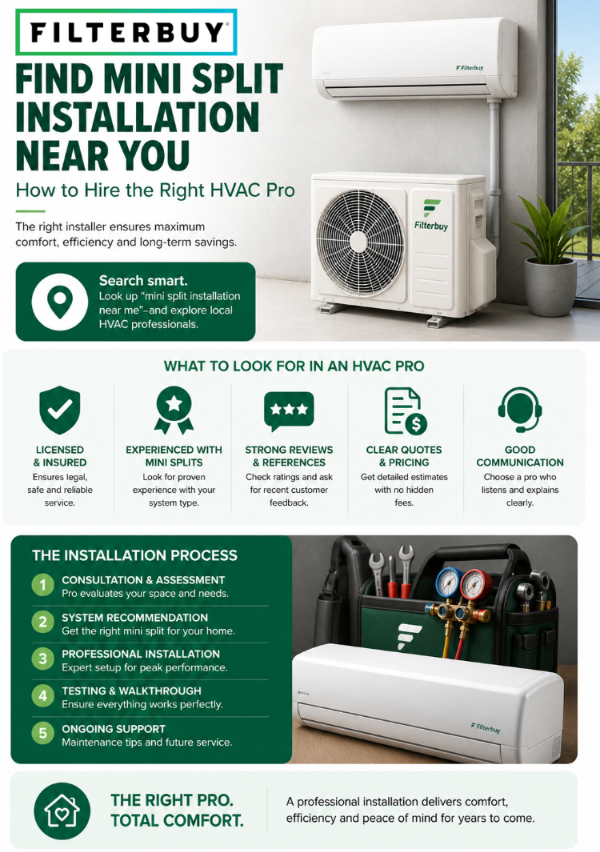
To find a qualified mini split installer near you, start with three verified sources and cross-reference them: the NATE contractor locator, the ENERGY STAR rebate finder, and your state HVAC contractor licensing board. Then verify EPA Section 608 certification on the specific technician who will be on your job. The install matters more than the brand, so vet the technician first.
- NATE contractor locator (natex.org): certified technicians, searchable by ZIP code.
- ENERGY STAR rebate finder: installers tied to local utility incentive programs.
- State HVAC licensing board: confirms an active license and complaint history.

Not sure which system to hand your installer?
Answer a few quick questions and we'll match you to the right Filterbuy mini split for your space.
Prefer to browse first? Shop Filterbuy Mini Split Systems →
Hire the wrong installer and the air your family breathes for the next 15 years takes a hit you can't see. That's the part most homeowners miss when they shop a mini split. The equipment shows up on a spec sheet, but the install is what decides how that equipment actually moves air through your house, day after day, for the lifetime of the system.
We see this in our customer service inbox every summer. A premium head from a top brand running hot, short-cycling, icing up in July, or failing by year three because the line set was sized wrong, the refrigerant charge came in low, or the indoor head landed in a spot the contractor never measured. You can compare brand catalogs in an afternoon. Your local installer pool is harder to map, and that's where this project actually gets won or lost.
TL;DR Quick Answers
Find Mini Split Installation Near You
The fastest way to find a qualified mini split installer in your area is to start with three verified sources and cross-reference what you find:
NATE contractor locator at natex.org. Search by ZIP code for installers whose technicians have passed industry-developed certification exams.
ENERGY STAR rebate finder. Locates installers tied to local utility incentive programs in your area.
Your state HVAC contractor licensing board. Confirms an active license and pulls up any complaint history.
Before booking, verify EPA Section 608 certification on the specific technician who'll be on your job. If you've already chosen a Mitsubishi or Daikin system, search for a Mitsubishi Diamond Contractor or Daikin Comfort Pro to lock in the extended manufacturer warranty.
The install matters more than the brand. After more than a decade obsessing over indoor air quality, what we consistently see is that even premium equipment fails when poorly installed. Vet the technician first.
Top Takeaways
Equipment selection is the easy part of a mini split project. Installer vetting is what protects the investment.
NATE certification, EPA Section 608, and brand-specific contractor designations like Mitsubishi Diamond and Daikin Comfort Pro are the credentials that matter most.
A single-zone install typically runs $3,000 to $6,000 in 2026, and multi-zone runs $6,500 to $14,500 depending on head count and region.
Manual J load calculation is non-negotiable. A contractor who sizes by square footage alone is guessing.
The federal Section 25C heat pump tax credit expired December 31, 2025. State and utility rebates remain active in many regions through the ENERGY STAR rebate finder.
Why Local Matters When You're Hiring a Mini Split Installer
"Near me" isn't just a search-engine signal. For mini splits, local matters because of how the work gets regulated, how systems get sized for a specific climate, and how warranties get registered after the truck pulls away.
Start with sizing. A 12,000 BTU head that handles a 500 square foot room in coastal Oregon will struggle with the same room in central Texas, where afternoon sun and summer humidity push cooling loads higher than capacity charts suggest. An installer who has worked your climate zone for years already knows that a north-facing bedroom sizes differently than a sun-exposed living room of the same square footage. National lead-gen contractors who route your job to whichever sub answers first don't.
Refrigerant handling is regulated state by state. Every technician who opens a refrigerant line on your property must hold EPA Section 608 certification, and your state HVAC contractor licensing board enforces it. Local contractors keep that paperwork on hand. If a traveling installer can't pull it up when you ask, you've already got your answer.
Warranty registration is the last piece. Mitsubishi, Daikin, LG, and most major manufacturers tie their full parts warranty to a registered, certified installer. If yours can't register the system, you walk away with a fraction of the warranty you paid for.
Before you start collecting quotes, we recommend reading how the right size depends on your space. Knowing the BTU range your room actually needs makes every contractor conversation shorter and harder to oversell.
How to Vet a Mini Split HVAC Contractor
Contractor vetting is mostly a paperwork exercise. The credentials worth checking are public and free to look up, and the contractors who have them want you to find them. That's the good news. The harder part is knowing which credentials actually matter and which are window dressing.
Verify Licensing and Insurance
Look up your installer on your state contractor licensing board's website before the first phone call. Confirm the license is active. Check the complaint history. Then ask for proof of general liability insurance and workers' compensation in writing. A contractor who hesitates to share current certificates probably doesn't have them, and that's information you wanted before you wired any money.
Look for NATE Certification and EPA Section 608
NATE, which stands for North American Technician Excellence, is the largest non-profit HVAC certification program in the country. Their techs pass industry-developed exams in installation, service, or specialties like heat pumps, and they recertify every two years. The certification is voluntary, which is part of why it counts. A tech who pursued it on their own time is committed to the trade in a way that shows up on install day.
EPA Section 608 is non-negotiable. Federal law requires it for any technician who handles refrigerant, which covers nearly every step of a mini split install. Ask which specific technician will be on your job and verify their Section 608 status individually. Crews rotate. The certified lead isn't always the person doing the work, and that distinction matters when refrigerant goes into your line set.
The third credential worth knowing about is ENERGY STAR Quality Installation. Contractors who carry it have committed to documented Manual J load calculations, post-install commissioning, and homeowner verification. Those are the steps that separate a competent install from one you'll still be happy with in year ten.
Check Brand-Specific Training
If you've already chosen a Mitsubishi or Daikin system, hire a brand-trained installer or you're leaving warranty value on the table. Mitsubishi's Diamond Contractor program extends parts warranty up to 12 years for systems registered by Diamond installers. Daikin's Comfort Pro program works the same way. Brand-trained contractors complete factory training and follow the exact commissioning sequence the manufacturer expects, which is part of why those warranties exist in the first place.
Read Reviews the Right Way
Star averages are noisy. Look at what the reviews are actually about. A contractor with 4.8 stars on service calls but zero installation reviews is a different risk than one with 4.5 stars specifically on installations.
Read the recent low-star reviews carefully. The pattern that should worry you isn't a single bad outcome (every contractor has one) but recurring themes: missed appointments, refrigerant leaks reported within months of install, warranty registration that never happened. Cross-check the contractor on the Better Business Bureau and on your state licensing board's complaint portal. If the patterns line up across all three sources, believe them.
What Mini Split Installation Actually Costs in 2026
Cost is the question every homeowner asks first, and the question every honest contractor answers in a range. Head count, capacity, brand, region, line set length, electrical panel capacity, and permit requirements all move the number meaningfully. Anchor your expectations on ranges, then push back on quotes that sit outside them without a clear reason.
Single-Zone vs. Multi-Zone Cost Ranges
A single-zone install pairs one outdoor condenser with one indoor head and typically lands between $3,000 and $6,000 in 2026, fully installed. The variables that move that range are capacity (a 9,000 BTU unit costs less than an 18,000 BTU), brand tier (Pioneer or MRCOOL DIY runs lower than Mitsubishi or Daikin), and your local labor market.
A multi-zone install with two to four heads typically runs $6,500 to $14,500. Cost scales with the number of heads but not linearly. The second head adds the most marginal cost because the outdoor condenser jumps capacity tiers. Heads three and four add less.
A whole-home install with five or more heads usually starts around $14,000 and goes to $28,000 or higher for premium brands or homes that need electrical panel upgrades. At that price point, a mini split system is closer to a small construction project than a service call.
How Costs Vary by Region
A few regional patterns are worth knowing.
Northeast metros (Boston, New York, Philadelphia) tend to run highest. Labor rates are higher, permitting is stricter, and cold-climate hyper-heating equipment is often in scope.
Southeast metros (Atlanta, Tampa, Charlotte) tend to fall in the middle. Cooling-dominated loads keep equipment costs moderate, and labor is more competitive.
Western metros (Denver, Phoenix, Seattle) vary widely. Phoenix is competitive on cooling-only installs. Seattle pricing reflects the cold-climate heat pump premium.
One note on incentives. The federal Section 25C heat pump tax credit expired December 31, 2025. State and utility rebates are still active in many regions, often through state energy offices and the ENERGY STAR rebate finder. Ask your contractor what local programs apply before you sign. They should know.
Mini Split vs. Central Air: When Each Wins
Both systems do the same job. They remove heat from inside your home and reject it outside. They differ in how they distribute conditioned air. Central air conditioning moves air through ducts to vents in every room, controlled by one or two thermostats. A mini split moves conditioned air directly into the room from a wall- or ceiling-mounted head, and each head runs on its own thermostat.
The right choice depends on the home, not the technology.
When a Mini Split Is the Right Call
Mini splits are usually the better fit for homes without existing ductwork. That includes older houses with hydronic heat, room additions, finished basements, accessory dwelling units, and detached garages. Retrofitting ductwork into a finished home is expensive and disruptive. A mini split needs a three-inch wall penetration and a small outdoor pad.
They also win when one or two rooms run consistently hot or cold relative to the rest of the house. A central system controlled by one thermostat can't solve that problem. A single-zone mini split installed in the problem room can.
Homes converting from oil, propane, or electric resistance heat are a third strong fit. A modern mini split heat pump handles both heating and cooling on the same equipment, and it can run two to four times more efficiently than electric baseboards.
When Central Air Is the Right Call
Central air still makes sense for homes with existing, well-sealed ductwork. The marginal cost of replacing a central system is far lower than installing a multi-zone mini split from scratch in the same home.
Aesthetics are part of the conversation too. Indoor mini split heads are visible. Modern models are slimmer than they used to be, but they're not invisible. If concealed vents matter to you, central air or a ducted mini split (a hybrid that hides the air handler) is worth pricing.
The third case for central air is whole-home cooling preference. Some homeowners want one thermostat, one schedule, one system. A multi-zone mini split is designed around the opposite philosophy.
How Mini Split Installation Works, Step by Step
A standard single-zone install runs six to eight hours for an experienced two-technician crew. Knowing the seven steps helps you spot when a contractor is cutting corners.
Step one is the Manual J load calculation. The contractor measures square footage, ceiling height, window orientation, insulation, and how many people use the room, then runs those numbers through ACCA's Manual J protocol to land on the BTU capacity your space actually needs. An installer who skips this and quotes from square footage alone is guessing.
Step two is placement. The indoor head goes high on a wall where it can throw conditioned air across the longest dimension of the room without blowing on a bed or sofa. The outdoor condenser goes on a level pad with clear airflow on all sides, ideally 12 inches off the ground in regions that get snow.
Step three is the wall penetration. A three-inch hole through the exterior wall carries the conduit, which contains the refrigerant line set, electrical wiring, and condensate drain. The hole slopes slightly outward so condensate drains by gravity.
Step four is mounting. The indoor head locks onto a backplate the technician levels and secures into wall studs. The outdoor unit bolts to the pad and sits on rubber feet to dampen vibration.
Step five is the refrigerant work. The technician pulls a vacuum on the line set, holds it to verify there are no leaks, and then releases the factory refrigerant charge from the outdoor unit. Shortcuts here cause long-term failures. A partial vacuum or undercharged system runs harder, runs less efficiently, and burns out the compressor years early.
Step six is electrical hookup. The system gets a dedicated breaker sized to the manufacturer's spec, and the condensate drain runs to an approved location.
Step seven is commissioning. The contractor powers up the system, verifies operating pressures, checks superheat and subcool readings, and walks you through the remote, the filter, and the maintenance schedule. Documentation goes in your file. They register the warranty before the truck leaves.
Common Installation Scenarios
Sizing and placement assumptions change with the room. Most homeowner installs fall into one of a few common scenarios.
Mini Split Installation for a Garage
Garages are the room most homeowners undersize. An attached garage shares one wall with conditioned space, but the other three walls are uninsulated, sun-exposed, or both. Add a warm vehicle and the heat load runs higher than a bedroom of the same square footage.
A 12,000 BTU unit handles a typical two-car garage in moderate climates. In hot or sun-exposed conditions, step up to 18,000 BTU. If the garage doubles as a workshop with a welder or other heat-producing equipment, work with your installer on a custom load calculation. A garage that hits 95 degrees inside on summer afternoons doesn't get fixed by a unit sized for square footage alone.
Mini Split Installation for a Bedroom or Home Office
Bedrooms are the room most homeowners oversize, and oversizing causes its own problems. A unit with too much capacity hits temperature quickly, shuts down, then short-cycles back on. The system never runs long enough to dehumidify, so the room feels clammy even when the thermostat reads 72 degrees.
A 9,000 BTU unit fits most bedrooms up to 350 square feet. A 12,000 BTU works for larger primary bedrooms or rooms with strong sun exposure. Trust the load calculation, not the impulse to oversize for "extra capacity on hot days."
Whole-Home Multi-Zone Installation
A whole-home install with five or more heads is closer to a small renovation than a service appointment. Plan on two to four working days, multiple electrical permits, and a real conversation about which rooms cluster onto which outdoor condenser. Mismatched zones, like a north bedroom and a south sunroom on the same condenser, fight each other and run inefficiently.
If you're converting an entire home to ductless, ask your contractor for a written zoning plan with a one-line diagram showing every head, every line set, and every breaker. Get it before you sign.
Brand-Specific Mini Split Installation Considerations
Brand-trained installers matter more than people realize, and the warranty math is the easiest way to see why.
Mitsubishi Mini Split Installation
Mitsubishi sells one of the most-installed mini split lines in North America. The Diamond Contractor program is what makes the brand worth choosing for many homeowners. Diamond installers complete factory training, hold ongoing certification, and can register your system for an extended 12-year parts warranty, twice the standard length.
Mitsubishi's Hyper-Heating (H2i) cold-climate units require certified installers in many regions. If you live where temperatures regularly drop below freezing and you want a heat pump that handles winter without backup heat, hire a Diamond Contractor who has installed H2i systems specifically. The capacity calculations and refrigerant work for cold-climate units differ from standard mini splits, and the installer needs the experience.
Filterbuy, Daikin, LG, MRCOOL, and Pioneer
Daikin's Comfort Pro program works like Mitsubishi's. Comfort Pros register your system for extended warranty coverage and have completed factory training. If you're buying Daikin, hire a Comfort Pro.
Filterbuy, LG, Carrier, and Bosch run similar programs at smaller scale. Ask the brand you've chosen which contractor designation extends warranty coverage in your region.
MRCOOL's DIY series ships with pre-charged line sets, which lowers the installation barrier for homeowners with electrical experience. You still need a licensed electrician for the dedicated circuit, and you still need to register the system to activate the warranty. The DIY label means you can do the refrigerant connection without Section 608 certification, not that you can skip the rest of the install.
Pioneer, Senville, and Klimaire are typically installed by independent contractors without a manufacturer-certification program. Vet on credentials, not brand affiliation.
Questions to Ask Before You Sign the Contract
Print this list and ask every contractor the same questions. The answers tell you who has done this work before and who is reading from a script.
Are you NATE-certified, and which technician on your team will be on my install?
Do you and your technicians carry EPA Section 608 certification for refrigerant handling?
Will you perform a Manual J load calculation, or are you sizing by square footage alone?
Are you a Mitsubishi Diamond Contractor, Daikin Comfort Pro, or other brand-certified installer for the system I'm buying?
What's the manufacturer parts warranty, and what's your labor warranty?
Will you register the warranty on my behalf, and can you send me confirmation when it's done?
What's included in the quote? Line set length, condensate pump if needed, electrical work, permits, and commissioning?
How will you charge the refrigerant, by weight or by gauge readings? Will you pull a vacuum and hold it to verify no leaks before charging?
How will you commission the system, and what documentation will I receive?
What's the timeline, and which technician will be on site each day?
"We've spent over a decade manufacturing filters and serving more than two million households, and the same pattern keeps showing up in our inbox: homeowners spend weeks comparing mini split brands and ten minutes choosing the installer, when it should be the other way around. The brand sets the ceiling on a system's performance, but the installer is the one who decides whether you ever reach it."
— The Filterbuy Team
Essential Resources
Seven sources we recommend reading before you sign with any installer. Each one is from a federal, state, or industry organization and links directly to the relevant page.
1. U.S. Department of Energy — Ductless Mini-Split Heat Pumps Guide
The federal authority on home energy efficiency. The DOE's overview of mini split benefits, sizing, and installation considerations is the cleanest starting point for a homeowner who wants the basics without manufacturer marketing.
Source: U.S. Department of Energy — https://www.energy.gov/energysaver/heat-pump-systems/ductless-mini-split-heat-pumps
2. ENERGY STAR — Ductless Heating & Cooling
Certified product list, contractor-hiring tips, and the rebate finder that shows what state and utility incentives are active in your ZIP code. Use the rebate finder before you sign any contract.
Source: ENERGY STAR — https://www.energystar.gov/products/ductless_heating_cooling
3. NATE — Find a Contractor
The single most useful tool in the contractor search. Enter your ZIP code, get NATE-certified contractors in your area, and verify individual technicians' NATE IDs before they show up at your house.
Source: North American Technician Excellence — https://natex.org/homeowner/find-a-contractor
4. EPA — Section 608 Technician Certification
The federal page explaining the Section 608 requirement. Understanding what the certification covers helps you ask the right questions and recognize when an installer is bluffing.
Source: U.S. Environmental Protection Agency — https://www.epa.gov/section608/section-608-technician-certification-0
5. Building America Solution Center — Ductless Mini-Split Heat Pump Installation Guide
A technical reference produced by Pacific Northwest National Laboratory under DOE contract. The level of detail is designed for installers, but a homeowner who reads even the first few sections can verify their contractor's process step by step.
Source: Building America Solution Center (PNNL / DOE) — https://basc.pnnl.gov/resource-guides/ductless-mini-split-heat-pumps
6. ACCA — Manual J Load Calculation Standard
The Air Conditioning Contractors of America's residential load calculation standard. Any contractor worth hiring runs Manual J before quoting. This page tells you what that means.
Source: Air Conditioning Contractors of America — https://www.acca.org/standards/approved-standards/acca-2-manual-j
7. NEEP — Cold Climate Heat Pump Specification Product List
Northeast Energy Efficiency Partnerships maintains an independent cold-climate heat pump product list referenced by state energy offices. If you live in a region where winter temperatures regularly drop below freezing, cross-reference any heat pump quote against this list.
Source: Northeast Energy Efficiency Partnerships — https://neep.org/heating-electrification/ccashp-specification-product-list
Supporting Statistics
Three figures worth knowing as you compare quotes. Each one comes from a distinct federal or industry source.
The first is the case for ductless. According to the U.S. Department of Energy, duct losses in ducted forced-air systems can account for more than 30 percent of energy consumption for space conditioning, especially when ducts run through unconditioned attics or crawlspaces. A mini split bypasses that loss entirely.
Source: U.S. Department of Energy — https://www.energy.gov/energysaver/ductless-minisplit-heat-pumps
The second is the long-term cost frame. ENERGY STAR data puts the typical American household's annual energy spend around $1,900, with nearly half going to heating and cooling. Installation efficiency compounds across that spend year after year.
Source: ENERGY STAR — https://www.energystar.gov/products/ductless_heating_cooling
The third is the indoor air quality argument. The U.S. Environmental Protection Agency reports that Americans spend roughly 90 percent of their time indoors, and indoor concentrations of some pollutants run two to five times higher than typical outdoor concentrations. The system you install today determines what air your family breathes for the next 15 years.
Source: U.S. Environmental Protection Agency — https://www.epa.gov/report-environment/indoor-air-quality
Final Thoughts
The contractor decision is the part of a mini split project that almost no homeowner researches as hard as the equipment, and it should be the other way around. The equipment is on a spec sheet, vetted by reviewers, comparable across brands. The contractor is the variable that turns those specs into real-world performance, and the variable that determines how long the system actually lasts.
Once you've hired the right installer and the system powers up, the work shifts. The contractor's job ends at commissioning. The filter routine takes over from there. A mini split's built-in filtration is lighter than central HVAC, which means the air your family breathes depends on what you put in front of the indoor head every month.
That's the part Filterbuy has been obsessed with from day one.
Next Steps
Three things to do this week, in order.
Pull three NATE-certified contractor names from natex.org for your ZIP code. Cross-check each name on your state contractor licensing board to confirm an active license and a clean complaint history.
Request itemized quotes from all three. Line items should include capacity, brand, line set length, electrical work, permits, commissioning, and warranty registration. If a quote is a single number, ask for the breakdown before you continue the conversation.
Ask each contractor the ten questions in the section above. Hire the one whose answers are specific, written, and consistent. The right installer won't be offended by the questions. They'll appreciate that you asked.
Frequently Asked Questions
You've Vetted the Installer. Now Hand Them the Right System.
Filterbuy Mini Splits ship in 12,000, 18,000, and 24,000 BTU configurations with 17 SEER2 variable-speed inverters, multi-stage filtration, high-temperature self-cleaning, and built-in refrigerant leak detection — every feature included, no add-on packages. Pair the system with the contractor you just hired to activate a 7-year compressor with professional installation.