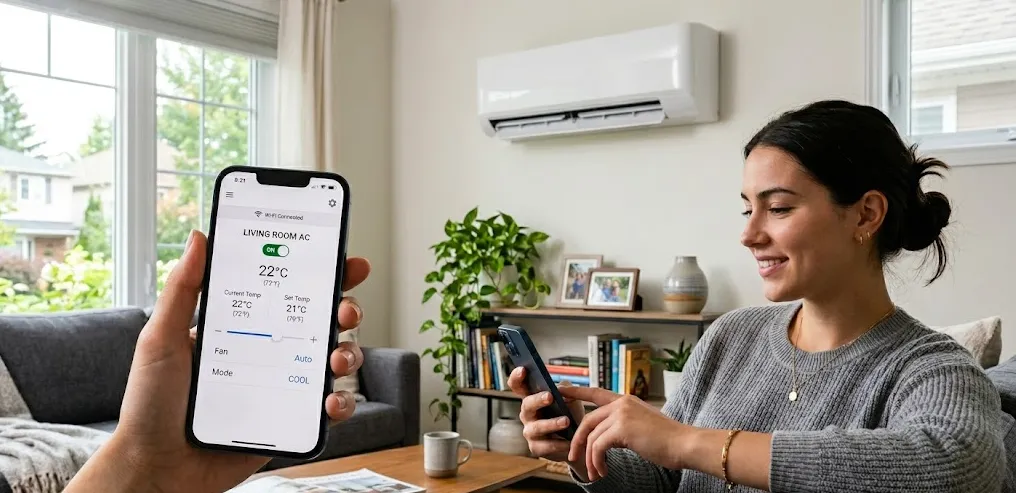
Smart Mini Splits With WiFi
The Best App-Controlled Ductless Systems
How to Choose the Right WiFi Mini Split for Your Home
Start with a WiFi-native system, not an add-on controller. It is the only kind that sends a filter-cleaning alert to your phone, and a clean filter is what actually protects your family's air.
Judge any system on three things:
- WiFi built into the unit, so you get real energy data and real filter alerts, not estimates
- A SEER2 rating of 18 or higher
- Filter maintenance alerts tied to runtime hours or a filter sensor
For most homes, the MRCOOL DIY series fits, with self-installation, SEER2 ratings from 18 to 22, and Alexa and Google built in. Want whole-home zoning or advanced smart-home integration? Look at the Daikin LV Series or the Mitsubishi M-Series. Adding one room on a budget? The YITAHOME 12,000 BTU WiFi unit covers it.

Not sure which system fits your space and your air-quality goals? Answer a few quick questions and we will point you to the right setup.
Ready to browse smart, app-controlled units?
Your mini split's WiFi connection isn't the feature worth obsessing over. The filter alert is.
Most smart ductless systems marketed in 2026 lead with voice commands and energy dashboards. Those matters. What they don't advertise — what most buying guides skip entirely — is that app-connected systems protecting your family's air quality do it through one thing that doesn't sound impressive at all: a reminder to clean the filter.
We've been manufacturing air filters for over a decade. In that time, serving more than two million households, we've seen the same failure point again and again. A good system gets installed. The app gets set up. And six months later, the filter is clogged because no one thought to check it. The unit runs harder, efficiency drops, and the indoor air quality the system was supposed to protect gets worse instead of better.
This guide ranks the best WiFi mini splits of 2026. We explain what separates a genuinely smart ductless system from a basic unit with a remote control app. And we show you how to use WiFi connectivity the right way — starting with the filter.
TL;DR Quick Answers
What is the best WiFi mini split?
Best WiFi mini split ranked
The best WiFi mini split for most homeowners in 2026 depends on your priorities. Features to compare include built-in WiFi, Alexa compatibility, SEER2 ratings between 18 and 22, ease of installation, and smart app control. Filterbuy mini split systems with WiFi app control are also an option to consider alongside other WiFi-enabled models.
Does a WiFi mini split work with Alexa?
Mini split Alexa compatibility explained: Yes. WiFi mini splits from MRCOOL, Mitsubishi, and Daikin are mini split Alexa compatible. Enable the brand's skill in the Alexa app, link your account, name your zones, and control your system by voice. Setup takes about ten minutes from start to first command.
Can I control a mini split from my phone?
Mini split app control and remote access
Any WiFi-native mini split connects to a manufacturer app that gives you mini split remote access from anywhere with a mobile signal — temperature adjustments, scheduling, energy monitoring, and filter alerts. Whether you're upstairs or across the country, the app keeps you connected to your system.
What is a smart ductless system?
Smart ductless system definition
A smart ductless system is a WiFi-enabled mini split that connects to your home network and a smartphone app. It delivers app-based climate control, scheduling, energy monitoring, and filter maintenance alerts — without ductwork. It's the core product type in the ductless mini split WiFi category.
Top Takeaways
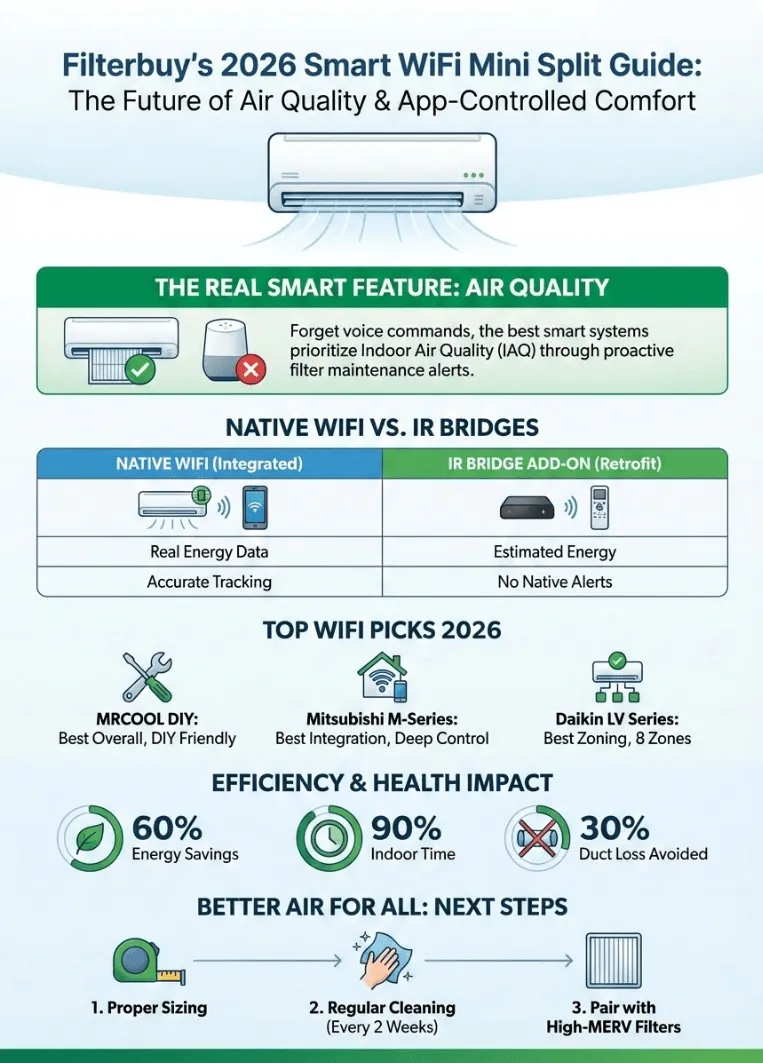
A WiFi-native mini split with a built-in wireless module gives you genuine energy data, reliable scheduling, and real filter alerts — features that an IR add-on controller cannot match
The filter maintenance alert is the most valuable smart feature for your family's health — more valuable than voice commands or any app interface feature
ENERGY STAR-certified mini splits use up to 60% less energy than standard electric resistance heating, and smart scheduling pushes those savings further by cutting unnecessary runtime
For most homeowners, MRCOOL DIY offers the best combination of smart features, self-installation, and value; for whole-home zoning and deep smart home integration, Mitsubishi M-Series leads the category
If you own a mini split with an IR remote, a smart AC controller — Cielo Breez or Sensibo Sky — brings WiFi control without a full system replacement
A smart ductless system protects your home's air quality only when the filter is clean — keep the two-week schedule during peak season, and pair your mini split with the right MERV-rated filter in your central HVAC for complete protection
What Makes a Mini Split 'Smart'? WiFi vs. IR Bridge Explained
Two things get sold as WiFi mini splits. Only one of them actually is.
A WiFi-native mini split has a wireless module built directly into the unit. It connects to your home network, and the manufacturer's app gives you real-time temperature monitoring, energy tracking, scheduling, and — on the systems that do this right — filter status alerts that push a notification to your phone when it's time to clean. These are the systems we rank below.
An IR bridge controller — a Cielo Breez, Sensibo Sky, or Flair Puck — is a retrofit device. You plug it in near your existing mini split, pair it to your network, and it mimics your remote control through an app using infrared signals. It works. It's a practical upgrade for homeowners with existing systems. But it can't read data from your unit directly, which means no real energy monitoring and no genuine filter alerts. We cover this option later, for homeowners who own a ductless unit and aren't ready to replace it.
Key Smart Features to Look For in a WiFi Mini Split
App-based scheduling and remote temperature control from anywhere with a signal
Real energy usage monitoring — actual consumption data, not estimates
Filter maintenance alerts tied to runtime hours or direct filter status sensors
Voice assistant compatibility with Alexa or Google Home
Multi-zone control from a single app for whole-home systems
17 SEER2 rating of 18 or higher
The Best WiFi Mini Splits of 2026: Our Ranked List
We evaluated each system on five criteria: efficiency (17 SEER2 rating), depth of smart features, reliability of WiFi connectivity, filter maintenance notification capability, and homeowner feedback from verified sources. Every pick below is a WiFi-native system.
Best Overall WiFi Mini Split — MRCOOL DIY 4th Gen Series
The MRCOOL DIY series earns the top spot because of one thing most competitors can't claim: you install it yourself without specialized HVAC tools. Pre-charged line sets and quick-connect fittings handle what normally requires a refrigerant vacuum pump and a licensed technician. The SmartHVAC app covers remote access, scheduling, and energy monitoring. Alexa and Google Assistant compatibility is built in. 17 SEER2 ratings run from 18 to 22, depending on the configuration.
We recommend this system more than any other to homeowners who want smart control, room to expand into multi-zone, and a system they can get running over a weekend.
Best for Smart Home Integration — Mitsubishi Electric M-Series
Mitsubishi's M-Series sets the standard for how deeply a ductless system can integrate with a smart home. The Kumo Cloud platform delivers precise zone-by-zone control, geofencing, and one of the most stable WiFi connections in the category. Full Alexa and Google Home compatibility, with select Apple HomeKit configurations supported. SEER2 ratings reach 33 on high-efficiency models.
The trade-off is real. Professional installation is required, and the price point is premium. For homeowners who want the most capable smart ductless system available and plan to stay in their home long enough to appreciate it, this is the right choice.
Best WiFi Mini Split for Whole-Home Zoning — Daikin LV Series
Daikin's LV Series runs up to eight indoor heads off a single outdoor unit, all managed through the Daikin One Home app. For homeowners replacing a ducted central system or covering a full home with independent zone control, this is the strongest option in the category. WiFi connectivity is native. Alexa compatibility is included. SEER2 ratings start at 20 for most configurations.
A warm master bedroom, a cool home office, a guest room that runs three weeks a year — the Daikin LV handles all of it from one app.
Best Budget WiFi Ductless AC — YITAHOME 12,000 BTU WiFi Series
App control and smart home compatibility without the premium price. The YITAHOME companion app covers scheduling, remote access, and basic energy tracking. Alexa and Google Assistant work out of the box. 17 SEER2 sits around 19 — solid performance at this price tier.
Start here when you're adding WiFi ductless AC coverage to a single room, a garage, or a home addition without committing to a whole-home system.
Mini Split WiFi Control and Your Filter Maintenance: What Smart Systems Get Right
Most WiFi mini split buying guides don't mention the filter. We're going to spend time on it, because in our experience it's the difference between a smart system that actually protects your home and one that just looks good in the app.
Why Filter Maintenance Matters More With a Ductless System
Mini splits use washable, reusable filters. That sounds convenient, and it is. It also means there's no subscription box arriving at your door as a reminder, no disposable filter to pull from a return grille and hold up to the light. You have to remember to clean it. According to most manufacturer guidance, that's every two weeks during peak cooling or heating season — a frequency most homeowners miss.
When they miss it, here's what happens. The filter clogs. Airflow drops. The system works harder to hit the set temperature. Efficiency falls. Dirty condensate builds up and can lead to mold growth inside the unit. And the indoor air quality that the system was supposed to protect gets steadily worse.
Wi-Fi-native systems with runtime tracking and filter status notifications change this pattern. When your phone tells you the filter needs attention, you act on it. When it relies on memory, most homeowners don't.
How Remote Access Supports Your Full Indoor Air Quality Plan
The runtime and energy data a WiFi mini split gives you is genuinely useful for scheduling. A system running eight hours a day in July needs filter attention more often than one cycling lightly in October. Use the app data to match your cleaning schedule to actual system load — not just the calendar.
A mini split is also one part of a complete indoor air quality plan, not the whole thing. If your home also runs a central HVAC system, the right MERV-rated filter in that system gives your family whole-home protection that a ductless unit alone can't provide. The two systems work best together.
How to Add WiFi to an Existing Mini Split: Smart AC Controllers
Already own a mini split? You may not need to replace it to get smart home control. If your unit takes a standard infrared remote, an add-on IR smart controller brings app-based scheduling and remote access to your existing system in under 30 minutes.
The Best Smart AC Controllers for Existing Mini Splits
On-device controls, scheduling, and broad compatibility with many AC brands
Automation features that adjust operation based on temperature and humidity
Multi-room control with room-level temperature management
Be clear-eyed about the trade-offs. IR controllers add convenience and scheduling. They can't read data directly from your unit, so energy monitoring is estimated rather than measured, and filter alerts aren't available. If maintenance visibility matters to your plan — and it should — a WiFi-native system is the better long-term investment.
For renters, for rooms with newer units in good condition, or for homeowners on a tighter budget, a smart AC controller is a practical and affordable bridge to WiFi ductless AC control.
Mini Split Smart Home Integration: Alexa, Google, and Beyond
Voice commands are a part of a mini split smart home setup that homeowners use every day without thinking about it. No remote to find, no app to open. You just speak.
Setting Up Your Mini Split With Alexa or Google Home
Download the manufacturer's app and complete the initial WiFi setup.
Open the Alexa or Google Home app and navigate to Skills or Devices.
Search for your brand's skill — "MRCOOL," "Mitsubishi Kumo Cloud," or "Daikin One Home," for example.
Enable the skill, link your account, and name each indoor unit by room.
Test it: "Alexa, set the living room mini split to 72 degrees."
One practical note before you invest: a strong, stable WiFi signal near each indoor unit is non-negotiable for reliable voice control. If coverage is weak in certain rooms, a mesh network extender before setup saves significant frustration later.
"Most homeowners don't think about the filter until something goes wrong — a drop in airflow, a musty smell, an energy bill that's higher than it should be. By then, the damage is already done. After working on hundreds of ductless installations, what I've found is that filter maintenance frequency is a stronger predictor of system health than the brand or the SEER2 rating. WiFi systems that push a filter alert to your phone close the gap between good intentions and actual maintenance. That's not a minor convenience. For the air quality in those homes, it's a real difference."
Essential Resources for WiFi Mini Split Owners
These government and authoritative sources give you the foundation to buy, install, and maintain a smart ductless system with confidence.
1. Ductless Mini-Split Heat Pumps — U.S. Department of Energy
The DOE's complete guide to how ductless mini splits work, where they beat ducted systems on efficiency, how to size them correctly, and what installation requires. Start here before you buy anything.
Source: https://www.energy.gov/energysaver/ductless-minisplit-heat-pumps
Ductless Heating & Cooling — ENERGY STAR
2. ENERGY STAR's overview of certified mini split heat pumps — efficiency benchmarks, rebate eligibility, and the product finder tool for verifying certified models. Use this to confirm any system on your shortlist before purchasing.
Source: https://www.energystar.gov/products/ductless_heating_cooling
3. ENERGY STAR Certified Heat Pumps (Mini-Split) — Product Finder
The live database of ENERGY STAR-certified mini split heat pumps. Filter by brand, BTU capacity, and efficiency rating to confirm your chosen WiFi mini split carries certified status.
Source: https://www.energystar.gov/productfinder/product/certified-mini-split-heat-pumps/results
4. Indoor Air Quality — U.S. EPA
The EPA's overview of indoor air quality risks, pollutant sources, and why HVAC filtration matters. Read this to understand why your mini split's filter schedule has a direct impact on your family's health — not just your system's efficiency numbers.
Source: https://www.epa.gov/report-environment/indoor-air-quality
5. The Inside Story: A Guide to Indoor Air Quality — U.S. EPA
The EPA's homeowner guide to preventing and addressing indoor air pollution. Covers ventilation, filtration, and the role your HVAC system plays in keeping a home healthy — directly relevant to any ductless mini split WiFi setup.
Source: https://www.epa.gov/indoor-air-quality-iaq/inside-story-guide-indoor-air-quality
6. Heat Pump Systems — U.S. Department of Energy
The DOE's resource on heat pump technology and the efficiency principles behind inverter-driven ductless systems. Useful for understanding why a WiFi ductless AC with inverter technology outperforms conventional systems on both efficiency and smart controllability.
Source: https://www.energy.gov/energysaver/heat-pump-systems
7. Going Ductless With Heat Pumps — U.S. Department of Energy
A first-person account from a DOE contributor documenting their own ductless heat pump installation, real energy savings, and what day-to-day maintenance actually looks like. Worth reading before you commit.
Source: https://www.energy.gov/energysaver/articles/going-ductless-heat-pumps
Supporting Statistics
ENERGY STAR certified mini splits use up to 60% less energy than standard home electric resistance heating systems.
Source: ENERGY STAR — Ductless Heating & Cooling
That gap exists because ductless systems transfer heat rather than generate it — a fundamentally more efficient process. Add smart scheduling through the system's app, and you cut runtime to only the hours your family actually needs conditioning. The savings compound.
Americans spend approximately 90% of their time indoors, where indoor pollutant concentrations are often 2 to 5 times higher than typical outdoor levels.
Source: U.S. EPA — Indoor Air Quality
This is why we keep returning to the filter. Your home is where your family spends nearly all of their time. A WiFi mini split running with a clogged filter isn't managing indoor air quality — it's circulating the problem. Cleaning the filter on schedule is one of the highest-impact health actions a homeowner can take.
Duct losses from central HVAC systems can account for more than 30% of energy consumption for space conditioning — especially when ducts run through unconditioned spaces like attics.
Source: U.S. Department of Energy — Ductless Mini-Split Heat Pumps
Ductless systems eliminate this loss. A smart ductless system with mini split app control adds a second layer: the system runs only when and where it's needed, cutting the energy waste that even a well-sealed ducted system can't fully avoid.
Final Thoughts and Opinion
The best WiFi mini split for your home is the one your family will actually use, actually maintain, and actually integrate into how you manage comfort day to day. Spec sheets can tell you a lot. They can't tell you that.
For most homeowners, the MRCOOL DIY series hits the right balance: strong smart features, self-installation, SEER2 ratings between 18 and 22, and a price that doesn't require a lengthy cost justification. For homeowners who want whole-home zoning and the deepest smart home integration the category offers, Mitsubishi's M-Series is where the conversation stops being about features and starts being about results.
Our honest take, after more than a decade working with homeowners on air quality: WiFi connectivity matters most when it changes behavior. A filter alert that gets acted on does more for your family's indoor air than any other feature on the spec sheet. Buy the system with the best filter notification capability. Keep the filter clean. Pair your ductless unit with a properly rated MERV filter in your central system. That's the setup that actually protects the air your family breathes.
Next Steps
Buying a New WiFi Mini Split
Use the ENERGY STAR Product Finder to confirm certified efficiency status before purchasing
Have a qualified HVAC professional size the system for your space — an oversized unit short-cycles and wastes the efficiency you paid for
Set up the manufacturer app and connect to Alexa or Google Home before your first day of use
Set a filter cleaning reminder in your phone calendar today: every two weeks during peak season, monthly during lighter use periods
You Already Own a Mini Split and Want Smart Control
Check your unit's compatibility with the Cielo Breez or Sensibo before ordering
Place the controller within a clear line of sight of your mini split's infrared receiver
Use the app's scheduling feature to reduce runtime while you're away
Building a Whole-Home Indoor Air Quality Plan
If you run a central HVAC system alongside your mini split, confirm you're using the right MERV-rated filter for your system's airflow requirements
Check your central air filter monthly — your mini split handles room-level conditioning; your central system carries the whole-home filtration load
Contact Filterbuy HVAC Solutions for a professional assessment of your filter schedule, MERV rating, or mini split installation
Frequently Asked Questions
Ready to Protect Your Home's Indoor Air Quality?
A smart mini split with WiFi gives you the visibility to manage your home's comfort from anywhere. The filter behind it protects the air quality worth managing.
Filterbuy has been manufacturing air filters for over a decade and has served more than two million households across America. We know that the most advanced HVAC technology only works as well as the maintenance behind it.