Best Mini Split for 500 Sq Ft in 2026 | Top Compact Ductless Picks
Most 500 sq ft spaces need a 9,000–12,000 BTU mini split, and 12,000 BTU (1 ton) is the safe choice for the majority of rooms. Choose 9,000 BTU for smaller, well-insulated bedrooms or offices, and step past 12,000 BTU for garages, ADUs, or hotter climates. Your exact number shifts with ceiling height, sun exposure, and how the room is used.
- 9,000 BTU — smaller, well-insulated rooms (bedroom, home office)
- 12,000 BTU — most spaces; the safest pick (living room, studio)
- 12,000+ BTU — hotter or harder-to-cool spaces (garage, ADU)
Take the quick match quiz below to find the right size and system for your space.

Answer 3 quick questions and we'll match you to the right mini split for your space.
Prefer to browse? See all mini split systems →
Most 500 sq ft rooms end up with the wrong mini split. We see it all the time—units that run nonstop but never quite get the space comfortable, or systems that short-cycle and waste energy. The issue usually comes down to sizing.
If you’re planning to install a mini split in a studio, garage, home office, or small living space, the number on the box isn’t the whole story. Square footage matters, but how your space holds heat matters just as much. Let’s walk through what actually works so you can get it right the first time.
TL;DR: Quick Answers
Best Mini Split for 500 Sq Ft in 2026
Best overall size: 12,000 BTU (1 ton)
Why it works: Handles most 500 sq ft spaces with enough flexibility for heat, sunlight, and daily use
Top picks: Mitsubishi, Daikin, LG, Pioneer, and Filterbuy 12,000 BTU systems
Our take:
Go with 9,000 BTU for well-insulated rooms
Choose 12,000 BTU if you want consistent performance across changing conditions
Step up to 12,000+ BTU for garages, ADUs, or hotter climates
What matters most:
Correct sizing
Steady airflow
Get those right, and almost any quality mini split in this range will perform the way you expect
Top Takeaways
Right size matters
9,000–12,000 BTU fits most 500 sq ft spaces
12,000 BTU is the safest choice in most cases
Sizing mistakes hurt performance
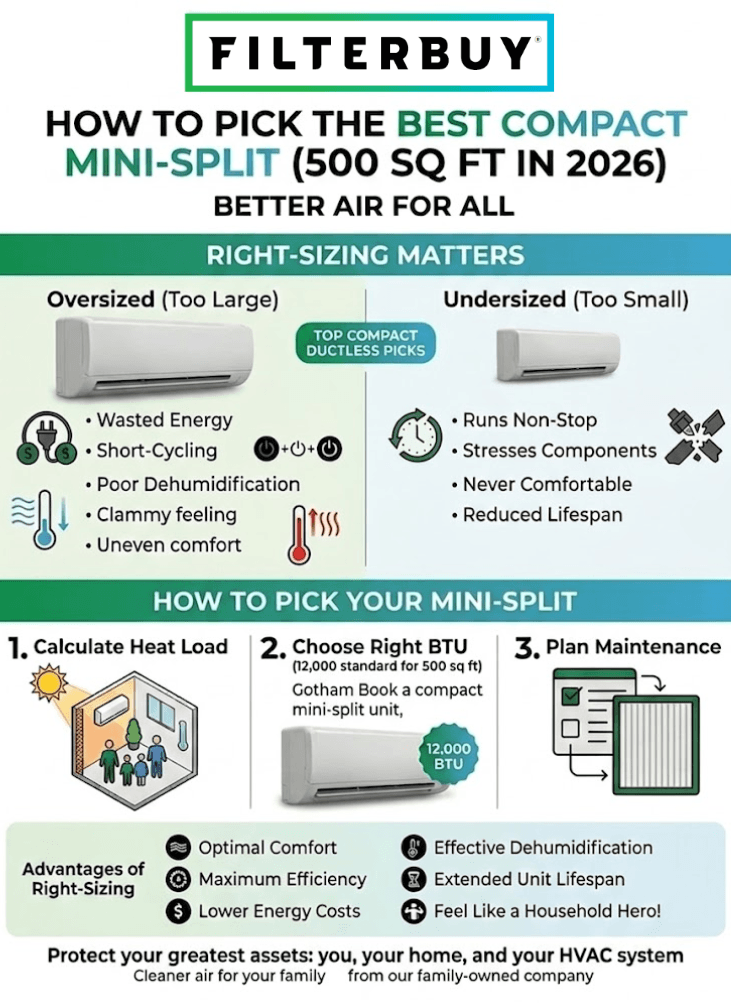
Too large → wasted energy
Too small → poor cooling
Efficiency depends on airflow
Clean filters = better performance
Blocked airflow = higher costs
Ductless systems reduce energy loss
No ducts = no 20–30% loss
Better for small or hard-to-cool spaces
Focus on the fundamentals
Correct sizing
Consistent airflow
Regular maintenance
What Size Mini Split for 500 Sq Ft?
In most homes, a 500 sq ft space calls for a mini-split in the 9,000-12,000 BTU range.
Here’s how that plays out in real conditions:
9,000 BTU works well in smaller, well-insulated rooms like bedrooms or offices
12,000 BTU (1 ton) covers most situations and gives you a margin for warmer days
12,000+ BTU makes more sense for garages, ADUs, or spaces that struggle to stay cool
From what we’ve seen working with homeowners across different setups, sizing mistakes usually go one of two ways. Garages get undersized. Bedrooms get oversized. Both lead to uneven comfort and higher energy use than necessary.
How Many BTU Do You Need for 500 Sq Ft?
A good starting point is 20 to 25 BTU per square foot.
For a 500 sq ft room, that puts you around 10,000 to 12,500 BTU.
But no home is “standard.” Small differences in your space can shift that number quickly:
Tall ceilings can push your cooling load up by 10–20%
Rooms with strong sun exposure need a bit more capacity
Each additional person adds roughly 600 BTU
Kitchens or heat-producing equipment can add up to 4,000 BTU
This is where many sizing charts fall short—they assume your home behaves like an average box. It doesn’t.
Is a 12,000 BTU Mini Split Enough for 500 Sq Ft?
In most cases, yes. A 12,000 BTU system handles 500 sq ft comfortably when the space is reasonably insulated and used as intended.
It works especially well in:
Living rooms
Studio apartments
Home offices
You may need more capacity if the space runs hotter than normal. Garages, older homes with poor insulation, or areas in extreme heat tend to push systems harder than expected.
Are Mini Splits Energy Efficient? (SEER Explained)
Mini splits earn their reputation for efficiency, but the numbers only tell part of the story.
SEER (Seasonal Energy Efficiency Ratio) measures how much cooling you get for the energy you use over time.
Typical systems fall into these ranges:
14–18 SEER for standard efficiency
20–30+ SEER for higher-efficiency systems
In practical terms, that often translates to noticeably lower energy use compared to window units or older systems.
Here’s what matters more in real homes:
You cool only the spaces you use, not the entire house
The system doesn’t cycle as aggressively when it’s sized correctly
Airflow stays consistent instead of fluctuating
One thing we’ve learned after years of working with HVAC systems: efficiency drops fast when airflow gets restricted. A well-sized unit can still struggle if it can’t move air the way it should.
Best Mini Splits for 500 Sq Ft (2026 Picks)
Choosing the right mini split for a 500 sq ft space depends on your priorities, including efficiency, installation needs, climate, and how the room is used. Different systems may be better suited for different situations:
Best for Overall Comfort and Efficiency
A 12,000 BTU inverter mini split is often a strong fit for spaces around 500 sq ft, especially when properly sized for insulation, windows, and heat load.
Best for Garages and Challenging Spaces
Look for systems with strong cooling capacity, reliable temperature control, and features designed to handle spaces with higher heat gain.
Best for Bedrooms, Studios, and Home Offices
Quiet operation, consistent airflow, and precise temperature control are key features for living and working areas.
Best Balanced Option for Everyday Use
Filterbuy 12,000 BTU Ductless Mini Split — a practical choice for smaller spaces, featuring inverter technology, modern refrigerant technology, filtration, and consistent temperature control.
Filterbuy focuses on practical comfort, efficient operation, and features designed to support consistent airflow and temperature control. The goal is reliable cooling performance—not just fast temperature changes, but a more comfortable indoor environment.
Mini Split Cost for 500 Sq Ft
Costs vary more than most people expect.
Unit cost:
$700 to $2,500
Installation cost:
$1,500 to $5,000
Total installed cost:
$2,200 to $7,500
Several factors drive where you land in that range:
Electrical work needed for the system
Installation complexity
Distance between indoor and outdoor units
Labor rates in your area
Mini Split for 500 Sq Ft Near You
Sizing the system correctly is one part of the job. Installing it properly is just as important.
Local climate, insulation standards, and even how homes are built in your area all affect performance. A licensed HVAC professional can account for those details and help avoid the common sizing mistakes we see.
Maintenance Tips That Protect Your Investment
Most people focus on sizing and forget what keeps the system running well over time.
Airflow.
When filters collect dust and debris, the system has to work harder to move the same amount of air. That affects comfort, efficiency, and long-term wear.
Here’s what we recommend:
Clean your mini split filters every 2–4 weeks
Check airflow regularly, especially during heavy use
Stay consistent with basic maintenance
We’ve seen this make a measurable difference. Systems that get regular filter care last longer and hold their efficiency much better over time
How Air Conditioning Works
Mini splits remove heat from inside your home and release it outdoors. That process stays the same whether you’re using a central system or a ductless unit.
Once you understand that, it becomes easier to see why sizing, airflow, and maintenance all connect. Each one affects how efficiently that heat transfer happens.
“After working with real homeowners and real spaces, we’ve learned that getting the BTU right is only half the equation, systems that deliver consistent airflow and are maintained properly are the ones that actually stay efficient, comfortable, and reliable over time.”
-Filterbuy Team
Essential Resources to Help You Get a Mini Split for 500 Sq Ft Right
Choosing the right mini split isn’t just about picking a unit—it’s about understanding how your space, your system, and your air all work together. These are the resources we recommend if you want to make a confident, informed decision the first time.
Start with Maintenance, Because Performance Depends on It
Filterbuy Mini Split Maintenance Guide
https://filterbuy.com/resources/mini-splits/cleaning-and-maintenance/how-to-maintain-your-mini-split/
Most systems lose efficiency long before they fail—and it usually comes down to airflow. This guide shows you exactly how to keep your mini split running the way it should with simple, consistent filter care.
See How Mini Splits Handle Real Heat Challenges
Best Mini Split Systems for Florida Rooms (Filterbuy)
https://filterbuy.com/heating-cooling/mini-splits/for/best-mini-split-for-florida-room/
Spaces that trap heat behave differently. This breakdown gives you a clearer picture of what works in hotter, sun-exposed environments—so you don’t end up with a system that struggles when it matters most.
Understand How Ductless Systems Actually Cool Your Space
U.S. Department of Energy: Ductless Mini-Split Air Conditioners
https://www.energy.gov/energysaver/ductless-mini-split-air-conditioners
If you want to make smarter decisions about efficiency, it helps to know what’s happening behind the scenes. This resource explains how mini splits move heat and why that matters for your comfort and energy use.
Supporting Statistics: What the Data Shows and What We See
These numbers match what we see in real homes. When sizing and airflow are right, performance follows.
1. Up to 60% Less Energy Use
Mini splits can use up to 60% less energy vs. electric resistance heating
Source: https://www.energystar.gov/products/ductless_heating_cooling
What we see:
Savings show up faster in smaller spaces
Proper sizing helps systems run steadily
2. Heating & Cooling = A Major Share of Home Energy Use
Space heating accounts for about 31% and air conditioning about 12% of U.S. household energy use
Source: https://www.eia.gov/energyexplained/use-of-energy/homes.php
What we see:
Together, heating and cooling make up one of the largest energy demands in a home
Even small inefficiencies—like poor sizing—can noticeably impact monthly costs
Final Thoughts & Our Take
Most mini split issues don’t start with the system.
They start with sizing—and what happens after installation.
A 500 sq ft space may look simple on paper. In reality, it isn’t. We’ve seen similar-sized rooms perform completely differently based on insulation, sunlight, and airflow.
What We’ve Learned in the Field
Two 500 sq ft spaces rarely behave the same
One may stay comfortable with 9,000 BTU
Another may struggle even with 12,000 BTU
Small factors can create big performance gaps
What Actually Drives Performance
Correct BTU sizing
Gets you in the right rangeConsistent airflow
Keeps cooling even and efficientRegular maintenance
Protects long-term performance
Miss one, and the system won’t deliver what you expect.
Our Perspective
Don’t focus only on the unit.
Pay attention to:
How your space holds heat
How air moves through the room
How often will you maintain the system
That’s where comfort is won or lost.
The Bottom Line
Right size → better efficiency
Clean airflow → steady comfort
Ongoing care → longer system life
When all three work together, the difference shows up every day in comfort, cost, and the air you breathe.
Next Steps: What to Do Next
Follow these steps to choose the right mini split with confidence:
1. Check Your Space
Start with 500 sq ft, then adjust for:
Insulation quality
Ceiling height
Sun exposure
Room use (office, garage, living space)
2. Pick the Right BTU Range
9,000 BTU → smaller, well-insulated rooms
12,000 BTU → most common choice
12,000+ BTU → hotter or harder-to-cool spaces
Tip: Avoid oversizing. It can reduce efficiency.
3. Compare Your Options
Focus on what matters:
SEER (efficiency rating)
Noise level
Installation needs
Warranty coverage
Shortlist 2–3 systems.
4. Get a Professional Opinion
Before installing:
Talk to a licensed HVAC technician
Request a load calculation
Confirm installation requirements
5. Plan for Maintenance
Set expectations early:
Clean filters every 2–4 weeks
Keep airflow clear
Stay consistent
6. Move Forward Confidently
You should now know:
The right size for your space
Which systems fit your needs
What installation involves
Frequently Asked Questions
Find the Right System and Keep It Running Right
Getting the size right is only the first step. What matters just as much is how the system performs over time.
When you size it correctly and stay on top of maintenance, you’re doing more than cooling a room. You’re creating a space that stays comfortable, runs efficiently, and supports healthier indoor air.
That’s the difference most people don’t see right away, but it’s the one you feel every day.