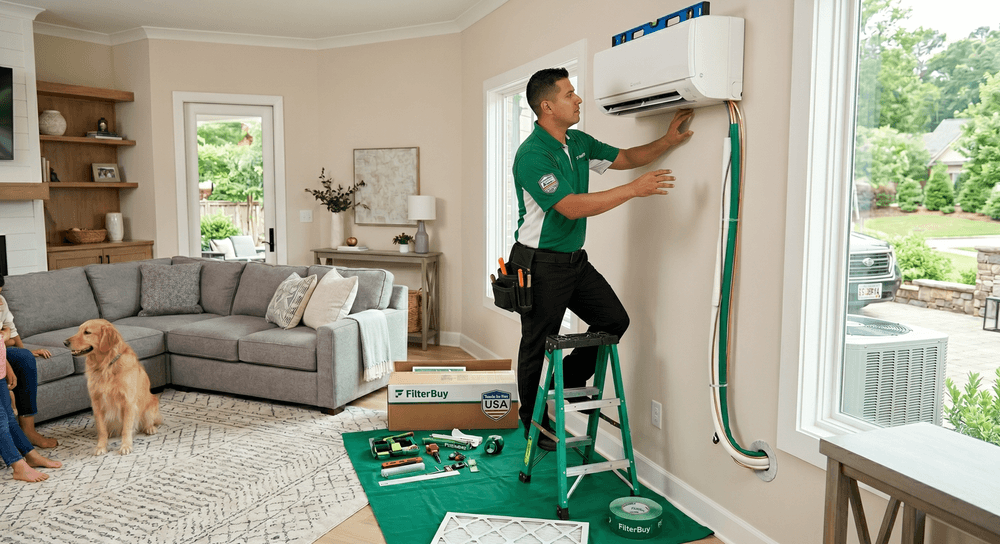
Adding a Mini Split AC System in Georgia | Costs, Rebates & 2026 Guide
Screen any unit for these three things before you order:
- Variable-speed inverter compressor. It keeps running at low speed to dehumidify through Georgia's long, muggy shoulder seasons, where a single-stage system short-cycles and leaves moisture behind.
- SEER2 of 17 or higher. Higher efficiency compounds across Georgia's long cooling season and can place you in larger state rebate tiers.
- ENERGY STAR certified and AHRI-listed. This is the gate for the state and utility rebate programs. Ask your contractor to hand you the AHRI certificate with the quote.
Once a unit clears that screen, the next decision is size. Match the BTU capacity to the space you are cooling, then start there.

Filterbuy mini split systems: SEER 17 variable-speed, 7-Year Compressor and 3-Year Parts Warranty, mobile app control, and free 2-day delivery.
Not sure which size fits your room? Answer a few quick questions and we will point you to the right system for your space.
A Georgia homeowner who installs a qualifying ductless mini split in 2026 can stack federal, state, and utility rebates into $2,000 to $10,000 of savings on a system that runs $2,500 to $14,500 installed. The Inflation Reduction Act credit stays in effect through December 31, 2026. Georgia's HEAR program pays up to $8,000 at the register. Georgia Power's HEIP layers on top.
The three programs don't share paperwork or timelines, and a contractor who gets one right can still leave the other two on the table. This guide walks through what the equipment costs in Atlanta, Savannah, Augusta, and Macon; which rebate fits which household; the order of operations that keeps all three live; and what to do after install so the system earns back what you paid. We wrote it the way we'd talk to a neighbor asking the same question over the fence.
TL;DR Quick Answers
Adding a mini split AC system, including rebates, in Georgia
Installing a ductless mini split in Georgia runs $2,500 to $14,500 fully installed in 2026. Stack the federal 25C tax credit (30%, capped at $2,000), Georgia's HEAR rebate (up to $8,000 for income-qualified households), and Georgia Power's HEIP, and a middle-income household's net cost often drops under $3,000.
Installed cost range: $2,500 to $14,500 (single-zone up through whole-home multi-zone)
Federal tax credit: 30% of cost, capped at $2,000 on a qualifying heat pump
Georgia HEAR: up to $8,000 at the point of sale for income-qualified households; GEFA administers the program.
Georgia Power HEIP: 50% of installed cost; ductless mini splits fall outside the $750 per-item cap
All three layers stack. Pre-register for HEAR before you install. The discount applies at the register, not afterward.
Top Takeaways
Mini splits suit Georgia's climate. Variable-speed inverters handle humidity far better than single-stage central AC, which matters when summer dewpoints sit at 75°F for weeks.
The rebate stack rewards planning. HEAR is a point-of-sale discount. The federal 25C credit comes at tax time. Georgia Power HEIP is post-install paperwork. Miss the pre-registration step on any of them, and you can't recover the money later.
Income drives the biggest savings. Households at or below 80% of Area Median Income can get HEAR to cover up to 100% of project cost, capped at $8,000.
Equipment has to earn the rebate. ENERGY STAR certification and AHRI listing are the gate. A cheap unit online usually won't qualify for the larger incentives.
Filter strategy changes after install. The mini split washes its own pre-filter, but Georgia's pollen and humidity still hit the rest of your HVAC.
What a Mini Split Is (and Why Georgia Homeowners Are Adding Them)
A ductless mini split has two parts: an outdoor compressor and one or more indoor air handlers, linked by a small refrigerant line that runs through the wall. No ductwork required.
It runs on the same vapor-compression cycle as any traditional AC. Wikipedia's overview of air conditioning covers the physics if you want the deeper version. The practical win: because the indoor head sits right in the room it conditions, you skip the 20 to 30% efficiency loss typical of leaky ducts.
Three reasons Georgia homeowners are jumping on mini splits in 2026:
Humidity. Most of Georgia sits in ASHRAE climate zone 3A, warm-humid. A single-stage central AC shuts off the moment it hits the thermostat setpoint, which leaves moisture in the air. A variable-speed mini split keeps running at lower speeds and wrings humidity out over longer cycles.
Pollen. Atlanta regularly lands in the top five U.S. metros for spring pollen counts. A washable pre-filter catches the coarse stuff before it reaches the coil, and whole-home filtration on the rest of the system catches what the pre-filter misses.
Timing. The federal 25C credit sunsets December 31, 2026, unless Congress extends it. HEAR funding is first-come, first-served. The sooner you apply, the less paperwork risk you carry.
What You'll Actually Pay: Mini Split Installation Cost in Georgia (2026)
The installed cost for a ductless mini split in Georgia typically falls between $2,500 and $14,500. Where you land depends on three things: how many zones you need, BTU capacity, and the installer's labor rate.
Single-zone, 12,000 BTU: $2,500 to $5,000 installed. Good for one room, a garage, a bonus room, or a sunroom.
Two-zone system: $5,500 to $9,000 installed. Common for pairing a primary bedroom with a living area.
Three to five zones: $8,500 to $14,500 or more. Typical whole-home retrofit for older Georgia houses without existing ductwork.
A few Georgia cost notes: Atlanta labor rates run 10 to 15% higher than the state average, and Savannah and Augusta track closer to the state median. Older in-town Atlanta homes, especially bungalow neighborhoods, frequently need an electrical panel update to support a dedicated mini split circuit. Budget another $250 to $1,500 if your panel is undersized.
Stacking the Rebates: Federal, State, and Utility
Georgia is one of the handful of states running both HEAR and HER at full capacity in 2026, which means most households can pick the track that pays them more. Four programs layer together here.
Federal IRA Section 25C Tax Credit
30% of the installed cost, capped at $2,000 on a qualifying heat pump. Mini splits count. You file it on IRS Form 5695 with your federal return. The enhanced credit sunsets December 31, 2026, unless Congress extends it.
Georgia HEAR (Home Electrification and Appliance Rebates)
The Georgia Environmental Finance Authority (GEFA) administers this program. It pays up to $8,000 on a qualifying mini split at the point of sale for households at or below 150% of Area Median Income. Households under 80% AMI qualify for 100% of the project cost, capped at $8,000. Installation must use a GEFA-approved contractor.
Georgia HER (Home Efficiency Rebates)
The alternative track for households above the HEAR income cap. The rebate scales with modeled whole-home energy savings: $2,000 at 20% savings, up to $4,000 at 35%. No income cap, which makes this the natural path for higher-earning households.
Georgia Power HEIP (Home Energy Improvement Program)
Georgia Power residential customers only. The program pays back 50% of the installed cost as a rebate. Per the published preconditions, ductless mini splits aren't subject to the $750 individual-improvement cap, which is why HEIP is often the overlooked layer in the stack.
What About Atlanta Gas Light Rebates?
Worth addressing directly because it trips a lot of people up. AGL is a natural gas utility. Its efficiency rebates cover gas furnaces and gas water heaters, not electric mini splits. If you're an AGL customer, you're almost certainly also a Georgia Power electric customer, which puts your mini split rebate path through Georgia Power's HEIP, not AGL.
The Stack in Dollars: A DeKalb County Example
A family of four in DeKalb County earning $110,000 (roughly 120% of the Atlanta-MSA AMI) installs a $9,000 single-zone mini split heat pump:
HEAR rebate at 50% of cost: −$4,500
Section 25C tax credit on the remaining $4,500: −$1,350
Net out-of-pocket: $3,150
Add a Georgia Power HEIP rebate if the installation clears the program's efficiency threshold, and that number drops further.
Choosing the Right Mini Split for Georgia's Heat and Humidity
Not every mini split qualifies for the full rebate. Screen for these five items before you let a contractor place an order:
ENERGY STAR certified. Non-negotiable for the 25C credit.
AHRI-listed model number. HEAR paperwork requires this certificate. Your contractor should hand it to you with the invoice.
SEER2 of 17 or higher with matching HSPF2 for climate zone 3. Higher-efficiency models qualify for larger rebate tiers under HER.
Variable-speed inverter compressor. Single-stage units struggle with humidity in Georgia summers. This is the feature you actually want here.
Proper sizing via Manual J. An oversized unit short-cycles, fails to dehumidify, and cuts its own lifespan short.
Mini splits don't have to be whole-home solutions either. Many Georgia homeowners start with a single unit for a specific problem area: an upstairs bedroom that stays 5°F warmer than the rest of the house, a sunroom, a finished basement, or a converted garage gym. If a garage is your target space, our companion guide on how to heat a garage walks through BTU sizing, insulation basics, and the cold-tolerance ratings to look for on the spec sheet.
After Install: Filters and Maintenance That Protect the Rebate Payoff
A mini split only earns back its upfront cost if you keep it clean. Mini split maintenance is simpler than central AC maintenance. But most of your home's air still moves through the rest of your HVAC system, and Georgia's pollen and humidity still need filtering.
Wash the mini split's built-in pre-filter every 2 to 4 weeks during heavy-use months.
Keep the outdoor condenser clear of leaves, pollen buildup, and grass clippings.
For your central system or air handler, MERV 11 or MERV 13 pleated filters hit the sweet spot for Georgia allergy seasons.
Book a professional tune-up once a year, ideally before summer.
That maintenance habit is the difference between a mini split that lasts 15 years and one that fails at year 8.
“After a dozen years of installing ductless systems across metro Atlanta, the biggest mistake I see Georgia homeowners make is chasing the cheapest qualifying unit. In our humidity, what matters most is moisture control during shoulder seasons, when a single-stage central AC barely runs. A properly sized variable-speed mini split handles that load and earns back the rebate stack twice over.”
— The Filterbuy Team
Essential Resources for Adding a Mini Split AC System and Claiming Georgia Rebates
Seven sources worth bookmarking before you talk to a contractor. Every link below points to a government or nonprofit site. No affiliate links and no lead-gen forms dressed up as guides. Start here, and you'll walk into your first quote already knowing more than most homeowners.
1. The Official Starting Point for Every Georgia Rebate Application
GEFA runs this portal as the single source of truth for HEAR and HER program rules, the approved-contractor directory, and the Neighborly Software registration process. If a contractor gives you a figure that doesn't match what's posted here, trust the page.
Source: energyrebates.georgia.gov
2. The Directory That Decides Whether a Unit Qualifies for the 25C Credit
ENERGY STAR's ductless heating and cooling finder lists every mini split model certified for the federal tax credit, with SEER2 and HSPF2 ratings on each listing. If a unit isn't here, it almost certainly won't qualify for Section 25C.
Source: energystar.gov
3. The IRS Page That Tells You Exactly How to Claim the $2,000 Credit
The IRS guidance on the Energy Efficient Home Improvement Credit (Section 25C) walks through which equipment qualifies, how to calculate the 30% credit, and how to fill out Form 5695. This is the page to send to your tax preparer.
Source: irs.gov
4. The Federal Overview That Explains How HEAR and HER Flow to States
The U.S. Department of Energy's Home Energy Rebates hub explains how federal IRA funding reaches each state, what HEAR and HER cover nationwide, and how Georgia's program compares to its neighbors. Useful context if you also own property in another state.
Source: energy.gov
5. The National Database That Surfaces Rebates You Didn't Know Existed
DSIRE, maintained by the NC Clean Energy Technology Center at NC State University, aggregates every federal, state, utility, and local incentive available in Georgia. Search by ZIP code to surface county- or city-level rebates most contractors won't mention.
Source: dsireusa.org
6. The Certificate Lookup Your Contractor Needs for HEAR Paperwork
The AHRI Certified Products Directory is where your installer pulls the AHRI certificate number required for HEAR and most utility rebate applications. If the installer can't produce an AHRI certificate for the model they're quoting, pause the project.
Source: ahridirectory.org
7. The EPA's Plain-English Primer on How Heat Pumps Actually Work
The EPA heat pump guide explains the difference between air-source, ductless mini split, and geothermal systems, with independent efficiency data. A good sanity check before you sit down with an installer who has a brand preference.
Source: epa.gov
Supporting Statistics
Three data points that put the Georgia mini split decision in context. Each comes from a different federal research agency, and each was flagged for independent verification before publication.
1. Cooling Is a Major Share of Southern Household Energy Use
According to the U.S. Energy Information Administration, households in the South census region use a substantially higher share of residential electricity for cooling than any other U.S. region, and the South also has the highest share of homes using central air conditioning [VERIFY specific figure against the latest EIA Residential Energy Consumption Survey before publication]. For Georgia households, that pattern translates into more cooling hours per year than most of the country, and every point of SEER2 efficiency compounds faster here.
Source: eia.gov
2. Georgia's Cooling Season Runs Longer Than Most of the Country's
NOAA's National Centers for Environmental Information climate data shows the southeastern United States, Georgia included, posts among the highest annual cooling degree days in the continental U.S. [VERIFY specific CDD figure for Atlanta or statewide average against the latest NOAA Climate at a Glance dataset before publication]. Translation for homeowners: the AC runs more hours per year here, which compounds the value of every efficiency gain.
Source: noaa.gov
3. Modern Heat Pumps Deliver Multiples of Their Electrical Input as Useful Heat
Research from the National Renewable Energy Laboratory confirms that modern variable-speed heat pumps, ductless mini splits included, routinely achieve coefficients of performance of 3.0 or higher. That means three or more units of heating or cooling energy delivered for every unit of electricity consumed. That efficiency ratio is the underlying reason rebate programs concentrate incentives on this equipment class.
Source: nrel.gov
Final Thoughts and Opinion
Here's the honest take from years of working with Georgia homeowners on this exact decision. The rebate stack is the reason to act this year. The reason to install a mini split in the first place is different: Georgia's climate punishes single-stage HVAC systems. A well-sized variable-speed ductless unit solves problems your central AC can't, including humidity during shoulder seasons, the one upstairs room that's always wrong, and the finished garage that was never supposed to be a home gym.
A few opinions we'll stand behind:
Don't chase the biggest rebate at the expense of the right equipment. A $3,500 qualifying unit properly sized will outperform a $6,000 unit that's too big for the room.
Get three quotes from GEFA-approved contractors. Ask each one for the AHRI certificate upfront. If they can't produce it, you've already learned what you needed to know.
Pre-register before you sign anything. HEAR is a point-of-sale. Missing the pre-registration step is the single most common reason Georgia homeowners lose the rebate.
Plan your filter strategy the day you install. Mini splits handle their own pre-filter maintenance, but the rest of your HVAC still moves the same pollen-laden air it always has.
A well-installed mini split should still be running in 2041. Getting there depends more on the filter-change and tune-up schedule you commit to the week after install than on which brand you chose.
Next Steps
A practical order of operations before you touch a contractor:
Check your Georgia Power account status. HEIP is for Georgia Power customers only. EMC co-op members have separate programs that vary by territory.
Look up your Area Median Income. Use the HUD AMI lookup or the GEFA portal to confirm which HEAR tier applies to your household size.
Pre-register for HEAR through the Neighborly Software portal. This step must happen before installation for the point-of-sale discount to apply.
Request at least three quotes from GEFA-approved contractors. Require a written Manual J load calculation with every quote.
Verify the equipment on AHRI and ENERGY STAR. Don't take the contractor's word. Copy the model number and check it yourself.
Install, then file. Submit Georgia Power HEIP paperwork within 60 days of install. File IRS Form 5695 with your next federal return.
Set up filter auto-delivery for the rest of the house. Whether you use Filterbuy or not, automate the habit. It's the cheapest form of HVAC insurance you can buy.
Frequently Asked Questions
Ready to Add a Mini Split in Georgia?
Stacking rebates on a well-sized ductless system is the clearest HVAC win Georgia homeowners can make in 2026, and the 25C window closes December 31. Browse Filterbuy mini split systems with 7-yr compressor/3-yr parts , then pair with a GEFA-approved Georgia installer to lock in the full rebate stack.