How to Cool a Garage?
April 9, 2026
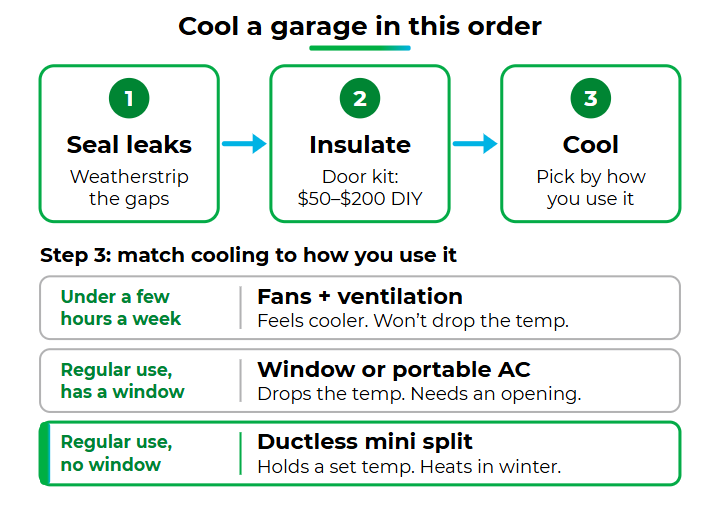
Seal air leaks and insulate the garage door first, then pick a cooling method that matches how often you use the space. Fans and ventilation are cheap, but they can’t drop the air below the outdoor temperature.
Fans and ventilation ($30–$400): feel cooler, but won’t lower the temperature.
Window or portable AC ($200–$800): lowers the temperature, but needs a window or vent opening.
Ductless mini split ($3,200–$7,500 installed): holds a set temperature with no window, and heats in winter.
Filterbuy’s 12,000 BTU mini split is $799 and sized for a typical 1-car garage. Like any mini split, it needs a licensed HVAC pro to install. Not sure what size you need? Take the quick quiz below.
Free 2-day delivery on in-stock systems. 7-year compressor and 3-year parts warranty.
Answer a few quick questions and we’ll match your garage to the right mini split.
TL;DR
Cooling a garage requires a two-step approach: reducing heat intake through insulation and air sealing, then choosing a cooling method matched to your usage. Passive methods (fans, door insulation) reduce heat buildup at low cost but cannot lower air temperature below outdoor ambient levels. For active refrigeration, window ACs and portable ACs offer budget solutions if an exterior opening is available. Ductless mini splits provide whole-room climate control without windows, but require professional installation and electrical setup, typically costing $3,200–$7,500 installed.
Key Takeaways
Garages heat up rapidly due to large uninsulated doors, roof radiation, lack of home HVAC connection, and residual heat from parked vehicles.
Airflow and insulation come first. Insulating the garage door ($50–$200 DIY) and sealing air gaps significantly reduce thermal load before purchasing cooling equipment.
Active cooling requires heat displacement. Portable units, window ACs, and mini splits all need a pathway to discharge heat outside the garage.
Garages require higher cooling capacity per square foot (typically 25–40 BTU/sq ft) than standard home interior rooms due to thermal leaks and structural heat loads.
Safety is paramount. Never run gas engines or combustion equipment inside an enclosed garage, even with doors or exhaust fans running.
Why Garages Get 20–30°F Hotter Than Outside
Under summer sun, unconditioned garages frequently experience internal temperatures significantly higher than outdoor air, sometimes exceeding ambient temperatures by 20°F to 30°F or more in severe conditions. Multiple factors contribute to this intense heat trapping:
Uninsulated Construction: Standard garage doors and exterior walls often lack thermal insulation, allowing direct solar radiation to heat the structure continuously.
Lack of HVAC Integration: Garages are isolated from the home's central air conditioning, leaving no continuous air exchange or temperature management.
Internal Thermal Sources: Parking a hot vehicle inside transfers substantial heat from the engine block, exhaust system, and brakes directly into the sealed space.
Garage Cooling Options Compared
Before purchasing an air conditioner, implement low-cost passive methods to control heat entry and promote basic air movement.
1. Insulate the Garage Door and Walls
Installing a garage door insulation kit ($50–$200 DIY) adds reflective or rigid foam barriers that cut radiant heat gain. Insulating exposed wall studs and the ceiling further reduces overall thermal transfer, making subsequent cooling methods far more effective.
2. Seal Air Leaks and Gaps
Replacing worn bottom weatherstripping and sealing wall penetrations prevents hot exterior air from infiltrating the garage. Proper air sealing is essential prior to operating active air conditioning.
3. Air Circulation via Fans
High-velocity floor or wall fans create wind-chill comfort across skin while working, though they do not reduce ambient air temperature. Circulating fans are economical ($30–$200) for short-term occupancy.
Garage Cooling and Climate Control Options Compared
Installed cost for a ductless mini split covers equipment plus professional labor. Fan, ventilation, portable, and window prices are equipment only.
A mini split costs several times more than a window unit upfront, operates as low as 28 dB in Mute Mode, and replaces a separate winter heater. Its variable-speed inverter compressor also adjusts output to demand instead of cycling on and off, so it uses less energy holding a temperature than a fixed-speed window unit does.
What About an Evaporative (Swamp) Cooler?
An evaporative cooler is a real option for a garage, but only where summer humidity is genuinely low. In practice, that means the desert Southwest and the high plains. It cools by evaporating water into the airstream, so it drops temperature and raises humidity at the same time. In Phoenix or Albuquerque, that trade is worth making, and the unit costs a fraction of a mini-split. In Houston or Atlanta, it is not, and a garage full of steel tools is the wrong room to add moisture to. An evaporative cooler also needs a continuous water supply and an open vent path, because the air it humidifies has to leave the building.
How to Cool a Garage Without AC
Fans, air sealing, and exhaust ventilation make a hot garage tolerable for $100 to $600, but none of them lowers the temperature below outdoor air. Fans move air across your skin so it feels cooler. An exhaust fan removes heat collected at the ceiling. Weatherstripping and a new bottom seal stop hot air leaking in.
Size the exhaust fan to air volume, not floor area:
CFM = (Length × Width × Ceiling Height × Air Changes per Hour) ÷ 60
Use 6–8 air changes per hour for storage and light use, 10–12 if you sand, weld, spray-paint, or run a gas engine indoors. A 450 sq ft garage with 9-foot ceilings holds 4,050 cubic feet, so 8 ACH needs a 540 CFM fan.
Mount the fan high on the wall opposite your intake, because heat stratifies at the ceiling, and give it a make-up air path, such as a louvered vent low in the wall or door. A fan with no inlet just depressurizes the room. Filterbuy HVAC Solutions technicians see this one constantly in Florida and Texas garages: a good exhaust fan installed with nowhere for replacement air to come from, moving a fraction of its rated CFM.
One rule once you add AC: don't run the exhaust fan while the mini split is cooling.
How to Insulate a Garage to Keep It Cool
Insulating the garage door is the highest-return single upgrade in a garage. A DIY kit costs $50–$200 and raises the door from roughly R-0 to between R-4 and R-9. Insulation does not cool the garage on its own. It makes every other method work better and usually lets you buy a smaller unit.
Recommended R-Values for a Garage
R-value targets vary by climate zone. See the U.S. Department of Energy insulation guidance for zone-specific recommendations.
Targets vary by climate zone. ENERGY STAR's recommended home insulation R-values, which follow the 2021 International Energy Conservation Code, call for R30 attic insulation in the warmest zone and R60 in the coldest.
Do it in this order: seal air leaks, insulate the door, insulate the ceiling, insulate walls, then size the equipment. Air leaks defeat R-value, so sealing comes first.
What Size Mini Split Do You Need for a Garage?
Square footage provides only a starting estimate for garage AC sizing. Standard home interior sizing (~20 BTU/sq ft) is insufficient for garages due to structural heat gains. Garages typically require 25 to 40 BTU per square foot, adjusted for insulation level, ceiling height, climate, and internal heat loads.
Mini Split Sizing by Garage Type
Add 20–25% capacity for an uninsulated garage, ceilings above nine feet, or unshaded western exposure. Confirm final sizing with a Manual J load calculation.
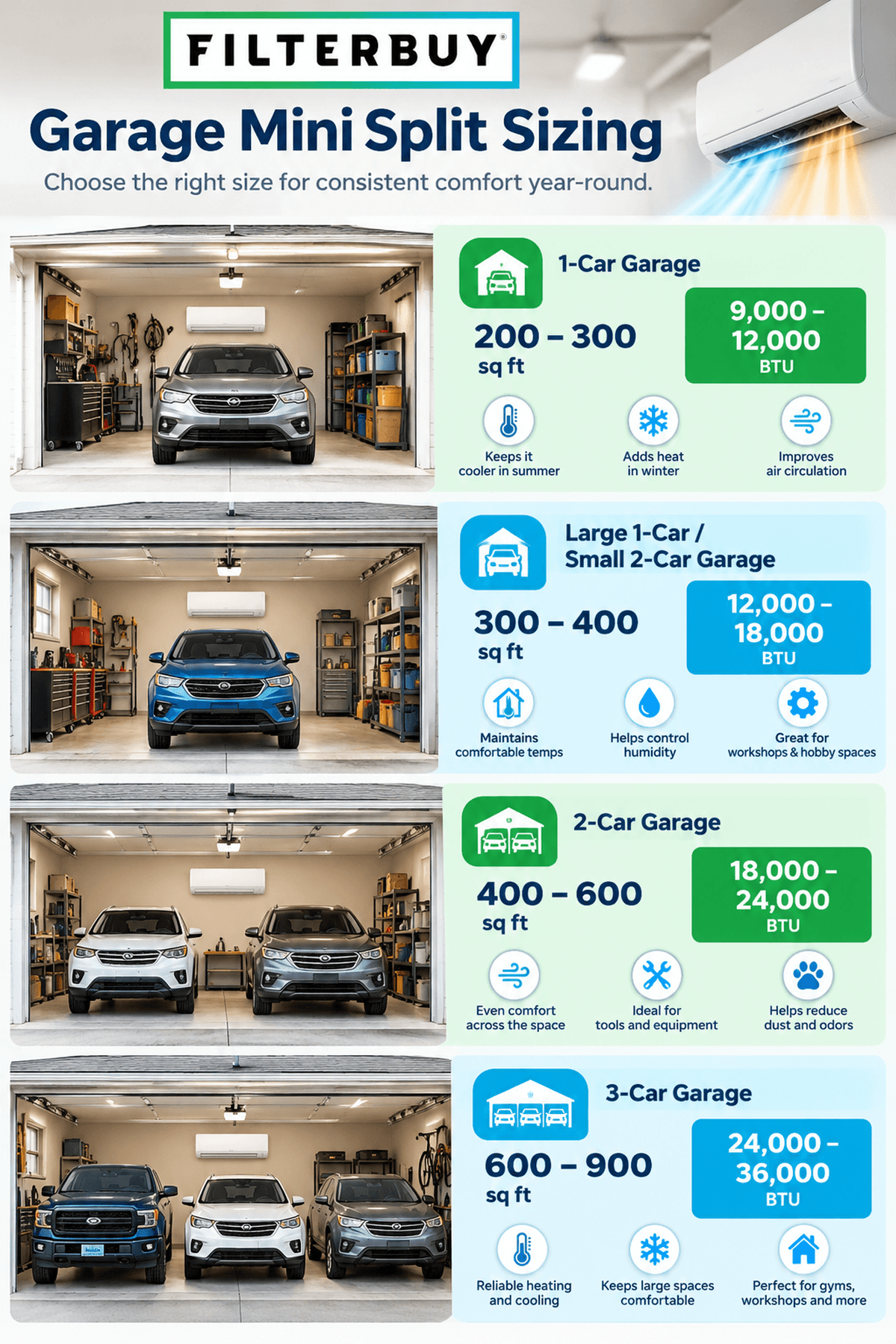
Homeowners size a garage off square footage the way they would size a bedroom, and that is the most expensive mistake in this job. A bedroom has insulated walls with conditioned space on the other side of them. A garage has a steel door facing the afternoon sun and an unconditioned attic overhead. Same square footage, completely different load.
Do not oversize beyond that. An oversized mini split cools fast, satisfies the thermostat, and shuts down before removing much moisture, which means condensation, rust on tools, and short-cycling. ENERGY STAR advises having your contractor verify capacity with a Manual J load calculation rather than square footage alone. For the full walkthrough, see how to choose a mini split system.
How Much Does It Cost to Cool a Garage?
Overall project costs depend on whether equipment can be self-installed or requires professional trade installation. Passive fixes and portable ACs cost $30 to $700. Professionally installed ductless mini splits range from $3,200 to $7,500+, depending on unit size, electrical panel capacity, and line set length.
Cost to Cool a Garage (2026)
Ranges reflect 2026 U.S. contractor pricing. Permits, an outdoor disconnect, and electrical panel work commonly add $200–$1,500.
Treat $3,500 as your anchor. That is the national average Angi reports for a garage mini split installation, across a full project range of roughly $500 to $14,500. The narrower per-size ranges in the table above come from 2026 contractor quote patterns rather than a national survey, so use them to sanity-check a quote, not to argue one down. Permits, a disconnect, and panel work commonly add $200–$1,500.
Get at least three quotes, because variation of 20–40% between contractors on the same job is common. Ask each to price labor-only installation of equipment you supply alongside their all-in number, a route that only exists because brands like Filterbuy sell factory-direct to homeowners, and see what to ask your HVAC installer before buying a mini split. On running costs, our mini split cost-per-month breakdown works the math, and ENERGY STAR reports certified mini splits use up to 60% less energy than standard electric resistance heating.
One thing to check: the federal Section 25C credit, worth up to $2,000 toward qualifying heat pump mini splits, applied only to systems placed in service through December 31, 2025, per ENERGY STAR’s federal tax credit guidance. The credit was terminated for systems placed in service after December 31, 2025, so confirm your own eligibility with a tax professional rather than relying on this page. Some state and utility programs run independently of the federal credit and often set their own SEER2 or HSPF2 minimums. Check your utility and your state energy office for what is current, and for what it is actually worth.
What Does It Cost to Run?
Sample Operating Cost Calculation: A 12,000 BTU mini split (approx. 1.0 kW electrical draw at full compressor speed) operating 8 hours per day in an insulated garage at an average electricity rate of $0.15/kWh costs approximately $1.20 per day (~$36/month). Because inverter compressors throttle down once setpoint is reached, intermittent or part-load usage lowers operating costs further.
If you use the space on weekends and a couple of weeknights, you are realistically looking at a fraction of that in summer, because a variable-speed inverter draws full power only during the initial pull-down and then throttles back to hold temperature. The mini split cost-per-month breakdown runs the math against your own rate.
The exception is an uninsulated garage. There the unit never reaches steady state. It stays near full output fighting heat that keeps arriving, so it runs closer to the published number even on short sessions. This is the operating-cost argument for insulating first, and it is larger over five years than the difference between any two brands you are comparing.
Electrical, Permits, and Code
Electrical and Code Requirements. Most 18,000+ BTU mini splits require a dedicated 208/230V circuit, whereas select 9,000–12,000 BTU models offer 115V configurations. Per National Electrical Code (NEC 440.14), a weatherproof disconnect switch must be installed within sight of the outdoor condenser. Line sets are factory pre-charged up to specific distances (commonly 25 ft); additional refrigerant charge must be weighed in by a licensed technician if line lengths exceed manufacturer limits.
Garage Mechanical Code Constraints: Model mechanical codes mandate that any potential ignition source in a garage be elevated at least 18 inches above the floor to prevent ignition of heavy gasoline vapors. Verify that the garage door and opener track clear the indoor air handler during full operation.
Unpermitted work can trigger fines, give an insurer grounds to deny a claim, and void parts warranties. A mini split is hardwired equipment and requires professional installation. On Filterbuy systems, self-installation voids the manufacturer warranty outright, so the work belongs to a licensed HVAC contractor, with a licensed electrician for the circuit and the disconnect.
What Cooling Won't Fix: Garage Air Quality
A mini split makes a garage comfortable but does not clean the air, and sealing the room to cool it can make air quality worse. Garages concentrate pollutants living spaces do not: vehicle exhaust and carbon monoxide, gasoline and solvent vapors, brake dust, sanding dust, welding fumes. Air-sealing removes the leakage that diluted them. The equipment is not the problem. ENERGY STAR notes a mini split has no combustion and so no direct NOx, CO2, or carbon monoxide emissions. What you do in the room is. The pattern in the questions homeowners send us is consistent: the cooling gets solved, the air gets quietly worse, and nobody connects the two until something smells.
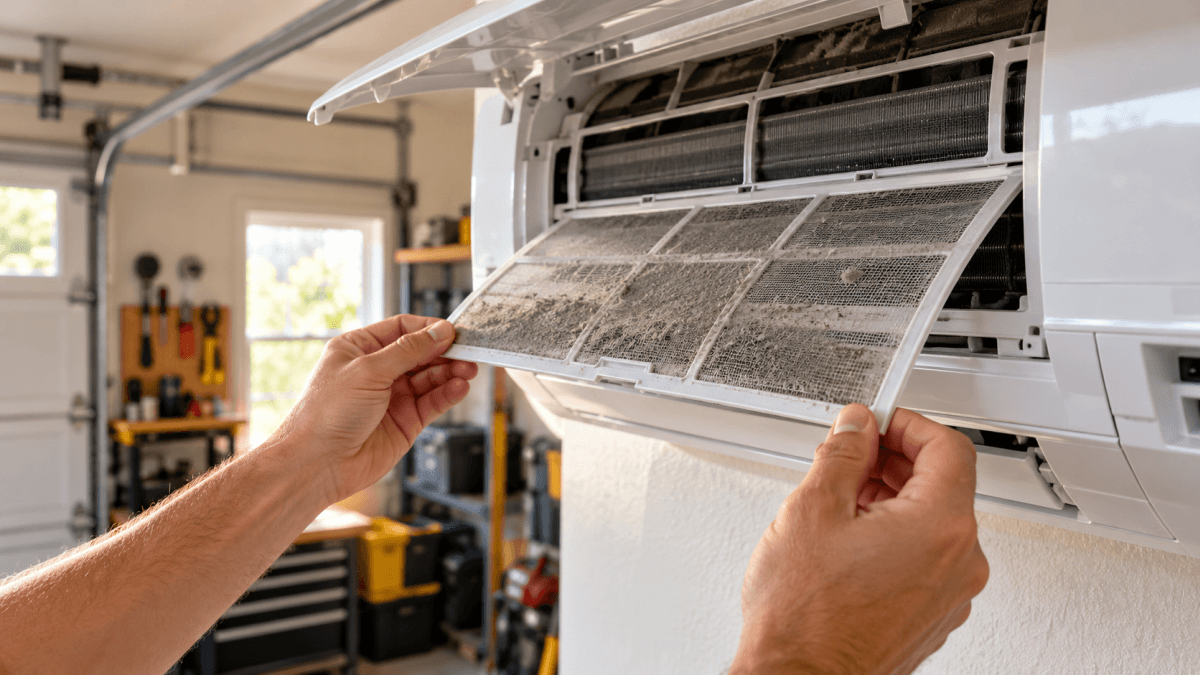
The mistake I see most often is not buying the wrong unit. It is sealing a garage up beautifully and never asking what is now trapped in there with you. Filtration is the thing we actually make, so let me be plain about the mesh screen inside that indoor head: it was never designed to clean your air. It is there to protect the coil. The filter doing the work for the air you breathe is the one in your return.
Mini split filters are pre-filters, not air filters. The washable mesh screens inside the indoor head keep lint off the evaporator coil. They carry no MERV rating and capture almost nothing in the fine-particle range that matters for health. See how mini split filtration affects indoor air quality.
Capture at the source. Tool-mounted dust collection plus exhaust ventilation beats filtering afterward.
Never move garage air into the house. Weatherstrip the shared door and install a UL 2034 carbon monoxide alarm on every level of the home. The U.S. Consumer Product Safety Commission warns never to leave a car running in an attached garage, even with the door open.
Upgrade the home's HVAC filter. A Filterbuy MERV 13 air filter captures fine particulates that lower ratings pass, and an odor eliminator filter with activated carbon adsorbs fuel and paint odors that no particulate filter can touch. The U.S. Environmental Protection Agency recommends a MERV 13 filter, or the highest rating your system can accommodate, for reducing indoor particles. Check the equipment before you change ratings: a higher-MERV filter adds airflow resistance, not every system is built for it, and your HVAC manual or a technician should confirm compatibility. Filterbuy makes both in 600+ standard sizes plus custom, so an odd return grille next to an attached garage is not a reason to settle for the wrong rating.
Clean the pre-filter monthly. Sawdust and brake dust load these screens fast, so follow our guide to cleaning a mini split.
The order that works: ventilate while you work, cool when you're done, filter what reaches the house.
Our Pick: Filterbuy 12,000 BTU Mini Split
The Filterbuy 12,000 BTU ductless mini split is $799 with free 2-day delivery on in-stock systems, a 7-year compressor and 3-year parts warranty, and a published price you do not have to request a quote for. It is a single-zone, variable-speed inverter heat pump on R32 refrigerant, ETL and AHRI certified, with WiFi and app control, refrigerant leak detection, high-temperature self-cleaning, heating down to 5°F, and operation as low as 28 dB in Mute Mode. At 17 SEER2 it clears the federal minimum rather than leading on efficiency. It is built for value, and a garage is the room where that trade costs you least: you use it in bursts, not on a bedroom schedule, so the hours you are paying for the difference are few. If this were your primary living zone we would point you at a higher-SEER2 unit. It ships in both a 115V version and a 230V version, so the same capacity fits either circuit type.
Filterbuy ships factory-direct and does not provide local installation. Mini splits are hardwired equipment: self-installation voids the manufacturer warranty, so the work belongs to a licensed HVAC professional, with a licensed electrician for the circuit and disconnect.
When a Mini Split Is the Wrong Answer for Your Garage
A ductless mini split is the wrong purchase for most garages. It earns its cost in a space you occupy regularly and want held at a temperature. If that is not your garage, insulation and ventilation get you most of the comfort for a tenth of the money. Five situations where we would tell you not to buy one:
You use the space under a few hours a week. A $150 door insulation kit and a $60 fan solve a walk-through garage. A $4,500 system does not pay back on twice-daily trips to the car.
You rent. A window or portable unit moves with you. A mini split is a permanent penetration through an exterior wall and a fixed circuit, and it becomes your landlord’s asset.
Your garage has open stud bays and a bare roof deck. The unit will run continuously and still lose on a 100°F afternoon. Insulate, then reassess. You may find you no longer need the system you were about to buy.
Your electrical panel is full. Price the subpanel or panel upgrade before the equipment. On older 100-amp service that electrical work can cost more than the mini split, which changes the whole calculation.
Your garage is detached and far from the house. Systems ship pre-charged for a set run, 25 feet on Filterbuy units, against a maximum line length of 50 feet on the 12,000 and 18,000 BTU systems and 65 feet on the 24,000. Past the pre-charged length the installer has to add refrigerant, and a long line set plus a separate circuit run pushes a straightforward job into premium territory.
Filterbuy sells these systems factory-direct, so this list costs us sales. We would still rather you insulate a door for $150 than spend thousands conditioning a room you walk through twice a day.
Five Mistakes We See Most Often
Most garage cooling projects fail for the same handful of reasons, and none of them is the equipment. These come from what Filterbuy HVAC Solutions technicians and the Filterbuy support team hear after the fact.
Venting a portable AC through a cracked garage door. The hose dumps heat outside, but the open gap pulls in roughly as much hot air as the unit removes. Vent through a purpose-cut panel or a window, not a gap.
Running the exhaust fan and the air conditioner together. Ventilation and cooling are opposite jobs. Ventilate while you generate fumes or dust, then close up and cool.
Buying one size up "to be safe." In a humid garage this backfires: the unit satisfies the thermostat before it has removed moisture, and you get condensation and rusted tools in a space that is technically at 72°F.
Mounting the indoor head in the door’s path. Measure the full travel of the garage door and the opener arm before the installer drills. This is the most common callback Filterbuy HVAC Solutions hears about, and it is entirely preventable with a tape measure.
Sealing the garage tight and stopping there. Air sealing is the right first move, and it removes the accidental ventilation that was diluting exhaust and solvent vapor. Add deliberate ventilation and a carbon monoxide alarm in the same project, not the following summer.
Supporting Statistics
Three findings from U.S. federal research explain why the order of operations on this page (seal, insulate, then cool) is the one that works.
5x — A garage leaks about five times more air than the house it is attached to.
Studies on air exchange (such as NISTIR 7072 testing attached garages) demonstrate that unsealed attached garages experience elevated air leakage compared to living quarters. This highlights the importance of sealing garage wall gaps before adding cooling equipment.
Why it matters for a garage: That leakage is the same path in both directions: it is how outdoor heat loads the garage in August, and how gasoline vapors and exhaust reach the living space year-round. It is also why sealing comes before insulating, and insulating before buying equipment.
Source: NIST / U.S. Department of Housing and Urban Development, NISTIR 7072: Air and Pollutant Transport from Attached Garages to Residential Living Spaces
15% — Air sealing and insulation cut heating and cooling costs by an average of 15%.
According to U.S. EPA and ENERGY STAR estimates, comprehensive home envelope air sealing and insulation yield average heating and cooling savings of ~15%. Individual garage results vary depending on structure baseline and climate zone.
Why it matters for a garage: A garage is the least-insulated room in that under-insulated housing stock, so the return on a $50–$200 door insulation kit is higher there than anywhere else in the house. It can also let you size the mini split a capacity tier smaller.
Source: U.S. EPA / ENERGY STAR, Why Seal and Insulate?
200+ — More than 200 people die in the U.S. every year from carbon monoxide produced by consumer products.
U.S. Consumer Product Safety Commission (CPSC) data underlines the danger of carbon monoxide accumulation from running fuel-burning engines or equipment in enclosed or semi-enclosed spaces. Always maintain proper combustion isolation.
Why it matters for a garage: This is the trade-off nobody mentions when they tell you to seal and cool a garage. Tightening the room removes the accidental ventilation that used to dilute exhaust and fuel vapor, so source control and CO alarms have to come with the upgrade.
Source: U.S. Consumer Product Safety Commission, Carbon Monoxide Fact Sheet
Frequently Asked Questions
How Much Does It Cost To Install A Mini Split In A Garage?
A professionally installed ductless mini split typically costs between $3,200 and $5,200 for a 1-car garage and $4,500 to $7,500+ for a 2-car garage in 2026, depending on electrical needs and structural layout.
What Size Mini Split Do I Need For A 2-Car Garage?
A standard 400–600 sq ft 2-car garage typically requires an 18,000 to 24,000 BTU cooling system operating on a dedicated 230V electrical circuit, adjusted for local insulation levels.
What Is The Cheapest Way To Cool A Garage?
The lowest-cost approach combines a DIY garage door insulation kit ($50–$200), weatherstripping, and high-velocity circulation fans ($30–$200). Note that fans improve circulation but do not lower air temperature below outdoor ambient levels.
How Can I Cool A Garage With No Windows?
Ductless mini splits are ideal for windowless garages because they require only a 3-inch wall penetration for refrigerant lines. Alternatively, portable ACs or exhaust fans require cutting dedicated exterior wall vent ports.
Is A Mini Split Worth It For A Garage I Barely Use?
Usually not. A ductless mini split earns its cost in a garage you occupy regularly. For a walk-through garage, a door insulation kit and a fan deliver most of the comfort for a fraction of the price.
Glossary
ACH (air changes per hour). How often a fan replaces a room's full air volume. Garages target 6–8 ACH, or 10–12 for workshop use. ACH50 is the same measure taken during a blower-door test at 50 pascals, which is how the NIST leakage figures on this page were recorded.
BTU (British Thermal Unit). The unit rating cooling capacity. Garages need roughly 25–40 BTU per square foot.
Ductless mini split. A system with an outdoor condenser and wall-mounted indoor air handlers joined by refrigerant lines instead of ductwork. Most sold today are heat pumps, so they cool and heat.
Manual J. The Air Conditioning Contractors of America load calculation that sizes equipment to a specific space rather than by square footage. Ask your installer for it by name.
MCA / MOCP. Minimum Circuit Ampacity and Maximum Overcurrent Protection, the two numbers on the outdoor unit's nameplate. MCA sizes the wire; MOCP caps the breaker. Neither comes from the BTU rating.
MERV. Minimum Efficiency Reporting Value, the 1–16 scale rating an air filter's particle capture. Mini split pre-filters carry no MERV rating.
R-value. Resistance to heat flow; higher is better. An uninsulated steel garage door is roughly R-0 to R-2.
SEER2 / HSPF2. The U.S. cooling and heat-pump heating efficiency ratings in use since 2023, replacing SEER and HSPF.
Sources
ENERGY STAR: Recommended Home Insulation R-Values (attic and floor R-values by climate zone, per 2021 IECC Table R402.1.3)
ENERGY STAR: Ductless Heating and Cooling (Manual J sizing, up to 60% less energy than electric resistance heat, no combustion emissions). Cited for sizing, efficiency, and emissions only. The 5°F figure on this page is the Filterbuy unit’s own published heating rating, not an ENERGY STAR cold-climate designation, and the page does not position the unit as a cold-climate system.
ENERGY STAR: Federal Tax Credits for Energy Efficiency (Section 25C, up to $2,000 for qualifying heat pumps, through December 31, 2025)
U.S. Consumer Product Safety Commission: Carbon Monoxide Fact Sheet (attached-garage CO guidance, UL 2034 alarm placement)
NFPA 70: National Electrical Code (NEC 440.14 disconnect, NEC 440.22 branch-circuit protection)
NIST and U.S. Department of Housing and Urban Development, NISTIR 7072: Air and Pollutant Transport from Attached Garages to Residential Living Spaces (garage vs house air leakage measurements)
U.S. EPA and ENERGY STAR: Why Seal and Insulate? (15% average heating and cooling savings; 9 in 10 U.S. homes under-insulated)
Angi: garage mini-split installation cost data, 2026. International Residential Code and International Mechanical Code: requirements for appliances in private garages.
Michelle Wan works directly with Filterbuy’s U.S. air filter manufacturing team across plants in Alabama, Florida, Pennsylvania, and Utah, and writes from how HVAC equipment is specified, tested, and used in real homes. Filterbuy is a family-owned American company that has manufactured air filters in the USA since 2013.