Are Mini Splits Energy Efficient?
SEER Ratings & Savings Explained (2026)
Yes — mini splits are among the most energy-efficient ways to heat and cool a home. A modern ductless system can cut energy use by 30% to 60% compared with traditional central AC, thanks to its variable-speed inverter compressor and the absence of leaky ducts.
Efficiency is measured by the SEER rating — think of it as miles per gallon for your AC. The higher the SEER, the less electricity it takes to cool the same space:
- Old AC unit — around 10 SEER · low efficiency · high running cost
- Standard AC — 13–15 SEER · moderate efficiency · medium running cost
- Mini split — 17+ SEER · high efficiency · low running cost (often $20–$50 per month per zone)
Not sure which system fits your space? Take the quick match quiz below, or browse Filterbuy's mini split systems.

Answer these quick questions and we'll match you to the right mini split for your home.
Are Mini Splits Energy Efficient? SEER Ratings Explained
Yes, mini splits are one of the most energy-efficient cooling and heating options available today. Upgrading to a modern ductless system can reduce your energy consumption by 30% to 60% compared to traditional systems.
If you're tired of high summer electricity bills, you're likely wondering how these compact units actually perform. Understanding the real-world efficiency of a mini-split air conditioner will help you make a smart investment for your home and wallet.
This guide will explain how much electricity a mini split uses, what SEER ratings mean in simple terms, and how much you can expect to save on your utility bills.
Key Takeaways:
Mini splits are highly energy-efficient, often cutting energy use by 30-60%.
Their efficiency is measured by SEER (Seasonal Energy Efficiency Ratio) ratings—the higher the SEER, the more efficient the unit.
Understanding SEER ratings helps you compare models and estimate long-term savings on your electric bills.
What Does “Energy Efficient” Mean for an AC?
At its core, energy efficiency in an air conditioner comes down to a simple ratio: the amount of cooling power the unit provides compared to the amount of electricity it consumes to produce that cooling. An energy-efficient AC keeps your home perfectly comfortable while drawing the least amount of power possible from your electrical grid.
To measure this performance consistently, the heating, ventilation, and air conditioning (HVAC) industry uses standardized metrics, primarily the SEER or SEER2 ratings. When you are shopping for a new system, setting a basic expectation is easy. A higher SEER rating directly translates to lower monthly electric bills.
What Is a SEER Rating?
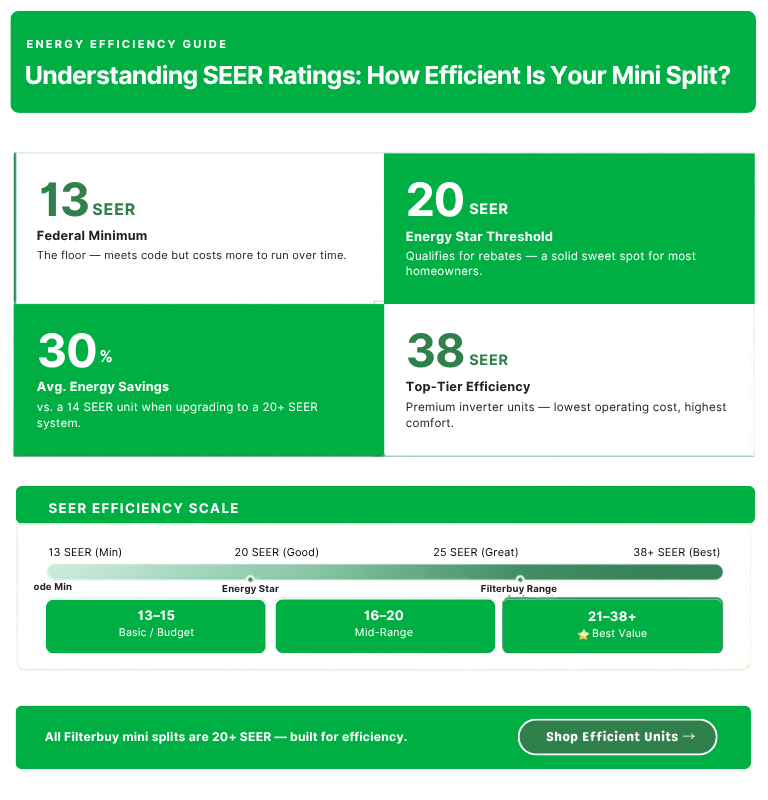
SEER stands for Seasonal Energy Efficiency Ratio. If you are looking for a SEER rating explained simply, think of it as the "miles per gallon" (MPG) for your air conditioner. Just like a car with a high MPG uses less gas to drive the same distance, an AC with a high SEER rating uses less electricity to cool the same amount of space.
Recently, the industry updated this metric to SEER2 (SEER2 meaning HVAC relates to a stricter, more accurate testing standard). In the United States, the Department of Energy requires new systems to have a minimum SEER2 rating of 14 or 15, depending on your region.
However, high-efficiency mini splits frequently boast ratings of 20, 22, or even 30+ SEER. The financial impact of this is massive. A 22 SEER unit uses approximately 40% less energy to cool your home than a standard 14 SEER system.
Why Mini Splits Are So Energy Efficient
Mini split AC efficiency outpaces traditional units for a few specific mechanical and structural reasons. Here is a breakdown of why these systems save so much power.
Inverter Technology
The most significant factor in a mini split's efficiency is its inverter compressor. Traditional central air conditioners run on a simple on/off cycle. They blast at 100% capacity until the room is cold, shut completely off, and then aggressively kick back on when the room warms up. This causes massive power spikes.
Inverter compressor benefits include the ability to smoothly speed up or slow down based on the exact temperature needs of the room. This variable speed mini split technology eliminates the heavy power surges of starting and stopping, resulting in 30% to 60% less energy waste and a perfectly consistent room temperature.
No Duct Losses
Standard central AC systems push cold air through a massive network of ducts in your walls, attic, or basement. According to the U.S. Department of Energy, these central systems lose 20% to 30% of their energy due to leaks, holes, and poorly connected ducts. Mini splits deliver cooled air directly from the wall unit into your living space, meaning zero cooling energy is lost in transit.
Zoned Cooling
Most central systems cool the entire house, even if you are only sitting in one room. Mini splits allow for zoned cooling. You can turn on the AC in your home office during the day and shut it off at night, cooling only the spaces you are actively using. This prevents you from paying to air-condition empty guest rooms or unused dining areas.
Variable-Speed Fans
Just like the inverter compressor, the fans inside a mini split operate at variable speeds. They constantly adjust their airflow to maintain your comfort level with the lowest possible power draw.
How Much Does It Cost to Run a Mini Split?
When homeowners ask, "How much electricity does a mini split use?", they usually want real dollar amounts. While exact costs depend on your local electricity rates and your climate, the mini split monthly cost in the USA is highly manageable.
For moderate use with a highly efficient unit, you can expect a mini split AC electric bill to add roughly $20 to $50 per month to your utility costs per zone. Because these systems are so heavily optimized, many homeowners see yearly savings of $300 to $600 when they switch from an older central AC system or inefficient window units.
SEER Comparison Table
To easily visualize how different systems stack up, here is a quick comparison of standard AC efficiency versus modern mini splits.
| System Type | SEER Rating | Efficiency Level | Estimated Annual Cost |
|---|---|---|---|
| Old AC Unit | 10 SEER | Low | High ($$) |
| Standard AC | 13 - 15 SEER | Moderate | Medium ($) |
| Mini Split | 17+ SEER | High | Low ($) |
Mini Split vs Central Air Efficiency
When evaluating mini split vs central air efficiency, the math heavily favors the ductless route. A standard new central air conditioner will typically offer a 15 to 18 SEER rating. However, because of the 20% to 30% duct losses mentioned earlier, the actual cooling power that reaches your room is lower than the lab rating suggests.
A ductless mini split starts with a higher baseline rating, often between 18 and 30+ SEER. Because there are no ducts to leak cold air into your hot attic, the real-world savings you experience with a mini split are incredibly close to their laboratory ratings.
What About Inverter Mini Split AC Costs Per Month?
A common search term for budget-conscious homeowners is "inverter mini split AC cost per month." While extreme usage in the middle of a blazing summer might cost around $70 per month, most users pay significantly less.
Why? Because efficient modulation means the inverter compressor rarely runs at full blast. Additionally, utilizing the system's zoning capabilities and running the unit during off-peak electricity hours helps keep that monthly bill near the lower end of the $20 to $50 range.
Product Spotlight: High-Efficiency Mini Split Option
Upgrading your HVAC system requires a reliable, high-performance product. For homeowners seeking an ideal blend of value and performance, Filterbuy offers a highly efficient 17 SEER ductless mini split.
This unit utilizes a variable speed inverter compressor to modulate power perfectly to your home's needs. It runs on R32 refrigerant, which has a lower Global Warming Potential (GWP) and yields better overall efficiency than older coolants. Because it is entirely ductless, you bypass the massive energy losses associated with central systems.
It also includes a convenient 24-hour timer, an energy savings feature designed to keep your electric bill low without sacrificing comfort. Shop high-efficiency systems like one from Filterbuy with fast, free shipping to start lowering your utility costs today.
4 Factors That Affect Your Mini Split Efficiency
While mini splits are inherently efficient, a few outside variables will dictate your actual savings:
Climate: Homes in hotter, more humid regions have a higher potential for raw dollar savings because the AC runs more frequently.
Usage Habits: Constantly turning the system completely off and back on is less efficient than letting the inverter compressor maintain a steady, moderate temperature.
Installation Quality: A system must be correctly sized and installed by licensed HVAC professionals to operate at peak efficiency.
Maintenance: Failing to clean your system impacts performance. Running your unit with dirty filters can easily cause a 10% increase in energy use.
Are Mini Splits Worth It for Energy Savings?
Investing in a mini split system is highly worthwhile for specific home layouts and energy goals. They are the absolute best choice for home additions, older homes without existing ductwork, and houses located in areas with high electricity costs.
Due to the significant drop in energy consumption, homeowners often see a return on investment (ROI) within 3 to 5 years from utility bill savings alone. Explore Filterbuy's energy-efficient mini split options today to find the right fit for your space.
Frequently Asked Questions