Installation, Costs & Filter Guide (FL Climate)
By Michelle Wan | Technically reviewed by David Clark, Licensed HVAC Technician | Updated July 2026
A single-zone mini split in Miami costs $2,000 to $6,000 installed, and the right size comes from the room you are cooling, not the size of the house. Match the capacity to the square footage:
Going bigger is the common mistake in this climate. An oversized unit cools the room fast, shuts off early, and leaves the air damp. Answer three quick questions below and we will point you to the size that fits.

Answer 3 quick questions and we will match you to your mini split size.
Prefer to browse first? See Filterbuy mini split systems in 12,000, 18,000 and 24,000 BTU.
A ductless mini split is a strong fit for Miami homes without ductwork, but only if it is sized for humidity rather than floor area. Expect $2,000 to $6,000 installed for one zone and $5,000 to $18,000 for multi-zone. Every installation in Miami-Dade County requires a permit, and the filter-cleaning schedule here runs roughly double what a manufacturer manual assumes.
Mini split installation in Miami costs $2,000 to $6,000 for a single zone and $5,000 to $18,000 for multi-zone systems, with labor accounting for $1,000 to $3,500.
Every mini split installation in Miami-Dade County requires a mechanical permit. Florida Building Code section 105.1 removes the like-for-like replacement exemption other states allow.
An oversized mini split is a more common failure in Miami than an undersized one, because a short-cycling system never runs long enough to remove moisture.
Indoor relative humidity above 60% allows mold growth. The EPA recommends 30% to 50%, and Florida HVAC practice targets 50% to 55%.
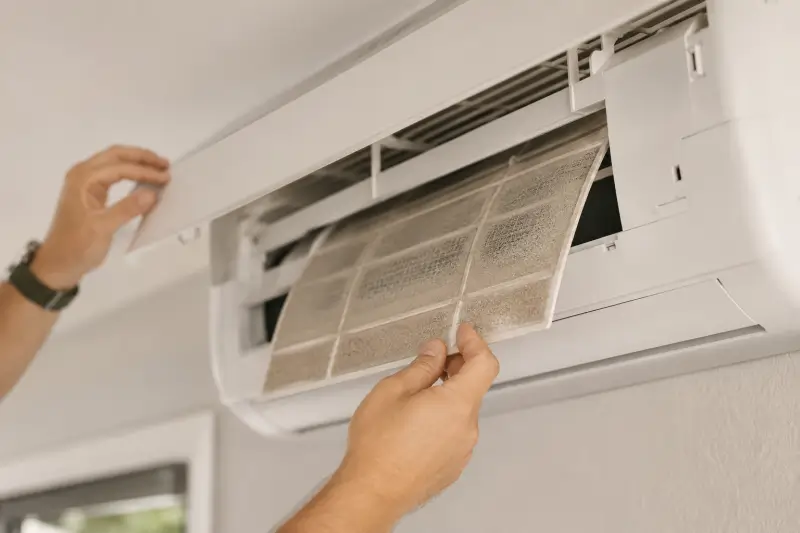
Mini splits use washable mesh screens, not pleated filters. There is no MERV rating and no filter upgrade path on a ductless head.
Rinse that mesh screen every two weeks during cooling season. Miami-Dade reports 133 days a year above 90F, up from 84 in 1970, so runtime here far exceeds what manuals assume.
Filterbuy has manufactured air filters in the USA since 2013, and our HVAC Solutions team works in Miami-Dade. We built this guide by reading primary documents rather than summarizing other articles. That turned up three findings we have not seen stated together anywhere else.
1. A Miami mini split buyer has no incentives left in 2026. Two programs look like they should help. Neither does. The federal 25C credit ended for equipment placed in service after December 31, 2025, and the FPL rebate standards exclude single-zone mini splits by name. Most guides still quote the $2,000 credit. Budget as though nothing applies, then check your exact configuration.
2. The permit myth has a specific origin, and it is one word. Contractors do say a straight changeout needs no permit. the Miami-Dade exemption list is where that comes from, and it is half right: an exact changeout is exempt from an electrical permit. The mechanical permit is still required. That distinction is the difference between an inspected install and a problem at claim time.
3. Oversizing is a health question here, not a comfort question. In most of the country an oversized system is an efficiency annoyance. In Miami it is what holds a room above the 60 percent humidity ceiling the EPA warns about, and Berkeley Lab attributes roughly 21 percent of U.S. asthma cases to damp housing. In this climate, sizing math and indoor air quality are the same conversation.
A ductless mini split is a heating and cooling system that links an outdoor compressor to one or more indoor air handlers through a small refrigerant line, with no ductwork between them. Miami homeowners choose ductless AC for two reasons: many older Miami-Dade houses were built without duct chases, and there is no duct to leak. ENERGY STAR estimates that about 20 to 30 percent of the air moving through a typical duct system is lost to leaks, holes, and poor connections, and in South Florida a lot of that ductwork runs through a blazing attic.
Mini splits are usually the right call for additions, in-law suites, converted garages, Florida rooms and enclosed porches, older Coral Gables or Little Havana homes with no ducts, and bedrooms that never keep up with the rest of the house.
Mini split installation in Miami costs $2,000 to $6,000 for a single-zone system and $5,000 to $18,000 for multi-zone, installed. Labor represents $1,000 to $3,500 of a typical job. South Florida quotes tend to land at or above national averages because of permit requirements, hurricane-rated equipment anchoring, and heavy summer demand for licensed technicians.
Table 1. Mini split installation cost by configuration, Miami FL
Figures are 2026 installed costs including equipment and labor. Coverage figures match the published specifications for Filterbuy mini split systems, which rate conservatively for real-world comfort. Local pricing runs 15% to 30% above or below national averages depending on labor rates, permit fees, and site conditions.
Local pricing typically runs 15% to 30% above or below national averages depending on labor rates, permit fees, and site conditions, so treat any published figure as a starting point rather than a quote.
Three Miami-specific line items surprise people. Permit and inspection fees are unavoidable in Miami-Dade. Line sets often run long in condos and townhouses, since a standard install includes about 25 feet of copper and each additional 10 feet adds roughly $50 to $150. And older Miami homes frequently need a new dedicated circuit before a ductless system can be added at all.
The federal tax credit no longer applies to a 2026 install. The Section 25C Energy Efficient Home Improvement Credit, which covered 30% of a qualifying heat pump up to $2,000, was terminated for property placed in service after December 31, 2025 by Public Law 119-21. Filterbuy covers the change in detail in are heat pump tax credits still available. Do not assume the utility rebate fills the gap either. FPL Residential HVAC Program Standards pay $200 per qualifying unit but explicitly exclude window units and single-zone mini splits, and require a complete replacement of an existing electric cooling system through a Participating Independent Contractor. For most Miami mini split projects, budget as though no incentive applies, then verify your specific configuration before you sign.
Related: mini split cost breakdown | mini split installation cost by zone | shop Filterbuy mini split systems
Yes. Every mini split installation in Miami-Dade County requires a mechanical permit and a final inspection. Florida Building Code section 105.1 requires a permit before anyone installs or replaces a mechanical system. Miami-Dade makes the HVAC case explicit in its own permit exemption list: an air conditioning changeout of the same capacity and amperage is exempt from an electrical permit, but a mechanical permit is still required. All of Miami-Dade sits inside the High Velocity Hurricane Zone, or HVHZ, the strictest wind-load jurisdiction in the continental United States.
For a ductless system, HVHZ status shows up in the details that matter after a storm. The outdoor condenser must be anchored to resist HVHZ design wind loads, not simply set on a pad or hung from a bracket rated for a milder region. Mounting hardware, stands, and wall penetrations must be detailed and inspected. In flood-prone areas such as Cutler Bay, Palmetto Bay, and parts of Homestead, equipment elevation matters too.
Ask any contractor how they will anchor the outdoor unit before signing. An unpermitted installation can complicate a hurricane insurance claim, void a manufacturer warranty, and surface as an open issue at resale.
Ask what refrigerant the system you were quoted actually uses. The answer changes what your repairs cost for the next fifteen years, and the rules moved again two months ago.
Since January 1, 2025, manufacturers can no longer build new residential air conditioners or heat pumps using R-410A. Under the EPA AIM Act, new equipment has to use a refrigerant below 700 global warming potential. For ductless mini splits that generally means R-32.
Here is the part most guides have not caught up with. There was a deadline of January 1, 2026 for installing leftover pre-2025 R-410A stock. EPA removed that deadline in a final rule on May 21, 2026. Legacy inventory can now be installed until it runs out.
So in Miami today you can still be quoted a brand-new R-410A mini split, and it is entirely legal. That is not a scam and it is sometimes cheaper. It does have a consequence worth pricing in: R-410A production is being phased down, so the refrigerant needed to service that system gets scarcer and more expensive across its whole life.
Two questions settle it:
Which refrigerant does this system use, R-410A or R-32? Get it in writing on the quote.
If it is R-32 or another A2L refrigerant, is the technician doing the install A2L certified? A technician without that certification cannot legally open the system to charge or recover refrigerant, which matters the first time you need service.
Neither answer is automatically the wrong one. A cheaper R-410A unit can make sense if you know what you are taking on. Being told nothing at all is the part to avoid.
For reference, Filterbuy mini split systems run on R-32 with built-in refrigerant leak detection, which is the safety feature the A2L standards are designed around. Whatever brand you land on, ask for that same detail in writing.
Local pricing typically runs 15% to 30% above or below national averages depending on labor rates, permit fees, and site conditions, so treat any published figure as a starting point rather than a quote.
Three Miami-specific line items surprise people. Permit and inspection fees are unavoidable in Miami-Dade. Line sets often run long in condos and townhouses, since a standard install includes about 25 feet of copper and each additional 10 feet adds roughly $50 to $150. And older Miami homes frequently need a new dedicated circuit before a ductless system can be added at all.
The federal tax credit no longer applies to a 2026 install. The Section 25C Energy Efficient Home Improvement Credit, which covered 30% of a qualifying heat pump up to $2,000, was terminated for property placed in service after December 31, 2025 by Public Law 119-21. Filterbuy covers the change in detail in are heat pump tax credits still available. Do not assume the utility rebate fills the gap either. FPL Residential HVAC Program Standards pay $200 per qualifying unit but explicitly exclude window units and single-zone mini splits, and require a complete replacement of an existing electric cooling system through a Participating Independent Contractor. For most Miami mini split projects, budget as though no incentive applies, then verify your specific configuration before you sign.
Related: mini split cost breakdown | mini split installation cost by zone | shop Filterbuy mini split systems
Yes. Every mini split installation in Miami-Dade County requires a mechanical permit and a final inspection. Florida Building Code section 105.1 requires a permit before anyone installs or replaces a mechanical system. Miami-Dade makes the HVAC case explicit in its own permit exemption list: an air conditioning changeout of the same capacity and amperage is exempt from an electrical permit, but a mechanical permit is still required. All of Miami-Dade sits inside the High Velocity Hurricane Zone, or HVHZ, the strictest wind-load jurisdiction in the continental United States.
For a ductless system, HVHZ status shows up in the details that matter after a storm. The outdoor condenser must be anchored to resist HVHZ design wind loads, not simply set on a pad or hung from a bracket rated for a milder region. Mounting hardware, stands, and wall penetrations must be detailed and inspected. In flood-prone areas such as Cutler Bay, Palmetto Bay, and parts of Homestead, equipment elevation matters too.
Ask any contractor how they will anchor the outdoor unit before signing. An unpermitted installation can complicate a hurricane insurance claim, void a manufacturer warranty, and surface as an open issue at resale.
Ask what refrigerant the system you were quoted actually uses. The answer changes what your repairs cost for the next fifteen years, and the rules moved again two months ago.
Since January 1, 2025, manufacturers can no longer build new residential air conditioners or heat pumps using R-410A. Under the EPA AIM Act, new equipment has to use a refrigerant below 700 global warming potential. For ductless mini splits that generally means R-32.
Here is the part most guides have not caught up with. There was a deadline of January 1, 2026 for installing leftover pre-2025 R-410A stock. EPA removed that deadline in a final rule on May 21, 2026. Legacy inventory can now be installed until it runs out.
So in Miami today you can still be quoted a brand-new R-410A mini split, and it is entirely legal. That is not a scam and it is sometimes cheaper. It does have a consequence worth pricing in: R-410A production is being phased down, so the refrigerant needed to service that system gets scarcer and more expensive across its whole life.
Two questions settle it:
Which refrigerant does this system use, R-410A or R-32? Get it in writing on the quote.
If it is R-32 or another A2L refrigerant, is the technician doing the install A2L certified? A technician without that certification cannot legally open the system to charge or recover refrigerant, which matters the first time you need service.
Neither answer is automatically the wrong one. A cheaper R-410A unit can make sense if you know what you are taking on. Being told nothing at all is the part to avoid.
For reference, Filterbuy mini split systems run on R-32 with built-in refrigerant leak detection, which is the safety feature the A2L standards are designed around. Whatever brand you land on, ask for that same detail in writing.
Twice a year is the Miami standard, once before Heat Season and once after. Annual service suffices in a mild climate; it does not here. Three local factors drive the shorter interval.
Table 2. Why South Florida mini splits need twice-yearly service
Service cadence reflects South Florida operating conditions. Inland and coastal homes differ most on salt exposure.
Ask six questions before you hire a mini split contractor in Miami. Are you a Florida state-certified or Miami-Dade county-registered HVAC contractor, and what is the license number? Will you pull the mechanical permit, and if a contractor says none is needed, that answer alone disqualifies them. How will you anchor the outdoor unit for HVHZ wind loads? Will you run a Manual J load calculation? Which refrigerant does the system use, and are your technicians A2L certified? And what does your maintenance plan cover, at what frequency?
Yes, when correctly sized. A properly sized inverter mini split runs longer at lower speed and removes more moisture than an oversized unit that short-cycles. An oversized ductless system in Miami produces a cold, clammy room and indoor humidity above the 60% mold threshold.
Yes. Nearly all modern mini splits are heat pumps, which is more than sufficient for the handful of nights Miami drops into the 40s. Heat pump operation used to be what qualified a system for the federal tax credit, but that credit ended for equipment placed in service after December 31, 2025.
Manufacturers generally rate mini splits for 15 to 20 years. Coastal salt exposure and near-continuous runtime are the two factors most likely to shorten that in South Florida, though we have not found published data isolating a Miami-specific figure. Treat any shorter number quoted to you as an estimate rather than a measured result.
DIY-branded systems exist, but Miami-Dade County requires a permit and inspection regardless of who performs the work, and refrigerant handling requires EPA Section 608 certification. An unpermitted installation can create insurance and resale problems.
Only partially. The mesh screen captures larger dust and hair. It is not equivalent to a MERV 11 or MERV 13 pleated filter, which is why whole-home filtration and humidity control still matter alongside a ductless system.
We do not make claims we cannot back. Three federal findings sit under the advice on this page. Each is linked, and each was checked on July 29, 2026.
The numbers: Florida 28 percent. National average 9 percent. Maine 2 percent.
Why it matters: Cooling carries roughly three times the national share of your energy bill. An oversized system costs you more here than almost anywhere else in the country.
The cause: Leaks, holes, and poorly connected joints.
Why it matters: In Miami much of that ductwork sits in an attic well over 100 degrees. A mini split has no ducts to leak.
Source: Berkeley Lab, Indoor Air Quality Scientific Findings Resource Bank, EPA-funded
The numbers: Roughly 4.6 million cases. Meta-analyses in the same review found 30 to 50 percent more respiratory symptoms in damp homes.
Why it matters: The 60 percent humidity ceiling is a design target, not a nice-to-have.
Data vintage: the EIA figures come from the 2020 survey, published 2023. It is still the newest release with state-level end-use data. EIA published 2024 survey data in May 2026, so recheck these at the next content review.
Most homeowners start second-guessing themselves right around the time the quotes come in. A contractor says something with confidence and you have no easy way to know whether it holds up. These seven sources let you check the big claims yourself, free, in about twenty minutes total.
We sell filters and mini split systems, so we left ourselves off this list. None of these seven sells either, which means nobody here has a reason to nudge your decision. Every link was tested on July 29, 2026.
Source: Miami-Dade County, Mechanical Permits
If someone tells you a mini split swap does not need a permit in Miami-Dade, this page settles it. You will find the application, the fee sheet, and the inspection checklist, plus a Permit Exemption tool that confirms exactly what has to be filed for your job.
Source: Florida DBPR, How to Verify a License
Search by name, business, or license number and see whether the license is active today. This one is worth doing before you sign anything, because a contractor without an active license cannot legally pull your permit, which means your install cannot pass inspection.
Source: ENERGY STAR, Ductless Heating and Cooling
We keep saying your contractor should run a Manual J calculation instead of guessing from square footage. This is the EPA saying the same thing, which is handy to have open while you compare quotes. One heads-up: the tax credit section on this page is out of date and still says the credit runs to 2032.
Source: AHRI, Directory of Certified Product Performance
Type in the model number you were quoted and see whether the SEER2 rating on the proposal matches the independently tested rating. For a matched indoor and outdoor pair, ask your installer for the AHRI Certified Reference Number in writing. Good ones hand it over without hesitating.
Source: ACCA, Quality Assured Contractor Directory
ACCA wrote Manual J, the sizing standard this whole page leans on. Search by ZIP for contractors who are licensed, insured, and willing to let ACCA review their installation records. Worth a call if your first quote felt rushed or the sizing math never came up.
Source: FPL, Residential HVAC Program Standards
We would rather you hear this from us than discover it at the invoice. FPL pays $200 per qualifying unit, but the program standards exclude window units and single-zone mini splits by name, and require a complete replacement of an existing electric cooling system through a participating contractor.
Source: EPA, A Brief Guide to Mold, Moisture and Your Home
Every sizing argument on this page traces back to one number: keep indoor humidity below 60 percent, ideally between 30 and 50. The EPA also flags keeping condensate drain lines clear, which happens to be the thing most likely to go wrong on a Miami mini split.
Filterbuy HVAC Solutions serves Coral Gables, South Miami, Kendall, Pinecrest, Palmetto Bay, Cutler Bay, Hialeah, Miami Beach, Miami Shores, Miami Lakes, Westchester, and Homestead from its Miami branch.
Get a free estimate from the Miami branch
Buying the equipment yourself? Shop Filterbuy ductless mini split systems in 12,000, 18,000 and 24,000 BTU. Not replacing a system yet? Find your filter size and set up auto-delivery.
Better Air For All
Each definition is written to stand alone if retrieved without the rest of the page.
Table 3. Glossary of terms used on this page