
Mesa, AZ Live Wildfire Smoke Map
Get Alerts For Wildfires In Your Area
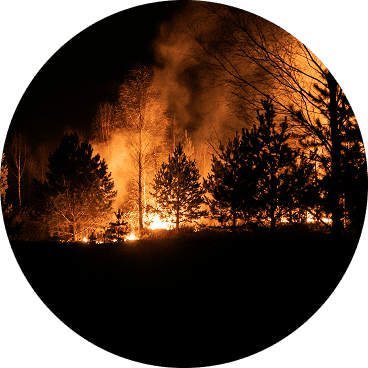
The moment a wildfire starts near you, you'll get an instant alert and simple tips to reduce your smoke exposure.
What's In The Smoke
30xSmaller than a human hair
Fine enough to reach deep into the lungs. A MERV 13 is built to capture it.
How Far It Travels


It Doesn't Stay Local
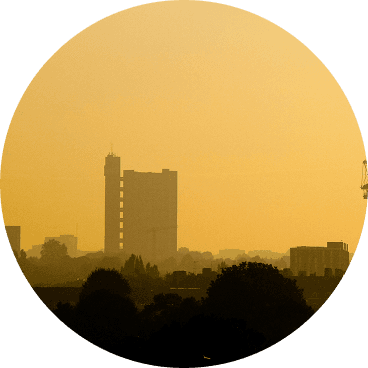
Smoke rides the wind far downwind — you can get smoky air with no fire nearby.
What To Do During A Smoke Event
Simple steps to reduce indoor exposure.
- Stay In, Close UpShut windows and doors to keep smoke out.
- Set Fan To "On"Keeps air cycling through your filter, not just when heating or cooling.
- Recirculate AirSwitch off fresh-air intake so you're not pulling smoke in.
- Run A MERV 13Built to capture the fine PM2.5 in smoke.
- Add A PurifierExtra filtration for the room you use most.
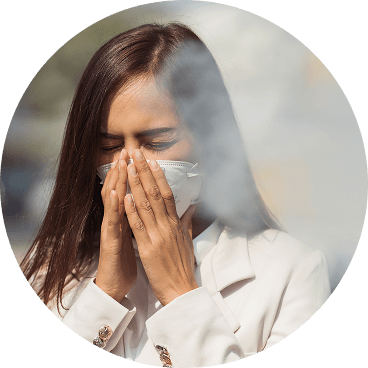
- Wear an N95 if OutsideFits snug to block fine particles — a cloth mask won't.


The Best Air Filter For Wildfire Smoke
During smoke events, the EPA recommends upgrading to a MERV 13 filter — or the highest-rated filter your system can handle — to help reduce the fine particles smoke brings indoors. MERV 13 is the level most home HVAC systems can run while still capturing PM2.5, the fine particulate that makes up the bulk of wildfire smoke.
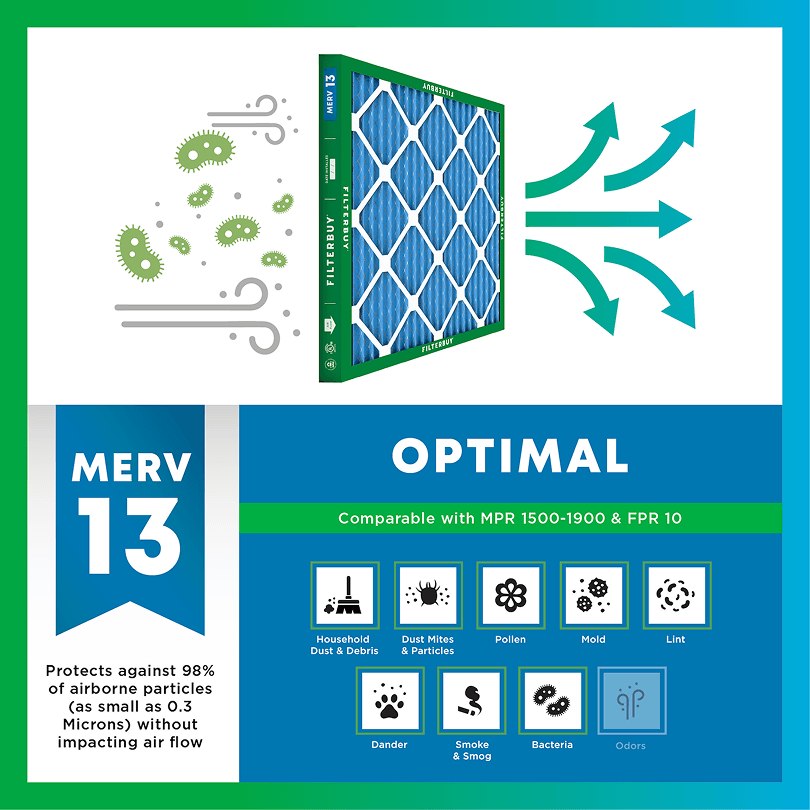
- Captures PM2.5 particles
- Blocks ash, soot, and smoke odor
- Keeps your indoor air safe—even when the outdoor air is dangerous
- Meets the EPA's recommended rating for filtering fine wildfire smoke particles.

Wildfire Smoke FAQs
Facts About Wildfires
Over 70,000 wildfires burn in the U.S. every year.
Wildfire smoke can travel 1,000+ miles, affecting states that aren't even near the blaze.
Exposure to wildfire smoke can worsen asthma, trigger heart issues, and lead to ER visits.
Indoor air can hold more fine particles during wildfire events unless it's properly filtered.
The EPA advises using MERV 13 filters or portable HEPA air cleaners during wildfire smoke events.
Don't Wait Until The Smoke's Inside.
Use the live wildfire smoke tracker and upgrade your air filters today to protect your lungs and your home.
Shop Filters For Smoke Protection
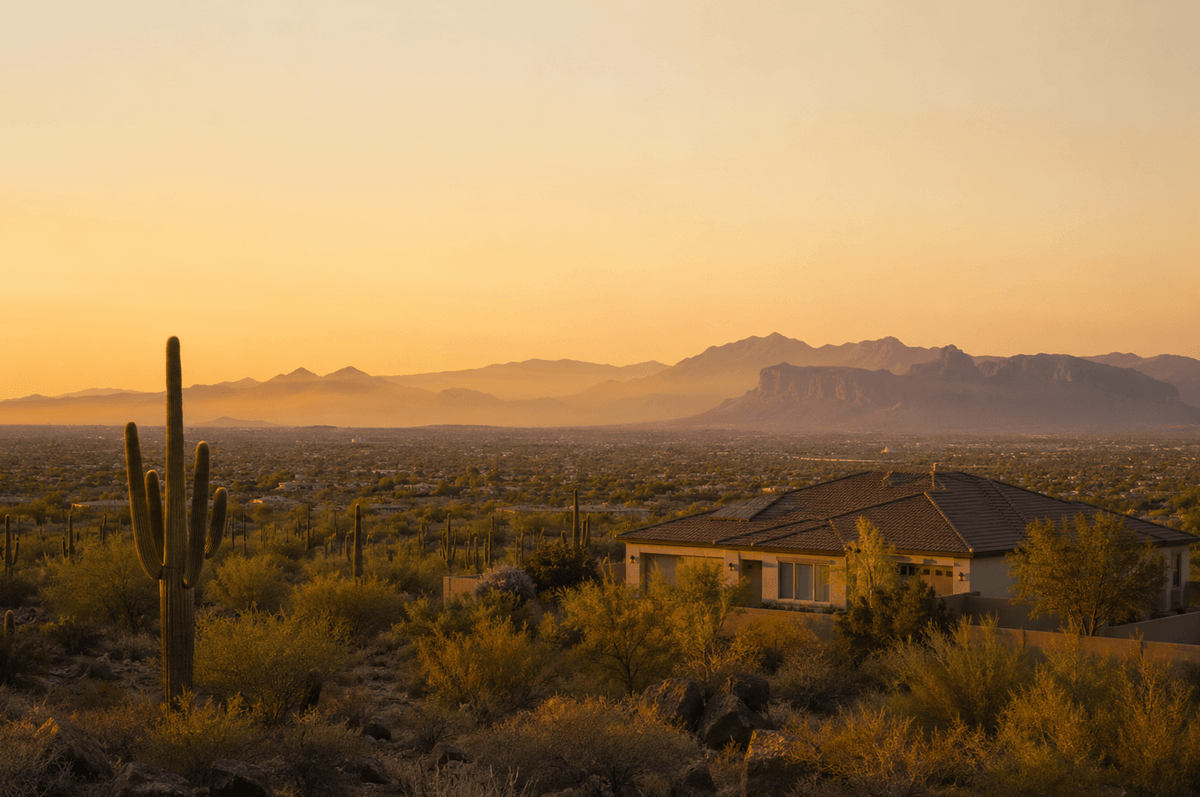
Current Live Wildfire and Smoke Map Mesa AZ Today From Filterbuy.com
By Michelle Wan · Reviewed by David Clark, Licensed HVAC Technician · Published July 6, 2026 · Updated July 6, 2026
Smoke from an Arizona wildfire can turn a clear Mesa morning hazy within hours, often before you notice any smell inside the house. The live map below tracks where fires are burning across the state right now, where their smoke is drifting, and the current air quality at monitors near Mesa and across Maricopa County.
Filterbuy builds air filters in the United States, and after years of shipping them into Arizona through one fire season after another, we have learned what actually keeps a home breathable when the sky turns brown. Most homeowners assume that closing the windows is enough. The families who stay comfortable, in our experience, pair a sealed house with a filter that can catch the fine particles smoke leaves behind, and that is the local playbook this page lays out for Mesa.
For conditions beyond the city, our Arizona wildfire and smoke map tracks active fires and drifting smoke across the whole state.
TL;DR Quick Answers
Mesa's wildfire smoke risk changes hour by hour with wind direction and fire activity across Arizona. The live map above and the AirNow reading for your ZIP code are the fastest way to know whether the outdoor air is safe right now. When the nearest marker turns orange or worse, stay indoors, keep windows and doors closed, run your air conditioning on recirculate, and filter your indoor air with a MERV 13 rated filter. A MERV 13 filter captures a large share of the fine smoke particles that drift indoors, though it is not the same as a true HEPA filter.
Is the air in Mesa safe to breathe right now? Check the marker closest to your ZIP code on the live map above. Green or yellow means the air is generally safe for most people. Orange means sensitive groups should limit time outdoors. Red, purple, or maroon means everyone should stay inside and filter their indoor air. Readings can shift within an hour, so check again before any outdoor plans.
Where is the wildfire smoke over Mesa coming from? Most smoke that reaches Mesa drifts in from wildfires burning elsewhere in Arizona, including the Tonto National Forest north and east of the city and fires along the Mogollon Rim. Wind direction decides whether that smoke settles over the Valley or blows away from it. The map shows both the fire icons and the smoke plumes, so you can see the source.
What should I do at home when smoke is heavy? Close windows and doors, set your air conditioner to recirculate, and avoid anything that adds particles indoors, such as candles, frying, or vacuuming. Run your HVAC system with a MERV 13 filter, or set up one clean room with a portable air cleaner. These steps reduce how much smoke reaches the air your family breathes.
Top Takeaways
Mesa sits in Maricopa County, where smoke from Arizona wildfires can raise fine particle (PM2.5) levels even when no fire is burning nearby.
The live map on this page pulls real-time readings from EPA and Forest Service monitors plus low-cost sensors, all shown in the color-coded U.S. Air Quality Index.
Fine particles in wildfire smoke (PM2.5) are small enough to reach deep into the lungs and pass into the bloodstream, which is why sensitive groups feel the effects first.
A MERV 13 air filter captures a large share of smoke-sized particles from the air moving through a central HVAC system, though it does not match the efficiency of a true HEPA filter.
The strongest indoor strategy during a smoke event combines sealing the home, running air conditioning on recirculate, and filtering the air continuously.
How To Read The Live Wildfire And Smoke Map For Mesa
You can read the map in three steps. Locate Mesa or your ZIP code, read the color of the nearest air quality marker, then look for fire icons and shaded smoke plumes moving toward the Valley. The color tells you how safe the air is, and the plume tells you whether conditions are likely to get better or worse over the next few hours.
The three steps below cover the basics. Our full guide on how to read a wildfire smoke map walks through every icon, color, and monitor type in more detail.
Find Your Location On The Map
Type your ZIP code or city into the map's location search, or allow it to center on your device. The map then shows the air quality circles nearest you. Each circle represents a monitor or sensor measuring fine particle pollution, the main pollutant in smoke. Click a circle to open the current reading and recent trend for that spot.
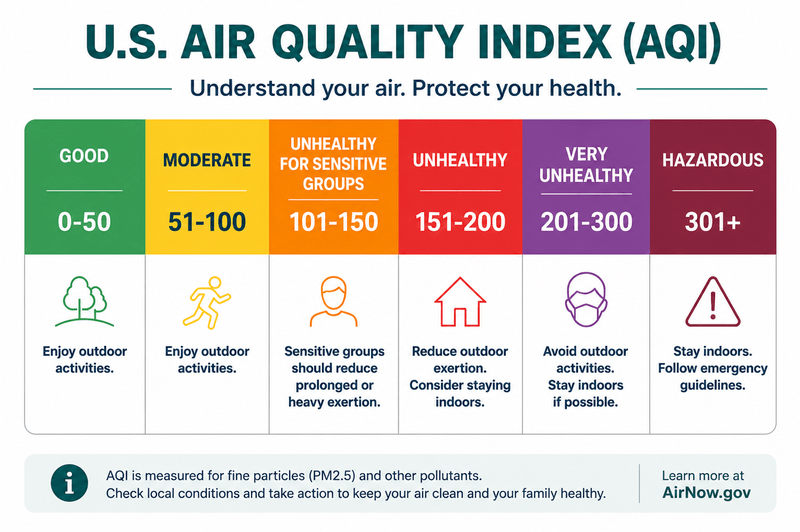
Match The Color To The Air Quality Index
The map uses the U.S. Air Quality Index, the same color scale the EPA uses nationwide. Match the color of the marker near you to the row below to see what the reading means for your household.
Source: U.S. EPA Air Quality Index. Readings update throughout the day, so check the live map before any outdoor plans.
Check The Fire Icons And Smoke Plumes
Flame icons mark reported fire incidents, and glowing circles mark fires that satellites have detected. Gray shaded areas show smoke plumes. When a plume sits upwind of Mesa and the wind is blowing toward the Valley, expect conditions to worsen. When the plume is drifting away, the air near you should improve. The map refreshes throughout the day, so treat every reading as a snapshot rather than a forecast.
Where Mesa's Wildfire Smoke Comes From
Mesa rarely burns, but it often breathes smoke from fires elsewhere in Arizona. The Tonto National Forest borders the city to the north and east, and its Mesa Ranger District manages land within a short drive of local neighborhoods. Fires there and along the Mogollon Rim can send smoke into the Valley when winds line up, which is why the air can turn hazy on a day with blue sky directly overhead.
Arizona's wildfire season runs heaviest from late spring through the summer monsoon. During that stretch, the Tonto National Forest often operates under fire restrictions, and the Arizona Department of Environmental Quality issues a statewide wildfire smoke forecast whenever an Arizona fire threatens extended air quality impacts. The department also publishes a daily Phoenix-area forecast that covers Mesa. Pair that forecast with the live map for both the current picture and the next 24 to 48 hours.
To see which fires are burning statewide right now, the state's interagency wildfire program maps the current Arizona wildfire situation, including incidents on the Tonto National Forest and along the Mogollon Rim that most often send smoke toward the Valley.
Wildfire smoke is not the only particle problem Mesa air throws at a filter. The same Valley sees blowing dust and haboobs through the summer, so airborne particles stack up across much of the year, well beyond fire season. That is why we at Filterbuy suggest leaving a MERV 13 filter in year-round rather than dropping back to a basic filter once the smoke clears, as long as your system is rated to handle it.
The 5-3-1 Visibility Method
When you cannot reach the map or a nearby monitor is offline, the Arizona Department of Environmental Quality recommends a visibility check known as the 5-3-1 method. Stand with the sun behind you and look toward a landmark at a known distance, such as a mountain or a tall building. The farthest point you can still see clearly is your visibility range. Use the range to estimate air quality with the guide below.
Source: Arizona Department of Environmental Quality 5-3-1 Visibility Method. Use this only when a nearby air monitor is unavailable.
How To Protect Your Home And Family During A Mesa Smoke Event
Your goal during a smoke event is to keep outdoor particles out and to filter the particles that get in. Seal the home, run your air conditioning on recirculate, filter the air continuously with a MERV 13 rated filter, and set up one clean room for the people most sensitive to smoke. These steps work together, and no single one does the whole job on its own.
Seal The Home
Keep windows and doors closed while smoke is in the air. Set your air conditioner to recirculate so it is not pulling smoky outdoor air inside. If you cool your home with an evaporative cooler, the EPA suggests covering the outside air intake with a MERV 13 furnace filter when you can do so safely, since evaporative coolers draw in outdoor air by design. Avoid activities that add particles indoors, including burning candles, frying food, and vacuuming.
Filter The Air Continuously
Run your central HVAC system with a MERV 13 filter and set the fan to On rather than Auto, so the system keeps cleaning the air even when it is not heating or cooling. A MERV 13 filter captures a large share of the fine smoke particles moving through the system and reduces how much reaches the rooms you live in. It captures and reduces particles rather than removing every one, and it is not a HEPA filter. Before you move up to a higher rating, confirm the filter is compatible with your equipment, since some systems restrict airflow with denser filters. A licensed HVAC technician can confirm the right rating for your setup.
Here is the pattern we notice every fire season. The Mesa homes that ride out a smoke event most comfortably are the ones that put a MERV 13 filter in before the smoke arrives, not the ones hunting for one after the air already smells like a campfire. A fresh filter waiting in the closet is cheap insurance against a week of hazy skies.
Filterbuy manufactures MERV 13 air filters from Filterbuy in standard and custom sizes, so you can match the exact dimensions your system needs before the next smoky stretch.
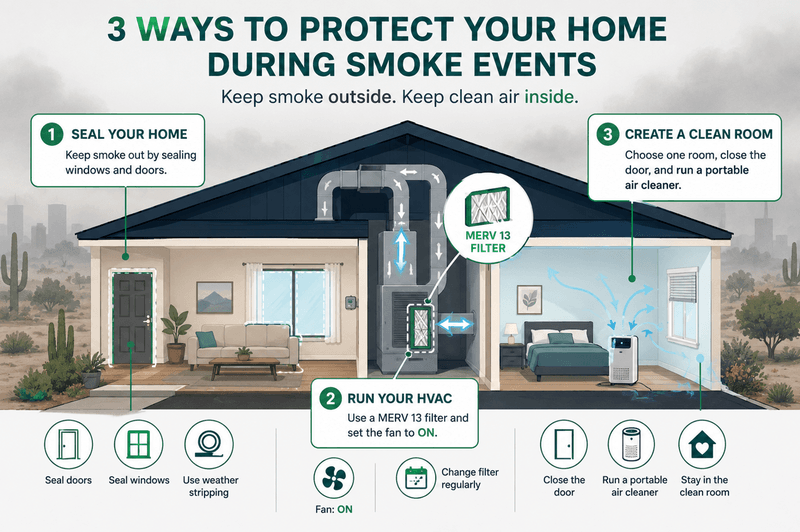
Set Up One Clean Room
Pick one room where your family can spend most of its time, ideally a bedroom with few windows and no fireplace. Keep its doors and windows closed and run a portable air cleaner sized for the room. Choose an air cleaner that does not produce ozone. Both the EPA and the American Lung Association point to a single clean room as one of the most reliable ways to lower smoke exposure at home when the air outside is unhealthy.
If a portable air cleaner is out of reach, the EPA and CDC both point to a low-cost alternative you can build in minutes. Tape a MERV 13 furnace filter, such as a Filterbuy MERV 13, to the intake side of a box fan so the air pulls through the filter, and run it inside the clean room. The CDC adds one safety rule that matters. Never leave a box-fan filter running unattended.
Protect Sensitive Groups
Children, older adults, pregnant people, and anyone with asthma, COPD, heart disease, or diabetes react to smoke sooner and more severely than the general population. Keep their medicines on hand, follow any asthma action plan, and watch for coughing, wheezing, or shortness of breath. If someone has trouble breathing that does not ease with rest and cleaner air, contact a healthcare provider. For any medical emergency, call 9-1-1..
Choosing An Air Filter For Wildfire Smoke In Mesa
For wildfire smoke, the EPA recommends a MERV 13 or higher filter in a central HVAC system. MERV 13 is the practical sweet spot for most Mesa homes, because it captures a large share of fine smoke particles while still allowing normal airflow in many residential systems. A MERV 13 filter is effective against smoke, and it is not the same as a HEPA filter.
MERV stands for Minimum Efficiency Reporting Value, a scale from 1 to 20 that rates how well a filter captures particles. Higher numbers capture more small particles, including the PM2.5 that makes wildfire smoke dangerous. Very high ratings can restrict airflow in systems that were not designed for them, which can reduce efficiency and strain the blower. That trade-off is why compatibility matters more than simply buying the highest number on the shelf.
The right filter is the one that fits your system, matches your exact dimensions, and carries a MERV 13 rating your equipment can handle. Because we build these filters, we watch the same avoidable mistake repeat every smoke season. A filter that is close to the right size, but not exact, leaves a gap around the frame, and smoky air takes that gap instead of passing through the media. Filterbuy filters come in exact standard sizes and custom sizes for that reason, so the filter fills the opening with no gap to slip past. Check the size printed on your current filter, and if you are unsure how to read it, our guide on how to measure your filter walks through it. Keep spares on hand so you can swap in a fresh one when smoke loads it up.
After manufacturing filters for over a decade and serving more than two million households, we have seen what most people miss during a smoke event. The air inside an unprepared home can get nearly as smoky as the air outside. A quality MERV 13 filter running with the fan set to On captures a large share of those fine particles before they reach the room you are sitting in, and that steady circulation is what separates a rough smoke week from a manageable one.
David Heacock, Founder and CEO, Filterbuy
7 Essential Resources
Source: AirNow Fire and Smoke Map: How the Map Works
The EPA and U.S. Forest Service map that powers real-time fire, smoke, and air quality data, with guidance on reading each icon and reading.
Source: EPA Guidance on Creating a Clean Room During Wildfire Smoke
Step-by-step advice from the EPA on setting up a clean room and using MERV 13 or higher filtration to lower indoor smoke exposure.
Source: CDC Safety Guidelines for Wildfires and Wildfire Smoke
Federal health guidance on reducing smoke exposure, protecting sensitive groups, and knowing when symptoms call for medical care.
Source: Arizona DEQ Air Quality and Wildfire Smoke Forecasts
The state agency that issues Arizona wildfire smoke forecasts and a daily Phoenix-area air quality forecast covering Mesa.
Source: National Weather Service Phoenix Forecast Office
Local weather, red flag warnings, and air quality alerts for the Phoenix metro, including the wind conditions that steer smoke over the Valley.
Source: Tonto National Forest Fire Information
Current fire restrictions, active incidents, and prescribed burns on the forest that borders Mesa to the north and east.
Source: Ready.gov Wildfire Preparedness Guide
Federal preparedness resource covering what to do before, during, and after a wildfire, including evacuation and smoke safety.
3 Supporting Statistics
Wildfire smoke sends more people to the hospital. Wildfire PM2.5 raises respiratory hospitalizations by 1.3% to 10% for every 10 micrograms per cubic meter. Particle pollution from other sources raises them by only 0.67% to 1.3%.
Source: Aguilera et al., 2021, Nature Communications (via NIH National Library of Medicine)Mesa sits in a county full of at-risk residents. Maricopa County counts 412,752 residents with asthma. That figure includes 83,547 children.
Source: Maricopa County Air Quality DepartmentWildfire smoke now drives much of the nation's fine particle pollution. Wildfires have caused up to 25% of PM2.5 across the United States in recent years. In some Western regions, that share reaches half.
Source: Burke et al., 2021, Proceedings of the National Academy of Sciences
Final Thoughts And Opinion
In the Valley, wildfire smoke is a seasonal reality. From what we see every season, the families who handle smoke days best are the ones who prepare before fire season, not during it. They know the size and rating of the filter in their system; they keep a spare on the shelf, and they have one room ready to become a clean room the moment the map turns orange.
The live map is the tool that tells you when to act. Clean, well-fitted filtration is the tool that protects the air you breathe once you are inside. Filterbuy's view is simple. Watch the air, seal the house, and keep filtered air moving, and a smoky week in Mesa becomes far easier on your family and your lungs.
Next Steps
Bookmark this page and check the live map before any outdoor plans on hazy days.
Check the filter currently in your HVAC system and write down its size and MERV rating.
If your system supports it, move to a MERV 13 filter from Filterbuy and set the fan to On during smoke events. You can find your exact filter size to order the right fit.
Set up one clean room with a properly sized portable air cleaner for the most sensitive people in your home.
Sign up for Maricopa County or Arizona DEQ air quality alerts for your ZIP code so you hear about smoke early.
Frequently Asked Questions
Be Prepared Now
Do not wait for the sky to turn orange. Get a Filterbuy MERV 13 filter in place now so filtered air is running the moment smoke reaches the Valley. Shop MERV 13 filters for wildfire smoke and match the exact size your system needs, made in the United States and built to keep your family breathing cleaner air.
Glossary
Air Quality Index (AQI): A color-coded scale from the U.S. Environmental Protection Agency that reports how clean or polluted the air is and what health effects to expect, running from Good (green) to Hazardous (maroon).
PM2.5: Fine particulate matter measuring 2.5 micrometers or smaller, the main pollutant in wildfire smoke, small enough to reach deep into the lungs and pass into the bloodstream.
Wildfire Smoke: A mix of gases and fine particles released when vegetation and other materials burn, capable of traveling hundreds of miles from the fire that produced it.
MERV: Minimum Efficiency Reporting Value, a scale from 1 to 20 that rates how well an air filter captures particles of different sizes. Higher numbers capture more small particles.
MERV 13: A filter rating that captures a large share of fine particles, including much of the PM2.5 in wildfire smoke. A MERV 13 filter is not a HEPA filter.
HEPA: High-Efficiency Particulate Air, a filter standard that captures at least 99.97% of particles at 0.3 micrometers, most often used in portable air cleaners rather than standard residential HVAC systems.
HVAC: Heating, ventilation, and air conditioning, the system that heats, cools, and circulates air through a building.
Clean Room: A single room set up to keep smoke particles as low as possible, with windows and doors closed and a portable air cleaner running.
Particulate Matter (PM): Solid particles and liquid droplets suspended in air, measured as PM10 for coarse particles and PM2.5 for fine particles.
Subscribe to wildfire smoke alerts for Mesa, AZ, to get a heads-up before the next event reaches your area.