
Santa Fe Real-Time AQI Tracker

Get Alerts For Unhealthy AQI In Your Area
When air quality in your area reaches unhealthy levels, we'll send you a quick alert, along with expert tips on how to reduce your exposure.
What's Actually In Santa Fe Air Today?
What High AQI Means for Your Lungs in Santa Fe
How to Read AQI
The Air Quality Index (AQI) measures how polluted the air is and how it may affect your health.
0–50 (Good): Air quality is satisfactory.
51–100 (Moderate): Acceptable, but some pollutants may pose minor concerns.
101–150 (Unhealthy for Sensitive Groups)
151–200 (Unhealthy)
201–300 (Very Unhealthy)
301+ (Hazardous)
Moderate
Still okay for most, but if you have asthma or allergies, take it easy and avoid long outdoor workouts.
Shop MERV 11 filters→What's the Right Filter for Your AQI Level?


Check Today's Live Real Time Air Quality Index AQI Map in Santa Fe, NM Now
TL;DR
The live map above shows Santa Fe's air quality right now. Most days the air is clean, so the days that matter are smoke days. At AQI 100, Filterbuy's action line, switch to MERV 13, set the fan to On and close up.
Santa Fe Air Quality Now: Reading the Live Map
Filterbuy has built air filters in its own U.S. factories for more than a decade, so we read the Santa Fe air quality map above with one question: what will reach the air inside your home? When PM2.5, the fine particles in smoke, drives the number here, the cause is usually smoke.
Key Takeaways
Smoke is Santa Fe's main air quality risk, especially from fires to the west.
At AQI 100, Filterbuy's action line, switch to MERV 13 and set the fan to On.
Homes without ducts rely on a portable HEPA cleaner in each occupied room.
Santa Fe AQI Categories: What Each Color Means and What to Do
Filterbuy's AQI Color Chart: What Green to Maroon Means explains each map color. Santa Fe uses the U.S. AQI, which runs 0 to 500 across six categories.
| AQI | Category | Typical Santa Fe Situation | What to Do |
|---|---|---|---|
| 0–50 | Good | Clear, dry, breezy days | Normal activity for everyone |
| 51–100 | Moderate | Bright summer afternoons, light haze | Unusually sensitive people ease off long exertion |
| 101–150 | Unhealthy for Sensitive Groups | Regional fire smoke or nearby burns | Asthma, COPD, heart disease, children, over-65s: shorten outdoor exertion |
| 151–200 | Unhealthy | Heavier smoke, often held overnight by an inversion | Everyone cuts back; sensitive groups move activities indoors |
| 201–300 | Very Unhealthy | Rare; a large fire upwind | Follow AirNow and local guidance; stay in a clean room |
| 301+ | Hazardous | Very rare | Follow official guidance first; stay indoors |
Categories and precautions per EPA AirNow guidance. Follow the category shown on the live map above.
Filterbuy's action line is AQI 100. Check AirNow and state health advisories first. Then, at 100 on the live map, take four steps in order:
Put a MERV 13 filter in the HVAC to treat the whole house.
Set the thermostat fan to On so the system filters continuously; Auto filters only while heating or cooling.
Run a portable HEPA air cleaner in each occupied room, bedrooms first.
Close the house up: windows and doors shut, swamp cooler off, and no candles, frying, vacuuming or smoking indoors.
Orange starts at 101 on the official scale; we act one step early.
Why Santa Fe's AQI Can Disagree With What You See or Smell
The EPA's NowCast blends several past hours, so it can lag behind fast-moving smoke. And the New Mexico Environment Department (NMED) runs the city's regulatory monitor at Santa Fe Regional Airport, on the southwest edge of town. An east-side canyon can fill with smoke the airport never picks up, so trust your eyes and nose first.
The AQI also skips pollen, and a Santa Fe allergist calls juniper the worst spring allergen around New Mexico, so a "Good" March day can still be miserable.
Is the Air in Santa Fe Safe to Breathe Today?
Whether air quality is bad in Santa Fe today depends on the live map. AirNow advises that above 100, people with asthma, COPD or heart disease, children and older adults limit time outdoors; above 150, everyone should. With a heart or lung condition, follow your doctor's plan.
Where to Get Santa Fe Smoke Advisories, Plus the 5-3-1 Rule
The New Mexico Department of Health (NMDOH) and NMED issue joint smoke advisories; NMDOH's Fire, Smoke and Health page explains what to do. The Santa Fe National Forest posts burn dates and expected smoke on NMFireInfo.
After a burn above the city, the Forest Service notes that inversions usually lift by about 9:30 the next morning.
With no monitor nearby, NMDOH's 5-3-1 Visibility Method judges the air by how far you can see:
Under 5 miles visibility: sensitive groups should cut time outdoors.
Under 3 miles: sensitive groups should stay inside.
Under 1 mile: everyone should stay inside unless told to evacuate.
Santa Fe Air Quality by Neighborhood and Sensor
With one regulatory station in town, sensors on the EPA and Forest Service's AirNow Fire and Smoke Map add neighborhood detail, and NMED adds temporary smoke monitors in Santa Fe and at the Nambé Community Center during smoke events. In October 2016, trapped Watershed burn smoke pushed monitors on Upper Canyon Road and at the Runnels Building to unhealthy, and the Forest Service halted the burn.
What's in Santa Fe's Air? Ozone, PM2.5 and Smoke
Santa Fe air pollution today usually comes down to two of the five pollutants the AQI tracks: ground-level ozone and fine particulate (PM2.5). Ozone forms in sunlight and breaks down quickly indoors, so closed windows do most of the work.
PM2.5 is harder to keep out. Here it comes mainly from wildfire and burn smoke plus winter wood smoke, which the Lung Association lists among major particle sources. The particles slip indoors and linger until filtration pulls them out.
How Santa Fe's Air Compares With Other U.S. Cities
Santa Fe has long ranked among the cleanest U.S. cities for particle pollution; Santa Fe-Espanola placed 2nd in the American Lung Association's 2011 report. The wider metro struggles with ozone. The 2026 State of the Air report ranks the Albuquerque-Santa Fe-Los Alamos metro 19th worst for ozone, a grade set by Bernalillo County's 12 unhealthy days a year. Check county grades on the New Mexico report card, or compare cities on Filterbuy's New Mexico air quality map or Albuquerque AQI page.
Wildfire and Prescribed-Burn Smoke in Santa Fe: Watch the Wind
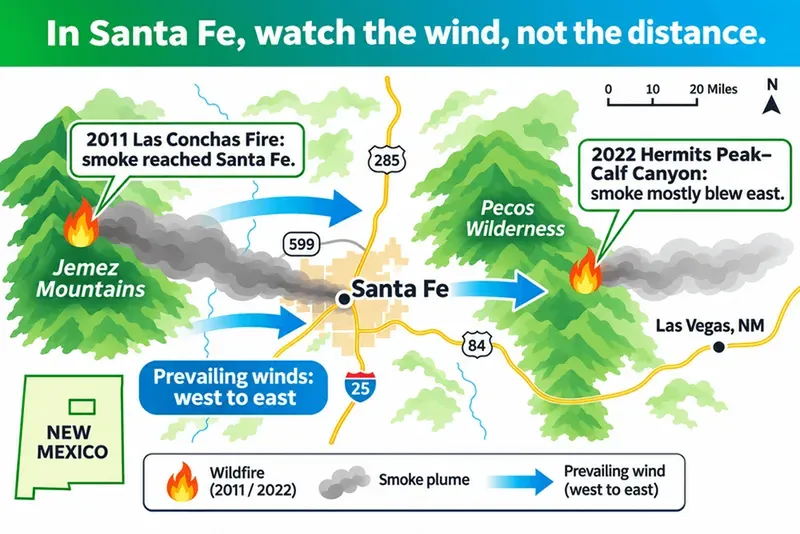
In Santa Fe, the wind decides where smoke goes.
On June 26, 2011, the Las Conchas Fire started west of town in 40 mph west winds and burned 156,593 acres, and the official fire update reported smoke heading toward Santa Fe. In 2022, the larger Hermits Peak–Calf Canyon Fire burned east, and most smoke blew away. Air quality firm IQAir found Las Vegas, NM averaged six times Santa Fe's PM2.5 that spring. Meanwhile, the Cerro Pelado Fire to the west put Santa Fe under a National Weather Service air quality alert on May 1.
So check a new fire's direction first:
| Where the Fire Is | What Santa Fe Can Expect | What to Do |
|---|---|---|
| West: Jemez Mountains | Prevailing west winds can carry smoke straight into town | Close up early; check the map hourly |
| East: Pecos and Las Vegas area | Smoke mostly blows away, though shifting winds can bring some back | Check the map before opening windows |
| Above the city: Santa Fe Watershed | Burn smoke can settle over town overnight | Close windows before bed; air out once the map improves |
Filterbuy guide based on the fires above. Always follow official advisories.
When smoke moves in, follow the four action-line steps above, starting with the swamp cooler, which EPA discourages running during smoky periods.
Track fires on Filterbuy's New Mexico wildfire and smoke map.
Smoke Steps for a Santa Fe Home With a Swamp Cooler and No Ducts
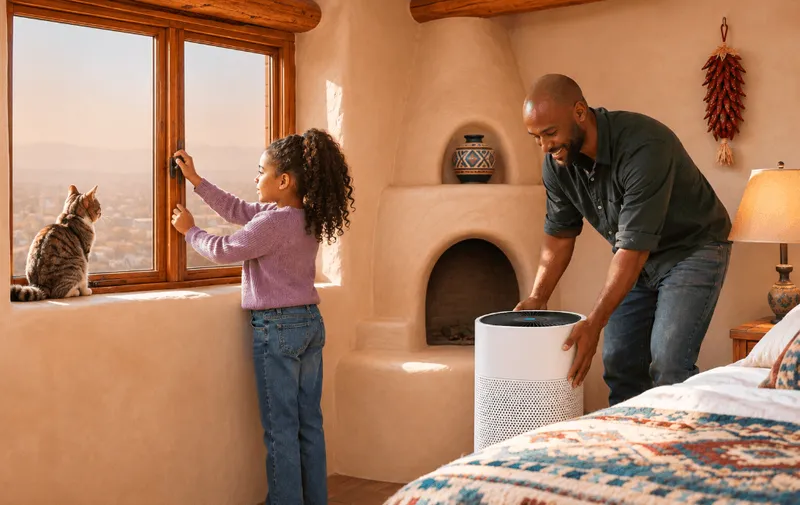
Plenty of Santa Fe houses were never built with ducts. Older adobe homes often pair radiant floors with a swamp cooler, leaving no filter slot, and Filterbuy would rather tell you so than sell a filter that won't fit. Here, portable HEPA cleaners are your primary defense. We don't make them, but we would put one in every occupied room.
Right-size each cleaner. EPA's sizing rule calls for a smoke CADR (clean air delivery rate) of at least two-thirds of the room's square feet: about 200 for a 300 sq ft bedroom. EPA advises against cleaners that produce ozone, so skip ozone generators.
Borrow one. The Forest Stewards Guild and Santa Fe Fire Department run a HEPA loan program.
Use a DIY box-fan cleaner as a stopgap, built to the EPA's tested design with a 4-inch MERV 13 filter and a certified box fan from 2012 or newer, and don't leave it running unattended.
Filter the swamp cooler if you must run it. EPA's clean room guide suggests covering its intakes with 4-inch MERV 13 filters.
Which Filter Your Santa Fe AQI Level Calls For
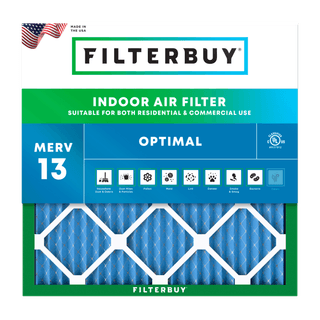
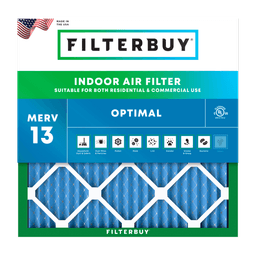
Smoke calls for MERV 13. EPA recommends MERV 13 or higher in central HVAC during smoke events and notes that most home systems handle MERV 13 without equipment trouble when the filter is changed often. Treat it as a normal fit check. HEPA belongs in portable cleaners, never the furnace slot, as our MERV 13 vs. HEPA guide explains why.
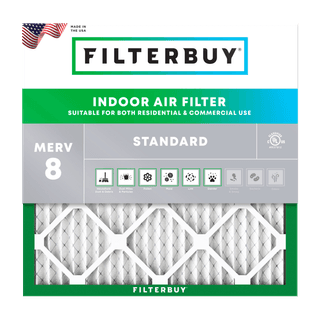
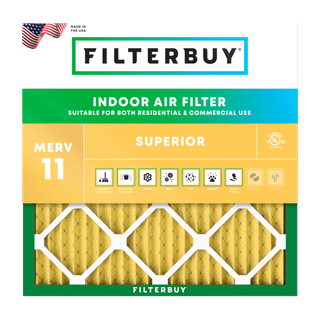
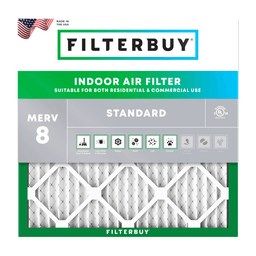
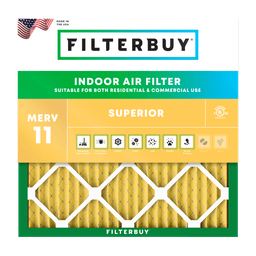
Filterbuy makes MERV 8, MERV 11 and MERV 13 in the USA in 600+ sizes, plus custom sizes. Pleated filters capture particles; for odors, see the Odor Eliminator line.
| AQI on the Map | Filter | Best For |
|---|---|---|
| 0–50 (Good) | MERV 8 | Everyday dust, lint and juniper pollen |
| 51–99 (Moderate) | MERV 8 or MERV 11 | Pets and allergies; also stock a MERV 13 spare now |
| 100 and above (action line) | MERV 13 | Smoke events and prescribed-burn weeks |
Filterbuy guidance by AQI level.
During smoke: EPA advises checking the filter often and replacing it when it looks dark brown or black, which can be well before its normal interval. Keep a spare on hand.
Filterbuy also makes replacement air purifier filters; Auto Delivery keeps spares coming.
What a Filter Maker Notices in Santa Fe's Air
Most air quality guides stop at the outdoor number. We notice two things:
Smoke season and swamp cooler season overlap. Each fire on this page started in dry weeks, when evaporative coolers pull in the most outdoor air, so the cooler's off switch matters more than any filter.
Filter depth beats filter hype. We build both, and a 4-inch filter carries far more pleated media than a 1-inch, so it catches smoke longer.
Supporting Statistics
A 4-inch MERV 13 filter with a shroud more than doubled a box-fan cleaner's smoke removal in 2022 EPA tests.
248,966 New Mexico children breathe unhealthy air.
Fine particle pollution causes more than 50,000 premature U.S. deaths a year, with no known safe level.
Frequently Asked Questions
What is the air quality in Santa Fe today?
Check Filterbuy's live AQI map above. If it reads over 100, sensitive groups should limit time outdoors.
What MERV rating do I need for Santa Fe wildfire smoke?
MERV 13. EPA recommends MERV 13 or higher in a central HVAC system during smoke events, and most home systems handle it when the filter is changed often.
How do I check Santa Fe PM2.5 today?
Use the live map above or the AirNow Fire and Smoke Map's PM2.5 readings.
Is Santa Fe air quality bad during prescribed burns?
It can be, mostly overnight. Watershed burn smoke can settle over town until inversions lift by mid-morning, so close up before bed.
Should I run my swamp cooler when it's smoky in Santa Fe?
Ideally, no. EPA discourages swamp coolers during smoky periods because they pull in outdoor air. If you must run one, cover its intakes with 4-inch MERV 13 filters.
Glossary
AQI (Air Quality Index): The national 0-to-500 air pollution scale.
PM2.5: Particles 2.5 micrometers or smaller.
Inversion: Warm air over cool air, trapping smoke low.
MERV: A filter's 1-to-16 particle-capture rating.
HEPA: A high-efficiency filter standard built for portable cleaners, not furnace slots.