
Air Quality in Michigan
Air quality index (AQI⁺) and PM2.5 air pollution in Michigan •


Get Alerts For Unhealthy AQI In Your Area
When air quality in your area reaches unhealthy levels, we'll send you a quick alert, along with expert tips on how to reduce your exposure.
Live Air Quality Ratings in Michigan
Live Most Polluted City Ranking
Real-time most polluted cities in Michigan
The Right Air Filter For High AQI Days
When outdoor air quality drops, the EPA recommends upgrading to a MERV 13 filter — or the highest-rated filter your HVAC system can handle — to help capture more of the fine particulate (PM2.5) that comes with poor air quality. MERV 13 is the highest rating most residential systems can run without restricting airflow.
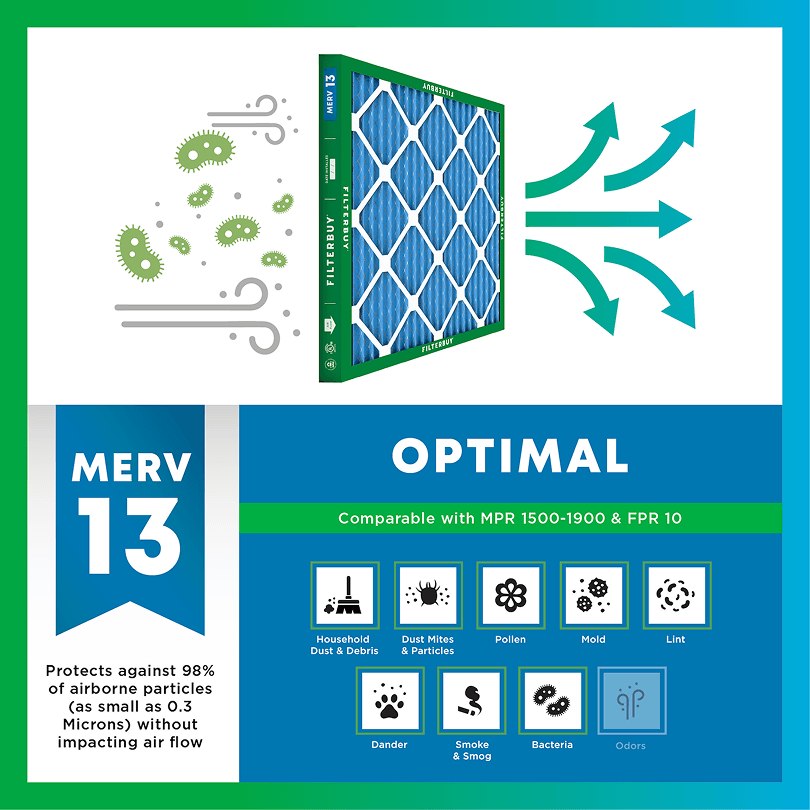
- Captures PM2.5 and other fine particulates
- Filters ash, soot, and smoke particles
- Rated to capture particles as small as 0.3 microns
- Matches the filter rating the EPA suggests during high-AQI and smoke events

AQI FAQs
What is AQI?
AQI stands for Air Quality Index, the EPA's scale for reporting daily air quality. It runs from 0 to 500. The higher the number, the greater the level of air pollution. Values at or below 100 are generally considered satisfactory; values above 100 mean air quality is unhealthy, first for sensitive groups, then for everyone as numbers climb.
What does AQI measure?
The AQI tracks five major pollutants regulated by the Clean Air Act: ground-level ozone, particle pollution (PM2.5 and PM10), carbon monoxide, sulfur dioxide, and nitrogen dioxide. The reported AQI value reflects whichever pollutant is highest at that time — most often ozone or fine particles (PM2.5).
How is AQI calculated?
Monitoring stations measure pollutant concentrations, and the EPA converts each into a standardized 0–500 score using set breakpoints. Each pollutant gets its own sub-index, and the highest sub-index becomes the reported AQI. That's why a single number can represent different pollutants on different days.
What is a good AQI?
An AQI of 0–50 is rated "Good" — air quality poses little or no risk. 51–100 is "Moderate," acceptable for most people though unusually sensitive individuals may want to limit prolonged outdoor exertion. Anything at or below 100 is generally considered satisfactory air quality.
What does an AQI of 100 (or 150) mean?
100 is the dividing line: at or below it, air quality is satisfactory for the general public. From 101–150, air is "Unhealthy for Sensitive Groups" — people with respiratory conditions, older adults, and children. From 151–200, it's "Unhealthy" and everyone may begin to feel effects.
Why is the AQI bad today?
Short-term AQI spikes usually come from wildfire smoke, temperature inversions that trap pollutants near the ground, high-ozone weather (hot, sunny, stagnant days), or heavy traffic and industrial activity. Check a real-time source like the map on this page to see which pollutant is driving today's reading in your area.
What AQI is bad for running or exercise?
Many runners follow the EPA category lines: below 50, no adjustment needed; 51–100, unusually sensitive people may shorten intense workouts; above 100, sensitive groups are advised to reduce prolonged or heavy outdoor exertion; above 150, that advice extends to everyone. Exercise increases how much air you breathe in, which is why thresholds matter more during workouts.
What AQI is safe to open windows?
A common rule of thumb is to keep windows open when the AQI is under 100 and close them when it climbs above, especially during wildfire smoke events when fine particles are elevated. When windows are closed, running your HVAC system with a fresh filter helps capture particles circulating indoors.
Should I wear a mask based on AQI?
Public health agencies generally suggest considering a well-fitted N95-style respirator outdoors when the AQI exceeds 150, particularly during smoke events. Cloth and surgical masks don't filter fine particles effectively. Follow guidance from your local health department, which may adjust recommendations during severe episodes.
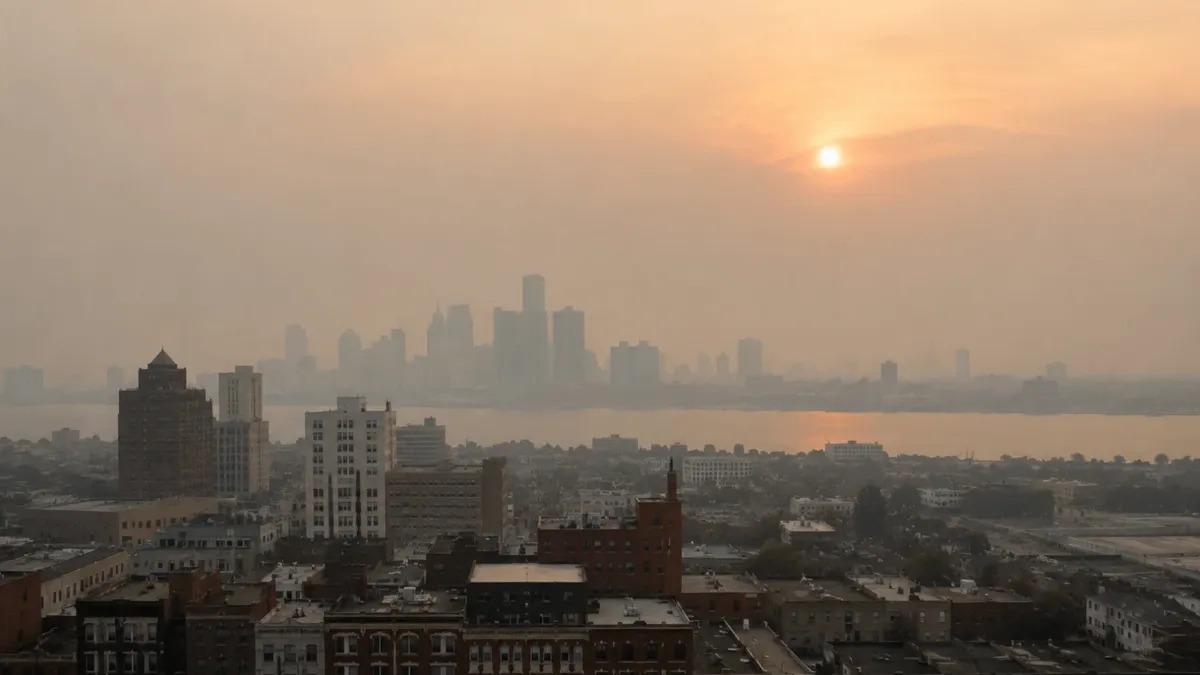
Check Today's Live Real Time Air Quality Index AQI Map in Michigan Now
Author: Michelle Wan | Reviewer: David Clark, Licensed HVAC Technician | Published: July 21, 2026 | Updated: July 21, 2026
TL;DR
Michigan's air quality changes hour to hour, so the number that matters is the one on the live map above, not a figure printed on any page. In recent weeks the state has seen repeated statewide air quality alerts as wildfire smoke from Canada settled over Michigan, pushing conditions into unhealthy and sometimes hazardous territory. Use the map for your city's current reading, then match your activity level to the color category. People with asthma, heart disease, or lung conditions, along with children, older adults, and pregnant women, should take action earlier than the general public.
Key Takeaways
Michigan's official Air Quality Index is tracked through a statewide network of more than 100 monitors managed by the Michigan Department of Environment, Great Lakes, and Energy (EGLE).
Wildfire smoke drifting in from Canada and the Upper Midwest has been the leading driver of poor air quality across Michigan this summer, sometimes triggering statewide alerts rather than the more typical single-region ozone alerts.
The AQI scale runs from 0 to 500 in six color-coded bands, and values above 100 mean the air is unhealthy for at least one sensitive group.
Sensitive groups, including people with asthma, COPD, or heart disease, children, older adults, and pregnant women, should check conditions before spending extended time outdoors.
Closing windows and running central air conditioning with a MERV-13 or higher rated filter is a commonly recommended step during smoke events.
Conditions can shift within hours during a smoke event, so the live map is more reliable than yesterday's forecast.
What Is Michigan's Air Quality Index Right Now
Michigan's current AQI reading depends on where you are and what's happening in the atmosphere at that hour, which is why the live map above is the fastest way to get an accurate answer. The AQI is EPA's standardized 0-to-500 scale for communicating how polluted the outdoor air is and what that means for your health. A reading at or below 100 is generally considered acceptable for most people, while anything above that starts to affect sensitive groups first and then the broader public as the number climbs.
Why Michigan's Air Quality Has Been Under Alert This Summer
In mid-July 2026, EGLE issued a series of statewide air quality alerts as smoke from wildfires burning in Canada and the northern Minnesota area moved into Michigan, pushing fine particulate levels into the unhealthy and, at times, hazardous range across both the Lower and Upper Peninsulas. Statewide alerts of this kind are less common than Michigan's typical summer ozone alerts, which are usually limited to one region. EGLE's meteorologists track incoming smoke plumes and issue updated guidance as conditions change, so an alert that's active today can lift within a day or two once wind patterns shift. Readers who want to track the actual smoke plume, not just the alert, can check AirNow's Fire and Smoke Map.
How Michigan's Air Quality Alerts Actually Work
Michigan doesn't run one alert system. It runs three, and they don't always agree.
Statewide alerts, issued by EGLE, cover the whole state at once. This is the level driving the current wildfire smoke alert.
Regional alerts cover a cluster of counties tied to one weather pattern, most often ozone. A late-June alert this year, for example, applied only to Muskegon, Ottawa, Kent, Allegan, Van Buren, and Berrien counties on Michigan's west side, while the rest of the state stayed clear.
County-specific alerts get even narrower. One alert in late June covered just St. Clair, Livingston, Oakland, Macomb, Washtenaw, Wayne, and Monroe counties in southeast Michigan.
This is why your neighbor two counties over can be under a different alert status than you are on the same day. The live map above reflects your specific location. The alert level in the news might not. It's also why Filterbuy tells Michigan customers to check their own county's status directly, rather than assume a statewide label tells the full story.
How This Summer Compares to Past Michigan Smoke Events
Michigan gets Canadian wildfire smoke most summers. This one has been different in degree, not just in kind.
Michigan saw smoke-driven alerts in 2023 and again in 2025.
On July 16, 2026, the meteorologists tracking the state's air quality described that week's smoke concentrations as unprecedented, stating they far exceeded the 2023 and 2025 events.
The numbers back that up. On July 17, 2026, hourly PM2.5 readings peaked at 517 micrograms per cubic meter in Marquette in the Upper Peninsula, compared with 285 micrograms per cubic meter in the Detroit area that same day, showing how much harder the UP was hit even as southeast Michigan also dealt with unhealthy air.
That gap between regions is also why a single statewide number never tells the whole story. Marquette and Detroit can be experiencing two different air quality realities on the same afternoon. Filterbuy watches this same Upper Peninsula versus southeast Michigan gap closely. It's often the households farthest from the fire itself that end up needing the higher filtration rating first.
Source: Air Quality Forecast Archive, West Michigan Clean Air Coalition
How to Read the AQI Color Categories
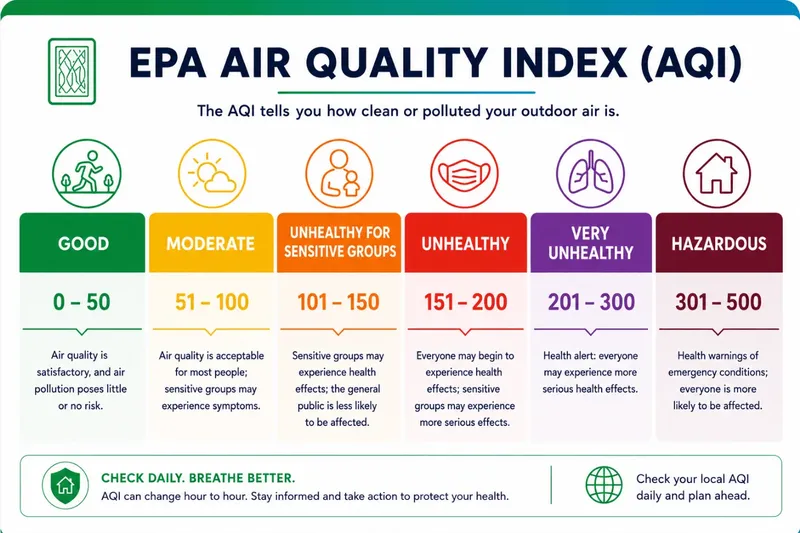
AQI ranges and categories reflect the U.S. EPA Air Quality Index scale used by AirNow and Michigan EGLE.
Who Is Most at Risk When Michigan's Air Quality Drops
Fine particle pollution, known as PM2.5, is the main pollutant behind Michigan's wildfire-driven air quality alerts, and it affects some groups more severely than others. Children, older adults, pregnant women, and people with asthma, COPD, heart disease, or diabetes face a higher risk of symptoms ranging from coughing and eye irritation to more serious cardiovascular and respiratory events. Even healthy adults can experience breathing difficulty when smoke concentrations climb into the unhealthy or hazardous range, so it isn't only a concern for people with pre-existing conditions.
What to Do When Air Quality Is Unhealthy in Michigan
We think about a smoke event as two separate jobs happening at once: keeping smoke from getting in, and making sure your filtration can actually handle it once some gets in anyway. Filterbuy's role is squarely the second one.

Check the live map above for your specific city before heading outside for an extended period.
Keep windows and doors closed, especially overnight when smoke tends to settle closer to the ground.
Run your central air conditioning or HVAC system with a MERV-13 or higher rated filter to help capture fine particles indoors, and consider browsing Filterbuy's MERV-13 rated air filters if your current filter needs replacing before the next smoke event. For moderate AQI days, MERV-11 filters are a lighter-duty option.
Avoid outdoor burning and residential wood-burning devices while an alert is active.
If you must go outside during an alert, a properly fitted N95 respirator offers more protection than a cloth or surgical mask.
Watch for symptoms like coughing, wheezing, or chest tightness, and contact a healthcare provider if they don't improve.
How Michigan Tracks Air Quality by Region
Michigan's air quality can vary sharply between regions on the same day. The Upper Peninsula and northern Lower Peninsula are often the first areas smoke reaches as it drifts south from Canada, while southeast Michigan, including Metro Detroit, tends to see smoke settle and linger longer due to local weather patterns. EGLE's statewide monitoring network feeds the data behind the official AQI, which is why checking your specific city on the map above gives a more useful answer than a single statewide number. For city-level detail, see Detroit's live AQI map and Grand Rapids' live AQI map. Filterbuy pays attention to this same regional split when talking with Michigan customers about filtration, since a household in Marquette and a household in Dearborn aren't always fighting the same air on the same day.
After manufacturing filters for over a decade and serving more than two million households, we've learned that the households who handle a smoke event best are the ones who already knew their filter's MERV rating before the alert went out.
David Heacock, Founder and CEO, Filterbuy
Bookmark These Seven Resources Before Michigan's Next Air Quality Alert
At Filterbuy, we've spent years obsessing over what's really in the air people breathe, and these seven resources are the ones we point Michigan families to first.
1. Learn What Your AQI Number Is Actually Telling You
A reading of 45 and a reading of 250 aren't just different colors on a map, they're different instructions for your family. AirNow's official breakdown of the six AQI categories is the plain-language key that makes every other resource on this list make sense.
Source: AQI Basics, AirNow.gov
2. See Exactly What Fine Particles Do Once They're Inside Your Body
PM2.5 doesn't stop at your lungs. The EPA lays out how these particles travel deep enough to reach the bloodstream, and why that connects directly to real effects like aggravated asthma, irregular heartbeat, and reduced lung function. Once you see the mechanism, the “why” behind every precaution on this page gets a lot clearer.
Source: Health and Environmental Effects of Particulate Matter, EPA
3. Get a Plan Built for Your Specific Condition, Not a Generic Warning
Asthma, COPD, diabetes, and heart disease each respond to smoke differently, and the CDC treats them that way instead of lumping every household into one instruction. This is where a family managing a chronic condition finds out exactly when to act and when it's time to call a healthcare provider.
Source: Wildfire Smoke and People with Chronic Conditions, CDC
4. Check Your Own Backyard, Not a Statewide Average
Michigan runs more than 100 air monitors across over 40 locations for a reason. Averages hide what's happening on your specific block, and EGLE's MiAir dashboard is where that gap closes, alerts included.
Source: MiAir Air Quality Monitoring Network, Michigan EGLE
5. Build the Habits That Actually Keep Smoke Out of Your Home
Closing the windows is step one, not the whole plan. The American Lung Association walks through setting up a clean room and explains why the mask sitting in your junk drawer probably won't filter smoke particles at all, so you're not finding that out the hard way.
Source: Wildfire Smoke and Your Health, American Lung Association
6. Protect Someone With Asthma Before the Smoke Ever Rolls In
AAFA breaks down exactly what each AQI color band means for a person managing asthma, plus what to have on hand before conditions turn, from a quick-relief inhaler to a mask that actually fits. It's the difference between reacting to an attack and preventing one.
Source: Wildfires and How They Affect Air Quality and Asthma, AAFA
7. Put a Household Plan in Place While the Skies Are Still Clear
The best time to build an emergency kit and map an evacuation route is on a calm afternoon, not while smoke is already rolling in. Ready.gov's wildfire guide is built for exactly that kind of quiet preparation.
Source: Wildfires, Ready.gov
Supporting Statistics
“Every one of these numbers comes from a lab or a satellite, not from us. What we bring is fifteen years of watching what Michigan households actually do with a number like this once it shows up on their phone,” said Michelle Wan, Filterbuy's Air Quality Writer.
1. Wildfire PM2.5 Hits Respiratory Health Harder Than Ordinary Particle Pollution
A 10 microgram per cubic meter increase in wildfire-specific PM2.5 raises respiratory hospitalizations by 1.3 percent to 10 percent.
The same increase from non-wildfire PM2.5 raises hospitalizations by only 0.67 percent to 1.3 percent.
Wildfire smoke is why this page treats a smoke alert differently from a routine ozone alert.
This is the research that backs something we've built our own filtration guidance around long before this study existed: smoke particles and everyday dust don't get treated the same way in our sizing recommendations, and this is the clinical reason why.
Source: Aguilera et al., 2021, Nature Communications (PMC7935892), National Institutes of Health
2. Wildfire Smoke Can Push Unhealthy Air Hundreds of Miles Past the Fire Line
One smoke event in June 2023 pushed unhealthy air over more than 86 million people across the eastern U.S.
More than 17 million of them breathed air rated Very Unhealthy.
None of the affected cities had a wildfire burning nearby. The smoke traveled in from hundreds of miles away, the same pattern behind Michigan's alerts this summer.
We hear a version of this same surprise from Michigan customers every smoke season: the assumption that distance from a fire means safety from its smoke. It doesn't, and that gap between what people expect and what the map actually shows is exactly why we built this page around checking conditions rather than assuming them.
Source: NOAA Satellites Tracked Historic Levels of Harmful Smoke, NESDIS
3. The Fires Behind Michigan's Smoke Are Tracked in Real Time
The National Interagency Fire Center publishes a daily Incident Management Situation Report on wildfire activity across North America.
EGLE and AirNow both build their smoke forecasts from this same data.
Checking it alongside the live map above shows whether today's smoke is a short plume or the start of a longer event.
Knowing a plume is short-lived changes what we'd actually recommend. A one-day spike calls for closed windows and patience. A multi-day event is when Filterbuy tells customers to check their filter's MERV rating before the smoke arrives, not after.
Source: National Interagency Fire Center
Frequently Asked Questions
Glossary
AQI (Air Quality Index): EPA's standardized 0-to-500 scale for communicating outdoor air pollution levels and associated health risk.
PM2.5: Fine particulate matter measuring 2.5 micrometers or smaller in diameter, small enough to reach deep into the lungs.
Air Quality Alert: An official notice issued by EGLE when pollutant levels are expected to reach unhealthy ranges for part or all of Michigan.
Sensitive Groups: People at higher risk from air pollution, including those with asthma, COPD, or heart disease, along with children, older adults, and pregnant women.
MERV Rating: Minimum Efficiency Reporting Value, a scale measuring how effectively an air filter captures airborne particles.
Ozone: A gas pollutant formed by chemical reactions in sunlight, distinct from smoke-driven PM2.5 and typically more of a concern on hot, sunny days.
EGLE: The Michigan Department of Environment, Great Lakes, and Energy, the state agency responsible for Michigan's official air quality monitoring and alerts.