
Nampa Real-Time AQI Tracker


Get Alerts For Unhealthy AQI In Your Area
When air quality in your area reaches unhealthy levels, we'll send you a quick alert, along with expert tips on how to reduce your exposure.
What's Actually In Nampa Air Today?
What High AQI Means for Your Lungs in Nampa
How to Read AQI
The Air Quality Index (AQI) measures how polluted the air is and how it may affect your health.
0–50 (Good): Air quality is satisfactory.
51–100 (Moderate): Acceptable, but some pollutants may pose minor concerns.
101–150 (Unhealthy for Sensitive Groups)
151–200 (Unhealthy)
201–300 (Very Unhealthy)
301+ (Hazardous)
Moderate
Still okay for most, but if you have asthma or allergies, take it easy and avoid long outdoor workouts.
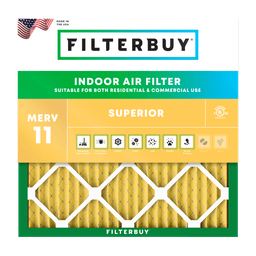
Shop MERV 11 filters→What's the Right Filter for Your AQI Level?


Check Today's Live Real Time Air Quality Index AQI Map in Nampa, ID Now
TL;DR
The live map at the top of this page shows Nampa's current Air Quality Index (AQI) and the pollutant behind it. Once the number passes 100, sensitive groups should ease off hard outdoor activity, and past 150, everyone should. Burning rules kick in sooner: the city bans open burning once the AQI hits 60.
Key Takeaways
Check both the live AQI and the Idaho Department of Environmental Quality (DEQ) burn status, which can restrict burning on a day the map looks fine.
Fine particles (PM2.5, the tiny particles in smoke and exhaust) are Canyon County's biggest air problem. The American Lung Association counted 8.7 unhealthy short-term particle days a year for 2022 to 2024, the most in the Boise metro.
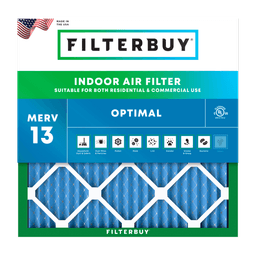
At AQI 100, Filterbuy's action line, switch to a MERV 13 furnace filter, set the fan to On, run a portable HEPA cleaner in each occupied room, and close up the house.
How to Read Nampa's Live AQI Map
The map above shows Nampa's latest AQI. Start with the number and color, which follow the EPA and AirNow AQI categories. Next, check the pollutant: PM2.5 means smoke-type particles, ozone means summer smog. Then watch the trend: a slow cold-morning climb usually means an inversion, a sudden jump usually means smoke.
Filterbuy's 30-second Nampa check:
1. Read the map's number and pollutant label.
2. Check DEQ's burn status map, because local restrictions can trigger on forecast air as well as current readings.
3. In winter and during smoke, glance at your furnace filter, and change it if it looks dirty.
What Each AQI Level Means for a Nampa Household
When Filterbuy lined up Nampa's burn ordinance against EPA's health categories, one gap stood out. The city restricts burning at 60, well before the map turns orange, so a yellow day can already cancel weekend yard burning.
Nampa AQI levels and what to do
| AQI | Category | Who is affected | What to do in Nampa |
|---|---|---|---|
| 0–50 | Good (green) | No one | Open windows. A MERV 8 or 11 filter is enough. |
| 51–59 | Moderate (yellow) | Unusually sensitive people | Check DEQ burn status before burning. Stock a MERV 13 and a spare before smoke season. |
| 60–99 | Moderate (yellow) | Unusually sensitive people | No open burning in Nampa. Keep a MERV 13 ready. |
| 100 | Moderate (yellow), top of range | Unusually sensitive people | Filterbuy's action line: MERV 13 in, fan On, portable HEPA in each occupied room, house closed up. |
| 101–150 | Unhealthy for Sensitive Groups (orange) | Children, older adults, people with heart or lung disease | Keep all four action-line steps in place. Sensitive people limit long outdoor exertion. |
| 151–200 | Unhealthy (red) | Everyone | Same steps. Inspect the filter more often and keep replacements on hand. |
| 201–300 | Very Unhealthy (purple) | Everyone | Follow AirNow and DEQ guidance first. Stay in your cleanest room; filtration is one layer. |
| 301 and higher | Hazardous (maroon) | Everyone | Follow DEQ and local authority instructions. Keep filtration running as support. |
Filterbuy's AQI 100 action line. After checking AirNow and DEQ guidance, Nampa households should take four steps at an AQI of 100: put a MERV 13 filter in the HVAC system, set the thermostat fan to On, run a portable HEPA air cleaner in each occupied room (bedrooms first), and close up the house, skipping candles and frying. That number still sits in EPA's Moderate range; Filterbuy simply chooses to move there.
Ozone or smoke? Ozone breaks down quickly indoors, so closing up and exercising in the morning works; filters can't catch it. Wildfire smoke is different: PM2.5 drifts indoors and stays until a filter captures it.
Why Nampa's AQI Can Lag Behind What You See
Nampa's map can trail the sky because AirNow-based particle readings use NowCast, a weighted average of recent hours, so fast-moving smoke may take an hour or more to show up. Filterbuy's rule of thumb: if you can smell smoke indoors, close up and start filtering.
DEQ's Nampa-Ridgecrest monitor, cited in its 2024 exceptional events filing, measures one fixed spot, so your street can read differently. Smoke can also ride high above the valley, turning the sky orange while ground-level air stays cleaner than it looks.
Inversion air usually loosens a little by midday, and DEQ's burning tips point to 11 a.m. to 4 p.m., also the best window for a walk.
Is It Safe to Be Outside in Nampa Today?
Nampa's outdoor safety depends on the live map. At 100 or below, the air is acceptable for nearly everyone. Between 101 and 150, sensitive groups should cut back on hard outdoor activity, and at 151 and above, everyone should.
Sensitive groups make up much of Nampa. U.S. Census Bureau data shows 25.3% of residents are under 18 and 14.7% are 65 or older.
Where to Check the Treasure Valley Forecast and Burn Status
For tomorrow, the DEQ Treasure Valley air quality forecast posts a daily outlook and burn status. Get email or text alerts through EPA's EnviroFlash sign-up, or call DEQ's Boise Region air quality hotline at 208-373-0313.
Burn rules vary by city, and DEQ's list of local ordinances shows how Nampa compares:
Treasure Valley burn rules by AQI level
| Jurisdiction | AQI trigger | Prohibited | Still allowed |
|---|---|---|---|
| Nampa (Ordinance 2190) | 60 and up | Open and outdoor burning | Fireplaces and all woodstoves |
| Caldwell (Ordinance 2335) | 60 and up | Open and outdoor burning | Fireplaces and all woodstoves |
| Canyon County (Ordinance 10-005) | 74 and up | Open burning, fireplaces, noncertified woodstoves | Certified woodstoves |
| Boise (Ordinances 7-01-23 and 4-06-04) | 60, then 74 | Open burning at 60; fireplaces and all woodstoves at 74 | Fireplaces and woodstoves below 74 |
A DEQ air quality advisory stops all outdoor burning, including campfires, fire pits, and burn barrels. Barbecues are still allowed. Outside city limits, ask Canyon County which rule applies.
What's in Nampa's Air Through the Year
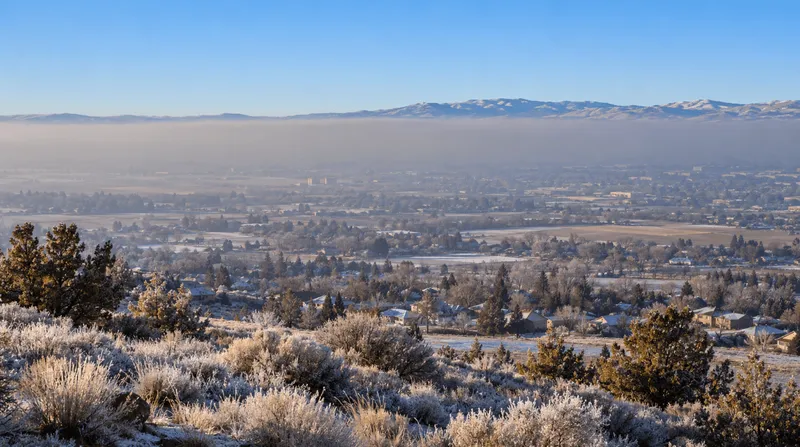
DEQ notes that the Treasure Valley's terrain and weather make it prone to winter inversions and summer ozone and smoke. Fine particles (PM2.5) are Canyon County's worst-graded pollutant, with ozone added in hot weather.
Local sources include wood stoves, Interstate 84 traffic, fall yard burning, farm dust, and permitted industry such as the Amalgamated Sugar Company's Nampa factory, which runs under conditions in Idaho's federally approved air plan.
Nampa air quality calendar
| Season | Main driver | Pollutant to watch | Household move |
|---|---|---|---|
| December–February | Inversions trap smoke and exhaust | PM2.5 | Check burn status; inspect the filter monthly. |
| March–May | Field preparation, wind, and pollen | Coarse dust, pollen | MERV 11 handles pollen and dust. |
| June–September | Regional wildfire smoke and hot afternoons | PM2.5 and ozone | Keep a MERV 13 on hand; exercise early on ozone days. |
| October and November | Yard burning, crop residue burns, early inversions | PM2.5 | Watch the 60 burn trigger. |
How Nampa's Air Compares With Boise and the Metro
The American Lung Association's 2026 State of the Air report gave the metro an F for both short-term particles (17th worst nationally) and ozone (24th worst), and Canyon County also failed the year-round particle standard. Filterbuy's read: Ada County leads the metro for ozone, which no furnace filter catches, while Canyon County leads for particles, which a good filter does.
In Idaho DEQ's January 2025 recommendation to EPA, the Nampa Canyon monitor's annual PM2.5 value for 2021 to 2023 was 8.9 micrograms per cubic meter. The value sits just under EPA's 2024 standard of 9.0 and well above Meridian's 7.6, so one heavy smoke year could push Nampa over the line.
By early September 2024, EPA data reported by the Idaho Press counted 25 unhealthy-or-worse days in Boise, more than double the 2020 record of 11. Follow plumes on the Nampa live wildfire smoke map or the AirNow Fire and Smoke Map, and compare nearby cities on the Idaho statewide AQI map.
Which Furnace Filter Nampa's AQI Calls For
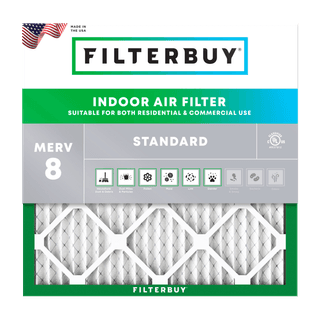
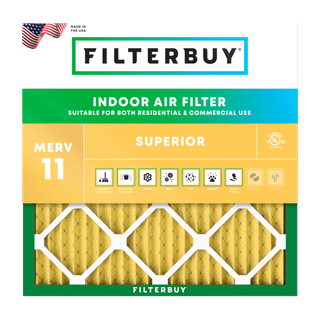
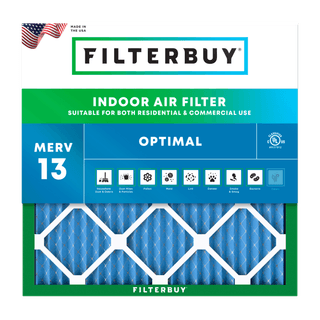
MERV 13 is the filter tier Filterbuy recommends for wildfire smoke. On green and low-yellow days, a MERV 8 filter handles household dust and pollen, and homes with allergies or pets do better with MERV 11 filters. Before smoke season, put in MERV 13 air filters and keep a spare.
EPA's wildfire guidance recommends a filter rated MERV 13 or higher in a central HVAC system during smoke events, with the fan set to "On" so air keeps passing through it. Check the fit as you would a size. During smoke, replace the filter when it looks dirty, which can be well before the usual interval.
A portable HEPA cleaner works alongside the furnace filter, treating one room harder. Per EPA's cleaner air room guidance, the unit's smoke CADR should be at least two-thirds of the room's square footage, so a 300-square-foot bedroom needs a CADR of about 200. Pick a model from the CARB-certified air cleaner list, since EPA says those produce little or no ozone.
Homes heated by baseboard, wall, or mini-split units have no filter slot, so portable HEPA cleaners are the primary defense there, not a backup. Filterbuy's MERV 13 vs. HEPA guide explains how the two layers differ.
Nampa's Indoor Air Problem Peaks in Winter, Too
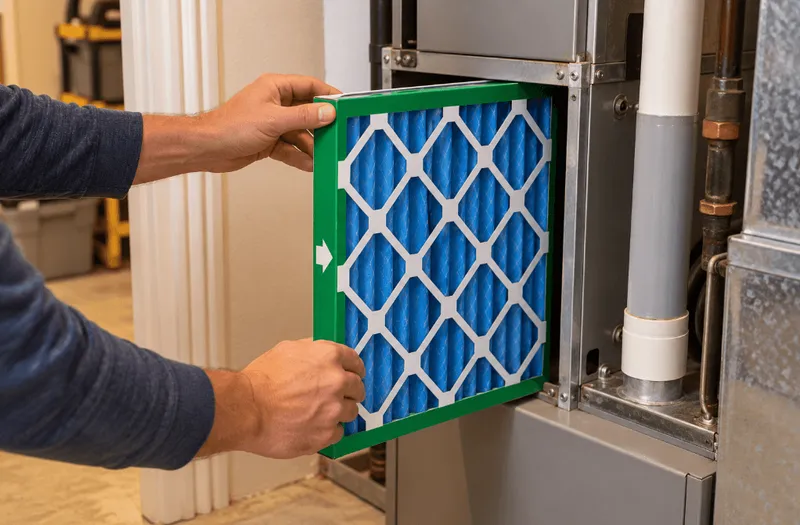
As an American filter maker, Filterbuy watches when a filter works hardest. In Nampa that happens twice a year: summer smoke, and winter inversions, when the furnace runs long while wood smoke settles on the valley floor. A standard replacement schedule misses that second season, which is why we recommend a two-season filter plan.
"In the Treasure Valley, we tell homeowners to plan for two filter seasons, not one. Check the filter monthly from December through February and again from July through September, and swap it as soon as it looks dirty."
- Michelle Wan, Brand Manager and Copywriter, Filterbuy
Supporting Statistics
1. 8.7 days a year: unhealthy particle pollution in Canyon County, 2022–2024, the Boise metro's worst. Source: American Lung Association
2. 8.9 µg/m³: Nampa Canyon monitor's annual PM2.5, 2021–2023, just under EPA's 9.0 limit. Source: Idaho DEQ via EPA
3. 90%: share of time Americans spend indoors, where some pollutants run 2 to 5 times higher. Source: U.S. EPA
Frequently Asked Questions
What is the air quality in Nampa today?
Nampa's current AQI and main pollutant appear on the live map at the top of this page. Up to 100 is acceptable for most people.
Is the air quality bad in Nampa today?
Nampa's air counts as bad once the live map shows 101 or higher. Orange (101 to 150) affects sensitive groups, and red (151 and up) affects everyone.
Can I burn yard debris or use my fireplace in Nampa today?
Nampa bans open burning when the AQI reaches 60, and a DEQ advisory stops all outdoor burning. Outside city limits, Canyon County also bans fireplaces and noncertified woodstoves at 74, so check DEQ's burn status.
What PM2.5 level is unhealthy in Nampa?
EPA's updated PM2.5 AQI breakpoints set the thresholds. A level of 35.5 micrograms per cubic meter marks the start of Unhealthy for Sensitive Groups, and 55.5 upward is unhealthy for everyone.
Does a furnace filter help with wildfire smoke in Nampa?
Yes. MERV 13 is the tier Filterbuy recommends for smoke, and EPA recommends MERV 13 or higher in central systems during smoke events. Set the fan to On and replace the filter when it looks dirty.
Glossary
AQI: The EPA's 0 to 500 Air Quality Index, with six color-coded health categories.
PM2.5: Fine particles 2.5 micrometers or smaller, found in smoke and exhaust.
Ozone: A ground-level gas formed from emissions on hot, sunny days; summer smog.
Temperature inversion: Warm air sitting over cold air, trapping pollution near the ground.
NowCast: EPA's weighted average of recent hourly readings.
Air Quality Advisory: A DEQ notice of degraded air that bans outdoor burning.
MERV: A 1 to 16 rating of how well an HVAC filter captures particles.
HEPA: High-efficiency filtration used in portable air cleaners.