
Work From Home in Wildfire Smoke: Office HVAC Setup, Gear, and Productivity
September 23, 2026
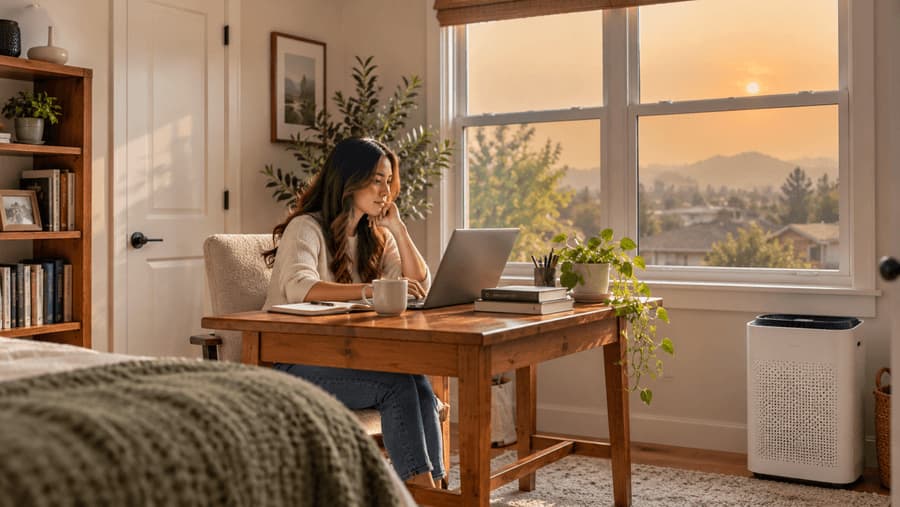
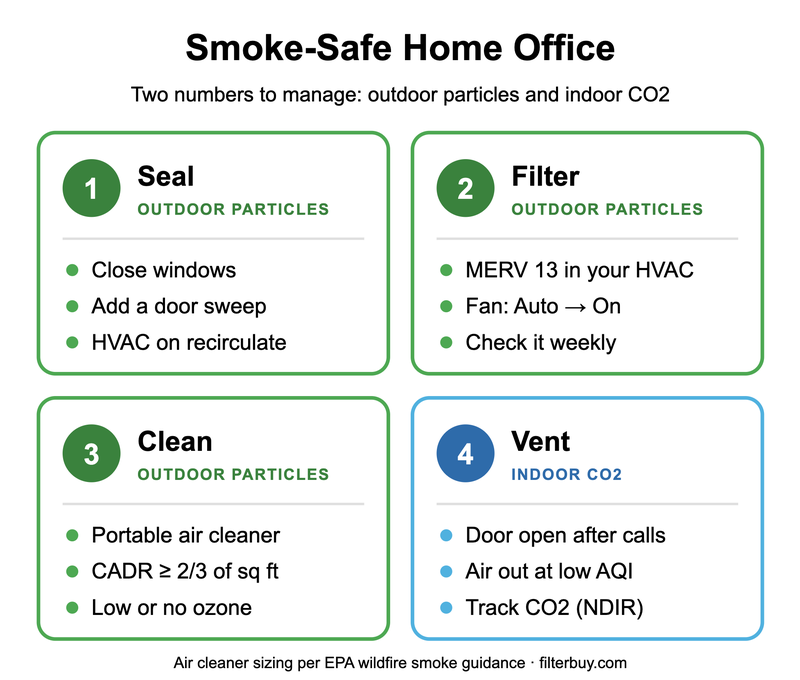
Seal the room, run a MERV 13 filter with your thermostat fan set to On, add a portable air cleaner sized to the room, then ventilate on a schedule. A closed office has two numbers to manage: fine particles drifting in from outside, and carbon dioxide building up from you.
The EPA recommends a MERV 13 or higher HVAC filter during smoky periods. MERV 13 filters capture microscopic particles, the highest level of residential filtration. Take the quick quiz below to find your match.
Answer a few quick questions and we'll match you to the right filter for your system.
TL;DR
A smoke-safe home office comes down to two numbers: the fine particles drifting in from outside, and the carbon dioxide building up from you. Seal the room, run a MERV 13 filter with the thermostat fan switched to On, add a portable air cleaner sized to the room, then vent on a schedule. Both numbers affect how clearly you think, and most wildfire advice deals with only one.
Key Takeaways
The EPA recommends a MERV 13 or higher HVAC filter during smoky periods, and reports that running one with the fan on continuously may cut indoor PM2.5 by roughly 50%.
Indoor PM2.5 typically sits at 55% to 60% of outdoor levels during a smoke event with windows closed and no air cleaner running.
A sealed room traps carbon dioxide. In a Harvard-led study in Environmental Health Perspectives, cognitive scores were 50% lower on a day averaging 1,400 ppm CO2 than on well-ventilated days.
What Actually Makes a Home Office Smoke-Safe?
A smoke-safe home office is a small, well-sealed room that gets filtered air, holds a correctly sized portable air cleaner, and is ventilated on purpose rather than by accident. The seal keeps wildfire PM2.5 out, filtration removes what slips in anyway, and the schedule stops carbon dioxide from replacing smoke as the drag on your afternoon.
Most wildfire guidance is written for a bedroom you retreat to for a few hours. A home office is a different problem. You sit in it eight hours with the door shut for calls, doing work that depends on holding a thought, and that creates a tension nobody warns remote workers about. We call it the two-number problem, and it is why this guide exists apart from Filterbuy's other wildfire pages.
The first number is PM2.5. Wildfire smoke is mostly fine particulate matter small enough to reach deep into your lungs, and it has erased about a quarter of the air quality progress the US made since 2000. It does not stop at your siding either. EPA guidance puts indoor PM2.5 at 55% to 60% of outdoor levels with the windows shut and no air cleaner running, and higher in older, leakier houses. Children, older adults, and anyone with a heart or lung condition feel it first and should act at lower AQI numbers than everyone else.
The second number is CO2. One adult breathing in a closed 10-by-12-foot room pushes carbon dioxide up faster than most people expect. In the COGfx study led by Joseph Allen at Harvard's T.H. Chan School of Public Health, cognitive scores came in 15% lower at roughly 945 ppm and 50% lower at 1,400 ppm.
Both numbers point the same direction. A study of 302 office workers across six countries, also from the Harvard team, tied higher indoor PM2.5 and higher CO2 each to slower response times and lower accuracy. So the aim is not to seal the room as tightly as you can. Seal it, filter it hard, then open it again on purpose.
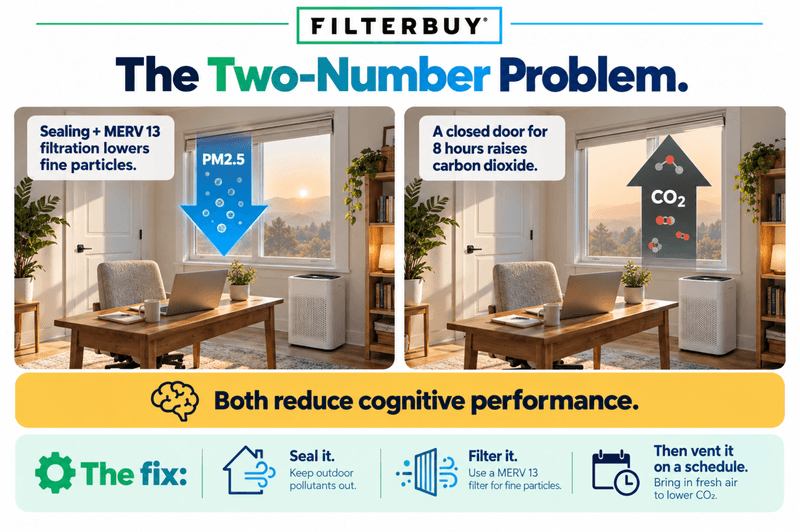
Every fire season the question shifts, from what does this number mean to why does my house still smell like smoke. Working from home adds a third: why is the afternoon harder than the morning. Sealing the room answers the first two and quietly creates the third.
Michelle Wan, Brand Manager and Air Quality Writer, Filterbuy
How Many People Does This Actually Affect?
Three numbers set the scale, and none of them are ours.
22.6% of US workers teleworked or worked at home for pay in March 2026, and the rate has held between 21.5% and 23.0% all year (US Bureau of Labor Statistics). Tens of millions now spend the workday in a single room whose air they control.
Americans spend roughly 90% of their time indoors, where some pollutants run 2 to 5 times outdoor levels (US EPA, Report on the Environment). The room you seal against smoke is also where everything else concentrates, which is why ventilation belongs beside filtration rather than after it.
61.5 million people live in US counties graded "F" for short-term particle pollution spikes (American Lung Association, State of the Air 2026, using 2022 to 2024 data). Short-term spikes are the pattern wildfire smoke creates, and what a fire-season office setup is built to answer.
Which Room Should Be Your Office During Smoke Season?
Pick the smallest interior room with tight windows, its own HVAC supply and return, and a door you can leave open most of the day. Square footage matters more than comfort here, because the air cleaner you need scales with floor area.
How Should You Set Up Your HVAC for Smoke Season?
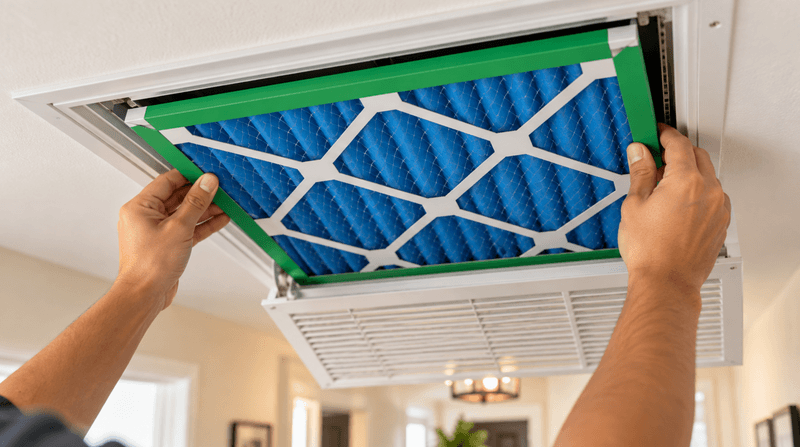
Install a MERV 13 filter sized to your system, switch the thermostat fan from Auto to On so air keeps cycling through it, close the fresh-air intake or set the system to recirculate, then check the filter weekly. This is the highest-leverage move a remote worker has, because central HVAC moves far more air than any portable unit.
The EPA reports that a high-efficiency filter run this way may cut indoor PM2.5 by about 50%, and that even a low-efficiency filter run continuously may cut it by about 24%.
EPA fire-season guidance notes that most furnaces and HVAC systems can accommodate MERV 13, provided the filter gets replaced frequently. That last condition is why Filterbuy publishes an air filter pressure drop chart instead of telling everyone to buy the highest number on the shelf. We have built filters in the US since 2013, and the honest version is that MERV 13 is rarely wrong for a house. A smoke-loaded MERV 13 left in too long is. If your system is older or already runs long cycles, have a technician measure static pressure first, or move to a 4-inch filter for the same rating with less resistance.
Buy your spares before the season rather than during it. Odd-sized slots are common in older houses, which is why Filterbuy cuts custom sizes alongside the 600-plus standard ones. If you are not sure where your filter slot is, start with Filterbuy's MERV guide for high-AQI days.
What Size Portable Air Cleaner Does a Home Office Need?
Filters are what Filterbuy makes, so treat what follows as a biased but informed view. Your HVAC filter is the whole-home baseline, and a portable air cleaner makes one room cleaner than the rest, which is why the two work best together, as our MERV 13 versus HEPA comparison lays out. EPA sizing guidance says to pick a unit whose tobacco-smoke CADR is at least two-thirds of the room's floor area.
Minimum smoke CADR is two-thirds of the room's floor area, per EPA wildfire guidance. Ceilings above eight feet need a unit rated for a larger room. Confirm any unit produces little or no ozone.
Ceilings above eight feet need a higher rating than the table suggests, and whatever you buy should produce little or no ozone. The CARB list of low-ozone air cleaners is where to check.
What if You Rent, or Your Office Has No HVAC Vent?
Build a DIY air cleaner instead, which is a box fan with high-efficiency furnace filters taped to the intake side. Everything above assumes you can change the filter in a system you own, and plenty of remote workers cannot. This is the version for a rental, a converted garage, or a room the ductwork never reached.
This is not a workaround Filterbuy invented. The EPA lab-tests DIY air cleaner designs and publishes the plans. In one home measured during a real smoke event, a DIY unit cut PM2.5 by about 56% in a larger room after 90 minutes, and by about 99% in a smaller room within an hour. The agency treats them as a temporary substitute rather than a permanent replacement.
Two cautions apply if you rent. Use a single-hose portable air conditioner sparingly while smoke is around, because it pulls replacement air in from outdoors as it exhausts, and choose a clamp-on door sweep over anything adhesive that takes paint with it.
How Do You Keep CO2 Down Without Letting Smoke Back In?
Ventilate on a schedule tied to the outdoor AQI rather than to how the room feels, because carbon dioxide is odorless and you will not notice it climbing. The cheapest fix costs nothing. Leave the office door open whenever you are not on a call, so the room shares air with the whole filtered house.
When the door has to stay shut, work in blocks, closed for the meeting and open the moment it ends. Past about ninety minutes shut, a $60 to $150 CO2 monitor starts earning its keep. Look for an NDIR sensor, which measures CO2 directly rather than estimating it.
For actual fresh air, watch the numbers instead of the clock. Smoke often thins overnight, so ten minutes with a window open at 6 a.m. buys hours of headroom at a fraction of the particle cost of the same ten minutes at 3 p.m. Check the Filterbuy live AQI map or the EPA Fire and Smoke Map first, then run the air cleaner on high for twenty minutes.
The Smoke-Season Home Office Gear List
Here is the whole kit, most of which you buy once.
What This Setup Will Not Fix
Filtration is not ventilation, and neither one is evacuation. A MERV 13 and a portable air cleaner remove particles, and they do nothing about the carbon dioxide you exhale, which is why the schedule is not optional. Particle filters do not capture gases either, so smoke odor outlives a clean filter and needs carbon media to clear.
None of it substitutes for leaving, either. If there is an active fire near you, or officials tell you to go, then go. A cleaner air room is built for smoke, not for fire.
A Workday Routine for Smoky Weeks
Before you log on, check the AQI. If it is climbing, close the windows and switch the thermostat fan to On.
At your first break, check the filter and the air cleaner indicator, because smoke loads media faster than dust.
Between meetings, open the door. Every hour it stays closed is CO2 you vent back out later.
Around lunch, decide on a window opening from the reading rather than the clock.
At the end of the day, leave the air cleaner running, so tomorrow starts from a cleaner baseline.
Frequently Asked Questions
Does Closing My Windows Actually Keep Wildfire Smoke Out of My Home Office?
Partly. EPA guidance puts indoor PM2.5 at 55% to 60% of outdoor levels with the windows closed and no air cleaner running, ranging from about 30% in tight new construction to nearly 100% in leaky older homes. Filtration closes the rest of the gap, even for smoke that drifted in from Canada.
Is MERV 13 Safe for My Hvac System?
For most homes, yes, provided the filter gets replaced frequently. Older or undersized systems are the exception, so if you hear whistling at the return or the system short-cycles, call a technician.
How Often Should I Change My Filter During a Smoke Event?
Inspect it weekly and replace it as soon as it looks dirty or airflow drops. Heavy smoke can cut a filter's life from months to weeks, which is why stocking the right MERV rating early beats anything you do once the haze arrives.
Glossary
AQI (Air Quality Index): The EPA's 0 to 500 scale for outdoor air quality, in six color categories.
PM2.5: Fine particulate matter 2.5 microns or smaller, the main health concern in wildfire smoke because particles that small reach deep into the lungs.
MERV (Minimum Efficiency Reporting Value): An ASHRAE 52.2 scale of 1 to 20 for how well a filter captures particles. Federal guidance recommends 13 for smoke.
CADR (Clean Air Delivery Rate): A standardized measure of filtered air a portable cleaner delivers, rated for smoke, dust, and pollen.
Cleaner air room: The EPA's term for a room kept as free of smoke particles as possible.
Recirculate mode: An HVAC setting that stops the system drawing in outdoor air and filters the indoor air instead.
Static pressure: The resistance air meets moving through an HVAC system, normally kept under 0.5 inches water gauge.
ppm (parts per million): The unit used for indoor carbon dioxide. Outdoor air runs about 420 ppm, and anything above 1,000 ppm means it is time to ventilate.
About the Author and Reviewer
Michelle Wan is Brand Manager and Air Quality Writer at Filterbuy. She works directly with the company's US manufacturing teams, so her guidance reflects how filters are built and used, not spec sheets. More from Michelle Wan.
Reviewed for technical accuracy by David Clark, Licensed HVAC Technician.
Published by Filterbuy, a family-owned American manufacturer building air filters in the US since 2013 in 600+ sizes plus custom. Set up auto-delivery before fire season, or shop Odor Eliminator carbon filters for smoke odor.
Sources
US EPA. Strategies to Reduce Exposure Indoors, Wildfire Smoke and Your Patients' Health. Updated October 10, 2025.
US EPA. Preparing for Smoke and Heat, Wildfire Smoke and Your Patients' Health. Updated October 9, 2025.
US EPA. Create a Clean Room to Protect Indoor Air Quality During a Wildfire.
US EPA. Research on DIY Air Cleaners to Reduce Wildfire Smoke Indoors.
Allen JG, MacNaughton P, Satish U, Santanam S, Vallarino J, Spengler JD. Associations of Cognitive Function Scores with Carbon Dioxide, Ventilation, and Volatile Organic Compound Exposures in Office Workers. Environmental Health Perspectives 124(6):805-812, 2016.
Cedeno Laurent JG, et al. Associations between acute exposures to PM2.5 and carbon dioxide indoors and cognitive function in office workers. Environmental Research Letters 16:094047, 2021.
Burke M, Childs ML, de la Cuesta B, et al. The contribution of wildfire to PM2.5 trends in the USA. Nature 622:761-766, 2023.
California Air Resources Board. List of CARB-Certified Air Cleaning Devices.
US Bureau of Labor Statistics. 22.6 percent of workers teleworked in March 2026, The Economics Daily, April 16, 2026.
US EPA. Indoor Air Quality, Report on the Environment. Updated May 27, 2026.
American Lung Association. State of the Air 2026 Key Findings.